QUESTION : What is a Human Being and his Human Dignity in an Age shaped by Machines and Technology? What is the theological reflection on this in the light of Magnifica Humanitas? – Hesed
ANSWER : Jacob Parappally MSFS
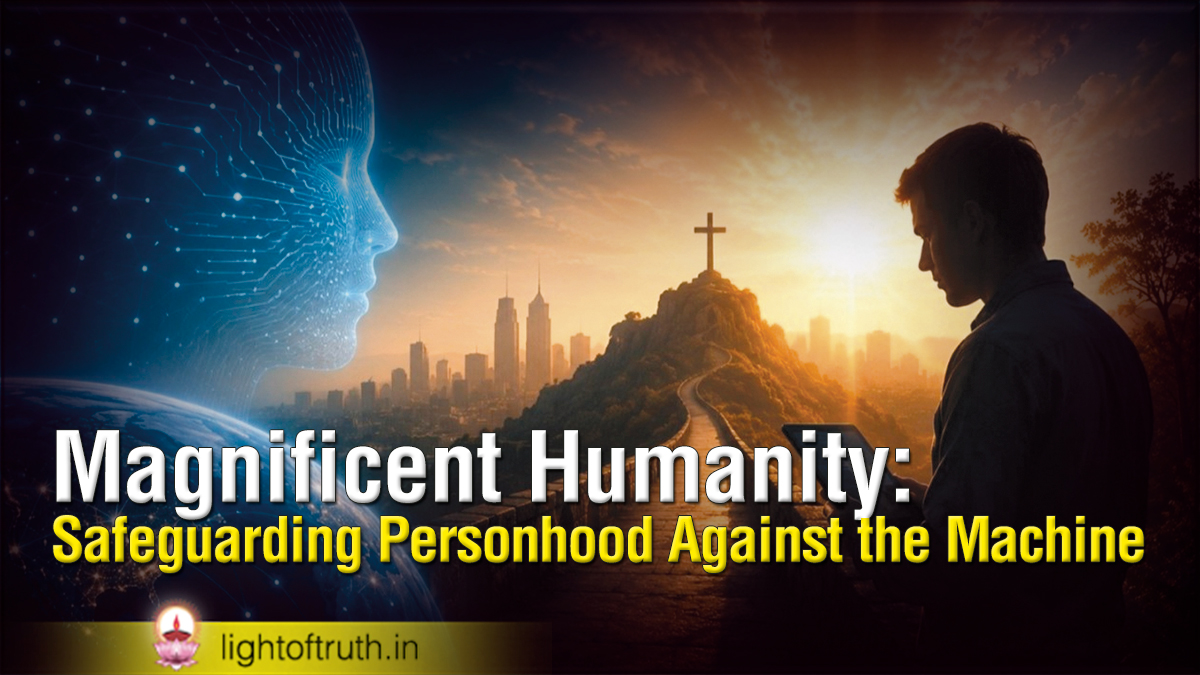
The first encyclical letter of Pope Leo XIV, Magnifica Humanitas (Magnificent Humanity), focuses on safeguarding the human person in the age of Artificial Intelligence. It addresses concerns about the devaluation of human persons and their dignity in the context of rapid scientific progress and technological development. The encyclical recalls the landmark encyclical of Pope Leo XIII, Rerum Novarum, and the historical context in which it was written, namely the Industrial Revolution. As the Industrial Revolution of the nineteenth century concentrated vast amounts of wealth in the hands of a few while exploiting the labor of thousands who were denied just wages and a dignified standard of living, Pope Leo XIII declared: “To misuse men as though they were things in the pursuit of gain, or to value them solely for their physical powers—that is truly shameful and inhuman” (RN, no. 20). In a similar way, Pope Leo XIV, in the present encyclical, addresses the danger of losing sight of human dignity and the uniqueness of the human person in a world shaped by unprecedented technological progress and the immense possibilities of Artificial Intelligence.
We live in an age marked by astonishing technological developments. These advances have introduced us to a world that was previously unknown or imagined only in the realm of science fiction. Much of what once belonged to fiction has now become reality, confronting us directly and often leaving us confused, overwhelmed, and vulnerable. Algorithms can identify our preferences, anticipate our choices, and predict our decisions even before we consciously make them by analysing patterns in our behaviour. They influence our actions, shape political opinions, and increasingly mediate human relationships. Technology appears to have moved beyond being a mere instrument under human control and has begun to exert control over us. It has created a world of its own, distinct from the world in which human beings traditionally seek meaning, purpose, and fulfilment.

A machine can simulate or facilitate conversation, but only human persons can enter into relationships of trust, love, and self-sacrifice. Therefore, in his encyclical Magnifica Humanitas, Pope Leo XIV calls for a renewed understanding of the nature of the human person and resists every attempt to reduce human beings to technological categories.

Pope Leo XIV’s vision of humanity, as expressed in his first encyclical, is firmly grounded in Christian anthropology. The document critically examines the technological and scientific advances of our time and proposes constructive ways of engaging with them for the common good of humanity without compromising human dignity. Regardless of the field of technological innovation, it must always remain subordinate to the unique dignity of the human person. One may legitimately ask whether the world shaped by algorithms is not also a human world, since it is ultimately a product of human creativity. Why, then, should we not regard it as a new environment in which humanity can flourish? To a certain extent, this is true. Technology is a valuable means and tool for promoting human well-being. However, the danger arises when the tool becomes the master and begins to control the lives of its creators. This represents a modern form of slavery. Unless we reclaim our freedom to guide technological progress through human values and ethical principles, we risk becoming slaves without even realizing it. It is in this context that Pope Leo XIV’s encyclical Magnifica Humanitas becomes profoundly relevant for the whole of humanity.
Identity of Humans in an Age of Technology
If we have traditionally understood what makes human beings uniquely different from the rest of the animal world as their capacity to think, reason, exercise freedom in choosing what is good, and distinguish right from wrong, as well as their ability to transcend themselves, these assumptions are being challenged today. If machines can think, predict, and perform tasks that were once considered exclusively human, then what distinguishes human beings from machines? If machines can carry out tasks more efficiently and profitably than human beings, what are the consequences for those who are weak, vulnerable, or considered unproductive? Do such persons lose their value in society? These are some of the ethical questions arising from contemporary technological developments. They lead us to deeper questions about the meaning of human existence: Who are we as human beings? What is our identity? What gives meaning and purpose to our lives?
Karl Rahner, addresses the questions about the identity of humans as humans in his book Foundations of Christian Faith (1978). He writes: “When we have said everything which can be expressed about ourselves, which is definable and calculable, we have not yet said anything about ourselves unless in all that is said we have also included that we are beings who are oriented towards the God who is incomprehensible” (p. 217). For Christian faith, the identity and meaning of the human person are rooted in the conviction that human beings come from God and are destined to return to God. St. Augustine expresses this truth when he says that the human heart remains restless until it rests in God, for humanity is created by God and for God. The more human beings become conscious of their origin in God and their destiny toward God, and shape their lives accordingly, the more they discover meaning, fulfilment, and authentic happiness in this world.
Human beings are persons. Persons exist within a network of relationships. This is because human beings are created in the image of God, the Trinity, who is Absolute Communion. By their very nature, they are communitarian. They possess the innate capacity to become conscious of themselves, to choose freely what they consider good for themselves, and to actualize their communitarian nature by entering into right relationships with others. In the technological age, the mystery of the human person needs to be emphasized more than ever because human beings are increasingly reduced to algorithms that fail to recognize them as persons. Instead, they are treated merely as individuals who can be classified according to various categories and probabilities. Human persons, however, cannot be quantified or computed.
Ambivalence of Technology
Modern technology is highly ambivalent. In itself, it is neither good nor evil. It can be used either for constructive purposes or for destruction. It can improve the quality of human life, but it can also undermine human relationships and give rise to alienation, domination, discrimination, and inequality.
Certainly, the technological advancements of our time have brought enormous progress in healthcare, communication, education, transportation, and scientific research. People living in distant parts of the world can easily communicate with one another and build relationships. The reality of their natural interconnectedness can become visible and audible through technological means. At the same time, digital technologies can alienate people by fostering suspicion, enmity, and even the destruction of one another.
A distorted understanding of the purpose of technological progress runs contrary to the very nature of the human person. It must be emphasized that a machine can only process information, whereas a human person can interpret the meaning of reality in relation to his or her origin and destiny. A machine can execute instructions programmed by its designer, but human beings can discern, make judgments, and exercise freedom. A machine can simulate or facilitate conversation, but only human persons can enter into relationships of trust, love, and self-sacrifice. Therefore, in his encyclical Magnifica Humanitas, Pope Leo XIV calls for a renewed understanding of the nature of the human person and resists every attempt to reduce human beings to technological categories. It is his conviction that anything that impedes human beings from unfolding themselves as God intends them to be, must be carefully addressed, critically assessed, and discerned. Pope Leo XIV recognizes the benefits of technology and AI. He affirms that technology is not intrinsically evil but it cannot be considered neutral because of it exhibits the intentions and values of those who design, control and use it. Therefore, any technological progress must be guided by ethical norms, moral responsibility, solidarity and common good.
Algorithms and the Challenge to Human Freedom
One of the greatest gifts God has bestowed upon humanity is freedom. Deprived of freedom, human beings become little more than machines. Freedom is therefore one of the defining characteristics of the human person. It is not merely the ability to choose between alternatives but the capacity for self-determination and moral responsibility. The human vocation to become fully human can be realized only when freedom is exercised wisely and responsibly. Through freedom, human beings shape their lives, pursue values, build communities, and respond to God’s call.
However, contemporary technological developments, particularly in the field of Artificial Intelligence, pose new challenges to human autonomy and freedom. AI systems can influence human decisions and gradually transform persons into consumers manipulated by algorithms rather than autonomous subjects capable of critical judgment. In Magnifica Humanitas, Pope Leo XIV emphasizes that all technological development must serve the whole of humanity, especially the poor, the weak, and the vulnerable, and must contribute to the common good. Progress should be measured not merely by technological sophistication but by the extent to which it promotes human dignity, creativity, freedom, and communion among peoples.
Human- and Earth-Centred Technology
Technological development driven solely by profit, with little regard for human beings or the natural world, is already producing grave consequences. Climate change is causing immense suffering to human communities and threatening countless animal species with extinction. Despite unprecedented opportunities for connectivity, many people experience increasing fragmentation within themselves and within society. Superficial digital interactions often intensify feelings of loneliness and isolation. The apparent satisfaction derived from living within the private sphere of the virtual world can insulate individuals from the suffering of the poor, the marginalized, the discriminated against, and the exploited. As a result, many lose sensitivity and compassion toward those who lack even the basic necessities of life. It is within this context that the call of Magnifica Humanitas becomes especially relevant and challenging. The encyclical reminds all people of goodwill of their responsibility toward one another and toward the environment that sustains life.
The rapid advancement of Artificial Intelligence offers remarkable possibilities, yet it can also diminish creativity and inhibit the growth of human consciousness. It may hinder the flourishing of artistic imagination, poetic expression, and spiritual insight. Human creativity, which participates in the creative activity of God, can be weakened or reduced when AI tools replace rather than assist human initiative. Pope Leo XIV strongly warns against the use of AI in warfare, where it can contribute to the destruction of human lives and cultural treasures that embody centuries of human creativity and labour. He calls for the building of a civilization of love founded on dialogue, solidarity, and authentic human relationships rather than a culture of power that normalizes violence and war.
For the survival and flourishing of humanity, created in the image of the Triune God who is Absolute Communion, it is essential to embrace an ethical vision that promotes the well-being and communion of all peoples and fosters responsible care for the Earth, our common home.
When human beings become slaves to technology or begin to think of themselves as machines, humanity itself is diminished. The challenge, therefore, is to remain convinced that technology must always be at the service of human beings and the common good. It should assist persons in becoming more fully human by fostering freedom, compassion, responsibility, and solidarity. The encyclical Magnifica Humanitas insists that every form of technological development must be guided by wisdom, moral discernment, respect for human dignity and freedom, and care for creation. The more human beings grow in wisdom and virtue under the guidance of the Spirit of God, the more they will be able to use technological advances to deepen freedom, strengthen communion, and participate in the realization of God’s dream for humanity.