QUESTION: It is reported that the freedom of press in India is in a lower state today. Is it a threat to the democracy of our country? – Hesed
- ANSWER : Saji Mathew Kanayankal CST
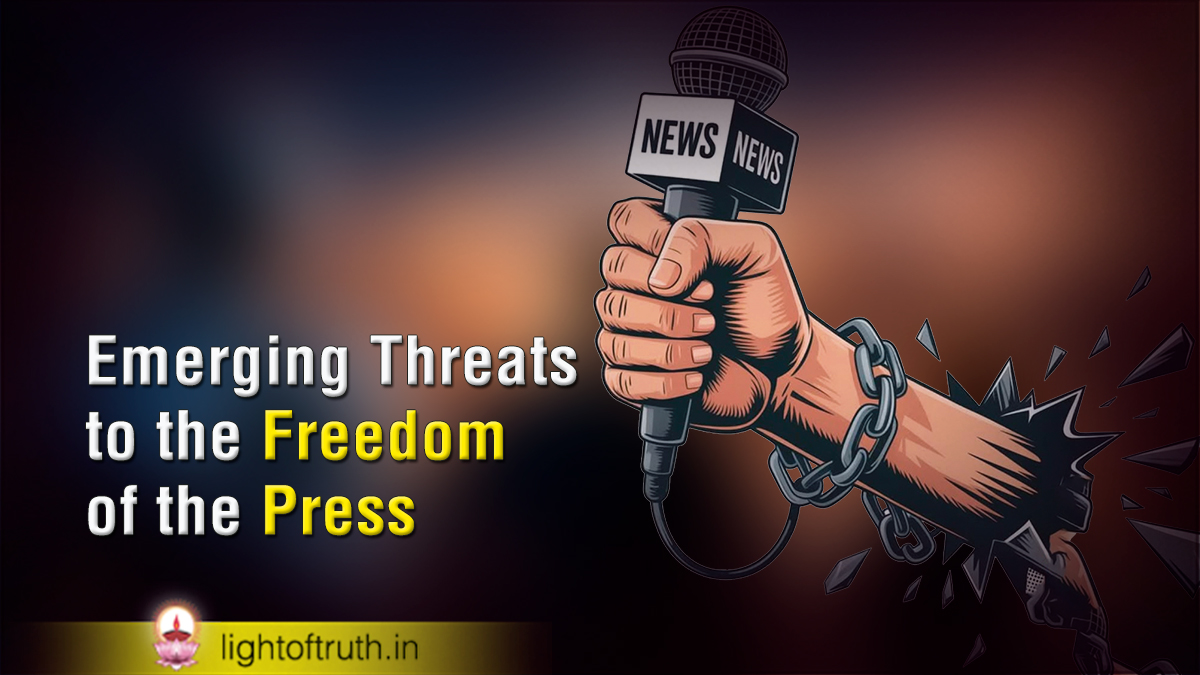
As per the World Press Freedom Index report released on 30 April 2026, India ranks 157th out of 180 countries. According to the report, “with a rise in violence against journalists, highly concentrated media ownership, and outlets with increasingly overt political alignment, press freedom is in crisis in ‘the world’s largest democracy.’” It is significant that nearly all of India’s neighbours, Pakistan (153), Bhutan (150), Nepal (87), Sri Lanka (134), and Bangladesh (152), rank higher than India, while only China (178) ranks lower in the region. The report uses particularly strong language in observing that India’s media has fallen into an ‘unofficial state of emergency’ since 2014.
Reporters Sans Frontières (RSF), widely recognised as a global journalism watchdog, evaluates press freedom through five indicators such as the economic, legal, political, social, and security environments that assess the conditions in which journalists operate and the degree of media independence. Among them, the legal indicator has shown the steepest decline over the past year, signalling the increasing criminalisation of journalism across the world. Reflecting on its findings over the past twenty-five years, the current report underscores a long-term global deterioration in press freedom.
The report observes that “journalism is being asphyxiated by hostile political discourse towards reporters, weakened by a faltering media economy, and squeezed by laws being used as weapons against the press.” According to the report, authoritarian regimes, complicit or ineffective political authorities, predatory economic actors, and poorly regulated digital platforms are all contributing significantly to the global erosion of press freedom. The report also criticises the political tactic of branding independent media as ‘anti-national,’ ‘Soros agents,’ or similar labels in order to discredit critical journalism.
Creeping of censorship
Describing India as one of the world’s most dangerous countries for media professionals, the report notes that “an average of two to three journalists are killed due to their work every year,” while “journalists who are critical of the government are routinely subjected to online harassment, intimidation, threats and physical attacks, as well as criminal prosecutions and arbitrary arrests.” The deterioration of press freedom in India, therefore, appears not merely incidental but systemic in nature. The present Indian government has increasingly adopted an evasive and adversarial approach toward independent journalists and digital content creators who critically scrutinise its policies and decisions.
Although the expression “freedom of the press” is not explicitly mentioned in the Constitution of India, it is understood to be protected under the fundamental right to freedom of speech and expression guaranteed by Article 19(1) (a). However, critics argue that the present Indian government has increasingly relied on laws relating to sedition, defamation, and anti-state activities to suppress critical media voices. Anti-terror legislation, too, has been invoked with growing frequency against journalists and media professionals. The rhetoric of national security is often employed to justify the imprisonment of journalists and the imposition of restrictions that effectively curtail the media’s right to access and disseminate information.

The decline in open press conferences has weakened opportunities for independent questioning and public accountability, while simultaneously strengthening a media culture increasingly shaped by political loyalty and carefully managed communication strategies.

When the Union Government introduced the Digital Media Rules in 2021, one of the earliest legal challenges was filed by The Wire, followed by numerous petitions from smaller and independent media organisations rather than large corporate media houses. Subsequently, legislations such as the Telecommunications Act (2023), the Information Technology Amendment Rules (2023), and the Digital Personal Data Protection Act (2023) have raised further concerns regarding state control over media freedom and digital expression.
The report particularly criticises the Digital Personal Data Protection Act (2023), observing that it “directly undermines the fundamentals of journalism by restricting access to, processing of, and publication of certain types of information that could be of interest to the public, starting with administrative documents, public archives, and all other information that could implicate public officials or institutions entrusted with a mission of general interest.” Legal challenges to several provisions of the Act are currently before the Supreme Court of India. The Reporters’ Collective, along with civil society organisations, journalists, and transparency advocates, has filed petitions arguing that the DPDP Act undermines democratic transparency by significantly weakening the Right to Information Act, 2005, and violates fundamental constitutional guarantees under Articles 14 and 19(1). The matter is presently under judicial consideration.
The report also highlights a serious and growing threat to investigative journalism. Under the emerging legal framework, journalists investigating individuals may be required to inform those persons about the information being collected or processed concerning them. According to RSF, such provisions could severely obstruct investigative reporting and discourage whistle-blowers from coming forward with sensitive information. Unlike journalists employed by major media institutions, many independent reporters and digital creators lack the protection of unions or professional associations that might support them when they face arrest, intimidation, online harassment, or physical attacks. As a result, independent journalists often remain isolated and exposed to institutional pressure.
Two recent incidents illustrate this growing climate of suppression. The X account of Cockroach Janta Party, a satirical political collective that reportedly gained more than six lakh registrations within a week and attracted widespread online attention, was withheld in India by 21 May 2026. Likewise, Helle Lyng, the Norwegian journalist who publicly questioned Prime Minister Narendra Modi about his avoidance of press conferences, stated that her Instagram and Facebook accounts had subsequently been suspended.
Monopolisation of Media
Following the economic liberalisation of 1991, much of the print media gradually became commercialised, and news increasingly came to be treated as a marketable ‘product’ designed to maximise profit and audience engagement. Over time, this commercial orientation contributed to the consolidation of media power among a limited number of large conglomerates that now dominate a substantial share of India’s television, print, and digital news landscape.
For instance, the Reliance Industries group, owned by Mukesh Ambani, who is widely perceived as being close to Prime Minister Narendra Modi, reportedly controls more than seventy media outlets, including major television channels, digital platforms, and print publications. Similarly, NDTV, long regarded as one of India’s most prominent independent news networks, was acquired in 2022 by Gautam Adani, another influential industrialist perceived to have close ties with the present government. Reports by the Reuters Institute for the Study of Journalism and RSF observed that the acquisition signalled a further shrinking of editorial independence within India’s mainstream media environment.
When media ownership becomes concentrated, editorial positions often begin to align with the corporate and political interests of those who control them, thereby reducing the diversity of perspectives available to the public. The report observes that “the economically powerful owners go along with this either because their politics matches that of the ruling party or because they are aware of the cost of not doing so, given the extent to which the Modi government has weaponised the use of agencies to deal with any opposition.” Consequently, while many mainstream media outlets increasingly display a pro-government orientation, critical and dissenting voices are frequently marginalised or silenced. Thus democratic discourse becomes progressively narrowed, and the range of opinions accessible within the public sphere is significantly reduced.
Contemporary Indian media increasingly reflects the priorities and interests of political and economic elites. The wealthy, the politically influential, and celebrities are consistently projected as ‘newsworthy,’ whereas the concerns of the poor, the working classes, and those living on the social and economic margins receive comparatively little attention. Such a selective representation of reality weakens the democratic function of the media, which ideally ought to amplify the voices of all sections of society, especially the vulnerable and underrepresented.
In contrast to earlier decades, when press conferences by Indian prime ministers were more frequent and formed an important part of democratic engagement with the media, public interactions with journalists under the present administration have become comparatively limited. Critics argue that the decline in open press conferences has weakened opportunities for independent questioning and public accountability, while simultaneously strengthening a media culture increasingly shaped by political loyalty and carefully managed communication strategies.
Freedom of the Press – The Essence of Democracy
The media is often described as the fourth pillar of democracy, and its freedom, like constitutionalism, justice, equality, and fraternity, is essential for sustaining a fair and healthy democratic order. Indeed, the condition of the press frequently reflects the condition of democracy itself. No democracy can function effectively without the free flow of information, open criticism, and mechanisms of public accountability.
One of the primary responsibilities of the press is to hold governments accountable and ensure transparency in governance and public administration. A free press, therefore, is not merely an institutional privilege but a democratic necessity that protects citizens’ rights and strengthens the moral and political foundations of society.
Only a free and independent media can keep citizens informed, aware, and socially conscious. The constant vigilance exercised by the media helps a nation preserve its democratic values and freedoms from erosion. By presenting diverse viewpoints and encouraging meaningful public debate, the media enables citizens to think critically, participate responsibly, and make informed decisions.
A responsible journalist must report events truthfully, courageously, and independently, viewing reality not merely through the lens of the powerful and privileged, but also from the perspective of the oppressed, marginalised, and voiceless. Ethical journalism gives visibility to those who are often ignored by dominant structures of power and ensures that democracy remains attentive to justice and human dignity. In this sense, freedom of the press is not merely a professional privilege enjoyed by journalists; rather, it is a fundamental right of the people to know the truth.