QUESTION : How does Pope Leo XIV, in Magnifica Humanitas, address the ethical challenges posed by Artificial Intelligence? What moral criteria does he propose for its development, governance, and responsible use? – Hesed
ANSWER : Saji Mathew Kanayankal CST
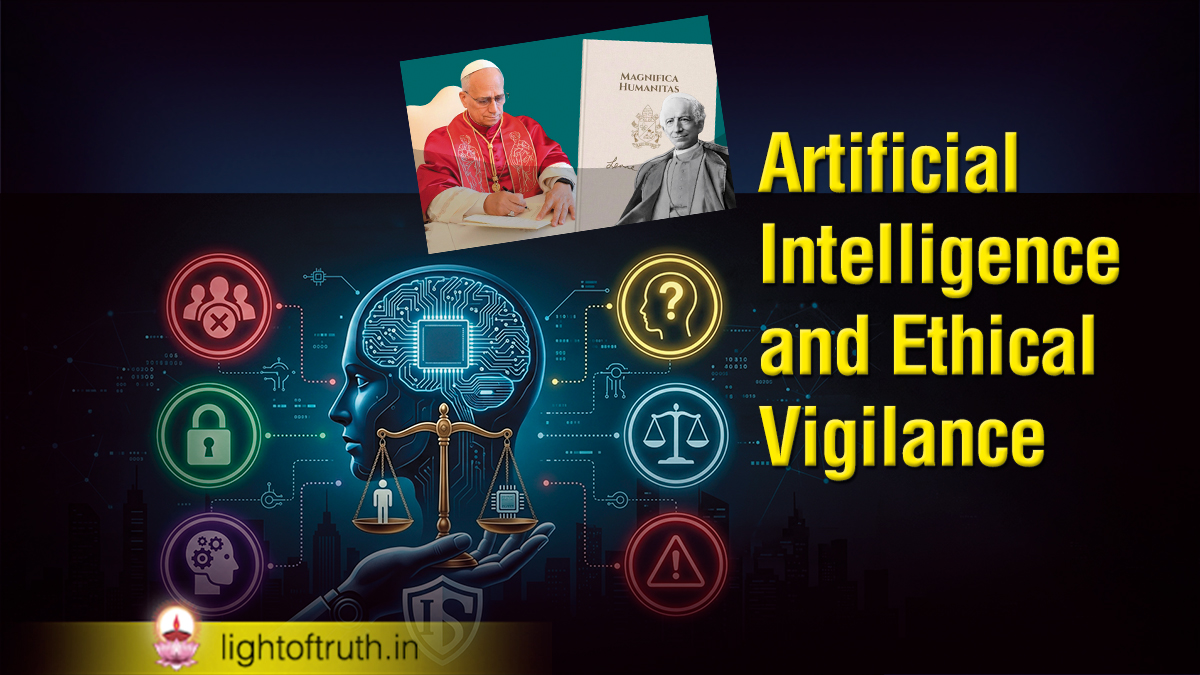
Magnifica Humanitas, the first encyclical of Pope Leo XIV, published on 15 May 2026, focuses to safeguard human person in a time of Artificial Intelligence (AI).The central theme of the encyclical is the uniqueness and dignity of the human person. Pope insists that the challenges posed by AI are not merely ethical or technological, but fundamentally anthropological, touching the very meaning and vocation of the human person.
The encyclical argues that technology is neither inherently good nor bad; its value depends on how it serves the common good and respects the dignity of the human person. So do not treat technology as the ultimate source of human progress neglecting the moral, spiritual, and relational dimensions of human life. Authentic human flourishing, is found in the well-being of humanity, virtuous living, meaningful work, leisure, community, goodness of creation and friendship with God and neighbour. Thus the primary contribution of the encyclical is ethical orientation. It seeks to shape the moral vision that technological progress must remain at the service of the human person.
- Ethical Dilemma in Using AI
While acknowledging the immense potential of AI, the encyclical warns against its misuse that threaten democracy, truth, social relationships, and human integrity. Rather than rejecting technological innovation, Pope Leo calls for responsible development and governance of AI guided by wisdom, solidarity, justice, and care for the vulnerable. At its heart, Magnifica Humanitas is a call to remain deeply human in a rapidly changing technological world. The Pope reminds humanity that no machine can replace the dignity, freedom, creativity, and spiritual depth bestowed by God. As he writes, “We must lovingly safeguard the grandeur of humanity bestowed upon us and revealed in its fullness in Christ, the splendour of which no machine can ever replace” (n. 15).
Pope clearly views AI as one of the key challenges and to respond to it in the light of our faith, the Gospel and the Catholic Social Teaching. It is a warning against allowing ourselves to build further inequality into our social structures. Because it may help to concentrate the economic and technological resources into a few hands widening the gap between the rich and the poor, and the people in the main streams and in the peripheries. “Technology has the power to heal, connect, educate and protect our common home; but it can also divide, exclude and generate new forms of injustice” (n. 9).
Pope Leo XIV teaches that technology is never neutral in practice, because it inevitably reflects the values, intentions, and interests of those who design, finance, regulate, and employ it (n. 98, 199). Consequently, the decisive question is not whether society should accept or reject technology, but whether technological development serves the common good or future generations. Any vision or developments that excludes God and seeks human domination is harmful to the society.
- AI: A Friend or Foe?
Immediately after the publication of Magnifica Humanitas, many concerns were raised regarding the Vatican’s position on AI. Some wondered whether Pope Leo XIV was entirely against AI. Does he regard AI as fundamentally bad or he promotes it? Pope does not condemn AI, nor does he accept it uncritically. Rather, he acknowledges both the opportunities and the risks associated with AI and other emerging technologies. While recognizing the potential to foster innovation, productivity, and economic development, technological progress must always remain ordered to the dignity of the human person and the common good (n. 4). Rather than prescribing specific regulatory mechanisms, Pope Leo XIV offers a set of ethical principles rooted in the Church’s Social Doctrine to guide the development, deployment, and governance of artificial intelligence. According to him, AI can be a “valuable tool” (n. 100), but it is not morally neutral because it inevitably takes on the characteristics of those who “who devise, finance, regulate and use it” (n. 9). Therefore, the fundamental question is not whether AI should be used, but whether its use promotes human dignity, justice, and authentic human flourishing.

Pope Leo XIV offers a set of ethical principles rooted in the Church’s Social Doctrine to guide the development, deployment, and governance of artificial intelligence. According to him, AI can be a “valuable tool” (n. 100), but it is not morally neutral because it inevitably takes on the characteristics of those who “who devise, finance, regulate and use it” (n. 9?). Therefore, the fundamental question is not whether AI should be used, but whether its use promotes human dignity, justice, and authentic human flourishing.

The encyclical recognizes many concerns such as “job insecurity, inequality” (n. 151), the “manipulation of information or violations of privacy” (n.102), the presence of “ideological bias” within technological systems (n.102), the development of “autonomous weapons systems” (n.197), and transhumanist visions that promote the idea of an “enhanced human being” (n.115). While acknowledging these challenges, the encyclical does not reject its use. Rather, it invites believers and all people of goodwill to engage critically and responsibly with technological developments. So the central concern is the values and priorities that shape its design and use.
- Two Symbols: Two Attitudes
Pope Leo XIV presents the current technological revolution as a decisive cultural and moral turning point. Humanity stands before a choice: either to construct an inhuman future marked by domination, exclusion, and technological control, or to build a society in which God and human beings dwell in justice, dignity, and fraternity. To explain it, he uses two narratives from the Old Testament, the construction of Babel Tower (Gen 11:1-9) and the rebuilding of Jerusalem (Neh 1-7). The Tower of Babel is a symbol of power, greed, authority, overconfidence, and a techno-culture. They solely relied on their own abilities. “It was a project conceived without reference to God, supported by a uniformity that eliminated diversity and that chose homogenization over communion” (n. 7). On the other hand, the leadership of Nehemiah for the rebuilding of Jerusalem is an excellent model for the responsible use of technology. Nehemiah functioned as a good leader listened to everyone, shared responsibilities, and encouraged collective participation. He adopted an inclusive style of leadership. The rebuilding of Jerusalem is a model of prayer, sacrifice, mutual cooperation, and reliance on God. “He did not impose solutions from above. He convened the families, assigned each of them a section of the wall to rebuild, listened to their concerns, coordinated their efforts and addressed any opposition.” The city is reborn, “not through the initiative of one man, but through the shared responsibility of all” (n. 8). Similarly, we must use technology based on dialogue, participation, and responsibility. Pope Leo asserts that technology should be developed by respecting others and through collaboration.
- Digital Discernment: An Obligatory Virtue in a Digital Era
Pope Leo XIV calls for a spirituality of digital discernment. Technological progress must be accompanied by ethical reflection, moral responsibility, and a commitment to the common good. Human beings must critically evaluate how technology shapes culture, relationships, and social structures, rather than allowing technological developments to determine the future uncritically. Adequate legal and ethical safeguards are essential for protecting human rights and limiting harmful distortions generated by emerging technologies.
However, the deeper issue concerns is who possesses technological power and how that power is exercised. The Pope notes that technological innovation is increasingly driven by private and often transnational performers whose influence extends beyond traditional political and social structures. Apparently these technologies may assert its objectivity, but we should be able to reflect upon “the cultural assumptions of those who designed and trained them, with all their strengths and limitations” (n. 100). Pope asserts that the ethical discernment cannot be limited to asking whether we are using a system for good or bad purposes; it must also examine how that system is designed and what vision of the human person and society is embedded in the data and models that guide it (n. 104). We need prudence and rigorous evaluation as we use any AI system. “At times, a slower pace in adopting AI does not mean opposing progress; instead, it is an exercise of responsible care for the human family” (n. 106). He also advocates a process of shared discernment involving governments, institutions, communities, and individuals. Society must not merely react to technological crises as they emerge; it must also identify the cultural, moral, and spiritual forces driving technological change and consciously choose pathways that foster human flourishing.
The Pope proposes a fundamental ethical criterion for evaluating technological innovations, including AI. Every technological development must be judged according to a crucial question: “Do they genuinely help individuals and peoples become more humane and fraternal while respecting our common home and safeguarding the well-being of future generations?” (n. 85). In this way, Pope Leo XIV places human dignity, fraternity, truth, moral responsibility, work, freedom, solidarity, peace, common good and integral ecology at the centre of technological ethics, offering a framework for evaluating AI and other emerging technologies. These principles provide a moral framework for discernment, enabling individuals, institutions, and policy makers to assess whether technological innovations genuinely serve humanity or undermine its flourishing.
- Practical Implications
The encyclical also proposes a series of practical and ethical questions that encourage the individual and community. Does this technology help one to remain faithful to the truth, even when confronted with attractive but misleading content? (n. 237) Does it contribute to authentic learning and enable one to educate and serve others more effectively? (n. 238) Does it strengthen genuine human relationships and help one appreciate those moments and places where physical presence remains indispensable? (n. 239) Does it encourage one’s participation in the promotion of justice, solidarity, and peace? (n. 240). These questions shift the focus from technological capability to human flourishing. Magnifica Humanitas affirms that decisions affecting human dignity must never be delegated entirely to technological systems. The encyclical insists that the governance of data and the development and use of AI be guided by transparency, accountability, and meaningful human oversight. These principles ensure that technological innovation remains subject to ethical discernment and human responsibility, safeguarding the dignity of every person and promoting the common good. Those who design, manage, and employ such systems must remain morally responsible for their consequences and ensure that technological processes respect the rights, dignity, and freedom of every person.
Ultimately, Magnifica Humanitas is not a call to reject Artificial Intelligence or technological innovation. Rather, it is a call to ensure that the development and use of AI remain oriented toward the “magnificence of humanity” (n. 4). Pope Leo XIV challenges humanity to employ technology in ways that uphold human dignity, strengthen fraternity, promote justice, and foster a culture in which technological progress remains at the service of persons.