- QUESTION : Who are the priestly fraternity of Saint Pius X and the present Crisis? What is meant by Excommunication in the Catholic Church? What is Heresy, Schism and Apostasy?
- ANSWER : Jacob Parappally MSFS
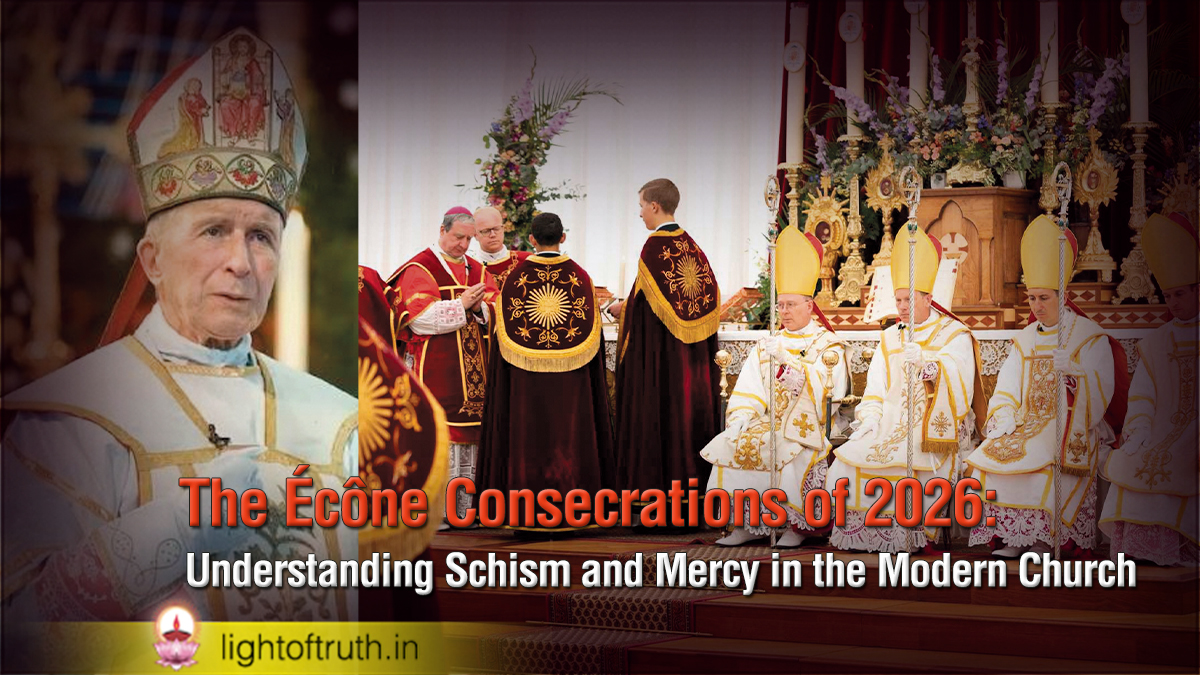
By consecrating four bishops without papal approval on 1 July 2026 at Écône, Switzerland, the Society of St. Pius X (SSPX) formally placed itself in schism from the Catholic Church. Despite Pope Leo XIV’s personal appeal to the leaders of the SSPX to refrain from consecrating four priests as bishops, the Society proceeded with the episcopal ordinations. Following these consecrations, Pope Leo XIV declared that the SSPX had entered into formal schism. Subsequently, the Dicastery for the Doctrine of the Faith (DDF) withdrew the faculties previously granted to SSPX clergy, declared invalid the confessions they hear and the marriages they celebrate, and imposed the canonical penalty of excommunication on those clergy and lay faithful who continue to adhere formally to the Society. These developments mark the culmination of more than five decades of tension between the Holy See and the SSPX.
- Origins of the Society of St. Pius X
The Society of St. Pius X is a traditionalist Catholic priestly fraternity founded in 1970 by the retired French Archbishop Marcel Lefebvre. Its principal purpose was to preserve what its members regarded as the authentic Catholic faith, traditional priestly formation, and the celebration of the liturgy according to the 1962 Roman Missal, the form of the Roman Rite in use before the liturgical reforms of the Second Vatican Council.
This form of worship, commonly known as the Traditional Latin Mass or the Tridentine Mass, is rooted in the Roman Missal promulgated by Pope Pius V in 1570 following the Council of Trent. Members of the SSPX maintain that they are safeguarding the authentic tradition of the Church and, on this basis, reject several teachings and reforms introduced by the Second Vatican Council.
The origins of the Society are inseparable from the life and convictions of Archbishop Marcel Lefebvre (1905–1991) who is a member of the Congregation of the Holy Spirit (Spiritans). Lefebvre served as a member of the Central Preparatory Commission for the Second Vatican Council (1960–1962). During the Council he emerged as one of the principal leaders of the Coetus Internationalis Patrum, the organized group of conservative Council Fathers who opposed many of the proposed reforms. At the opening of the Council, the council fathers rejected most of the preparatory schemas drafted by the preparatory commissions, judging them inadequate for addressing the pastoral challenges of the modern world. In response, Pope John XXIII established new commissions to prepare revised texts that reflected the Council’s desire to renew the life and mission of the Church through a fresh reading of the Gospel in the light of the “signs of the times” and under the guidance of the Holy Spirit.
Archbishop Lefebvre strongly opposed many of these developments. He rejected the liturgical reforms that permitted the celebration of the Mass in the regional languages, the Council’s teaching on religious freedom and ecumenism, the principle of episcopal collegiality, and its commitment to dialogue with other religions.
- The Schism of the Society of St. Pius X
In 1969, Archbishop Lefebvre established the International Seminary of St. Pius X in Fribourg, Switzerland. The following year, he transferred the seminary to Écône, in the canton of Valais, where it became the principal center for the formation of priests according to the traditional pre-conciliar model. In the same year, 1970, he founded the Society of St. Pius X (SSPX). Initially, the Society received canonical approval from Bishop François Charrière of Fribourg as a pia unio (pious union). However, as tensions with the Holy See increased over its rejection of the reforms of the Second Vatican Council, the Society’s canonical approval was withdrawn in 1975.
The conflict deepened in 1976 when Pope Paul VI suspended Archbishop Lefebvre a divinis, thereby prohibiting him from exercising his priestly and episcopal ministry. Lefebvre refused to submit to the papal decision and continued to ordain priests, establish seminaries, and expand the Society’s apostolic activities in several countries. The crisis reached its climax on 30 June 1988 when Archbishop Lefebvre, despite the explicit prohibition of Pope John Paul II, consecrated four bishops at Écône without the required pontifical mandate. The co-consecrator was Bishop Antônio de Castro Mayer, the retired Bishop of Campos, Brazil. According to Canon 1382 of the 1983 Code of Canon Law, both the bishop who consecrates another bishop without a pontifical mandate and the person who receives episcopal consecration incur latae sententiae excommunication reserved to the Apostolic See.
Although Archbishop Lefebvre maintained that he acted out of fidelity to Catholic Tradition and out of concern for the future of the Church, Pope John Paul II regarded the illicit episcopal consecrations as “a schismatic act” because they constituted a direct rejection of papal authority in a matter touching the unity of the Church. In his Apostolic Letter Ecclesia Dei (2 July 1988), the Pope appealed to the faithful not to follow Archbishop Lefebvre into schism and reaffirmed that authentic fidelity to Tradition necessarily includes communion with the Successor of Peter.
- The Church’s Efforts at Reconciliation
Despite the illicit episcopal consecrations of 1988 that interrupted ecclesial communion, as Mater et Magistra, Mother and Teacher, the Church consistently sought to restore communion through dialogue, patience, and pastoral charity. The Holy See kept the door open for reconciliation. In January 2009 Pope Benedict XVI, motivated by his profound desire to promote the unity of the Church, remitted the excommunication of the four surviving bishops consecrated in 1988. The decree described this gesture as a “gift of peace,” intended to foster ecclesial charity, remove the scandal of division, and encourage renewed dialogue with the Society.
The remission of the excommunication, however, did not restore the Society to full communion with the Catholic Church. Two months later, Pope Benedict XVI clarified that the SSPX continued to lack canonical status within the Church and that its ministers exercised no legitimate ecclesiastical ministry. Later Pope Francis also demonstrated remarkable pastoral generosity towards the Society. During the Extraordinary Jubilee of Mercy (2015–2016), he granted SSPX priests the faculty to validly and licitly absolve sins during the Holy Year. At the conclusion of the Jubilee, he extended this faculty indefinitely as a pastoral provision for the spiritual welfare of the faithful.
Despite these significant gestures of goodwill, the Society of St. Pius X continued to reject essential aspects of the Second Vatican Council and remained outside full ecclesial communion. The episcopal consecration of four new bishops on 1 July 2026, carried out without papal approval, marked a decisive rejection of the reconciliation that the Holy See had patiently pursued for decades. In response, Pope Leo XIV declared that the Society of St. Pius X had formally separated itself from the communion of the Catholic Church.
- Heresy, Schism, Apostasy, and Excommunication: Understanding the Church’s Canonical Sanctions
The declaration of the Society of St. Pius X (SSPX) as a schismatic body and the imposition of canonical sanctions invite a deeper reflection on the meaning and purpose of these penalties within the life of the Church. The Catholic Church possesses not only a sacramental and spiritual structure but also a juridical order that safeguards its faith, unity, and mission. Canon law is a juridical expression of the Church’s communion, intended to protect the integrity of the faith, preserve ecclesial order, and promote the spiritual welfare of the faithful. Consequently, when fundamental elements of the Church’s faith or communion are gravely violated, canon law provides appropriate disciplinary measures intended to restore justice and foster reconciliation. Among the gravest offence against the unity and faith of the Church are apostasy, heresy, and schism.
Apostasy is the total repudiation of the Christian faith by a baptized person. It involves a complete abandonment of the faith once professed and a rejection of one’s communion with Christ and his Church. Heresy is the obstinate denial or obstinate doubt, after Baptism, of a truth that must be believed with divine and Catholic faith. Throughout the Church’s history, various heresies (Docetism, Arianism). Schism, by contrast, does not primarily concern the denial of doctrine but the rupture of ecclesial communion. According to the Code of Canon Law, schism is “the refusal of submission to the Supreme Pontiff or of communion with the members of the Church subject to him.” It is therefore a rejection of the visible unity of the Church established by Christ through communion with the Successor of Peter and the bishops united with him. Excommunication is the gravest ecclesiastical penalty that the Church can impose upon one of its members. It excludes the individual from full participation in the sacramental life of the Church and bars the exercise of ecclesiastical offices and ministries. It is a medicinal penalty intended to awaken the individual’s conscience, encourage repentance, and lead ultimately to reconciliation with God and the Church.
- Communion and Excommunication: A Theological Reflection
Human existence is fundamentally relational. We become truly human through communication, participation, and communion with God, with one another, and with the whole of creation. Without communication, there is no communion. From a Christian perspective, the entire history of salvation is the story of God’s self-communication to humanity, culminating in the person of Jesus Christ. The Church continues Christ’s ministry of reconciling humanity with God and with one another. To belong to the Church means to participate in the communion inaugurated by Christ through the Holy Spirit.
The history of the Society of St. Pius X illustrates the tragic tension between fidelity to tradition and communion with the Church. The Society has consistently presented itself as the guardian of authentic Catholic Tradition. Yet, from the Catholic perspective, fidelity to Tradition cannot be separated from communion with the living Magisterium of the Church. Tradition is not a static inheritance preserved unchanged through the centuries; it is the living transmission of the apostolic faith under the guidance of the Holy Spirit. The Church’s understanding of the deposit of faith grows continually through the contemplation and study of believers, the lived experience of the faithful, and the teaching ministry of those who have received the apostolic office.
It was precisely this understanding of Tradition that Pope John Paul II emphasized in his Apostolic Letter Ecclesia Dei following the illicit episcopal consecrations of SSPX. He observed that the root of Archbishop Lefebvre’s schismatic act lay in “an incomplete and contradictory notion of Tradition,” one that failed to recognize its living and dynamic character under the guidance of the Holy Spirit. Authentic Tradition exists in a relationship of mutual fidelity and continuity. The Church disciplines are to heal and correct to restore communion, and remains ever ready to welcome back those who sincerely seek to return to the unity of faith, hope, and love. Excommunication, therefore, is not an act of exclusion but a pastoral and medicinal call to reconciliation, to restore communion in Christ.