The Archdiocese of Hamburg has celebrated the 24th anniversary of its foundation with a Eucharistic celebration on 7th January, presided over by Card. Reinhard Marx, President of the German Bishops’ Conference. According to a press release, the Cardinal in his homily “placed particular emphasis on the history of our intrinsic ecumenical bond: all Christian denominations are on a journey to serve each person,” since “Christianity is a religion that does not exclude anyone.” And when we celebrate the Eucharist, it is important for us to “constantly refocus and ask ourselves what the priorities are,” and then “look and act,” bearing in mind that “looking always means listening.” Referring to the anniversary of the founding of the Archdiocese, the cardinal asked: “How can we live together and listen to one another? How can we foster our joint responsibility and active participation in the Church?” And he referred to the “Synodal Church” often advocated by Pope Francis: “a new journey towards a synodal Church can help us to learn from one another and also to overcome serious crises,” the Cardinal concluded.

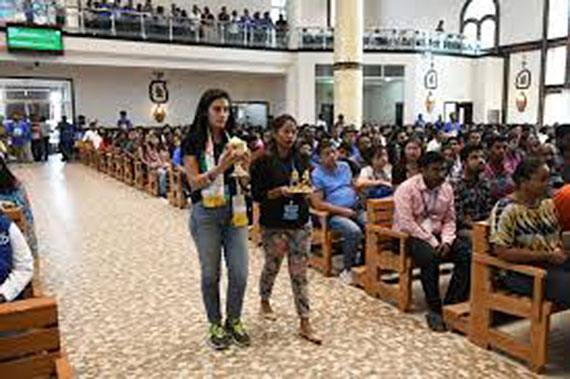
CATHOLICS FIND FLOURISHING FAITH LIFE IN MUSLIM UAE, WHERE POPE WILL VISIT
Catholics from around the world living in the United Arab Emirates are waiting with great anticipation for Pope Francis’s on Feb. 3-5 visit, the first papal trip to the Arabian Peninsula.
“Pope Francis is the ambassa dor of peace, courageously crossing borders and fostering personal encounters with religious leaders, heads of states and humanitarian organizations in the Arab world,” said Father Johnson Kadukkan, parish priest at Saint Joseph’s Cathedral in Abu Dhabi, where Francis will stop for a private visit on Feb. 5 before celebrating Mass at Zayed Sports City Stadium.
There are eight Catholic Churches throughout the seven emirates of the UAE, with a ninth church under construction. Each church offers an extensive schedule of “weekend” Masses, all of which are full. Since the UAE is an Islamic country and Friday is considered a day of prayer for Muslims, Catholics attend weekend Mass on Friday or Saturday; Sunday is a workday.
St Joseph’s Cathedral in Abu Dhabi, for example, has about 90,000 parishioners, with eight priests celebrating nearly 20 Masses during the weekend in various languages: Arabic, English, Tagalog, Spanish, French, Italian, German, Korean, Polish, Ukrainian, Urdu, Sinhalese and the Indian languages of Konkani, Malayalam and Tamil.

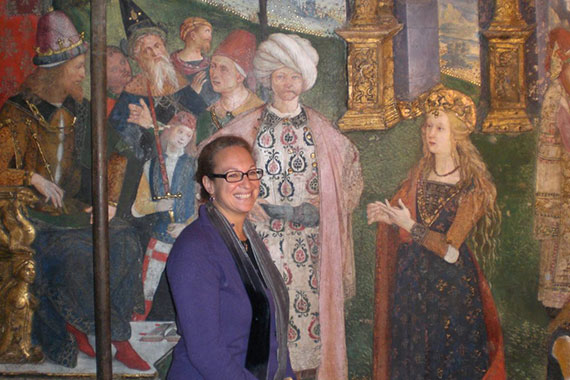
HISTORIAN ARGUES THAT CHURCH’S EMBRACE OF ART SAVED THE FAITH
As the Catholic Church struggled to recover from the tumultuous effects of the Protestant Reformation, art historian Elizabeth Lev believes that it was the Church’s embrace of art that effectively saved the faith. Lev, an Americanborn, Rome-based scholar, is one of the most sought after guides in Rome who makes the treasures of the Eternal City more relevant than ever.
In her new book, How Catholic Art Saved the Faith: The Triumph of Beauty and Truth in CounterReformation Art, Lev chronicles how individuals such as Michelangelo and Caravaggio, and lesser known artists such Annibale Carracci and Lavinia Fontana, turned to stone and canvas to combat challenges to the faith.
Why after the Protestant Reformation, where language (95 theses, in fact!) had been used to contest Catholicism, did the Church turn to art to recapture the essentials of the faith?
“The printed word can be painful, as anyone who has been trolled on the Internet will tell you. In the wake of Martin Luther’s famous theses, a flood of printed pamphlets overwhelmed people with conflicting information, polemical statements, and sometimes outright name-calling. While the Catholic Church excelled at scholastic tomes, literary click bait was not its forte, so it turned to art, where it had 1300 years of experience of communication through images. While the Protestants were debating to clast or not to clast with icons, the Catholic were sponsoring beautiful images that would draw people together, gazing in the same direction at artwork designed to point to the divine. These paintings still attract millions of viewers today, even though many tourists no longer understand the teachings or the stories behind them. It was a brilliant PR coup, deploying artists as visual preachers to the public.”


THOUSANDS JOIN ANNUAL CATHOLIC PROCESSION IN MANILA
Hundreds of thousands of people have thronged the streets of Manila to fling themselves at a statue of Jesus Christ as it inched its way through the Philippine capital in an annual procession that is one of the world’s biggest shows of Catholic devotion.
The faithful gathered before dawn on Jan 9 to catch a glimpse of the statue as it was wheeled on a metal float along a seven kilometre route through the city.
They believe touching the religious icon known as the Black Nazarene, or simply being in its presence, can heal the sick or deliver good fortune. Police said at least 800,000 people were in the crowd.
“I survived a stroke because of him (God),” 70-year-old Joaquin Bordado, who has attended the procession for decades, told the AFP news agency. “I will do this every year until I am 100 years old.”
Around him, the crowd, mostly walking barefoot as a sign of penitence, chanted “Viva Nazareno” (Long live Nazarene) and jostled for a glimpse of, or selfie with, the statue cloaked in a maroon robe that is topped with a crown of thorns and cross.

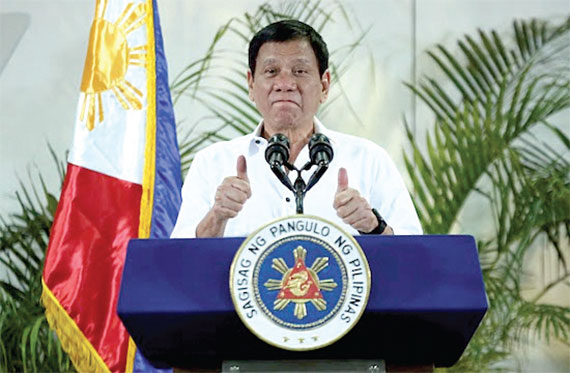
DUTERTE CALLS PHILIPPINE BISHOPS ‘SONS OF BITCHES’
Philippine President Rodrigo Duterte has renewed his attacks on bishops in the Catholic majority country by describing them as “sons of bitches.”
The outspoken leader has been criticized by the Church for his war on drugs in which 5,000 people have been killed by police since 2016. “Only I can say bishops are sons of bitches, damn you. That is true,”
Duterte said in a speech during a groundbreaking ceremony for a school north of capital Manila on Jan. 10, Reuters reported. Duterte also suggested that most bishops are homosexual. “Most of them are gay,” he said. “They should come out in the open, cancel celibacy and allow them to have boyfriends.”
The president, who is not a regular churchgoer, said early in his presidency that he was sexually abused by a priest when he was a boy. Almost every time he addresses a crowd, he starts by acknowledging that his staff prepared a speech for him — but he never calls it his own. He always makes a point of putting some distance between him and his speechwriters.

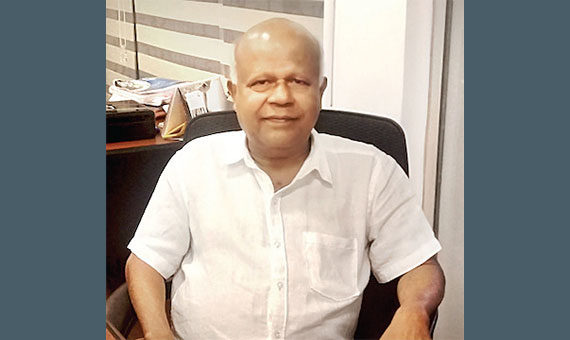
SRI LANKAN CARTOONIST SENDS CATHOLIC MESSAGES IN A MOVIE
Camillus Perera’s father was so impressed with his son’s sketches and cartoons in his younger years that he told him: “One day you will capture the attention of the world.” The comment proved prophetic.
Now Perera, a devout Catholic, is one of the most famous cartoonists in Sri Lanka — a country in chaos as it reels from a constitutional crisis inspired by a power play by President Maithripala Sirisena and two competing prime ministers.
The artist, whose pictures are often inflected with political messages, now ranks among the top four cartoonists in the country, joining the elite ranks of compatriots Aubrey Collette, Wijesoma and S.C. Opatha.
He lives in Negombo, near capital Colombo, and has spent more than half a century perfecting his art.
His vocation began when he was a schoolboy as he liked to draw cartoons and caricatures of his friends and teachers.
Even though his principal disapproved when he first saw Perera’s caricature of him — sitting by a table with a bottle of liquor on it — the older man was wise enough to recognize the boy’s talent, and he encouraged him to keep developing his skills.
SINGAPORE’S ‘SHEPHERDS’ SPREAD CATHOLIC MESSAGE
Singapore may be known as a fast-paced financial centre but its growing Catholic community is spreading the word of God even at work.
Established in 2008 as a non-profit organization under the auspices of the Archdiocese of Singapore, the Catholic Business Network (CBN) brings together thousands of “friends” willing to serve the community and promote Catholic morals, values and ethics in the workplace.
President Goh Teik Poh said that business owners can be the voice and face of Christ by embodying Catholic social values in the workplace and showing how they conduct their business with integrity and care for their staff, AsiaNews reported.
Goh, a 59-year-old managing director in the maritime and logistics industry, said entrepreneurs and professionals play a prominent role in their families, companies and communities.
“We don’t have to look very far to see individuals, perhaps within our own families or communities, who need a listening ear or a helping hand to get out of a difficult situation that they find themselves in,” he said.
Singapore’s Christian community is on the rise. Catholics number about 383,000 or 9% of the population and are active in the country’s political and economic life. CBN’s motto is “Shepherds in the Marketplace.”
“We spend a good part of our lives at work. Living our faith therefore must imply that we live out our faith at work as well,” said vice-president Chan Beng Seng.
VIETNAMESE BISHOP CONDEMNS DEMOLITION OF 100 HOMES
Redemptorists and a bishop have condemned Vietnamese officials for destroying more than 100 houses and called on the government to compensate victims. “I learned with great sorrow of the destruction of your beloved homes and properties by the authorities in Ho Chi Minh City,” Bishop Vincent Nguyen Van Long of Parramatta in Australia told the victims in an open letter. “I would like to express my deep solidarity with you and add my support to your struggle for dignity in the midst of the incredible ordeal that has been forced on you. I pray that you remain committed in your faith and your search for justice.” Bishop Long, who was born in Vietnam before he fled the communist country on a refugee boat in 1979, said the evicted land belongs to generations of people who moved from the north 65 years ago.
FILIPINO BISHOP TELLS CATHOLICS TO IGNORE DUTERTE TIRADES
A former head of the Philippines’ Catholic bishop’s conference, has called on people to ignore President Rodrigo Duterte’s repeated rants against the church.
In his New Year message, Archbishop Socrates Villegas of Lingayen-Dagupan said those who call God stupid and teach that it is useless to go to church are “anti-Christ.”
“Do not listen to him who tells you it is useless to go to church and attend Mass. Whoever teaches you that is an anti-Christ and there are many of them, including those who look at it is a joke,” said the prelate.
In an open letter to his godson named Seth, Archbishop Villegas said he feared the child “might catch the wrong values.”
The prelate did not name Duterte in the message but clearly referred to the president’s statements. He told his godson to always treat women and girls with respect and reverence. “Do not laugh when older men make fun of women. That is vulgar and if you laugh or imitate them, you become vulgar yourself,” he said.
“Rape is not a joke. Immodesty is no laughing matter. Respect girls and women always. You have no excuse to abuse women specially poor women,” said the archbishop in what was seen as criticism of a speech in which Duterte said he had sexually assaulted a housemaid when he was a teenager.
A spokesman later said the president’s comments were made in jest.
Duterte has also earned flak from various groups for calling God stupid and for suggesting that people should not go to church to attend Mass.
On Dec. 29, the president vowed to continue attacking the church until it “corrects itself.” “If not, I will remain its opponent … and I will continue to attack it,” he said as he enumerated allegations against priests involved in sex abuse.
40 MISSIONARIES KILLED IN THE YEAR 2018
In the course of the year 2018, 40 Missionaries were killed throughout the world, almost double the 23 of the previous year, and they were priests for the most part: 35. After eight consecutive years in which the highest number of Missionaries killed was recorded in America, in 2018 it is Africa to take the first place in this tragic category.
According to the data collected by Fides Agency, in 2018, 40 Missionaries were killed: 35 priests, 1 seminarian, and 4 lay people. In Africa, 19 priests, 1 seminarian, and 1 lay woman were killed (21); in America, 12 priests and 3 lay people were killed (15); in Asia, 3 priests were killed (3); in Europe, 1 priest was killed (1). We are using the term “missionary” for all the baptized, aware that “in virtue of the Baptism received, every member of the People of God has become a missionary disciple. Each baptized person, whatever his function in the Church and level of instruction in the faith, is an active agent of evangelization” (EG 120).