Analysis: Pope Francis’ new exhortation ‘Christus Vivit’

Laphidil Oppong Twumasi, a youth leader from Ghana, reads Pope Francis’ apostolic exhortation, “Christus Vivit” (Christ Lives), during a news conference for its presentation at the Vatican on April 2, 2019

As a young Jesuit, Jorge Bergoglio taught literature to a group of rowdy, hormonal teenage boys at a private school in Argentina who, according to one of them, “had no desire to study.”

Faced with the chaos of the classroom, the 28-year-old Bergoglio refused to adopt a dictatorial path of control but instead engaged his pupils by posing them challenges. He demonstrated his passion for a range of writers, even managing to get one of Spanish literature’s greats, Jorge Borges to come and talk to the class.

Recalling those days Jorge Milia, who is now a writer, said the future Pope always urged his students to analyse, break down arguments and not be “hood winked.”

Decades later, and now sitting in the Chair of St Peter, Pope Francis is adopting a similar teaching method when it comes to how the Church can better connect with young people.

Trump’s border wall will make US a “prisoner” of isolation, pope says

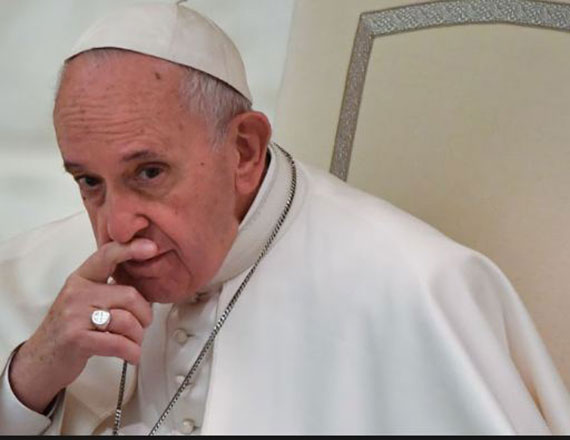
President Donald Trump’s decision to build an anti-immigrant wall will leave the United States alone and a “prisoner” of its own isolation, according to Pope Francis in his latest wide-ranging interview, this time with a Spanish journalist.

“He who raises a wall ends up a prisoner of the wall he erected,” the Pope said. “That’s a universal law in the social order and in the personal one. If you raise a wall between people, you end up a prisoner of that wall that you raised.”

“Yes, I defend my autonomy, yes,” Francis said, “but you’re left alone like a mushroom.”

Francis’s words came in a pre-recorded interview, which took place before he departed for an overnight trip to Morocco. Speaking to Spanish journalist Jordi Evole of La Sexta, Francis said countries that traffic in arms “have no right to talk about peace.”

“Are they fomenting war in another country and then want peace in their own?” Francis asked. “That theory will boomerang. Life charges them, one way or another. If you arm the war there, you will have [the war in] your house whether you want it or not.”

Asked about victims of clerical sexual abuse and whether they should go to the police to denounce a crime, Francis said “of course” and insisted such a standard was the outcome of a recent summit on abuse he convened.

German bishops publish ‘10 theses on climate protection’

The German Bishops’ Conference on April 3, 2019 has published a contribution to climate policy discussion as a central social challenge in the field of the creation of creation. The expert text “Ten theses on climate protection. A discussion contribution “is based on socio-ethical, economic, natural and juris prudential considerations and contains solutions.

Based on Pope Francis ‘Encyclical Laudatosi,’ the text clarifies the need for climate protection from a socio-ethical perspective. The task of counteracting dangerous climate change is described as a requirement of justice. The text is committed to the goal of achieving greenhouse gas neutrality as early as possible, but by 2050 at the latest. Specific implementation steps will be identified, including taking a pioneering role in Europe and the world, the phasing out of fossil fuels Frame-work for the transformation of the energy system, the involvement of consumers and producers and the promotion of sustainable lifestyles. Reflections on the model function of the church complete the text.

In extraordinary peace gesture Pope kisses feet of South Sudan’s leaders

For five years they were at war with each other in a bloody conflict that has killed 400,000, left six million starving, four million displaced from their homes and a devastated economy.

On 11 April 2019, the President of South Sudan, SalvaKiir, and his former vice-president Riek Machar sat together on a sofa in the Casa Santa Marta in the Vatican as Pope Francis appealed for them to persevere with their fragile peace agreement and “remain in peace.” After finishing his talk the Pope stood up from behind his desk, walked over to the warring leaders of the world’s youngest state and knelt down and kissed both of their feet. Machar, who was taken aback by the gesture, appeared to try to stop the Pope from bending down in front of him. Francis told him: “let me.”

Along with Kiir and Machar, the 82-year-old Pope also bent down to kiss the feet of the other political leaders gathered in the room including Rebecca Nyandeng, the widow of John Garang, the man who helped bring about an independent South Sudan. Nyandeng was in tears during the encounter, which is likely to go down as one of the most dramatic peace gestures of the Francis pontificate.

The Archbishop of Canterbury, Justin Welby, choking up with emotion after witnessing the scene said: “We have heard the prophetic call of Christ. We now commission you as ambassadors of peace.” He handed each of the leaders a Bible with the following message: “seek that which unites. Overcome that which divides.”

By any worldly measure, South Sudan’s problems seem insurmountable and might be best left to the intercession of St Jude, the patron of saint of hopeless causes.

Abp Barwa to the Christians of Orissa: We are gathering evidence on the Kandhamal martyrs

“We are gathering information on the Kandhmal martyrs:” announced Msgr John Barwa, archbishop of Cuttack-Bhubaneswar, to Christians in Orissa during a meeting with clergy and religious. The prelate started the formal process to have the Christians killed during the pogroms unleashed by the Hindu radicals in 2008 known as “martyrs of the faith.”

The meeting took place at the Kandhamal pastoral centre on 3 March, where over 60 diocesan priests and leaders presented various reports on financial aspects and land issues. The archbishop expressed the desire to strengthen the laity through education, both religious and secular, and to improve the socio-economic conditions of the district’s population. He said, “people are disadvantaged due to lack of higher education and professional training. We must encourage and strengthen them.”

Msgr Barwa participated in a retreat for the clergy, in which “the preacher emphasized that the Eucharist is at the heart of priestly spirituality, and invited prelates to devote more time to Eucharistic adoration and prayer.”

“I told our clergy and religious – he concludes – that it is our task to gather all the evidence and material, so that I can advocate [the cause] in the Vatican, in the first phase of the beatification process. Everyone – lay faithful, consecrated and priests – must share the documents in their possession. It is a joy for us.”

India’s secular nature ‘will die forever’ if BJP wins poll

Fears of India evolving into a Hindu theocratic nation loom large as the pro-Hindu Bharatiya Janata Party (BJP) seeks a second term by placating Hindu sentiment ahead of the April-May parliamentary election.

Secular and liberal political groups say the poll will be crucial in forging the future identity of the country, which defined itself as a secular-democratic nation after British rule ended in 1947.

“Hindu pride is the plat-form on which voters are being courted, which is a big concern,” said Alok Verma, a rights activist in the Northern State of Jammu and Kashmir.

The April 11 to May 19 elections will see 900 million eligible voters select 543 parliamentarians. The party with the most seats will govern the country for the next five years. The BJP, in office since 2014, again finds itself pitted against the Congress party, its nemes is. But critics like Verma worry it is stoking religious intolerance and hate as a ploy to win over more Hindus.

Political participation is also Christian mission: Telugu Churches

The Federation of Telugu Churches has urged Christians in Andhra Pradesh and Telangana to vote for candidates who promote India’s secular and pluralistic character and foster communal harmony and peace.

Vote for those “who strive for social justice and equality of the marginalized like the Adivasis/Tribals and Dalits, especially for equal status for the Dalit Christians and Dalit Muslims, and who protect and promote the rights of the minorities,” says a pastoral letter from the federation, the apex forum of various Churches in the two Southern Indian States that use Telugu as their common language.

The April 1 statement says the Church’s political service and political apostolate are the need of the hour.

“Hence, as bishops/Heads of Churches we encourage our members to opt for political vocation and to take up political service. FTC urges Christians, especially the youth, to take up leadership roles in public and political life,” the pastoral letter says.

Former street children mourn For their father

Bimal Das is no more a street child, nor is he Christian. But the 30-year-old stood inside a New Delhi church and wept as he joined funeral prayers for Salesian Father Antony Thaiparambil.

Das flew in from Kolkata to attend the funeral of Father Thaiparambil, who rescued him from a street in the eastern Indian city when he was barely six years old.

“I have not seen God, nor have I seen my parents. But if God is there, I am sure he looks like this man,” he said after the ceremony.

The priest helped at least 80,000 children like Das to leave the streets and secure a decent life, Salesian officials said.

Father Thaiparambil began his work with street children in Kolkata, three decades ago in 1985. Das was one of the initial beneficiaries of his mission.

The 84-year-old priest died in New Delhi of an age-related illness on March 19. About 500 people including former street children attended his funeral officiated by Arch-bishop Anil Couto of Delhi and retired Archbishop Vincent Cocessao of Delhi.

Indian police protect convent, school following mob attacks

Police are protecting a Catholic convent and a school two weeks after mobs attacked and injured several people, including four nuns, in southern India’s Tamil Nadu State. Indian bishops on April 6 appealed to political leaders in New Delhi and Tamil Nadu “to deal sternly” with criminals who attacked the convent of the Franciscan Sisters of the Immaculate Heart of Mary and its Little Flower Higher Secondary School in Chinna-salem town on March 25-26. “All the injured nuns are back from hospital now but police continue to guard the school and convent,” the congregation’s provincial superior, Sister Devaseer Mary, told ucanews.com on April 7.

Mobs attacked the school and convent after a grade 10 student committed suicide in the school hostel on the afternoon of March 25, hours after she had taken her mathematics exam after expressing fears of failing it. Local police officer N. Ramanathan told ucanews.com that the violence began after the school management refused to entertain a demand for 1 million rupees (US$14,250) in compensation.

Sister Mary said the school management refused to pay any compensation because the school had not committed any mistake. But those who demanded compensation on behalf of parents of the deceased student “left angrily saying they knew how they could get this amount.”

A bigger attack followed on March 26. About 200 people armed with sharp weapons, iron rods and wooden batons entered the compound. They attacked the convent, its chapel, school offices and staff in what appeared to be an organized criminal plan. They beat up nuns and school staff, destroyed furniture, windows, computers and shelves in the school office, and desecrated the chapel. The nuns estimate a loss of about 10 million rupees (US$1.4 million) from the attacks. “We are documenting the loss in a systematic way. We want the authorities to recover our loss from the criminals,” Sister Mary said.

Asia Bibi still in Pakistan, PM Khan says

Pakistan Prime Minister Imran Khan has said that Asia Bibi remains in the country, negating speculation that she had already joined her family in Canada. Khan told the BBC in an interview published online on April 10 that Bibi was still in Pakistan because there was “a little bit of a complication” which he declined to explain.

“But I can assure you she is safe, and she will be leaving in weeks,” Khan said during the interview conducted in London.

The Catholic mother of five had been on death row for blasphemy since 2010 and was held in solitary confinement for eight years.

In a landmark judgment, the Supreme Court of Pakistan quashed her death sentence in November last year and ordered her immediate release from prison.

The ruling, however, sparked violent nationwide protests that came to an end only after the government agreed to stop Bibi from leaving Pakistan until a challenge to her acquittal was heard by the top court.

The court, however, upheld Bibi’s acquittal on Jan. 29, allowing her to exit Pakistan. Days after the court’s ruling, she was airlifted from a prison in Multan to the capital Islamabad, where she was reportedly kept in a safe house due to death threats. Subsequent media reports stated preparations were being made for Bibi to be relocated with her family who are living in an undisclosed location in Canada.

One German media quoted her lawyer saying that she had already been flown to safety in Canada. Her current situation remains unknown. Catholic activists in Pakistan were dismayed that Bibi had still not been flown out of Pakistan.

Katherine Sapna, the director of Christian True Spirit, said that there was “total confusion” about what Bibi’s real situation was.

Official Website

Exit mobile version