Middle East patriarchs discuss plight of Christian minorities with Pope Francis

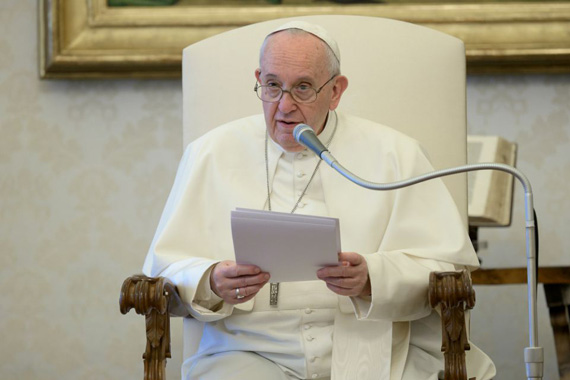
Six Catholic patriarchs from Lebanon, Syria, Egypt, and Iraq met with Pope Francis at the Vatican on Feb 7, 2020 to discuss the difficulties faced by Christians in the region and their mass emigration. In the morning of Feb. 7, the Pope met Cardinal Louis Raphael Sako, Chaldean Patriarch of Babylon; Cardinal Bechara Boutros Rai, Maronite Patriarch of Antioch; Coptic Patriarch Ibrahim Isaac Sedrak of Alexandria; Melkite Patriarch Youssef Absi of Antioch; Armenian Patriarch Gregoire Pierre XX Ghabroyan of Cilicia; and Syriac Patriarch Ignatius Youssef III Younan of Antioch.

Patriarch Younan told CNA that the patriarchs requested the meeting with Pope Francis because of the “dramatic situation of the Middle East in general, whether in Syria, Iraq, Lebanon” and because of the “migratory flux” of the Christian minorities from their homelands.

It is a “a threat to our survival,” he said, explaining that they are struggling to provide proper spiritual assistance to their faithful in other parts of the world, especially Western Europe.

Russian Church plans to end blessing nukes

The Russian Orthodox Church has proposed a stop to the practice of having priests bless weapons of mass destruction, though sprinkling holy water on planes and ships is still deemed appropriate.

The Church on February 3 published a draft document out-lining its role in blessing Orthodox Christians who “protect the Fatherland” and “carry out their military duty,” inviting internet users to discuss the proposal online.

Russians often ask priests to bless anything from new cars and flats to Soyuz spaceships in the belief that the gesture bestows divine protection.

Since the fall of the Soviet Union, priests have also begun blessing troops, planes and ships, and all sorts of weapons, from Kalashnikov rifles to nuclear-capable Iskander ballistic missiles.

But the document proposed that “blessing any type of weapons the usage of which can inflict an indefinite number of deaths, including weapons with indiscriminate effects or weapons of mass destruction… be removed from pastoral practice.”

At the same time, it remains “appropriate” to “bless transport used by soldiers on land, water and in the air,” to ask God to protect the men using them, it said.

Bishop in India ‘categorically denies the false allegations of forced conversion’

An archbishop in India is denying the accusations of a Hindu nationalist organization that “forced conversions” are taking place in the northern State of Uttar Pradesh.

The Vishwa Hindu Parishad (VHP) – meaning Universal Hindu Council – announced it had identified 30 places in eastern Uttar Pradesh where alleged “forced conversions” by Christian missionaries are taking place.

“I deny this report, that forced conversion is taking place in Uttar Pradesh or anywhere in India. Any conversion is voluntary, and everyone has the freedom to follow the religion of his own choice,” Bishop Gerald John Mathias of Lucknow told Crux.

Uttar Pradesh is the most populous State in India, with nearly 200 million people. However, only about 350,000 Christians live in the state, a miniscule 0.18 percent of the population. By comparison, Christians make up nearly 2.5 percent of the whole of India’s population.

Uttar Pradesh, like the national government, is run by the Bharatiya Janata Party (BJP), with strong links to the Rashtriya Swayamsevak Sangh (RSS), a militant Hindu nationalist organization.

The VHP is also one of the many organizations affiliated with the RSS.

Hindu nationalists often accuse Christians of using forceful and surreptitious tactics in pursuing conversions. They then storm into villages and lead “reconversion” ceremonies – called Ghar Vapsi, or “back to home” – in which Christians are compelled to perform Hindu rituals.

Mathias told Crux that “forcing people with organised Ghar Vapsi programs are forced conversion, and this must be stopped.”

In November, Uttar Pradesh proposed an anti-conversion law, imitating several other states in India. Christians say such laws violate India’s secular constitution, which guarantees freedom of religion.

“Christians in India have constitutional guarantees to practice our faith, share the Good News and the message of Christ, which is for all humanity. This is not conversion nor is anyone forced,” Mathias said.

“I categorically deny the false allegations of forced conversion.”

Stop claiming benefits under Article 30: BJP to Church

Goa Archbishop Filipe Neri Ferrao urged the central government to revoke the Citizenship (Amendment) Act (CAA), calling the law “divisive” and “discriminatory,” state BJP general secretary Narendra Sawaikar on Feb. 10 urged him to stop claiming benefits under Article 30 of the Indian Constitution, which protects minority educational institutions from government discrimination.

“If CAA is discriminatory than Article 30 of Constitution of India is more discriminatory. Don”t claim benefits at taxpayers money by claiming minority status! CAA, Archbishop,” Sawaikar, a former Lok Sabha MP tweeted. As per Article 30 (ii) of the Constitution of India “the state shall not, in granting aid to educational institutions, discriminate against any educational institution on the ground that it is under the management of a minority, whether based on religion or language.”

Catholic religious support Shaheen Bagh’s women protesters

A group of Catholic religious has expressed solidarity with the women protesters of Shaheen Bagh in the national capital.

Around 25 Catholic priests and nuns from Delhi led by Presentation Sister Anastasia Gill on February 2 spent a day with the women who are protesting against the Citizenship Amendment Act (CAA)

“The Christian community rejects CAA as this piece of legislation that is against the spirit of the Constitution of India,” said Sister Gill while addressing thousands of women gathered at the south Delhi suburb for more than 50 days.

The nun, who is the Christian member of the Delhi Minorities Commission, said as “citizens of this great nation, Christians are in solidarity with the protesters as they defend the idea of India cherished by the father of our Nation Mahatma Gandhiji and Babasaheb Ambedkar.”

The Catholic religious sang with the protesters ‘Abide with me,” a favourite hymn of Mahatma Gandhi, and the popular hymn “Hum honge kaam yaab” (we will succeed), an anthem of many civil rights movements.

Shaheen Bagh protesters following the passage of Citizen-ship Amendment Act in both the houses of parliament the women spontaneously and peacefully began to demonstrate at Shaheen Bagh from Dec. 15. The women intensified their protest with the police brutality against the students of Jamia Millia Islamia.

CAA unconstitutional, say Catholic religious at grassroots

A group Catholic priests and nuns working among the poorest and most marginalized communities in Maharashtra has opposed the Citizenship Amendment Act (CAA) as unconstitutional.

“The CAA is the first instance of religion being overtly used as criterion for citizenship under Indian nationality laws and therefore fundamentally discriminatory and divisive in nature,” says a press release from 36 representatives of 16 Catholic congregations that oppose the act.

The group called Justice Coalition of Religious that met in Mumbai recently also opposed National Population Register (NPR) and National Register of Citizens (NRC).

They said these laws are at odds with secular principles enshrined in the Constitution and contradict Articles 13, 14, 15, 16 and 21 that guarantee to every citizen the right to equality, equality before the law, and non-discriminatory treatment by the State.

The group attended on January 16-18 a capacity-building workshop titled, “Rights-based Advocacy in relation to the Sustainable Development Goals (SDG).”

These religious work with urban and rural poor, Dalits and Adivasis, street children, women in prostitution, homeless populations, persons with disabilities and other poor and marginalized communities.

“As citizens deeply committed to a just and rights-based implementation of the SDGs, we strongly oppose the Citizenship Amendment Act as unconstitutional and therefore counterproductive with respect to SDG 16,” their statement asserts.

It expresses their deep concern about the negative fallout the proposed all-India-level National Population Register (NPR) and National Register of Citizens (NRC) will have on the people of the country, “disproportionately harming the poor, vulnerable, and marginalized and thereby nullifying efforts toward SDG 10 among others.”

Dialogue only way forward for social harmony: Cardinal Gracias

Cardinal Oswald Gracias, president of the Catholic Bishops’ Conference of India, says consistent dialogue with all sections of people is important and necessary to maintain unity and harmony in society.

“Dialogue is the tapestry of different cultures, languages and ethnic diversity and the Church has always stood for service of society,” the cardinal, who is also the Archbishop of Bombay, told a press conference on February 12, the eve of the bishops’ conference’s 34th biennial plenary session.

The February 13-19 meet at the St John’s Academy of Medical Sciences has chosen the theme “Dialogue: The Path to Truth and Charity.”

Cardinal Gracias called for a variety of dialogues, particularly cultural dialogue for the whole country.

As a new decade begins, the Catholic Church in India will move forward to dialogue with all groups in society. This could include civic bodies, government and non-governmental organizations so as to create a peaceful and a harmonious environment for all to live as true citizens of the rich land, India, the cardinal said.

The cardinal, one of the six consultants of Pope Francis, assured all Indian citizens that the Church in India would continue to live the gospel values of peace, joy and harmony and always work for the whole humanity.

“I place into the Lord’s hands this plenary assembly and pray that the fruits of the week-long deliberations may inspire us to continue to build bridges, first by under-standing the other person and then walking along with him/her, irrespective of his caste, creed and colour.”

Asked about the novelty of the theme, the cardinal said the plenary had the same theme 20 years ago and it might come up again. The Church wants to give an impetus and vitality to this theme with more networks to improve the dialogue, he said added that the Church looked forward in dialoguing for anybody having anxiety as the Church is second to none for many services.

Church leaders wary of Kerala’s burial rights bill

Catholic Church leaders in Kerala have expressed apprehension about the state’s communistled government proposing a new law on the burial rights of Christians.

The proposed law has several aspects that need clarification to ensure that it does not end up obscuring the rights and freedom Christians currently enjoy, Cardinal George Alencherry, major archbishop of the Syro-Malabar Catholic Church, said in a statement.

The head of the Eastern-rite Church was responding to the draft Kerala Christian Cemeteries (Right to Burial of Corpse) Bill, 2020, that the government presented in the state legislature on Feb. 6.

The law primarily aims to address the burial rights that Christians of two warring factions — Orthodox and Jacobite. Their century-old quarrel over ownership of land and churches has often resulted in each faction denying access to the other, even to cemeteries to bury their dead.

The dispute has intensified since 2017 when the Supreme Court gave ownership to the Orthodox faction. Since then, the Orthodox faction has denied Jacobites access to cemeteries where the ancestors of both factions are buried.

Proclaim good news through joyful service: Nuncio

Apostolic Nuncio to India Archbishop Giambattista Diquattro on February 13 urged Catholic bishops in the country to lead their people in proclaiming the good news through joyful services.

Nearly 200 bishops representing 174 dioceses in India are currently attending their biennial plenary assembly at Bengaluru’s St John’s Academy of Medical Sciences. Speaking at the opening session, the nuncio conveyed to the good wishes and blessings of Pope Francis to the participants while calling for effective and dynamic leadership for better service to the people.

The nuncio led the inaugural Mass presided along with Cardinals Oswald Gracias, George Alencherry and Baselios Cleemis. The Theme of the February 13-19 assembly is “Dialogue: The Path to Truth and Charity.”

The nuncio said all are called to foster harmony and peace in society. The nuncio also assured the bishops that he would convey to the Pope their filial greetings. He appreciated the services rendered by various Catholic organizations under the leadership of the local bishops.

Inner joy God’s gift, Justice Joseph tells Naga Catholics

Catholics are called to spread inner joy like light in the world and it can come only from God, says Justice Kurian Joseph, former Supreme Court judge.

“Wealth, power, or positi-ons cannot remove darkness; only God’s light can remove darkness,” Justice Kurian told opening session of the 36th annual convention of the Catholic Association of Nagaland on January 31 at Dimapur, the commercial capital of the northeastern Indian State.

The three-day convention has chosen as the theme, “Be the light that shines in the darkness.” It began with Mass led by Bishop James Thoppil of Kohima.

Justice Kurian, who was the chief guest, commended the joyous nature of Naga people and said he was fortunate to be in the land of festivals. “Unless you are joyful, you cannot have festivals,” said the native of Kerala State who was on his maiden visit to Nagaland.

Official Website

Exit mobile version