

Police in southern Vietnam have captured a famous blogger and rights activist who has been praised for bravely struggling for democratic freedom and accepting persecution.
The Public Security Ministry announced on Oct. 7 that police arrested Pham Thi Doan Trang and searched her boarding house in Ho Chi Minh City. Trang is accused of campaigning against the state and spreading information and documents against the communist government. The Hanoi resident will be detained for four months as her case is investigated.
Le Nguyen Huong Tra said police arrested Trang at midnight of Oct. 6 while she stayed at a boarding house in the city.
“I am not surprised at my friend’s arrest after she published reports on the lethal land clash between police and farmers in Dong Tam Commune,” Pham Thanh Nghien, Trang’s close friend, said. The clash claimed the lives of three police officers and farmers’ leader Le Dinh Kinh.
Nghien, a Catholic mother of one, said Trang’s arrest, which came when delegations from Vietnam and the US were holding their 24th annual human rights dialogue via virtual sessions on Oct. 6-7, showed that the Vietnamese government refused to respect human rights.
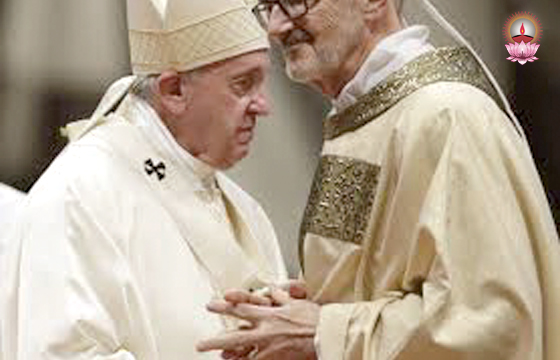
Cardinal says Pope’s new encyclical is a warning: The world is ‘on the brink’
One of Pope Francis’s top advisers said that the pontiff sees the current world situation comparable to that of the Cuban missile crisis, World War II, or 9/11 – and that to fully understand the papal encyclical released on Sunday, October 4, it’s necessary to acknowledge “we’re on the brink.”
“Depending on your age, what was it like to hear Pius XII deliver his Christmas messages during World War II?” said Cardinal Michael Czerny. “Or how did it feel when Pope John XXIII published Pacem in Terris? Or after the 2007/2008 crisis, or after 9/11? I think you need to recover that feeling in your stomach, in your whole being, to appreciate Fratelli Tutti.”
“I think Pope Francis feels today the world needs a message comparable to what we needed during the Cuban missile crisis, or World War II or 9/11 or the big crash of 2007/2008,” he said. “We’re on the brink. We need to pull back in a very human, worldwide and local way. I think that’s one way to get into Fratelli Tutti.”
Fratelli Tutti is the encyclical the Argentine Pope released on the feast of St. Francis of Assisi, after signing it the previous day in the Italian town where the Franciscan saint lived most of his life.
According to the cardinal, if Pope Francis’s previous encyclical, Laudato Si’, on the care of creation, “taught us that everything is connected, Fratelli Tutti teaches us that everyone is connected.”
“If we take responsibility for our common home and for our brothers and sisters, then I think that we do have a good chance, and my hope is re-kindled and inspired to keep on going and do more,” he said.
Czerny, head of the Vatican’s migrants and refugees section of the Dicastery for Promoting Integral Human Development, made his comments during a “Dahlgren Dialogue” session organized online by the Initiative on Catholic Social Thought and Public Life of Georgetown University.
The prelate said that Fratelli Tutti “brings some big questions and brings them home to each of us,” with the pontiff attacking a theory that most subscribe to without realizing they’re doing so: “We believe to be self-made, without recognizing God as our creator; we’re prosperous, we believe we deserve everything that we have and consume; and we’re orphans, disconnected, totally free, and actually alone.”
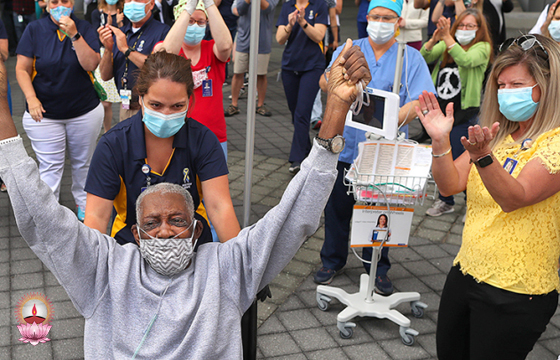
What Lessons Do Americans See for Humanity in the Pandemic Humanity in What Lessons Do
When an event has as much impact as the coronavirus outbreak – disrupting billions of lives and leading to more than 1 million deaths around the world – it’s natural for people to ponder big questions. Is this just a random occurrence, or is there something more at play? Is it all part of God’s plan? Or, at a more worldly level, can this experience teach us any truths about humanity?
We sought to explore these questions in a recent Pew Re-search Centre survey, conducted in mid-July on the Centre’s American Trends Panel. First, we asked people: Do you believe there is a lesson or a set of lessons for humankind to learn from the coronavirus outbreak? And if so, do you think these lessons were sent by God, or not?
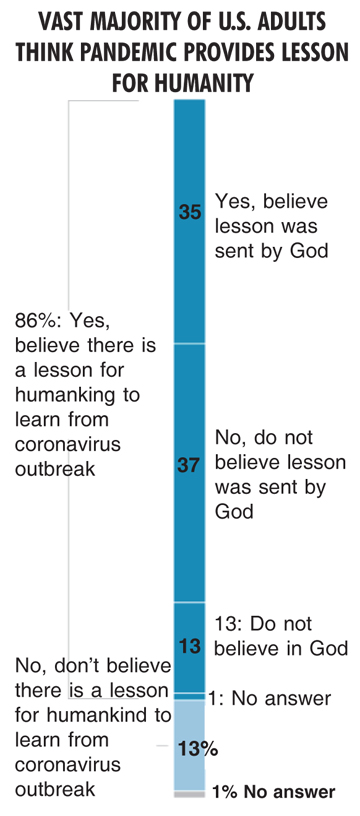
A large majority of U.S. adults (86%) say there is some kind of lesson or set of lessons for humankind to learn from the pandemic, and about a third of Americans (35%) say the lessons were sent by God. The remainder say the lessons were not sent by God (37%), they do not believe in God (13%), or there is no lesson to be learned (13%).
Then, we asked half the respondents who said yes to the first question to describe, in their own words, what lessons they think humankind should learn. This prompted more than 3,700 people to write their answers, which ranged from a few words to several sentences.
The rest of this essay looks at a sampling of responses – including many examples presented exactly as respondents wrote them. Some responses have been lightly edited for spelling and clarity. Due in part to the great variety of responses we received, we did not attempt to quantify what percentage of Americans believe there is a certain type of lesson to be learned.
Americans who say God is using the pandemic to send a lesson to humanity often highlight religious lessons. Those who do not think the lessons of the pandemic were sent by God mention a variety of topics – though rarely religious ones.
Among those who say there is a lesson about religion within the pandemic, some respondents point to the role God has in humans’ lives. For instance, a 53-year-old woman writes that “whether you believe it or not, God is in control and we must have God at the centre of our lives. He is our saviour.”
A 58-year-old man feels God wants people to reflect on their lives: “God is telling us that we need to change our ways or He will send a virus that will make us be alone so that we have time to think about how we live our lives. We all need to live as one we are all children of God. God did not create mankind to live as we do. And He is not going to let this virus end until He knows that we have learned our lesson.”

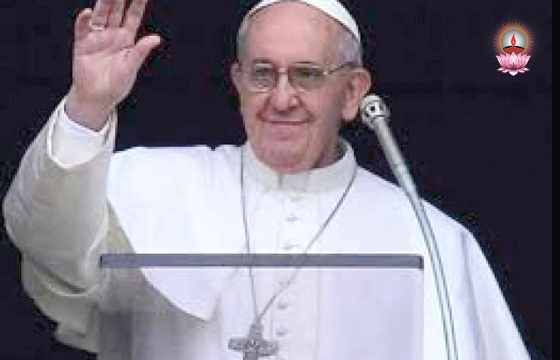
Pope calls for greater space for women in positions of ‘responsiblity in the institutions of the Church’
Let us pray that “the lay faithful, especially women, may participate more in institutions of responsibility in the Church, without falling into clericalism that nullifies the lay charism.” This was Pope Francis reflection after the Angelus, when he also appealed for a ”resumption” of the truce between Armenia and Azerbaijan and recalled the beatification of 15-year-old Carlo Acutis, indicating him as a “model” for today’s young people.
Pope Francis recited the Marian prayer together with a few thousand people present in St Peter’s Square on a drizzly Sunday on Oct. 11. Commenting on that day’s Gospel passage on the parable of the wedding banquet, the Pope underlined that twice in the story, the king’s servants are sent to call the guests “but they refuse, they don’t want to go to the celebration, because they have other things to think about.”
Pope Francis underlined that “often we too put our interests and material things before the Lord who calls us. But the king of the parable does not want the room to remain empty, because he wishes to donate the treasures of his kingdom and extends the invitation to even the most distant, “without excluding anyone,” because “no one is excluded from the house of God.” The king in fact says: “Call everyone, good and bad. Everyone.” “God calls the bad, too.”
In this way the Church too “is called to reach today’s crossroads, that is, the geo-graphical and existential peripheries of humanity,” all those places where “shreds of humanity without hope” live. “It is a question of not settling on the comfortable and habitual ways of evangelization and witness to charity, but of opening the doors of our hearts and of our communities to all, because the Gospel is not reserved for a select few. Even those who are marginalized, even those who are rejected and despised by society, are considered by God worthy of His love.”
It was after the Angelus that Francis said he “appreciated that a ceasefire for humanitarian reasons was agreed between Armenia and Azerbaijan, with a view to reaching a substantial peace agreement. Although the truce proves to be too fragile, I encourage it to be resumed and I express my participation in the pain of the loss of human lives, the suffering, as well as the destruction of homes and places of worship. I pray and invite you to pray for the victims and for all those whose life is in danger.”
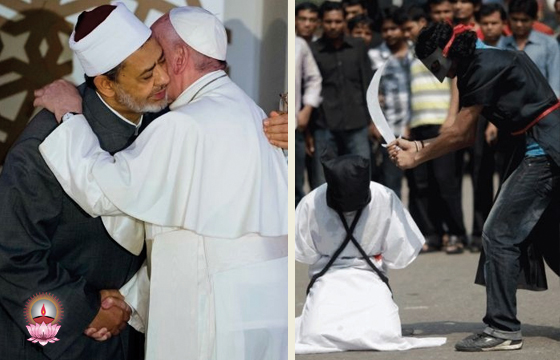
‘DEATH PENALTY’ IMAM DEBUNKS FRATELLI TUTTI
Pope Francis’ abrogation of the death penalty in Fratelli Tutti is being blown sky-high by his chief dialogue partner Grand Imam Ahmed al-Tayyeb – who, in accordance with Islamic jurisprudence, supports the execution of apostates from Islam.
Public hanging above freshly-dug graves in a Muslim country. “Today we state clearly that ‘the death penalty is inadmissible’ and the Church is firmly committed to calling for its abolition world-wide,” Francis declares in his latest encyclical, contradicting Scripture and 2,000 years of Sacred Tradition. But Al-Tayyeb, who is named five times and upheld as the pontiff’s inspiration in Fratelli Tutti (All Brothers), trashes Francis’ declaration, stating: “The four schools of law all concur that apostasy is a crime, that an apostate should be asked to repent, and that if he does not, he should be killed.”
“[Contemporary] juris-prudents concur – and so does ancient jurisprudence – that apostasy is a crime,” Al-Tayyeb asserts in a 2016 Arabic interview, translated into English by the Middle East Media Research Institute.
“We should be aware that the concepts of human rights are full of ticking time bombs,” the grand imam warned, labelling apostasy “high treason” and “a rebellion both against religion and what is held sacrosanct by society.”
Al-Tayyeb cites the “exception of the Hanafi School,” which legislates “that a female apostate should not be killed.” He explains the exception is “because it is inconceivable that a woman would rebel against her community.” Al-Tayyeb clearly teaches that those who leave Islam must be killed. This is in accord with traditional Islamic teaching. Al-Tayyeb has shown no sign of moving toward the Christian position of the freedom of conscience and dignity of the human person. Only the Pope is moving in the other direction.
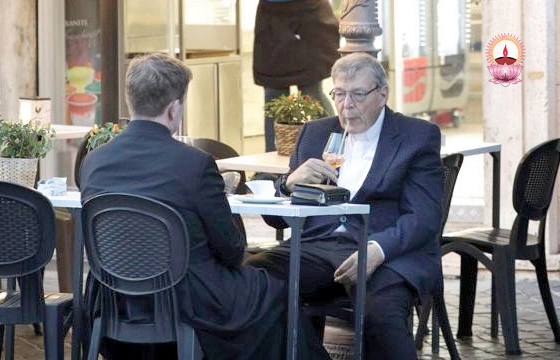
Cardinal Pell accuser denies bribe as Vatican intrigue grows
An Australian man who accused Cardinal George Pell of sexually abusing him denied he was bribed for his testimony, shooting down the latest con-spiracy theory to roil the Vatican amid a corruption investigation into its shady finances.
Italian newspaper Corriere della Sera has speculated in recent days that Vatican investigators were looking into whether Pell’s nemesis at the Vatican, ousted Cardinal Angelo Becciu, wired 700,000 euros ($823,000) in Vatican money to a bank account in Australia, and whether that money was tied to Pell’s sex abuse trial.
Pell, brought in by Pope Francis to bring accountability and transparency to the Vatican’s opaque finances, was convicted but ultimately absolved by Australia’s High Court of allegations he molested two choirboys in St Patrick’s Cathedral in Melbourne while he was archbishop in the 1990s.
Corriere speculated that Becciu might have “bought” the testimony of Pell’s accuser to get Pell out of the Vatican. Becciu and Pell were known to have clashed over the Australian’s financial clean-up efforts at the Holy See.
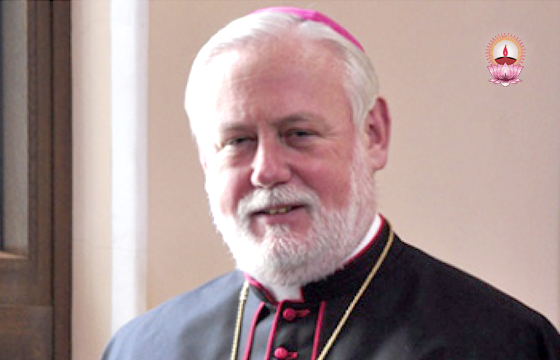
Vatican’s top diplomat defends China deal: ‘Something had to be done’
Despite criticism of a 2018 deal with China over the appointment of bishops, including from US Secretary of State Mike Pompeo, a senior Vatican diplomat said Rome is optimistic the accord will be renewed by the end of the month and won’t walk away from it because “something had to be done.”
Had Rome not granted Beijing a significant role in choosing bishops, said British Archbishop Paul Gallagher, “We would have found ourselves – not immediately, but ten years down the line – with very few bishops, if any, still in communion with the Pope.”
“If we don’t begin now, that’s the future,” he said.
Gallagher confirmed the Vatican has proposed a two-year extension of the deal, the terms of which have not been made public since it’s a provisional agreement rather than a formal treaty. He told Crux the Vatican does not yet have a response from Beijing, and that if no answer is received by the end of the month, then the deal expires.
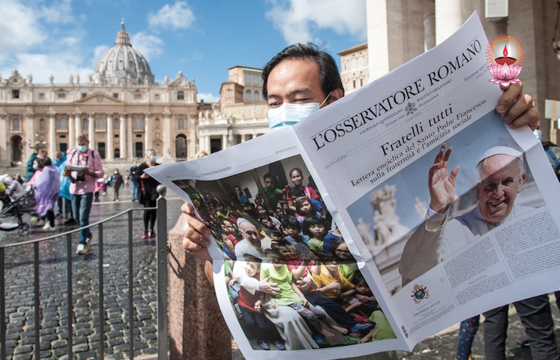
Pope Francis comments on financial scandals
Pope Francis has made his first public comments about Vatican financial scandals following the sudden dismissal of a powerful Rome-based cardinal over claims of embezzlement.
On Sunday 4 October, as he prepared to release a new encyclical to the world, Francis told a crowd in St Peter’s Square: “It is awful to see when people who have authority in the Church seek their own interests.”
Ten days earlier, Cardinal Angelo Becciu, a former papal chief of staff, had his cardinal rights removed and was sacked from his position as prefect of the Roman Curia’s department for saints.
Speaking during the Sunday Angelus, the Pope made an implicit reference to the mismanagement of money when he reflected on the Gospel parable of the tenants. The tenants are placed in charge of a vineyard by a landowner but kill the landowner’s servants and son when they come to collect the fruit. Francis says Jesus told this parable to “admonish the chief priests and elders of the people who are about to take the wrong path,” but added also that it “applies to all times, including our own.”
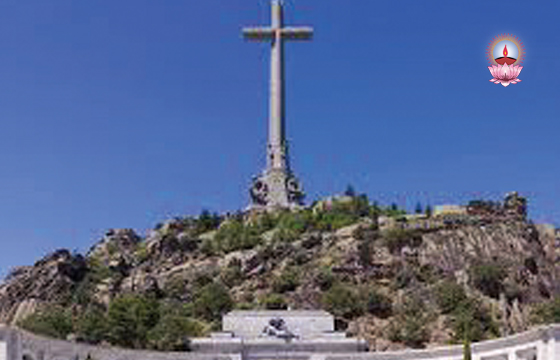
Spanish bishops decry government plan to redesign national memorial
The bishops’ conference of Spain warned of conflict over government plans to remove Catholic symbols from a civil war memorial site near Madrid from which the remains of former dictator Gen. Francisco Franco were exhumed a year ago.
The bishops’ conference of Spain warned of conflict over government plans to remove Catholic symbols from a civil war memorial site near Madrid from which the remains of former dictator Gen. Francisco Franco were exhumed a year ago.
“If there is a cross and basilica, it’s important there should also be a community to maintain worship there. We must immunize ourselves against a culture of confrontation,” said Auxiliary Bishop Luis Arguello Garcia of Valladolid, Spain, secretary general of the bishops’ conference.
“People in the church have different ideological perspectives, and problems occur when attempts are made to put faith at the service of one ideology,” he said of a draft law by the government of Prime Minister Pedro Sanchez that would convert the Valley of the Fallen into a civil cemetery.
The change would lead to the closing of a Benedictine monastery and removing other Catholic features at the site.

Australian academic Rowland wins prestigious Ratzinger Prize for theology
Tracey Rowland, professor of theology at the University of Notre Dame Australia, has won the Ratzinger Prize for theology, often described as the field’s equivalent to the Nobel Peace Prize.
The award is a stunning win for the Melbourne, Australia-based academic, who is the first Australian and only the third woman to receive the prestigious award.
The Ratzinger Prize is awarded to two individuals each year regardless of their religious denomination.
Pope Francis announced on Oct. 1 that Rowland would share this year’s award with Jean-Luc Marion, a French philosopher and Catholic theologian.
The prize is awarded in three areas: the study of sacred Scripture, patristics and theology.
It is presented by the Joseph Ratzinger-Benedict XVI Foundation, which was established in 2010 to support theological re-search and to promote studies on the theology and teaching of the retired Pope.
Rowland told The Catholic Weekly, newspaper of the Arch-diocese of Sydney, she was “surprised but not totally shocked” to find she had been chosen for the award given that she has published much about the theology of Joseph Ratzinger, including two books that have been translated into other languages.