
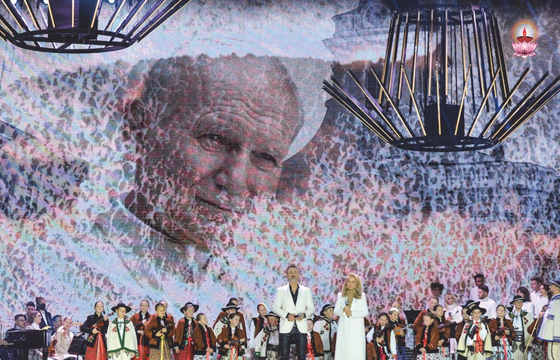
Nearly 1500 academics in Poland have written an appeal against “slandering and rejecting St John Paul II” after the publication of the McCarrick report by the Vatican on November 10.
The report documented the rise of dis-graced former Cardinal Theodore McCarrick, who was laicized by Pope Francis in 2019 after he was credibly accused of abusing minors, after rumours had for decades swirled around both the United States and the Vatican about his sexual misconduct with seminarians.
St John Paul played a significant role in McCarrick’s rise, appointing him a Bishop of Metuchen, Archbishop of Newark, and Archbishop of Washington before creating him a cardinal in 2001.
“We appeal to all people of goodwill for reflection. St John Paul II, as every other person, deserves to be discussed with honesty,” said the letter by the group of academics. “By slandering and rejecting St John Paul II we not only do harm to himself, but also to ourselves.”
Among the signatories were Krzysztof Zanussi, and award-winning director and teacher to a generation of filmmakers; Adam Daniel Rotfeld, former Minister of Foreign Affairs; and Hanna Suchocka, who served as Polish ambassador to the Holy See from 2001-2013.
“Unsupported attacks on the memory of St John Paul II are motivated by a preconceived thesis, which we view with sadness and deep disturbance,” the appeal reads.

Council of Cardinals studies Vatican constitution amendments
Pope Francis’ Council of Cardinals met online on December 1 to continue work on the new apostolic constitution to govern the Roman Curia, according to a Vatican statement.
The seven cardinals and an archbishop secretary are studying “observations, amendments, and proposals received from the dicasteries consulted in recent months” regarding the draft of the new constitution, known as Praedicate evangelium, a brief press release said.
Pope Francis also participated in the Dec. 1 meeting, connecting virtually from the Vatican guest-house where he lives.
The group of cardinal advisers, referred to as the C9 for its original nine members, was established by Pope Francis in 2013, with the aim of revising the text of the 1988 apostolic constitution Pastor bonus. At one of the council’s first meetings, it was decided that projected revisions to Pastor bonus would be substantial enough to warrant an entirely new constitution.

Muslim Migrant Beheads Madonna Statue
The 31-year-old Palestinian, who dismembered the statue of the Virgin late on December 1 in the Piazzale Giovannacci, is being held in the Gradisca D’Isonzo repatriation centre in Gorizia, northeastern Italy, waiting for deportation procedures to be completed.
The Islamic iconoclast intentionally stoned the head and hands of the statue to sever them from the body of the historic sculpture following the Koranic injunction to cast “terror into the hearts of the unbelievers; so strike the necks and strike every finger of them!” (8:12)
Police launched a search and arrested the migrant in the early hours of the morning after residents who spotted the vandalism called for help and gave the police a description of the vandal.
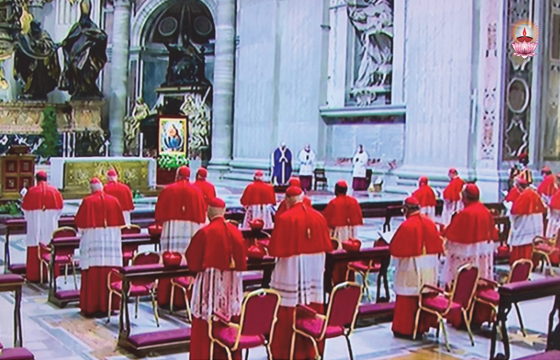
Pope tells new cardinals to expect God who is close against the slumber of mediocrity and indifference
Pope Francis led Mass November 29 Sunday. In his homily he noted that it “is the season for remembering” God’s closeness, a time to “be watchful” so that we can escape the “slumber of mediocrity” and the “slumber of indifference.”
The Holy Father concelebrat-ed the service with the new cardinals he created Consistory, marking the start of Advent. Last evening, the Pope and the cardi-nals visited Benedict XVI.
In the area of St Peter’s Basilica overlooking the Altar of the Chair, in addition to the cardinals, new and old, there were about a hundred faithful, linked in some way to the new cardinals. All those present wore medical masks and kept the distance required by regulations related to the pandemic.
In his homily the Pope also stressed the importance of Advent, the start of the liturgical year, in which “we need to recognize God’s closeness and to say to him: ‘Come close to us once more!’ […] Let us make our own the traditional Advent prayer: ‘Come, Lord Jesus’ (Rev 22:20).
“Why should we waste time complaining about the night, when the light of day awaits us?” Why should we look for ‘patrons’ to help advance our career? All these things pass away. Be watchful, the Lord tells us.” –AsianNews
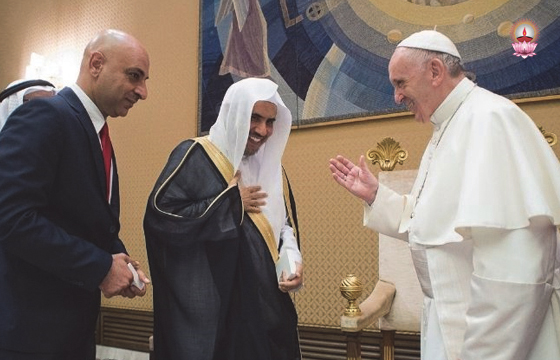
Pope’s United Nations envoy hypes dialogue with Muslim World League
The Vatican is stepping up its alliance with a pan-Islamic organization alleged to have provided “material support” to al-Qaeda’s 9/11 terrorist operation as well as to have funded terrorism and the global propagation of hardline Wahhabi Islam.
As part of recent efforts at re-branding its image through “religious diplomacy,” the Saudi-sponsored Muslim World League (MWL) hosted the Vatican’s envoy to the United Nations (U.N.) for a book presentation on interreligious dialogue.
Archbishop Ivan Jurkoviè, the Holy See’s permanent observer to the U.N. in Geneva, delivered a keynote address in Jeddah on the book The Promotion of Intercultural and Interreligious Dialogue as an Instrument for Peace and Fraternity, stressing the Vatican’s developing relationship that began under Pope Francis in 2017.
Making no mention of Christ or the gospel, Jurkoviè instead extolled the “polychromatic light of religions” that illuminates this world and “does not contrast the individual colours by putting them in antithesis to one another; rather, it combines them in a non-conflictual vision.”
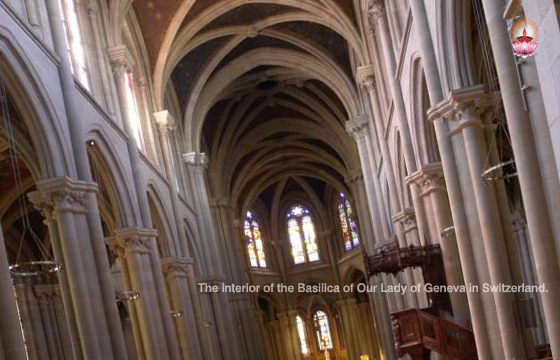
Switzerland’s Catholic bishops lament record exodus from Church in 2019
Bishops in Switzerland lamented a record exodus of Catholics from the Church in 2019. The new figures, released on Nov. 19, revealed that the Catholic Church lost 31,772 members in 2019 – equivalent to 1.1% of the total membership of the Catholic Church in Switzerland. This marked a 25% increase on the previous year, when 25,366 people left.

Global activists want India designated “country of particular concern”
New York: Leading American and global human and civil rights activists have come together to reinforce the demand to designate India as a “country of particular concern” to prevent and combat ongoing persecution of its religious minorities.
The November 16 discussion was organized by the Indian American Muslim Council in collaboration with Hindus for Human Rights, Students Against Hindutva Ideology, Dalit Solidarity Forum, India Civil Watch International and International Christian Concern.
Anurima Bhargava, the vice-chair of United States Commission on International Religious Freedom (USCIRF), said that as an ally and as a friend of India, the United States “needs to take steps to make sure that India upholds the rights guaranteed to all of its citizens as enshrined in its own constitution.”
“We saw this process play out in Assam. Many Indian citizens had their citizenship questioned and challenged by local authorities who excluded them from the national register of citizens despite their families having lived in India for generations.”
“And for that reason,” she added, “We made the recommendation to the State Department of the United States that India should be designated as a ‘country of particular concern,’” based on the deterioration and concerns about new state policies of the Narendra Modi government on religious minorities.
Joanne Lin, National Director, Advocacy and Government Affairs, Amnesty International USA, spoke about Amnesty India being forced to shut down its operation in India in October 2020 after two years of relentless threats, intimidation, and harassment by the Indian government.
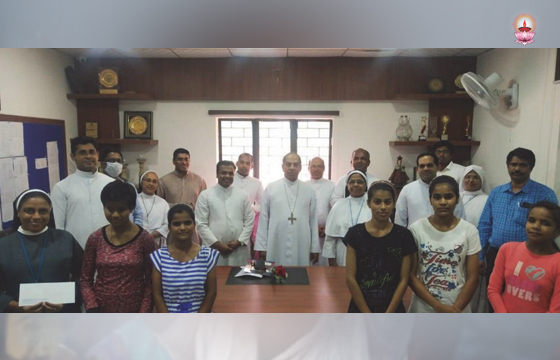
Four congregations work together to help girls with disabilities
Sr Teslin Poovathanickal is proud of the wounds on her face. “Oh, they are my Ruby’s gift,” the 43-year-old member of the Preshitharam Sisters says as she runs her fingers over the marks.
Ruby, a 26-year-old woman with speech and hearing impairment who gets violent occa-sionally, scratched Poovathanickal’s face in a fit of anger a few months ago. But the sister saw the incident as part of her mission.
“She beats and spits on us. But after some time, she would come and say, ‘Sister, sorry,’ and we forget our pain,” says the nun, who works in Sanjoe Bhawan (House of St. Joseph), a rehabilitation centre for women age 18 and older with various handicaps.
Sanjoe Bhawan is part of Sanjoepuram (City of St Joseph) Children’s Village in Chandpur, one of the few institutions in India that offer inclusive educa-tion. Poovathanickal serves there with 17 other nuns from four congregations, all members of the Syro-Malabar Church.
The village currently shelters 64 girls and women, ages 10-36, with disabilities, such as speech, vision and hearing impairment, cerebral palsy and developmental disorders. Some residents are orphans or children of prisoners.
The complex includes the Infant Jesus Senior Secondary School, where students from neighboring villages study with the Sanjoepuram children up to the 12th grade.
The school has 522 boys, all day students, and 368 girls, including 39 from Sanjoepuram.

Latin-Rite dioceses to mark “Communio India” Sunday
The Latin-Rite dioceses of India will mark “Communio India” Sunday on November 29 (first Sunday of Advent) with the theme “Love one another as I have loved you” (John 13: 34). “This year we observe Communio India Sunday amidst the suffering and the challenges created by the Covid-19 pan-demic. Nevertheless, the missionary journey of the whole Church continues, despite all the challenges facing us, be-cause the Risen Lord accompa-nies us on our way,” said Archbishop Filipe Neri Ferrão, President of Conference of Catholic Bishops’ of India (CCBI). “Communio India” is an initiative of the CCBI to assist all Dioceses and Religious Congregations working in rural and mission areas, in their pastoral ministry, said Fr Ste-phen Alathara, deputy secretary general.
The resources generated by Catholics will be used for poor communities in many parts of the country. “The aims of “Communio India” are to assist dioceses and religious congregations working in the missions; to build a culture of sharing among our people to express solidarity with the needy,” said Archbishop Ferrão.
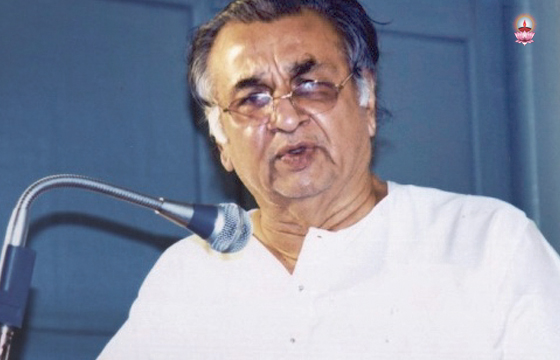
Jain businessman who promoted Bible passes away
A Jain businessman, who funded the publication of Bible reflections running to ten volumes eight years ago, died in Indore, Madhya Pradesh State.
Ajit Kumar Kasliwal passed away on November 19 after a prolonged period of illness. He was 84.
Father Alengaden says the Jain businessman was a sign of hope when India experiences tension and conflicts among followers of various religions. Kasaliwal not only learned about other faiths but motivated others to do the same, the priest adds.
“The root cause of these conflicts is prejudice and lack of understanding each other. An intense desire to learn about other faiths, especially the original source- the scriptures and the teachings contained in them- is essential to get liberated from prejudices and misunderstanding about the other faiths,” asserts Father Alengaden.