

A postgraduate girl student at Christ University Bangalore staying home during Covid 19 lockdown in Kochi found employment for herself and 21 other youth thanks to her language skills.
From being a mere translator, she was promoted to the post of Kerala Technical Head and Coordinator and had a team of 21 technicians assisted by her former batch mate.
After resigning from her job as Head of Operations for entire Kerala State, Reshmi Rose Tom of Kakkanad spoke to mattersindia.com before leaving for airport to catch a flight back to Bangalore.
Stating reason for resignation she says, “As my MA degree classes are resuming and I need to continue with my research work, I would not get time to wholeheartedly continue this work and hence I have asked the company to relieve me.”
It all started with lockdown induced rage for fitness machines in Kerala.
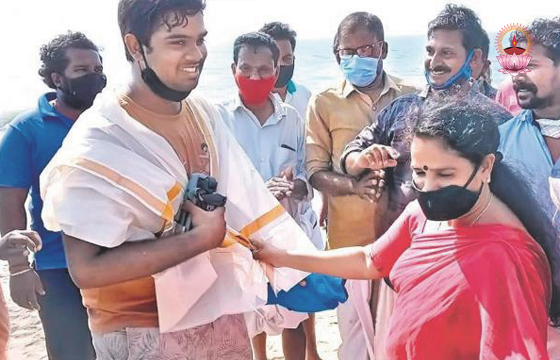
Christ University student helps rescue 4 from sea
An 18-year-old student of Bengaluru’s Christ University used his drone to save four fishermen who floated in the sea for hours after their boat capsized. Devang Subil, a student Bachelor of Technology, had come to his home in Kerala after the corona-virus forced closure of his college.
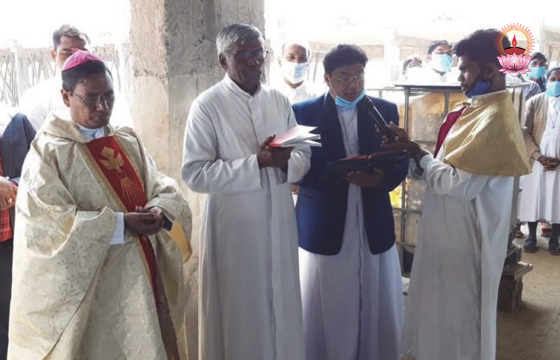
Odisha Church’s largest holistic laity centre opened
The diocese of Berhampur in Odisha has opened the largest holistic laity centre in the eastern Indian state.
Bishop Sarat Chandra Nayak of Berhampur inaugurated the “Anugraha Peetho”(centre of grace) on December 27 at Mohana in the Gajapati district. In his address at the inaugural function, Bishop Nayak thanked the Almighty for fulfilling a “long-awaited dream” of the Odisha Church.
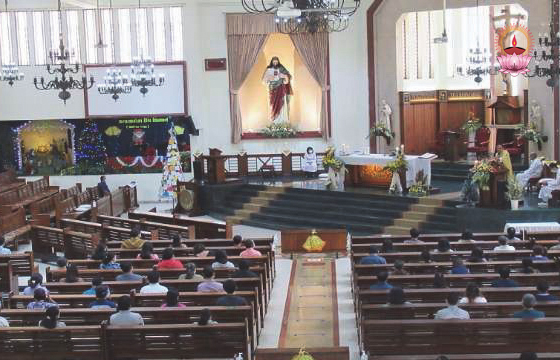
Pandemic puts squeeze on Jakarta’s parishes
The Covid-19 pandemic has greatly affected parish life, particularly in Jakarta Archdiocese, with the Indonesian capital recording the highest number of virus cases in the country. This, however, has forced the archdiocese’s parishes to be more creative. Indonesia has been hit hard by the Covid-19 pandemic which first hit the country in March last year. As of Jan. 4, the country had recorded 772,103 cases and 22,911 deaths. As of Jan. 3, Jakarta ranked first, with 189,243 cases and 3,316 deaths.
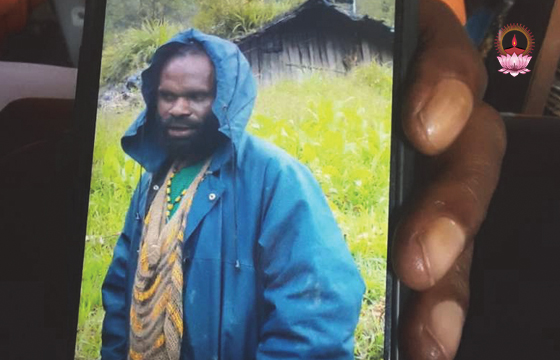
Worsening situation in Papua sparks church tensions
Intending to visit activists arrested for treason, Fr Pius Cornelius Manu, a priest in Papua’s Merauke Archdiocese, was shouted at by police, in-terrogated and had his bag searched. “I was shocked because I had often visited, arrested activists. Previously, I was not treated that way because many policemen knew me,” said the priest, talking about an incident last November when he went to visit 55 Papuans at Merauke district police station.

Bishops welcome India’s top court suspending controversial farm laws
The Supreme Court of India has ordered Prime Minister Narendra Modi’s government to suspend three controversial farm laws that stirred up nationwide protests by farmers.
The top court on Jan. 12 ordered the formation of a committee of experts to hold talks with the federal government and farmers to end the stalemate as the main protest on New Delhi’s outskirts entered its 48th day.
“The Supreme Court order gives some hope to the farmers who are protesting in very adverse conditions,” said Bishop Alex Vadakumthala, chairman of the Indian bishops’ office of labour.
“The government should find an amicable solution and end the protest as it is not good for any country to let their farmers struggle in the open for their genuine demands,” the prelate told.
Thousands of farmers from Punjab and Haryana states marched to New Delhi on Nov. 29 demanding the government repeal laws that they say work against their interests. When authorities blocked their entry to the capital, they sat on the highways to block major entry and exit points to New Delhi.
They want the Modi government to withdraw three laws passed last September — the Farmers’ Produce Trade and Commerce (Promotion and Facilitation) Act, 2020, the Farmers (Empowerment and Protection) Agreement of Price Assurance and Farm Services Act, 2020, and the Essential Commodities (Amendment) Act, 2020. The government, led by the pro-Hindu Bharatiya Janata Party (BJP), disregarded opposition to pass the bills, saying they are necessary to reform the farm sector and help farmers have the freedom to sell their products in an open competitive market and gain maximum profit.
Farmers’ unions say the laws take away the minimum support price (MSP) or the government guarantee for their products besides giving private businesses unrestricted opportunities to purchase and store produce.
Critics say the laws were designed to help multinational companies and would lead to the collapse of government-controlled markets and leave farmers at the mercy of big business houses. Government lawyers told the court that the new laws were drafted and implemented based on two decades of studies and disagreed with the farmers’ demand for their repeal.
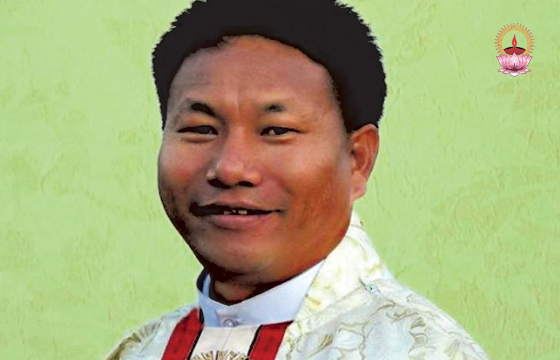
Jesuits get first priest from Rongmei tribe
When Archbishop Dominic Lumon of Imphal ordains Father Gangmei Pheigathuaipou Daniel on December 30, the Jesuits will get their first priest from Rongmei, a major Naga tribe in the northeastern India. Archbishop Lumon will ordain Father Daniel in St Ignatius Church Bishnupur, a Jesuit parish in Manipur State. Father Daniel is the first priest from the Bishnupur parish that was established by the Jesuits 35 years ago.
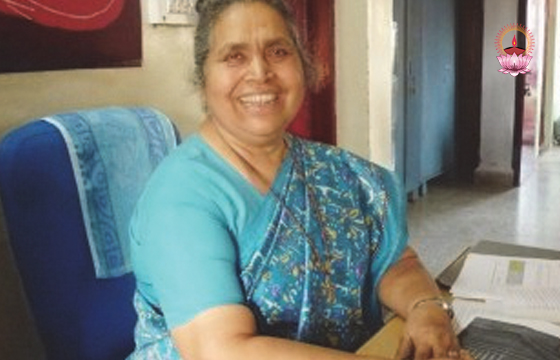
Indian nun listed 12 among world’s 100 most inspiring people
An Austrian magazine has listed a Catholic nun from India among 100 people, who influenced the world the most during the crises-ridden 2020.
The “OOOM” has placed Sister Lucy Kurien, founder director of the Pune-based Maher, 12th in the list, just above the Dalai Lama and Pope Francis.
The magazine says 2020 was a year no one ever expected. “The world today is different than it was 12 months ago. Which people have inspired, motivated and excited us most in this 2020 crisis? To whom do we owe leadership on the way to a better future? For the fifth time, OOOM presents the large ranking “OOOM 100: The World’s Most Inspiring People.”
“The OOOM editors and a prominent jury – including star designer Stefan Sagmeister, London’s Serpentine Galleries director Hans Ulrich Obrist, world-class geneticist Josef Penninger, gallery owner Thaddaeus Ropac and wallpaper manager Gilles Massé – contributed to the ranking. Every ranking is subjective. But it shows which people actually impressed us over the past year.”
The list is topped by Ugur Sahin, a German scientist and developer of the Covid-19 vaccine co-founder and CEO of BioNTech, who gave the world a new hope. His vaccine is a key component in the battle against a virus that has already claimed 1.7 million lives. The research he conducted with his wife Özlem Tureci has led to the most important medical development of our time. The second in the list is Kamala Harris, future Vice President of the United States, followed by Joe Biden, 46th President of the United States.
She said the Covid-19 lock-down was a challenging time for her organization. She said approximately 40 women, some with children, arrived at Maher seeking asylum as the lockdown began in India on March 25.
“We have to take care of four walls in this period — physical strength, emotional strength, mental strength and spiritual strength — to counter any exter-nal threat to our well-being,” the member of the Sisters of the Cross of Chavanod told.

Indian state criminalizes conversion for marriage
Madhya Pradesh State in central India has replaced its more than 50-year-old anti-conversion law with a new and more stringent one that can criminalize even conversion for marriage.
The law notified on Jan. 9 says any attempt to convert a person from one religion to another through misrepresentation, allurement, use of threat or force, undue influence, coercion or by marriage is a punishable offense.
Violators can be jailed for up to 10 years under the new law called the Madhya Pradesh Freedom of Religion Ordinance 2020. Those abetting or conspi-ring such conversions can also be punished.
The new law replaces the Madhya Pradesh Freedom of Religion act of 1968. However, it allows the reconversion of a person to one’s parental religion without violating the law’s provision.
Leaders of the state government-run by the pro-Hindu Bharatiya Janata Party (BJP) hold that Hinduism is the parental religion of religious minorities in the country such as Christians and Muslims.
In effect, the law allows Hindu groups to convert Christians and Muslims to Hinduism. But those Hindus who convert to Islam or Christianity for marriage can be punished along with their spouses, who can be accused of abetting and conspiring the con-version.
“This law is one-sided and against fundamental rights guaranteed in the Indian constitution,” said Father Maria Stephan, public relations officer of the Catholic Church in Madhya Pradesh.
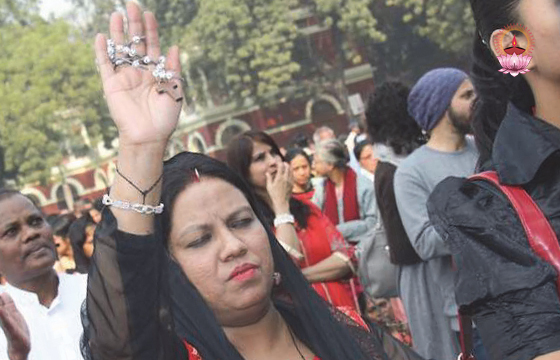
Police on alert after conversion claim in Indian state
Police in an Indian state have directed officers to keep a watch on prayer gatherings after five Christians were arrested on a charge of religious con-version. Vishwa Hindu Parishad (VHP), a hard-line Hindu group, handed the five Christians to police in Shahjahanpur district of Uttar Pradesh State, which is run by the pro-Hindu Bharatiya Janata Party (BJP).
“It is just an allegation from the fanatic groups and if they are sure about it, let them prove it. People are free to express their views in a democratic country,” Father Harold D’ Cunha, vicar general of Bareilly Diocese, told.
“As far as the Catholic Church is concerned, it does not promote or propagate religious conversion in the diocese as well as in the country.
“Occasionally, these groups blame us for conversions, but until now there is no record of any religious conversion where the Church is involved.”
He said the Church is engaged in many charitable works that can be construed as allurement to conversions, “but it is not true.”
S. Anand, superintendent of Shahjahanpur police, told the Press Trust of India that after the alleged religious conversion activities, officers have been asked to keep a watch on religious gatherings.
“We have directed concerned police officials to take strict action if anyone is found guilty of religious conversion activities,” he said.