
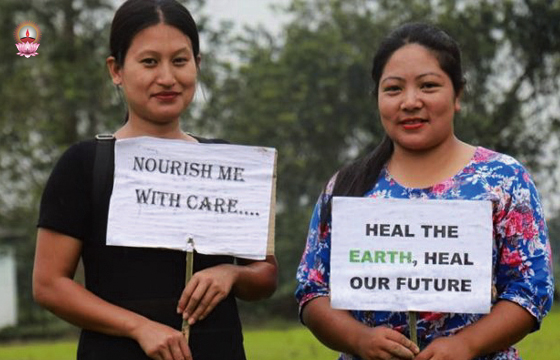
The diocese of Miao on June 6 launched a campaign to mark the World Environment Day. At small event held at Christ the Light Minor Semi-nary, Bp George Pallippara-mbil of Miao inaugurated the “Mitthi Sona Hai” (Earth is Gold) campaign to make people self-sufficient by encouraging them to cultivate and produce their food.
Celebrating the World En-vironment Day 2021 with the diocesan minor seminarians, the Salesian prelate said, “The Earth is gold and it has every-thing for everyone. We only need to till it and discover it.”
The campaign aims at making every parish in the diocese to produce its vegeta-bles and fruits.
Quoting the creation story of the Bible, the bishop said, “God asks us to subdue the earth and not subjugate it. It calls for free and equal co-existence with the nature. We are to be friends to the mother earth and not its master.”
Evil weeds poison good fruit in Pakistan
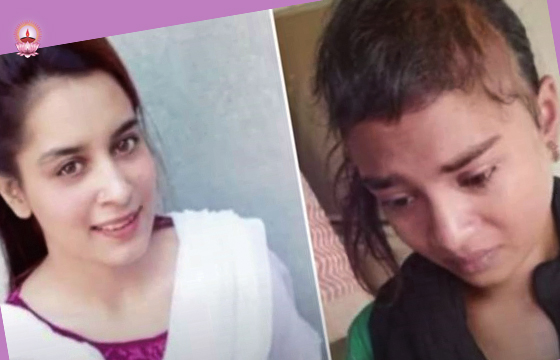
“While scrolling through my social media feed, my eyes fixed upon the troubled reflection of innocent angel Sunita Masih. She was staring back at me with helpless orbs. Her eyes betrayed the discomfort of humiliation and, without even uttering a single syllable, she proclaimed the tale of injustice through her misery-laced expression” reports Anee Muskan from Pakistan. Sunita, a 14-year-old Christian girl, was raped, molested, beaten and subjected to bullying in which her head was shaved by the culprits.
The crisis we are facing regarding forced conversion is highlighted by this story. The good fruits are the innocent girls born with the fate of being a minority in Pakistan. The poisonous weeds are the extremists living in our society.
A report by the Centre for Social Justice cited 162 allegations of forced conversion between 2013 and 2019. This figure merely covers reported cases; there are so many other cases that barely receive the limelight of sympathy and mercy.
Last year one case that actually received media attention was that of Maria Shahbaz, a 14-year-old Christian girl who was abducted and raped. To eradicate the stains of sexual abuse, the girl was forcefully converted and with the knot of marriage the whole dilemma of sexual abuse and abduction was erased.
Fears rising over China’s looming ‘re-education’ of Christians
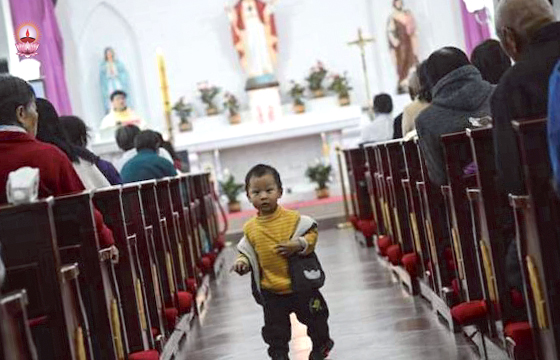
The recent arrest of a Vatican-approved bishop, priests and seminarians in north-central China came as a shocking development, if not sur-prising, as religious persecution in the communist country has continued to intensify under the watch of President Xi Jinping.
Bishop Joseph Zhang Weizhu of Xinxiang in Henan province was arrested by police on May 21, a day after police detained his seven priests and an unspecified number of seminarians. They are accused of violating new regulations on religious affairs.
The prelate and the priests drew the ire of authorities by using an abandoned factory as a seminary for religious formation of future priests.
They are charged with breaching a new set of rules for religious clergy implemented this month. It requires all clergy to register with the state in order to serve Catholics while asking Catholics to elect their bishops democratically.
The rules also make it illegal to perform religious activities including worship in places not registered or controlled by the state.
The arrests sparked condemnation from Christian and rights groups.
Indian women of Islamic State face uncertain future
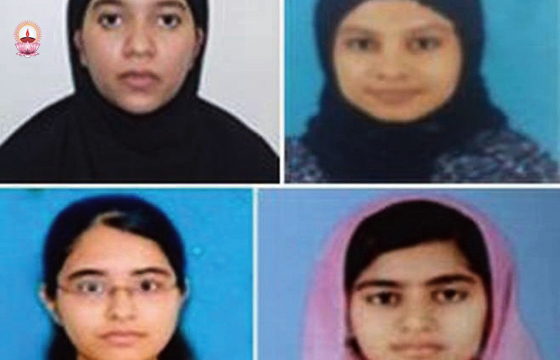
Four Indian women, who joined as Islamic State fighters and now lodged in an Afghanistan prison, seem to face a bleak future.
The women, all from Kerala, had accompanied their husbands to join the Islamic State in Khorasan Province (ISKP).
Church help for poor Covid patients in Jharkhand
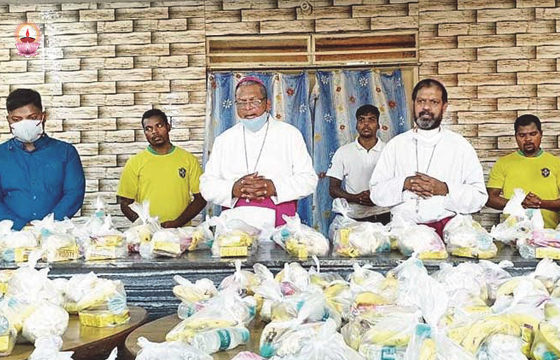
The Catholic Church has started distributing food packets to poor Covid patients admitted in hospital after giving pre-packed lunch packets outside the two largest state-owned healthcare facilities in Ranchi for their attendants and relatives.
“We had started distribution of lunch packets outside both the Rajendra Institute of Medical Sciences (RIMS) Ranchi and Sadar Hospital. We have distributed nearly 500 packets at the RIMS and 400 packets at Sadar Hospital since May 4.
“But it was getting difficult to control the crowd and abide by Covid protocols. This made us start distribution of over 300 food packets to Covid patients admitted in the RIMS. We will start distribution of food packets at Sadar Hospital too,” said auxiliary Bishop of Ranchi Archdiocese, Theodore Mascarenhas. According to sources in the Archdiocese, the poorest of the poor come for treatment at the RIMS and though meals are provided by the government to the patients, they don’t have the resources to avail of other items like fruits, biscuits, fruit juices, mineral water, beaten rice, etc.
Archbishop Felix Toppo and auxiliary Bishop Mascarenhas on June 2 blessed the first 300 packets to be distributed and also prayed for all the benefactors to acquire all the resources.
“The Archdiocese will soon launch a programme to distribute dry ration kits containing rice, dal (pulses), potatoes, cooking oil, salt, spices and onions in portions that would last two weeks for a family.
“We would identify the needy persons and distribute the ration packets at their doorstep adhering to Covid protocols. We are able to serve the poor only because many religious congregations and benefactors belonging to the Catholic Church as well as followers of other religions have been generously donating to the cause,” said auxiliary Bishop Mascarenhas.
With cemeteries full, Bengaluru’s Christians move to outskirts for burial
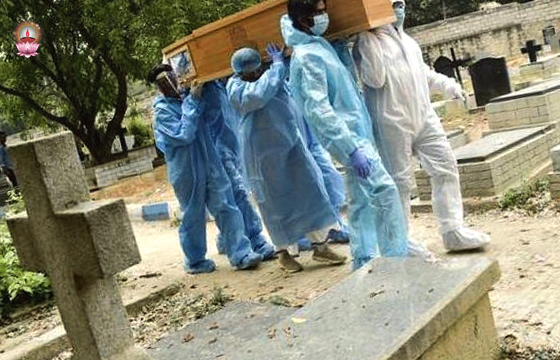
With close to 3,000 deaths reported in the Christian community since April 1, many of which are COVID-19-related, the five big cemeteries in Bengaluru have run out of space and have been closed for burials. Meanwhile the Karnataka government is yet to act on its promise of providing land for burial.
While the Catholic community alone has seen nearly 1,600 deaths since April 1, at least 1,200 deaths have been reported among other denominations, sources in the Archbishop’s office said. In the last few days, burials in new graves have stopped taking place in Kalpalli, Mysuru Road, Hosur Road and Ulsoor, since the cemeteries are full. Only families that have designated graves are conducting funerals in these cemeteries, church sources said.
Archbishop Peter Machado’s appeal to the State Government earlier in April for five acres on the City’s outskirts that all Christian denominations is yet to be addressed. It is learnt that even the Church of South India (CSI) has made a similar appeal to the Government.

Sonia’s photo with Christian conversion book morphed
A photograph of Congress President Sonia Gandhi has gone viral, which purportedly shows a bookshelf behind her with a book titled ‘How to convert India into a Christian Nation’. The image also shows a copy of the Holy Bible and a statue of Jesus Christ on the shelf.
A Twitter user ‘No Con-version’, first shared the image with the caption ‘Who reads all these books?’ It was retweeted by over 1,000 people and garnered more than 2,900 likes. The tweet has since been deleted.
In another tweet, the user with more than 200,000 followers, accused the Congress of “ramp-ant conversion appeasement, nd brainwashing of young gene-ration.” Several other Twitter users also shared the image with similar claims. It was widely shared on Facebook too.
One Twitter user asked if “Sonia Gandhi’s hand” was “behind the conversion in India.”
The viral photograph of Sonia Gandhi with the book on Christian conversion is fake and has been morphed.
Carmelites’ 5-bed clinic in Gujarat expands outside for COVID-19 patients
When some 30 people thronged a church-managed clinic run by three Carmelite sisters in the western Indian state of Gujarat early April 7, Sr. Lisset Vadakkekara saw it as an unusual sign to bear witness to her role as a Catholic nun and a follower of Christ in a predominantly Hindu area.
Vadakkekara, a member of the Congregation of the Mother of Carmel, is the supervisor of the Jyoti (light) clinic in Chachana, a remote village in Gujarat state’s Surendranagar district that falls under the Rajkot Syro-Malabar Eparchy.
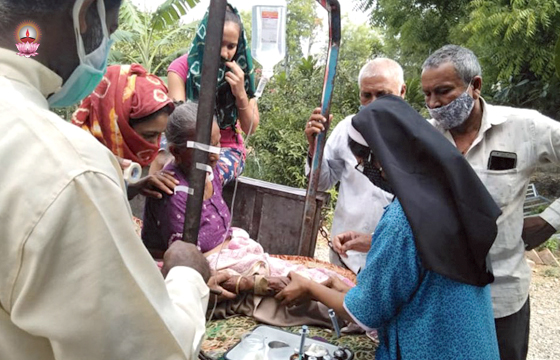
The 58-year-old nun said she had not seen so many people seeking medical help at the same time in her 28 years as a nurse in the five-bed clinic. She and two other sisters, also nurses there, scurried to fashion an open-air clinic with donated cots on Jyoti’s campus to handle the overflow.
In Indian villages, nuns run clinics, called dispensaries, often the only health care available to the local people. Facilities like Jyoti are small with an outpatient section and a few beds. Seriously ill patients are referred to a city hospital.
When Vadakkekara approached the crowd that day, she was surprised to see them looking so pale as they experienced the fever, cough and throat pain symptoms of COVID-19.
“They seemed frightened and utterly helpless. With folded hands, they asked me to check their health and provide medicines,” Vadakkekara told Global Sisters Report.
The three Carmelite nuns checked temperatures, blood pressures and pulse rates.
Study estimates 1.21 million Indians have died from Covid-19
It was three weeks ago when journalists combing obituary pages in Prime Minister Na-rendra Modi’s home state of Gujarat found authorities were concealing Covid-19 deaths that people started asking hard questions about the real number of Indian coronavirus fatalities. Now, epidemiologists and scientists around the world are struggling to solve the question.
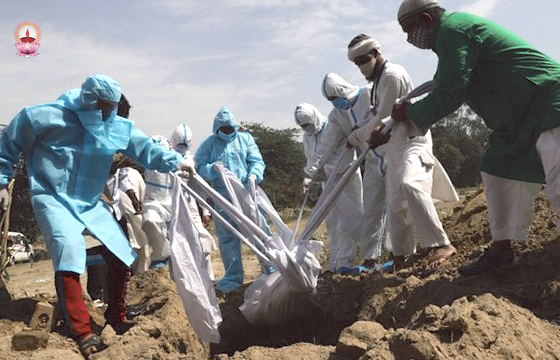
The latest to enter the fray is top epidemiologist Bhramar Mukherjee, who holds the biostatistics chair at the University of Michigan. She calculates that 1.2 million Indians had died and 495 million had been infected by the virus up to mid-May. These fatality and infection totals contained in her preprint study, meaning it still must be peer-reviewed, are vastly higher than the government’s numbers which showed a cumu-lative 25 million Covid cases and 270,000 deaths on May 15.
“I’ve tried to be very con-servative in terms of the assu-mptions we’ve made in the mathematical model.”
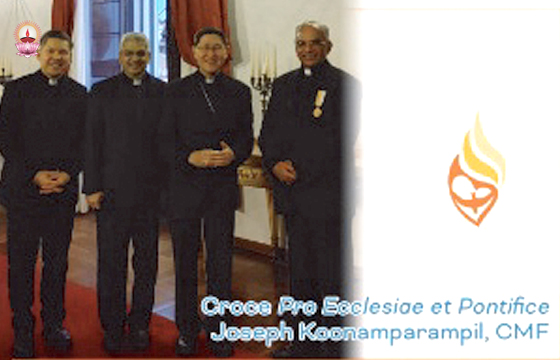
Indian Claretian receives Vatican honour
The Congregation for the Evangelization of Peoples has honoured an Indian Claretian priest for his two decades of service. Fr Joseph Koonamparampil received insignia of honour from Card. Luis Antonio Tagle, prefect of the congregation. The occasion also marked the Father Koonamparampil’s golden jubilee in the Claretian congregation.