
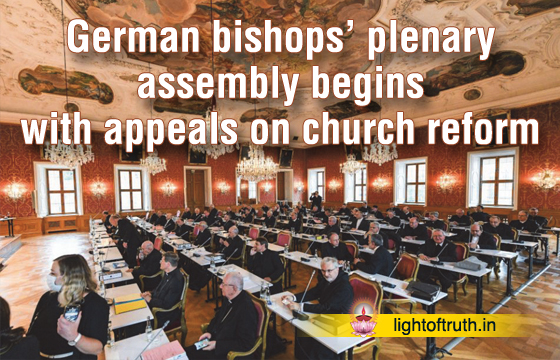
The German bishops’ plenary assembly began with urgent appeals for church reform and a reminder to heed admonitions from Pope Francis.
Bishop Georg Bätzing, conference president, called on all bishops to embrace radical change, reported the German Catholic news agency KNA. He said visible changes were need-ed soon in the Synodal Path German church reform project, which could be a “door opener” for the worldwide synodal process launched by the Pope.
Meanwhile, Archbishop Ni-kola Eterovic, the Pope’s ambassador to Germany, repeatedly urged the bishops to preserve the unity of the church and to follow the Pope’s directives.
At the start of the Sept. 20-23 assembly, Catholic reform groups and women’s associations held demonstrations demanding rapid and fundamental reforms, warning that this was the only way for the church to restore its credibility.
Bätzing called on his fellow bishops to agree radical changes are needed in the way they work and in their understanding of their ministry. In his sermon at the opening service, the Limburg bishop criticized the way some bishops have acted in preparation for the Sept. 30-Oct. 2 Synodal Assembly, part of the Synodal Path, an attempt to revitalize the church and restore trust follow-ing a September 2018 church-commissioned report that detailed thousands of cases of sexual abuse by Catholic clergy over six decades.
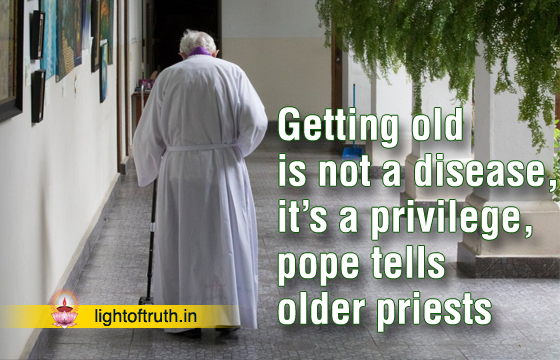
Getting old is not a disease, it’s a privilege, pope tells older priests
Getting to be a ripe old age is a privilege, Pope Francis told older priests. If facing an illness, that too, becomes a privilege in that one resembles Jesus, “who suffers, and one carries the cross, just like him,” he said in a written letter. “Pray for me as I am a little old and a little sick, but not a lot!” he added. The letter was read aloud to priests from the northern Italian region of Lombardy taking part in a “Day of Fraternity” Sept. 16 with their bishops in the town of Caravaggio.
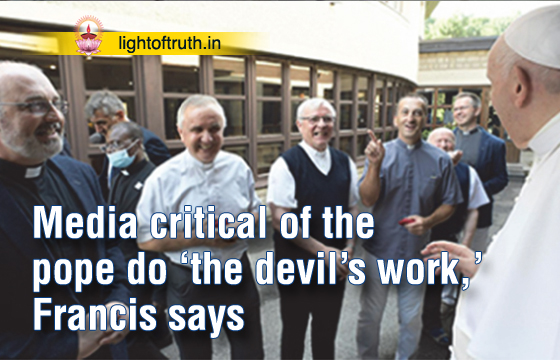
Media critical of the pope do ‘the devil’s work,’ Francis says
In his conversation with Slovakian Jesuits while visiting the country, Pope Francis took a swipe at his media critics, saying he sometimes loses patience with people who insult without know-ing the facts. He also criticized members of the Church who he said are too nostalgic for the past, such as priests who are more attached to the Old Latin Rite of the Mass than they are to their parish communities, which he said is a sign that the Church is going backwards.
Asked how he was doing at the opening of the Sept. 12 encounter, which took place as part of a broader apostolic visit to Hungary and Slovakia, Francis said he was, “Still alive, even though some people wanted me to die.”
His visit to Hungary and Slovakia was the first international trip he has made since he had colon surgery July 4, in which a large portion of his lower intestine was removed due to a stenotic diverticulitis, or a hardening of the tissue in his colon.

Armenian bishops elect former U.S. pastor as patriarch
The bishops of the Armenian Catholic Church elected Archbishop Raphaël François Minassian, the ordinary for Armenian Catholics in Eastern Europe, to be their church’s new patriarch.
Upon his election, the 74-year-old patriarch took the name Patriarch Raphaël Pierre XXI Minassian, the Vatican said in an announcement Sept. 23.
The patriarch-to-be and his 11 confreres began meeting in Rome Sept. 20 to begin their second attempt at electing a patriarch.
The bishops had met in Lebanon for two weeks beginning June 22, but no candidate had garnered the two-thirds vote necessary to succeed Patriarch Grégoire Pierre XX Ghabroyan, who died in Beirut May 25.
In accordance with church law, after the unsuccessful election, the bishops turned to Pope Francis. He asked them to gather in Rome and begin the electoral process again Sept. 22 after two days of prayer and reflection.
Patriarch Minassian was born in Beirut Nov. 24, 1946, and prepared for the priest-hood at the patriarchal semi-nary in Bzommar before studying philosophy and theology at Rome’s Pontifical Gregorian University and doing special studies in educational psychology at the Pontifical Salesian University.
Ordained to the priesthood in 1973, he served as pastor in Armenian parishes in Lebanon and as secretary for five years to Patriarch Jean Pierre XVIII Kasparian.
After serving as a judge in the Armenian church tribunal in Beirut and teaching Armenian at a Catholic university, he was transferred to the United States where he served as a pastor in New York before serving as pastor of Armenian Catholics in California, Arizona and Nevada.
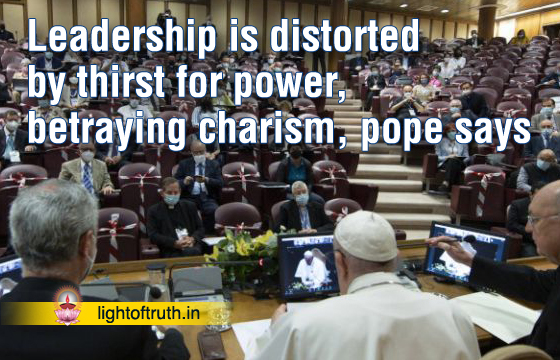
Leadership is distorted by thirst for power, betraying charism, pope says
Pope Francis praised Catholic lay movements and associations for living out the Gospel in their everyday lives and for promoting education, social support and evangelization in the world’s peripheries.
They show how “we don’t have to wait for a priest to come, for the priest to evangelize or a missionary,” he said, applauding the way many movements have reawakened the understanding that all the baptized have the duty to evangelize and be a missionary church.
However, just like the world’s religious orders and congregations, the Pope said, lay movements and associations of the faithful are just as susceptible to abuses and problems, all of which stem from an abuse of power.
All associations, not just some or just the large ones, must learn what good governance entails, he added.
The Pope spoke Sept. 16 in the Vatican’s synod hall to people taking part — online and onsite in Rome — in a meeting organized by the Dicastery for Laity, the Family and Life, focusing on the issue of responsible governance in lay movements and associations. Participants included “moderators” of associations of lay faithful, movements and new communities.
The Pope told them: “To govern is to serve. The exercise of governance within associations and movements is a topic that is particularly close to my heart, especially considering – what I said before – the cases of different kinds of abuse which have occurred in these situations, too, and that they always find their roots in the abuse of power.” “This is the cause — the abuse of power,” the pope said.
The issue of abuse of power and good governance is so close to his heart that the Pope’s already lengthy original talk of four pages became five pages as his off-the-cuff remarks expanded on particular points, offered explanations and provided colorful examples.
The study is showing that it has not just been happening with the larger groups, but also small institutes, he said, and that the scandals are not just the more well-known ones but include things groups “have done in order to feel like a separate church, they seem like saviors!” He said he knows of three religious institutes in his native country of Argentina that have already been suppressed after ending up in some “dirty” or dishonest situations.
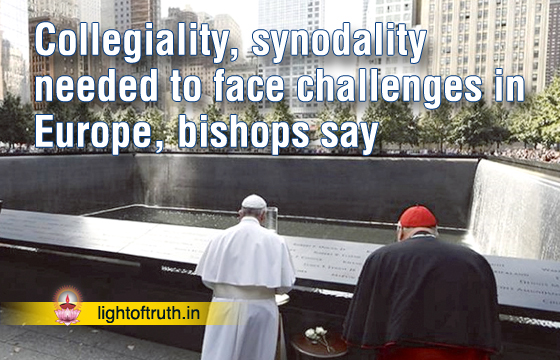
Collegiality, synodality needed to face challenges in Europe, bishops say
Heads of several bishops’ conferences and councils around the world called for greater collegiality and communion among bishops to confront the challenges facing the church in Europe and across the globe.
Cardinal Pietro Parolin, Vatican secretary of state, who addressed the plenary assembly of the Council of European Bishops’ Conferences Sept. 24, called on the bishops to “support one another in communion in order to bear witness to the Lord’s presence in all areas of life on our continent, which seems increasingly to be forgetting its history and its roots.”
The time of preparation for the 2023 world Synod of Bishops, which will reflect on synodality, communion, participation and mission, will be a “propitious occasion to reflect on the work of evangelization that awaits us in the face of the challenges of our present time, which is also in need of knowing the immutable truth of Christ and the Gospel,” Parolin said.
The Sept. 23-26 plenary of the Council of European Bishops’ Conferences, which is comprised of the presidents of 33 national bishops’ conferences and a dozen other Eastern- and Latin-rite bishops from across the continent, was held in Rome.

Moroccan Christians Welcome End of a Decade of Islamist Government
Turnout surged to 50% as liberals routed the Justice and Development Party (PJD), which led the North African nation’s parliament the past 10 years. Its share of the 395-seat legislature dropped from 125 to 13.
The PJD finished eighth overall.
“We thank Jesus, the Islamists are gone,” said Imounan, a church planter who lives in the southern city of Agadir. “God answered our prayers, and now we have the government we wanted.”
Aziz Akhannouch of the National Rally of Independents (RNI) was sworn in as prime minister by King Mohamed VI on September 11, after his party captured 102 seats. He is tasked with forming a coalition government to guide Morocco through its current economic downturn.
A constitutional monarchy, Morocco has held multiparty elections since its independence in 1956. But to stave off protests during the Arab Spring, in 2011 the king instituted reforms and transferred significant power to the prime minister.
Mohamed VI retains final say over several government positions, however, and is revered as “Commander of the Faithful” as a direct descendant of Islam’s founding prophet Mohammed.
Christians described “liberal” parties as those that favor freedom–except for challenges to-ward the person and position of the king, whose authority is respected by all political entities. Islamists, meanwhile, wished to impose sharia law, cover women, and remove pork and alcohol from neighbourhood super-markets.
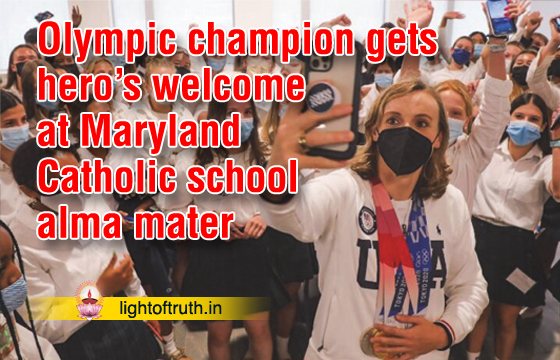
Olympic champion gets hero’s welcome at Maryland Catholic school alma mater
For three-time Olympian Katie Ledecky, her incredible journey to winning four more Olympic medals at the Summer Games in Tokyo began many years ago and winds through several roads.
Among them are two Catholic schools in the Archdiocese of Washington, a few area pools and the tight-knit community of her Bethesda hometown.
Stone Ridge School of the Sacred Heart, where she graduated from high school in 2015, gave Ledecky a hero’s welcome Sept. 17. She stopped by the all-girls Catholic school in Bethesda to share stories of her recent Olympic experience, of how she became a remarkable distance swimmer and to encourage the students in their future aspirations.
But most of all, she wanted to convey her deep gratitude for the lessons she was taught and the support she received from Stone Ridge going back almost a decade ago when she first hit the world’s stage in international swimming competitions.

New Swiss Guard barracks will allow room for families, maybe female guards
A complete rebuild and expansion of the living quarters for the Swiss Guard will not only improve life for guards and their families, it will also allow for the future possibility of recruiting women.
Currently, applications to serve in the 15-year-old corps are open only to Swiss male citizens who served in the Swiss Army and are Catholic, under 30 years of age and athletic, stand at least 5 feet 8 inches tall and boast an “unblemished reputation.”
But, at least since the new millennium, the overriding obstacle that stood in the way of opening the door to women had been housing, not gender. There is one barracks with most men living in cramped and shared spaces.
“Sixty percent of our corps is under the age of 25; women in the same barracks (as the men) would create big problems,” Col. Elmar Mäder, then-commander of the Swiss Guard, said in 2004, explaining why he would never allow women in the guard at the time.
The succeeding commander, Col. Daniel Anrig, told reporters in 2008 that he would love to allow female recruits, but such a move could be con-sidered only “when the circumstances change,” specifically, the housing situation.
Those circumstances are now set to change in the coming years after a massive rebuilding project breaks ground with a projected completion by 2026 – the 520 anniversary of the founding of the Swiss Guard. It is scheduled to be inaugurated May 6, 2027 – the 500 anniversary of the Sack of Rome, when 147 Swiss Guards lost their lives defending Pope Clement VII.
Jean-Pierre Roth, director of the “Foundation for the Renovation of the Barracks of the Papal Swiss Guard in the Vatican,” told Catholic News Service by email Sept. 13 that the new project plans for 123 single rooms distributed over four different floors. Today there are only 12 single rooms, he said.

Forced conversions a religious duty in Pakistan
Pir Abdul Haq, alias Mian Mithu, specializes in marrying off Hindu women to Muslim men in Pakistan and converting them to Islam simultaneously. His certificates preceded court verdicts before the partition of British India. “Even at that time, my father was jailed for four months when the local Hindus protested. The British gave us a logbook to keep a record of newly converted Muslim girls or any person and share its receipt,” he said at a Sept. 15 press briefing.
“I don’t return Hindu girls even if their community offers money. My faith is bigger than millions. I even refused Asif Ali Zardari [former president of Pakistan] on this issue. Do whatever you want, I told his minister. Allah will help me. I am performing his duty. I live and die for Islam.
“Girls, most of them housemaids, often come to us. Urgent marriages are organized so that they can live with a mehram [male guardian]. We keep the couple until the husband gets a job. I guarantee them protection at the seminary. Many courts forcefully return girls to Hindus. Those who protest these conversions have an agenda to defame Pakistan.”
Another speaker accused the Catholic bishops’ National Commission for Justice and Peace (NCJP) of getting foreign funding and raising an outcry. Their annual monitor is based on media reports of alleged victims of forced conversions, he said.
Mithu, 85, is the custodian of Dargah Bharchundi Sharif seminary, one of two major hubs in Sindh province for converting religious minorities to Islam. The former member of the National Assembly was a candidate of Zardari’s Pakistan People’s Party at the 2008 general election. In 2017, his photos with Prime Minister Imran Khan went viral on social media. He also leads mobs over blasphemy allegations.
“Women of this country, especially non-Muslim women, and especially underage girls, don’t stand a chance,” author Maria Rashid said in a recent tweet sharing photos of Mithu with Khan and Gen. Qamar Javed Bajwa.
The Council of Islamic Ideology invited him to discuss forced conversions during a session. The Ministry of Religious Affairs and Interfaith Harmony later rejected a bill that proposed regulations on conversions to Islam. On Sept. 24, Lahore High Court ruled that Muslim jurists regard the mental capacity of a child as of crucial importance for conversion to Islam. The age of discernment is generally reckoned as the age when one attains puberty, said Justice Tariq Nadeem while dismissing a petition filed by Gulzar Masih, a rickshaw driver from Faisalabad seeking recovery of his daughter Chashman Kanwal.