
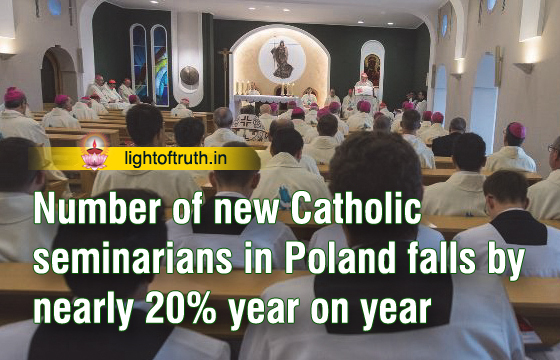
Nearly 20% fewer candidates for the Catholic priesthood have enrolled in Poland’s seminaries this year, compared to 2020.
Fr. Piotr Kot, chairman of the Conference of Rectors of Major Seminaries, told the Polish Catholic news agency KAI on October 12 that 356 seminarians began their studies in 2021.
Last year, he said, there were 441 candidates, meaning that “the number is lower by approxi-mately 20%.”
He explained that of the 356 candidates, 242 were training for the diocesan priesthood and 114 for religious orders.
There were 47 fewer semi-narians in diocesan seminaries and 38 fewer candidates for religious orders compared with the previous year, he said.
The Polish Catholic weekly GoϾ Niedzielny noted that priestly vocations had declined sharply in Poland in recent years.
In 2012, it said, 828 candidates enrolled in the first year of seminary. There were 498 in 2019 and 441 in 2020.
In March this year, Poland’s bishops made their final adjust-ments to a decree, called “The Way of Formation of Priests in Poland” (Ratio institutionis sa-cerdotalis pro Polonia), setting out new rules for priestly for-mation.
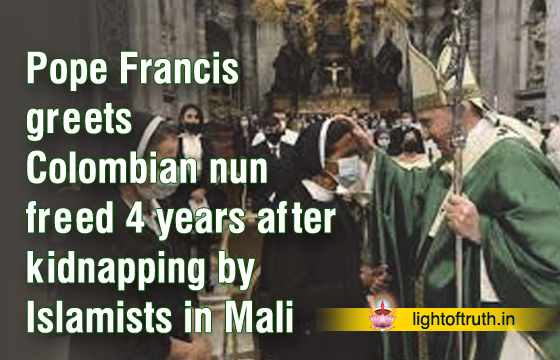
Pope Francis greets Colombian nun freed 4 years after kidnapping by Islamists in Mali
Pope Francis greeted a Colombian nun on October 10, shortly after she was freed four years after being kidnapped by Islamists in Mali.
The Pope blessed Sr. Gloria Cecilia Narváez Argoti before a Mass in Saint Peter’s Basilica launching a worldwide synodal process. Sr. Gloria, a member of the Congregation of the Franciscan Sisters of Mary Imma-culate, was kidnapped in southern Mali in 2017.
The Malian presidency announced that she was released on Oct. 9 after “four years and eight months of combined efforts of several intelligence services.”
It posted photographs on social media of her meeting with interim president Col. Assimi Goïta, accompanied by Cardinal Jean Zerbo of Bamako.
“We prayed a lot for her release. I thank the Malian authorities and other good people who made this release possible,” the cardinal told.
Armed men kidnapped Sr. Gloria in Karangasso, about 90 miles south of the town of San, near the border with Burkina Faso, on Feb. 7, 2017.
The men forced her to hand over the keys to the community’s ambulance. The vehicle was later found abandoned. Three other sisters were present at their house but escaped.
The kidnappers were going to take the youngest nun, but Sr. Gloria reportedly volunteered to take her place.

Science Closes In on Covid’s Origins
Where did Covid-19 come from? The answer can be found in the SARS-CoV-2 virus itself. To get to the truth, we need only unleash the power of science. Based on experience with SARS-1 in 2003 and MERS in 2012, we know that many people are infected by a host animal long before a co-ronavirus mutates to the point where it can jump from human to human. An extensive data set from late 2019—more than 9,000 hospital samples—is available of people exhibiting flulike (thus Covid-like) symptoms in China’s Hubei and Shaanxi provinces before the epidemic started. Based on SARS-1 and MERS, the natural zoonotic theory predicts 100 to 400 Covid infections would be found in those samples. The lab-leak hypothesis, of course, predicts zero. If the novel coronavirus were engineered by scientists pursuing gain-of-function research, there would be no instances of community infection until it escaped from the laboratory. The World Health Organization investigation analysed those stored samples and found zero pre-pandemic infections. This is powerful evidence favouring the lab-leak theory.
Within months of the SARS-1 and MERS outbreaks, scientists found animals that had hosted the viruses before they made the jump to humans. More than 80% of the animals in affected markets were infected with a coro-navirus. In an influential March 2020 paper in Nature Medicine, Kristian Ander-sen and co-authors implied that a host animal for SARS-CoV-2 would soon be found. If the virus had been cooked up in a lab, of course, there would be no host animal to find.
The WHO team searched for a host in early 2020, testing more than 80,000 animals from 209 species, including wild, domesticated and market animals. Not a single animal infected with SARS-CoV-2 was found. This finding strongly favours the lab-leak theory. We can only wonder if the results would have been different if the animals tested had included the humanized mice kept at the Wuhan Institute of Virology.
In their Nature Medicine paper, Mr. Andersen and colleagues pointed to what they considered the poor design of SARS-CoV-2 as evidence of zoonotic origin. But a team of American scientists mutated the stem of the coronavirus genome in nearly 4,000 different ways and tested each variation. In the process they actually stumbled on the Delta variant.
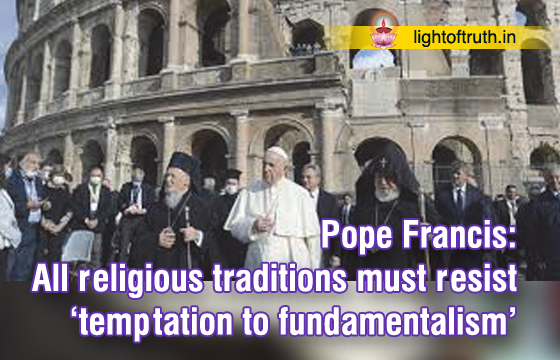
Pope Francis: All religious traditions must resist ‘temptation to fundamentalism’
Pope Francis asked leaders of world religions to resist “the temptation to fundamentalism” for the sake of peace at an interreligious gathering Thursday in front of the Colosseum. Peace “summons us to serve the truth and declare what is evil when it is evil, without fear or pretence, even and especially when it is committed by those who profess to follow the same creed as us,” the pope said Oct. 7. “For the sake of peace, please, in every religious tradition let us defuse the temptation to fundamentalism and every tendency to view a brother or sister as an enemy.” Speaking on a stage together with Muslim, Jewish, Buddhist, and Hindu representatives, Pope Francis appealed for peace amid the world’s current conflicts. “Dear brothers and sisters, as believers it is our responsibility to help eradicate hatred from human hearts and to condemn every form of violence. Let us unambiguously urge that arms be set aside and military spending reduced, in order to provide for humanitarian needs, and that instruments of death be turned into instruments of life,” the Pope commented.
“Fewer arms and more food, less hypo-crisy and more transparency, more vaccines distributed fairly and fewer weapons marketed indiscriminately,” he said.
The Islamic scholar, who signed the landmark Document on Human Fraternity with Pope Francis in 2019, criticized the uneven distribution of COVID-19 vaccines throughout the world.
He said that “the world has suffered a setback despite the efforts made by religious institutions, their representatives and leadership, to foster a collaborative approach and exchange of goods, giving precedence to the public interest over private interests.” The Pope was speaking at the live-streamed closing ceremony of “Peoples as Brothers, Future Earth. Religions and Cultures in Dialogue,” the 35th event promoted by the Sant’ Egidio Community in the “spirit of Assisi,” the interreligious gathering convened in St Francis’ birthplace by Pope John Paul II in 1986.
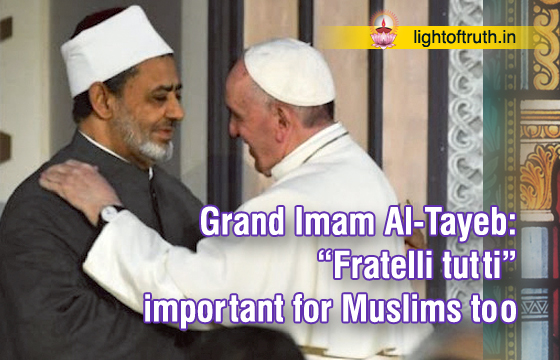
Grand Imam Al-Tayeb: “Fratelli tutti” important for Muslims too
The Grand Imam of Al-Azhar speaks to Vatican Media about his relationship with Pope Francis: “From the first minute of our meeting I had confirmation that he is a man of peace and humanity. The encyclical is an appeal to create a true fraternity where there is no room for dis-crimination on the basis of diffe-rences of religion, race, gender, or other forms of intolerance.”
“Each one of us has disco-vered a great spiritual and thoughtful attunement to the crises that afflict contemporary man…” The Grand Imam of Al-Azhar, Prof. Ahmad Muhammad Al-Tayeb, during his days in Rome to participate at some important events alongside Pope Francis and other religious lead-ers, visited the studios of Vatican Radio – Vatican News and spoke about his relationship with Pope Francis, one year after the publi-cation of the Encyclical Fratelli tutti.
The Grand Imam recounted that “after the election of dear brother Pope Francis, Al-Azhar took the initiative to congratulate him, and we received a beautiful response from Pope Francis.” He noted that it was a response that encouraged us to renew the relationship, and so, he decided to visit the Pope in the Vatican in May 2016.

Pope Francis to declare St. Irenaeus a Doctor of the Church with title ‘Doctor of Unity’
Pope Francis said on October 7 that he plans to declare St. Irenaeus of Lyon a Doctor of the Church with the title “Doctor unitatis,” meaning “Doctor of Unity.”
The Pope made the announ-cement in a speech to the St. Irenaeus Working Group, a group of Catholic and Orthodox theologians who conducted a study together on synodality and primacy. “Your patron, Saint Irenaeus of Lyon — whom soon I will willingly declare a Doctor of the Church with the title Doctor unitatis — came from the East, exercised his episcopal ministry in the West, and was a great spiritual and theological bridge between Eastern and Western Christians,” Pope Fran-cis said on Oct. 7.
St. Irenaeus was a second-century bishop and writer revered by both Catholics and Orthodox Christians and known for refu-ting the heresies of Gnosticism with a defence of both Christ’s humanity and divinity.
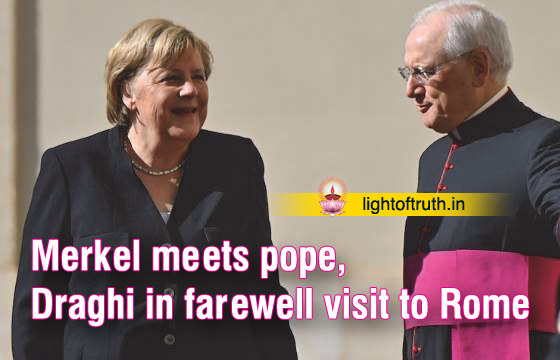
Merkel meets Pope, Draghi in farewell visit to Rome
German Chancellor Angela Merkel discussed climate change and clerical abuse with Pope Francis on October 7 in a fare-well trip to Rome that included talks with Italian Prime Minister Mario Draghi. Merkel, who is bowing out after 16 years in power, also visited St Peter’s Basilica and will lunch at a restaurant in central Rome before giving a speech at a peace conference at the Colosseum.
She was honoured with a ceremonial welcome by the Swiss Guards at the Vatican before meeting and exchanging gifts with the Pope, whom she has met several times before.
She said afterward they dis-cussed climate change – an issue on which Francis has been out-spoken – and the sexual abuse by children of clergy, a problem that has rocked the Catholic Church in Germany and else-where.
“We had important discuss-ions about child abuse,” Merkel, the daughter of a Lutheran clergyman, told reporters.
“I wanted to underline with my visit that we think that the truth must come to light, and the topic must be dealt with.”
Earlier, Merkel visited the site of a new institute within the Vatican’s Gregoriana university dedicated to child protection and met with Hans Zollner, the Vatican’s leading expert on measures to safeguard minors.
She was later due to meet with Draghi, with whom she has worked closely for years, notably when he was head of the European Central Bank — and where they did not always see eye-to-eye.
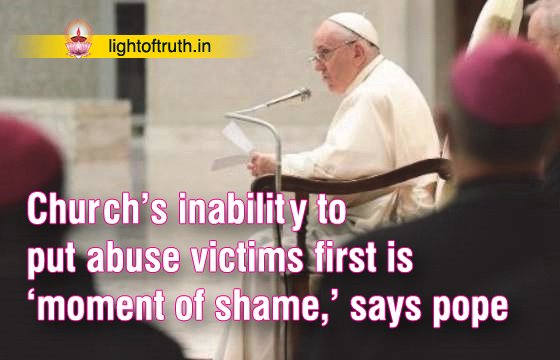
Church’s inability to put abuse victims first is ‘moment of shame,’ says pope
The Catholic Church’s inability to make victims of sexual abuse its top concern is a cause for intense shame, Pope Francis said.
In the wake of a major report investigating the extent of sexual aggression and abuse against minors in the church in France, the Pope said, “I wish to express to the victims my sadness, my grief, for the traumas they have endured, and also my shame.” This deep sense of shame, “our shame, my shame,” he said, was for “the too lengthy inability of the church to put (victims) at the center of its concerns.”
The pope made his remarks at his general audience in the Vatican’s Paul VI hall, in the presence of a group of bishops and a cardinal from France who had been in Rome for their “ad limina” visit. Just before the audience, the Pope and four of the bishops gathered privately for a moment of silent prayer for victims.
After delivering his main catechesis, the pope highlighted a recent report published by an independent body commissioned by the French bishops’ conference.
According to the four-year investigation, an estimated 216,000 children were abused by priests since 1950, and more than 100,000 others were abused by lay employees of church institutions.
This history of unchecked abuse extending over the course of generations challenges our comprehension of how innocent persons could have suffered so terribly
The Pope commented on the “considerable number” of known victims revealed in the report.
Assuring victims of his prayers, the pope asked everyone to pray with him: “To you, Lord, the glory; to us, the shame. This is the moment of shame.” He encouraged the country’s bishops and superiors general of religious orders “to continue to do their utmost so that similar tragedies are not repeated.”
Pope Francis also expressed his closeness to the priests in France, assuring them of his “paternal support before this ordeal, which is arduous but beneficial.”

Pope warns against ‘closed’ groups claiming righteousness
Pope Francis has warned against those doing the work of the devil by claiming “exclusive” rights over Jesus and the King-dom of God.
Referring to September 26 gospel reading from St Mark, Pope Francis cited Jesus’ warning that “instead of dividing people into good and bad, we are all called to watch over our hearts, so that we do not succumb to evil and give scandal to others”.
Jesus had criticised the disciples for wanting to prevent someone who was not in their group from taking certain actions in the name of Jesus.
The disciples wanted to prevent a good work because the one who did it did not belong to their group, the Pope said. “They think that they have exclusive rights over Jesus and that they are the only ones authorised to work for the Kingdom of God.”
But in this way, they consider others as strangers, to the point of becoming hostile towards them. Pope Francis warned that the temptation to keep those who do not think like us at a distance “is the root of many evils in history, of absolutism that has often generated dictatorships and of so much violence against those who are different.”
The devil, who is the “divider” – the word’s roots are in division – insinuates suspicion to divide and exclude people. “Sometimes we too, instead of being humble and open communities, can give the impression that we are ‘at the top of the class’ and keep others at a distance; instead of trying to walk with everyone, we can show our ‘believers’ licence.”

Public schools can display crucifix when decided democratically, court rules
Italy’s highest court of appeal has ruled that public school classrooms can approve the presence of the crucifix because it does not discriminate against anyone.
The court specified, however, that all religious symbols can also be “welcomed” as long as it is decided in a democratic, civil and “gentle” manner by students and faculty together.
That means, it said, all decisions regarding their presence must never be imposed and must seek “reasonable accommodation” between the different positions or convictions of people in the school community that includes respecting a per-son’s freedom of and from religion; in essence, decisions can-not come by a “tyranny” of the majority or the veto-power of one individual.
Italy’s Supreme Court of Cassation — the country’s court of last resort — released its 65-page brief explaining its decision Septem. 9 concerning an appeal against the display of the cruci-fix in the classrooms involving an Italian high school teacher whose claims were first rejected in a lower court in 2013 and in a court of appeals in 2014.
The full-time Italian literature teacher said his freedom of conscience was violated and he wanted the freedom to teach without the presence of a crucifix on the wall behind him.
According to court proceedings, the teacher would enter the classroom, take the crucifix down from the wall for the duration of his lesson and then rehang it when he was done teaching.