
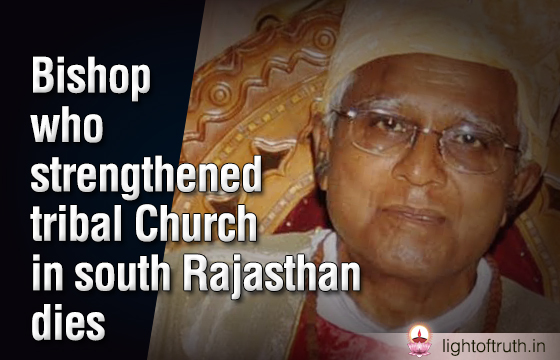
Emeritus Bishop Joseph Pathalil, the first prelate of Udaipur diocese in Rajasthan, died April 14 after a long illness. He was 85. The death occurred at 12 noon at Paras KJ Hospital in Udaipur.
A message from Bishop Devprasad Ganawa of Udaipur said his predecessor had developed some breathing difficulties in the morning and was rushed to the hospital. “Due to a cardiac arrest, he breathed his last,” Bishop Ganawa added.
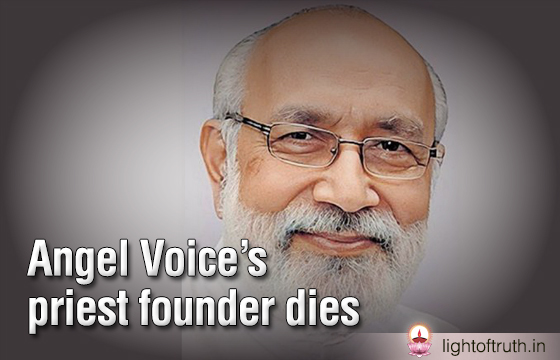
Angel Voice’s priest founder dies
Father Kuriakose Kachiramattom, the founder director of the nationally famous Christian music troupe – Angel Voice Gospel Music Group — died April 22. He was 79.
The death occurred in the after-noon at Lissie Hospital in Ernakulam, Kochi. Father Kachiramattom be-longed to Kothamangalam Syro-Malabar Eparchy.
Rani Maria film to hit silver screen soon
A Bollywood feature film on Blessed Rani Maria, a martyred social reformer, will be released in August, says director Shaison P Ouseph.
“This is the culmination of a 5-year dream and hard work, which is at the final stage of completion,” Ouseph told Matters India April 27.
Cardinal George Alencherry, head of the Syro-Malabar Church, released the film’s title – “The face of the faceless” – two days earlier.
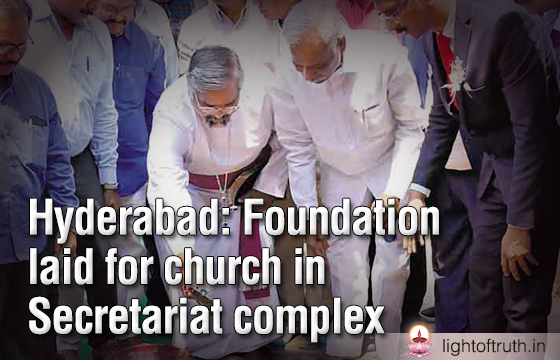
Hyderabad: Foundation laid for church in Secretariat complex
Medak Diocese Bishop Reverend AC Soloman said Chief Minister K Chandrashekhar Rao was safeguarding the secular fabric in Telangana by according equal importance to all communities.
The Medak Diocese Bishop along with MLC Rajeshwar Rao laid the foundation stone for a new church coming up at the new State Secretariat complex on April 28. Bishop Solomon participated in the ground-breaking ceremony of the new church and performed special prayers.
First women’s college on west coast turns coed
Come September, the first women’s college on India’s western coast will admit young men as students. The Apostolic Carmel congregation started St Agnes College in Mangaluru more than a century ago to exclusively educate women.
After its centenary celebrations in 2021, the college decided to start co-education, says principal Apostolic Carmel Sister M Venissa. “The college wished to extend its legacy of a century to male students at the undergraduate level. Finally, we are able to make it and admissions will commence from next academic year,” she told reporters. The principal also said they would admit about 30 percent male students in the first year. The number will be increased according to the demand.

Indian court settles row over interfaith marriage
A top court’s refusal to intervene in the marriage of a Christian woman to a Muslim man has brought the curtain down on a snowballing controversy in the southern Indian state of Kerala.
The father of Jyotsna Mary Joseph, who worked as a nurse in Saudi Arabia, had filed a habeas corpus petition in Kerala High Court seeking a probe into his daughter’s “dis-appearance” after she walked out on her family and married Shejin, a communist youth leader belonging to the Muslim community, without their con-sent. The family leveled charges of suspected “love jihad,” a conspiracy theory that accuses Muslim men of targeting women from other religions for conversion to Islam by means of marriage, deception and force.
But the high court division bench of Justice V.G. Arun and Justice C.S. Sudha on April 19 declined to interfere in the couple’s decision to marry and disposed of the father’s petition. The court arrived at a decision after Jyostna appeared before it and categorically stated that she had married Shejin of her own free will and not under any compulsion.
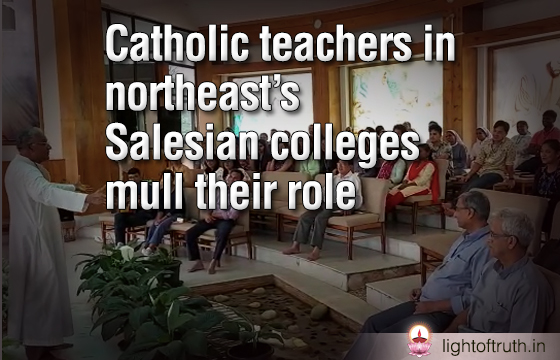
Catholic teachers in northeast’s Salesian colleges mull their role
More than 90 Catholic faculty members from 10 Don Bosco colleges in northeastern India spent four days reflecting on their role in higher education institutions. The ten participating Salesian colleges were Assam Don Bosco University Guwahati, Don Bosco Colleges of Maram, Bongaigaon, Gola-hat, Kohima, Siliguri, Sonada, Shillong, Tura and Government College Cherapunjee.
The program was held at Siloam Centre on Barapani Lake near Shillong, capital of Meghalaya state. Director of Siloam center Salesian Father George Palamattam complimented two principals and two vice-principals accompanying faculty members to the the program
Among the facilitators of the program were eminent resource persons from all over India including Archbishop emeritus Thomas Menamparampil of Guwahati, Archbishop Victor Lyngdoh of Shillong as well as youth leaders from Shillong.
The largest contingent of 27 participants came from Don Bosco (Autonomous) College, Maram, in Manipur.
The participants had immersion experience of major Holy Week liturgy.

Hindu nationalists want Christian chaplains banned from Indian jails
Hindu nationalists in India want Christian chaplains banned from visiting prisons, claiming they are trying to convert the prisoners.
The Vishwa Hindu Parishad (VHP) and Bajrang Dal groups complained to police in the southern Indian state Karnataka about the distribution of Bibles to the prisoners in the Gadag district jail and demanded the immediate suspension of all Christian prison chaplains in the state.
The April 6 declaration came after a Hindu chaplain had met a prisoner and seen a Bible in the jail. According to the complaint, a seven-person team of Christian evangelists visited Gadag District Prison on March 12 to pray with prisoners and distribute copies of the New Testament.The Hindu activists alleged Christian chaplains were trying to carry out religious conversions and said they should not have been permitted to distribute religious texts, despite the fact that Hindu religious literature is often distributed in jails. Archbishop Peter Machado of Bangalore said the complaint looks like a double standard.
“If Hindu preachers are allowed to meet Hindu prisoners, what is wrong with Christian preachers meeting Christian prisoners. If there’s evidence of forceful or fraudulent conversions of others, let them take action according to the law, with proofs of conversion at hand,” he told Crux. Karnataka is ruled by the Bharatiya Janata Party (BJP), which has also ruled India since 2014. The BJP is linked with the the Rashtriya Swayam-sevak Sangh (RSS), a Hindu nationalist group.Hindu nationalists often accuse Christians of using force and surreptitious tactics in pursuing conversions, and such “illegal conversions” can be punished with fines and jail time.Christians leaders have noted that despite the fear-mongering of some Hindu groups, the percentage of Christians is actually going down in the country. According to the government’s census data, the percentage of the Christian population in India in 2001 was 2.34%, but in 2011 it had dropped to 2.30%. A similar decrease was noted in Karnataka, where the percentage dropped from 1.91% to 1.87%.
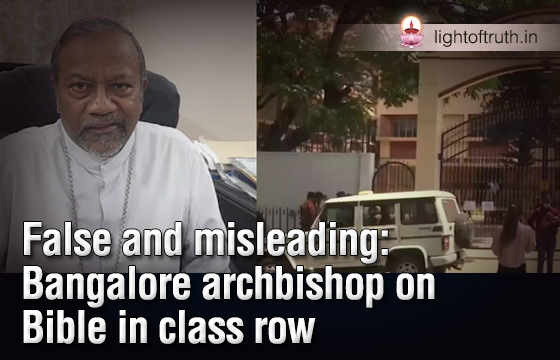
False and misleading: Bangalore archbishop on Bible in class row
Archbishop Peter Machado of Bangalore on April 26 dis-missed as false and misleading the media reports that some Catholic schools in the southern Indian city force children to buy Bibles and bring them to class.
According to an ndtv.com April 25 report a row erupted in Karnataka after a Catholic school in Bengaluru, the state capital, had allegedly taken an undertaking from parents that they would not object to their wards carrying the Bible to class.
The news portal also said the Hindu Janajagruti Samiti (Forum to awaken Hindus) accused Clarence High School of making it mandatory for students to carry the Bible.
The group’s state spokesperson Mohan Gowda alleged that the school has asked non-Christian students to compulsorily carry and read the Bible adding that it violated Articles 25 and 30 of the Constitution.
“It has been brought to my notice that the Christian Institutions are once again being target-ed for conversion in the allegation of the children being forced to buy Bibles and bring them to Schools in Bangalore. This allegation is false and misleading,” asserts Archbishop Machado in a press statement.
The prelate says Clarence High School’s management has clarified that such a practice existed in the past but since last year, no child is required to bring the Bible to the School or asked to read it by force.

Be vocal about minority rights: Nuncio
Apostolic Nuncio to India Archbishop Leopold Girelli has urged the Indian Catholics to speak up for the rights of all minority groups in the country.
“In this kind of struggle, if you want to call it that, we should remember that we are not standing up for just our rights as Catholics. We are standing for all minorities and the rights provided to minorities under the Indian constitution,” the Pope’s ambassador told a gathering of priests and Catholics April 23 in Bengaluru, southern India.
The nuncio was on a two-day pastoral visit to the capital of Karnataka state that ended April 24. It was his first visit to the city of gardens.
Archbishop Peter Machado of Bangalore presided over the event.