

Christian groups in India have welcomed the Delhi High Court questioning the basis for filing petitions on forced conversion.
The bench of Justices Sanjeev Sachdeva and Tushar Rao Gedela on June 3 pointed out that conversion is not prohibited in India.
“It’s a right of an individual to profess any religion, religion of his birth, or religion that he chooses to profess. That’s the freedom our Constitution grants,” the court said while hearing a petition by a lawyer seeking direction to the federal and Delhi governments to prohibit religious conversion by intimidating, threatening, and deceivingly luring through gifts and monetary benefits and by using black magic and superstition.
“An excellent move by the Delhi High Court,” says Sister Manju Devarapalli, secretary of the National Dalit Christian Watch.
The Carmelite Missionaries nun says the court’s stand co-mes at a time one was losing faith in the judiciary. “The High Court ruling comes as a soothing balm on seeming wounds, enforcing the sacredness of Indian Constitution,” she told.
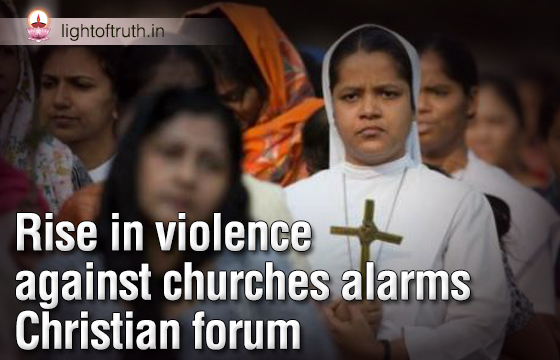
Rise in violence against churches alarms Christian forum
The United Christian Forum (UCF), an ecumenical group, has demanded urgent judicial and government intervention to check what it says is the rapid rise in incide-nts of violence, coercion and false arrests that traumatize the community.
The persecution is most acute in states such as Uttar Pradesh, Madhya Pradesh, Chhattisgarh and Karnataka; the UCF said June 13, citing data collected from its National Helpline Number 1800-208-4545 and human rights groups.
Although 2022 is not even halfway over, the helpline has received 207 cases of violence. Just in May, it recorded 57 cases. In 2021, the forum documented 505 cases, with Christ-mas seeing 16 acts of violence, including desecration and breaking of statues of Jesus Christ at a historic church in Haryana.
“This data flies in the face of statements by government functionaries and leaders of the ruling parties at the center and in the states that there is no persecution, and that there are only a few stray incidents by fringe elements,” the forum’s national president Michael Williams said.

Diocesan Synod renews Church in Tripura
Nine months of the in-tense synodal meetings at different levels ended June 11 with the diocesan pre-Synodal meeting in Agartala, capital of the northeastern Indian state.
As many as 92 representatives of laity, catechists, women’s groups, youth religious and priests attended the day-long prayer, reflection, discernment and planning for the future of the Church in Tripura.
The participants have resolved to make the spirit of Synodality, “Journeying together” beyond the diocesan synod meeting into their daily lives. “The meeting provided an opportunity for diverse members of the diocese to come together for a liturgical celebration, pray together, and reflect on their experience of the Synodal process,” said Jesuit Father Irudhaya Jothi, the contact person for the Synodal preparation in the diocese of Agartala.
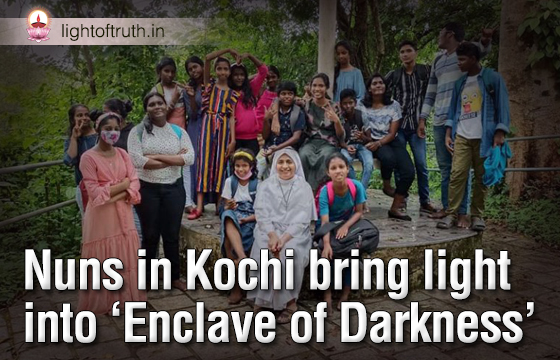
Nuns in Kochi bring light into ‘Enclave of Darkness’
A slum in this southwestern Indian city was once known as the “Enclave of Darkness” be-cause it was the den of thugs, alcoholics, drug runners and psychopaths.
It is now called Udaya Colony (Sunrise Enclave) after Catholic nuns dared to enter it 33 years ago as part of their mission to reach people in the peripheries.
What now welcomes visitors to the enclave in the middle of Kochi, the commercial capital of Kerala state, are buildings of two and three floors, paint-ed with attractive colors, that were once one-room, cramped tenements.
“The sisters faced stiff resistance in the beginning but people relented when they realized the sisters meant them good,” Anil Kumar, vice president of the Udaya Colony Residents Welfare Association, told Global Sisters Report.
Sister Anisha Arackal, who led the Sisters of the Destitute to turn the place into an upmarket residential area, recalls the slum’s notoriety.
Her congregation’s 1979 general chapter decided to help impoverished people and the marginalized on the peripheries, but it took 10 years for the first nuns to enter the Kochi slum. Sisters Redempta Alapp-at and Naveena Pulickal, the pioneers, started living in the slum in 1989, the year the congregation received pontifical status.
Alappat, 83, recalls reading an article in a magazine asking who will spread light in the enclave of darkness.

The rise of priestly vocations in Southeast Asia
An average of one priest ministering to 8,000 souls is a sad picture of the priestly vocation unable to cope with the growing population. The 2021 Catholic Directory of the Philippines counted more than 120 active bishops and 10,470 priests serving 85 million Catholics. It’s the same number of clergy as 10 years ago while the Catholic population has grown since then.
Recent international conferences about the clergy and religious vocation, particularly in the West, have identified the priest shortage as the most urgent problems facing the Church. Priestless parishes, empty altars and empty pews are sad realities in some parts of North America and Europe — a crisis caused by retiring senior clergy, added to those leaving the priesthood and the ever-decreasing sacerdotal vocation.
Sexual abuse scandals, coupled with the not-so-good examples set by bi-shops along the corridors of power in the Vatican and elsewhere, were not unlike a tsunami wiping out the Church’s credibility for more than decade or so until Pope Francis assumed the Chair of Peter in 2013 and began the radical reform of the Roman Curia.
Change has come and the Church in Asia is gradually overcoming the crisis of priestly vocations. In Bangladesh, Catholics saw 12 young men ordained as deacons in 2022. In this predominantly Muslim country with 500,000 Catholics or about 0.4% of the total population, the Church celebrates with the gift of new laborers in the vineyard of the Lord.
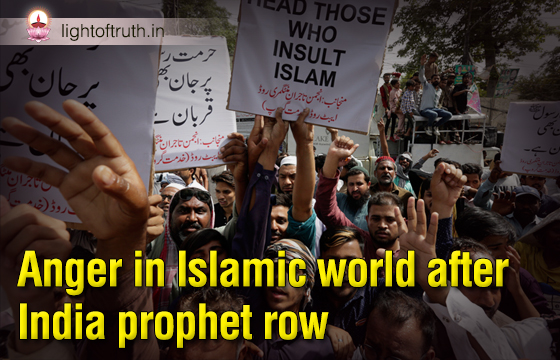
Anger in Islamic world after India prophet row
Muslims took to the streets in huge protests around Asia after Friday on June 10 prayers, sparked by remarks about the Prophet Mohammed by an Indian ruling party official that embroiled the country in a diplomatic storm.
Anger has engulfed the Islamic world since last week when a spokes-woman for Prime Minister Narendra Modi’s ruling party commented on the relationship between the prophet and his youngest wife on a TV debate show.

Arunachal youth cycle for peace and environment
A group of young people from Tezu town in Arunachal Pradesh marked the World Bicycle Day by promoting the cause of peace and environment. The 10-memeber youth group, cycled from Krick and Bourry Memorial School in Tezu to Demwe in Lohit district and back, 20 kilo-meters, to campaign for peace in the world, and to spread awareness on the need to protect and preserve environment.

Nun alleges torture, harassment, congregation denies
A Catholic nun has come to public with allegations of torture and mental harassment from her congregation. Sister Elcina, nee K.V Sudha, a member the Daughters of Our Lady of Mercy, an Italian congregation, made the revelation to media on June 7 in front of her provincial house in Mysore, a city in southern Indian state of Karnataka.
She alleged that her superiors had forcibly admitted to a mental hospital after her complaints to the state government about certain irregularities in her congregation.
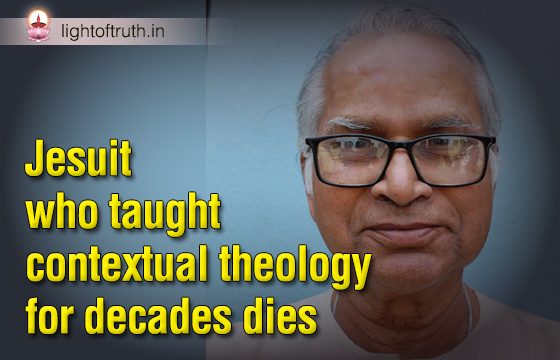
Jesuit who taught contextual theology for decades dies
The Indian Theo-logical Association and others have mourned the death of Jesuit Father Joseph Mattam, who had accompanied gene-rations of students in their theological research. The funeral was held May 30 at Vadodara’s Shrine of Our Mother of the Forsaken, Vadodara. Fr Mattam was a member of the Gujarat Jesuit province for 66 years and a priest for 55 years.

“We cannot completely say that they’ve been abolished”- First Dalit cardinal
The first “Dalit” Cardinal in history, Archbishop Anthony Poola of Hyderabad who will be created a cardinal at the August 27 Consistory, says his mission had been “to help as many poor children as possible.”
Derived from Sanskrit, the word “Dalit” means “broken” or “downtrodden,” and refers to those so low in ýsocial status ýthat they are considered outcasts or outside the four-tier caste system of Hindu society. Often referred to as “untouchables,” these people have been greatly exploited and subject to atrocities.
In a wide-ranging interview with Vatican News, the 60-year-old future cardinal reflects on how the caste system, even if technically abolished, still has remnants, what it is like serving India’s ‘untouchables’, and the current state of religious freedom for India’s small Christian minority. “I was in shock. It was like surprise news for me, that I never expected. I never dreamt. But for me, I feel it is the grace of God and it is His will through Pope Francis, that I receive the call. Pope Francis, our Holy Father. I deem it as a great opportunity for me to serve the people, to serve the people in South India and all sectors of the people, especially Telugu States of Telangana and Andhra Pradesh.”
“The caste system [was] abolished, we can say, but there are some social factors. Well, we cannot completely say that they’ve been abolished. But the real situation and the ground reality, as for your question, there are some differences. There are some people who are really fighting for recognition of their talent and the different activities they are doing. Long ago, there was no possibility for Dalit, “the untouchables” to have access to school or education. But now the government in India, especially in our states, Telangana and Andhra Pradesh where I come from, there are greater opportunities given to these marginalized, poor and Dalits, which also respect and encourage the poor people to go to school and pursue studies. Some become well-educated and are looking for a life. But they are treated differently as they aren’t ‘locals.’ There is a little bit of jealousy among human nature. I think what I expect from the people and what we try to practice, is raising awareness about people and situations, also these good situations, and trying to bring equality among all people.”