
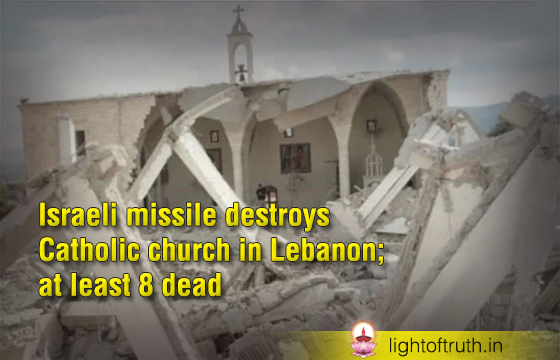
A church of the Melkite Greek Catholic Eparchy of Tyre, Lebanon, was hit by a missile from Israeli airstrikes in the country’s south Oct. 9, killing at least eight people, the British branch of the pontifical foundation Aid to the Church in Need (ACN) has reported.
Local sources told ACN that the church, located in the town of Derdghaya, was sheltering people displaced by the conflict. A priest’s house and a three-story building housing parish offices were also completely destroyed by another missile.
Pope Francis called for peace in the Middle East on X, stating that “all nations have the right to exist in peace and security: Their territories must not be attacked, their sovereignty must be respected and guaranteed through dialogue and peace.” In an additional post on Oct. 11, the pontiff said: “I call for an immediate cease-fire on all fronts of the war in the Middle East, including Lebanon. Let us pray together for the Lebanese, especially for the inhabitants of the south forced to leave their villages, so that they can return as soon as possible and live in peace.”
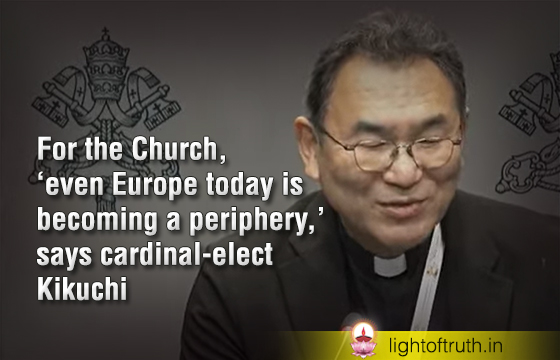
For the Church, ‘even Europe today is becoming a periphery,’ says cardinal-elect Kikuchi
“The mission today is an exchange of gifts between Churches, between those who have and those who have not,” the prelate said in his address. “Before, it was from West to East, now many countries in Asia and Africa give missionaries to the world. The very concept of periphery is changing, and even Europe today is becoming a periphery” said Archbishop Tarcisius Isao Kikuchi of Tokyo on October 8th briefing on the work of the Synod underway in the Vatican. In addition to the Archdiocese of Tokyo, the 65-year-old Kikuchi has chaired Caritas Internationalis since last year.
Pope Francis “has just come to our continent where he has visited many countries,” he said, stressing how the pontiff looks with particular attention to Asia. “He has chosen three more bishops from Asian dioceses among the new cardinals. More generally, the centre of the Church’s mission is moving towards the Global South.” On the experience of synodality, the prelate explained that the Japanese Church is focusing “more on its foundations than on the rush to build.” “We met with priests, religious and lay people for the National Congress of our 15 dioceses. We practised together the method of conversation in the Spirit. We also need a common understanding of synodality,” which “is not basing everything on consensus. Common discernment must indicate the direction, then someone has the task of making decisions.”
Archbishop Kikuchi had already written on his appointment as a cardinal in a message sent to his diocese and to all his friends. “This appointment is not just a personal honour for me, but a great honour for the Church in Japan, and especially for the Tokyo Archdiocese, and also for Caritas Inter-nationalis,” he said.
“I was surprised. It had been a long time since I was so shocked from the bottom of my heart. And I was confused. When I think about the fact that being a cardinal is not just an honorary position, but that there are many roles to play as an advisor to the Pope, I can only see my own shortcomings.”
Finally, the archbishop of Tokyo, who is also secretary general of the Federation of Asian Bishops’ Conferences (FABC), mentioned the presence of Philippine Bishop Pablo David among the new cardinals. He “will be the next FABC vice president (in January 2025 alongside the new president, Card Felipe Neri Ferrao, archbishop of Goa). I believe this appointment will have great significance for the FABC.”

Synod an opportunity ‘to overcome walls’ between Christians
The Pope presided over a candlelight vigil on October 11, the anniversary of the opening of the Second Vatican Council in 1962, and texts from council documents introduced the prayers of praise and the prayers of petition.
The Synod participants at the prayer service included the 16 “fraternal delegates” representing Orthodox, Anglican and Protestant churches, as well as the Rome-based representatives of the Anglican, Methodist and Reformed churches to the Holy See and other Christian ministers and faithful in the city.
Pope Francis did not read the meditation he prepared for the service, although it was distributed and published on the Vatican website.
Halfway through the Synod of Bishops, Pope Francis wrote, participants wanted to “express our shame at the scandal of division among Christians, the scandal of our failure to bear common witness to the Lord Jesus”.
“This Synod is an opportunity to do better, to overcome the walls that still exist between us,” the Pope wrote.
The vigil took place in the Square of the Roman Protomartyrs, just south of St Peter’s Basilica, which is the site where St Peter and other Christians were martyred in the first century under the Emperor Nero.
Noting the anniversary of Vatican II, he said the council “marked the official entry of the Catholic Church into the ecumenical movement,” which was begun by mainline Protestant churches out of a conviction that the lack of unity among Christians was harming their ability to preach the Gospel.
The goal of the work for Christian unity is the same as the goal for the Synod on Synodality, Pope Francis wrote. Both are focused on the mission Jesus gave to all his disciples to share the good news of salvation with everyone.
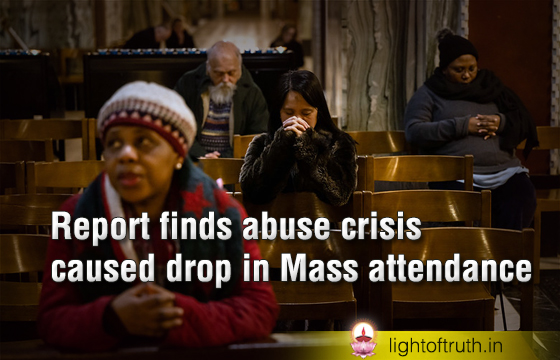
Report finds abuse crisis caused drop in Mass attendance
One in three Catholics who previously went to Mass have reduced their attendance or stopped going altogether as a result of the child sexual abuse crisis in the Catholic Church, according to a new report by Durham University. There has also been a corresponding fall in the number of financial donations, with a third of Catholics who previously donated no longer giving money to the Church. The YouGov survey was commissioned by the Centre for Catholic Studies at Durham University as part of a wider research project, “Boun-dary Breaking”, where research-ers are looking at the implications of the abuse crisis for the Catholic community.
More than 3,000 adults who identify as Catholic responded to the questionnaire, with 79 per cent saying that the Church needs to change “a great deal” to prevent further cases of child sexual abuse.
The sample was representative of the Catholic population in England and Wales. It included regular Mass-goers attending at least once a month and people attending less than once a month, as well as people who do not go to Mass but identify as Catholics.
According to the survey, the scandal of abuse has been a direct cause of distancing from the Church. However, it also shows that regular churchgoers have a more positive attitude towards the Church than non-attenders.
Nearly a third of those attending Mass regularly were more likely to consider child abuse in the Church to be a thing of the past compared to those who never attend Mass. Nearly half of regular Mass-goers were more likely to view the abuse as being about the same at other institutions that work with children.
Dr Marcus Pound from the Centre for Catholic Studies, who co-authored the study, said: “Overall, our analysis of the data shows that the Catholic community feels abuse is not a uniquely Catholic or clerical problem. However, there is also a conviction that the Church needs to make changes to prevent such abuse happening in the future.”
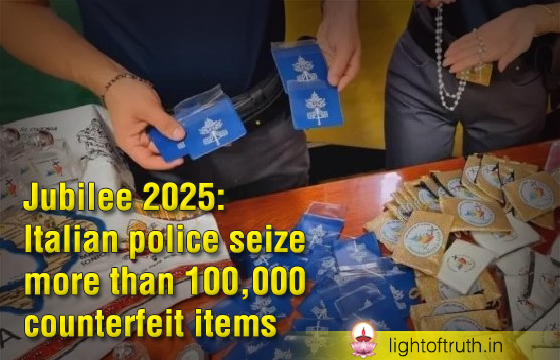
Jubilee 2025: Italian police seize more than 100,000 counterfeit items
As preparations intensify for the upcoming Jubilee Year in Rome, Italian authorities have cracked down on counterfeit religious merchandise flooding the city’s souvenir market. In a large-scale operation conducted by Italy’s financial police, more than 100,000 fake items bearing the official logo of Jubilee 2025 were seized from shops in the historic center of the capital.
The contraband haul, which included rosaries, medallions, bracelets, and pendants, was adorned with religious symbols, such as the image of Pope Francis and the emblem of the Papal Tiara, as well as the Jubilee slo-gan, “Pilgrims of Hope.” How-ever, these items failed to meet European Union safety standards, with several reportedly contain-ing harmful metals that pose health risks.
According to the Guardia di Finanza, the police force respon-sible for economic and financial crimes, four individuals of Chi-nese origin have been arrested in connection with the illegal trade. These suspects are accused of importing and selling counter-feit goods, as well as marketing items that contain substances banned under EU regulations. The authorities confirmed that these charges could lead to seri-ous legal consequences.
The discovery comes at a critical time, as Rome braces for the arrival of millions of pilgrims for the Jubilee Year, set to co-mmence on December 24, 2024. This Holy Year, an ancient Catholic tradition held roughly every 25 years, is expected to draw over 30 million faithful from around the world, who will visit the city’s major basilicas and sacred sites. With Rome already welcoming about 50 mi-llion tourists annually, the surge in visitors for the Jubilee poses additional challenges, including ensuring the safety and authenti-city of religious souvenirs.
Counterfeit religious items are a growing problem in Rome, especially around significant events like the Jubilee, when demand for holy symbols and memorabilia skyrockets. Not only do fake goods undermine the local economy and tarnish the sanctity of the event, but they also often fail to comply with safety regulations, posing a threat to consumers.
Authorities are stepping up efforts to prevent the circulation of counterfeit Jubilee items as the Holy Year approaches. In a statement, police stressed the importance of protecting consumers and the integrity of the event, warning that further raids and controls will be carried out across the city in the coming months.
With the official launch of the Jubilee Year fast approaching, both local authorities and the Vatican are keen to ensure a smooth and safe experience for pilgrims. Organizers are working closely with the Italian government to manage the anticipated influx of visitors and maintain order during this momentous religious event. As the countdown to Jubilee 2025 begins, the seizure of these counterfeit items serves as a reminder of the complex challenges that accompany major global religious celebrations in a city as iconic as Rome.
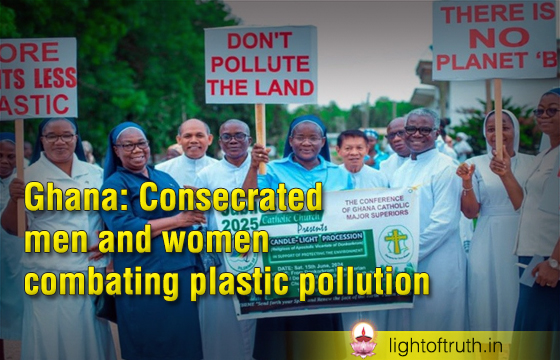
Ghana: Consecrated men and women combating plastic pollution
Consecrated religious in Ghana make time alongside their numerous other activities to help the wider community recognise the need to protect Creation, focusing especially on plastic pollution, which has become a major problem especially in suburban areas near cities.
Pollution is easily spotted in Donkorkrom, in the Eastern Region of Ghana, West Africa. Taking a leisure walk in Donkorkrom, from the doorstep through the streets to the markets, plastic bags can be seen lying on the ground.
Residents of Donkorkrom are frequently in the habit of drinking sachet water, and often as soon after consuming the water, the plastic is thrown anywhere on the ground. It is not unusual to see plastics littered on school or Church grounds, despite numerous pleas by priests and religious to take more care.
The indiscriminate dumping of plastics on the ground has serious effects on the environment. For instance, the rain collects the plastic from the ground and incorporates it into the land, which is often only discovered when one goes to plough the land for planting, and finds a dead land on which nothing can germinate as a result of plastic pollution.
Another problem with plastic pollution is that when the plastics get choked in the gutters, and it rains, the water is not able to move, resulting to spillage and floods, causing enhanced damage to the community.
Plastic pollution is not only detrimental to the soil but to animals as well, which are part of God’s Creation. Some of the plastics carried by the rain or floods hang on the grass, and if by any mistake any of the animals happen to swallow them, they die.
Consecrated religious have taken it upon themselves to sensitize the community on the need to protect the environment. They are doing this by engaging the community in talks and other activities on the subject, but mostly by their own lived realities. They undertake to take the lead so that others will follow.
Their goal is to continue to practice environmental care in their religious communities and parishes, so that when members of the local community visit their homes, they will see, become conscious, and follow suit.
The religious also believe that for this fight to be successful, there must be some kind of replacement to take care of the plastic pollution. In that light, they plan to produce shopping bags using fibre or material that can be disposed of, which they can consciously use for shopping instead of carrying numerous plastics from the shop, which only contributes to more pollution.
They believe that if the community sees them making this move, it will definitely effect a positive change in them, and they will become more conscious of preserving the earth.
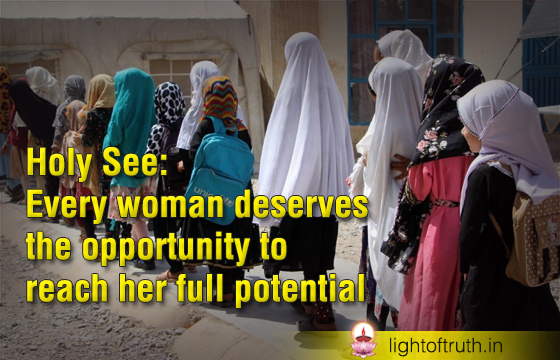
Holy See: Every woman deserves the opportunity to reach her full potential
“For a just society to thrive, it is essential to advance and recognize women’s capacities by combating all harmful stereotypes that deny them opportunities,” said the Holy See’s Permanent Observer to the United Nations addressing a Session dedicated to the Advancement of Women.
Archbishop Gabriele Caccia delivered his speech on October 09 during the Third Committee of the 79th Session of the United Nations General Assembly. Quoting from Pope Francis, the Archbishop described domestic violence as “a poisonous weed that plagues our society and must be pulled up from its roots,” and he called for a collaborative response to address domestic violence, which frequently, he noted, occurs behind closed doors.
The Archbishop emphasized that addressing root causes such as poverty and lack of proper education would ultimately reduce the abuse of women and girls, trafficking for sexual exploitation, and eliminate various forms of inhuman and degrading treatment towards women, particularly those characterized by violence, coercion, and drug abuse.
“The advancement of women cannot be fully achieved without respecting women’s unique capacities,” he said.
A renewed commitment, he continued, is essential to reduce maternal mortality and adequately equip clinics, particularly in regions where women are facing poverty.
“It would be a misleading assertion to claim that the advancement of women is being promoted or advanced when the pressing issues of poverty and abuse are not addressed,” he added.
Archbishop Caccia addressed surrogacy as a concerning form of exploitation, asserting that it leads to the “unacceptable commercialization of women’s unique capacity for motherhood.” He expressed his belief that this practice constitutes a serious violation of the dignity of both women and children and called for the prohibition and universal ban of surrogacy.
In concluding his speech, Archbishop Caccia stressed the importance of education as a crucial factor in empowering women and girls to develop their talents and realize their potential in society. “Changing both attitudes and practices to support women and men in their roles within the family and society is essential,” he said.
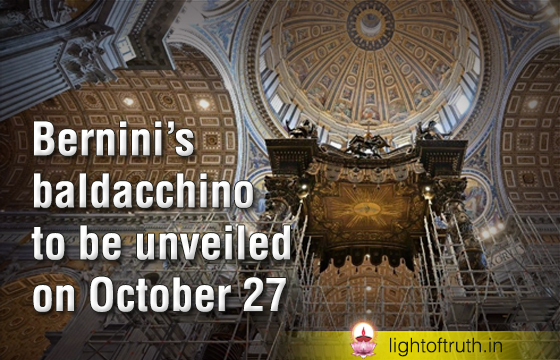
Bernini’s baldacchino to be unveiled on October 27
October 27 marks a significant day in the Vatican. Both the Synod and the work on the baldacchino covering the main altar in St. Peter’s Basilica will end. The Archpriest of the Basilica, Cardinal Mauro Gambetti, announced that Pope Francis will celebrate Mass and officially unveil the newly refurbished baldacchino.
“This is a significant date for many reasons,” the Cardinal explained. “October 27 will mark the conclusion of the Synod and Pope Francis will hold the concluding Eucharistic celebration. However, Oct. 27 is also a date of peace because it recalls the interreligious meeting desired by St. John Paul II in 1986 in Assisi.” Pope Francis has seen the progress on the baldacchino and, Cardinal Gambetti, said, he “appreciated it very much.”
The baldacchino was designed by Gian Lorenzo Bernini between 1624 and 1635 for Pope Urban VIII. It is an important structure in St. Peter’s Basilica because it stands above the tomb of the first Pope. Towering nearly 29 meters tall, the last refurbishment dates back to 1758. The Fabric of St. Peter described the work as “a challenging and necessary restoration” especially ahead of the Jubilee of 2025.
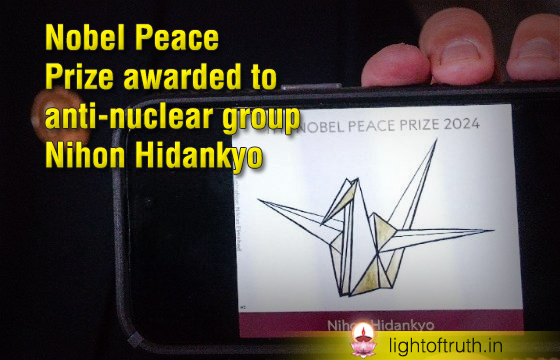
Nobel Peace Prize awarded to anti-nuclear group Nihon Hidankyo
The Nobel Peace Prize was awarded on October 11 to Nihon Hidankyo, a Japanese organiza-tion of survivors of the U.S. ato-mic bombings of Hiroshima and Nagasaki, for its “efforts to achi-eve a world free of nuclear wea-pons.”
Jørgen Watne Frydnes, chair of the Norwegian Nobel Commi-ttee, said the award was assigned to the grassroot organization as the “taboo against the use of nuclear weapons is under pre-ssure.” He said the Committee “wishes to honour all survivors who, despite physical suffering and painful memories, have cho-sen to use their costly experience to cultivate hope and engagement for peace.” Efforts to eradicate nuclear weapons have been ho-noured in the past by the Nobel Committee.
The International Campaign to Abolish Nuclear Weapons won the peace prize in 2017, and in 1995 Joseph Rotblat and the Pugwash Conferences on Science and World Affairs won for “their efforts to diminish the part played by nuclear arms in international politics and, in the longer run, to eliminate such arms.” This year’s prize was awarded agai-nst a backdrop of devastating conflicts raging in the world, notably in the Middle East, Ukraine and Sudan. “It is very clear that threats of using nuclear weapons are putting pressure on the important international norm, the taboo of using nuclear weapons,” Watne Frydnes said.
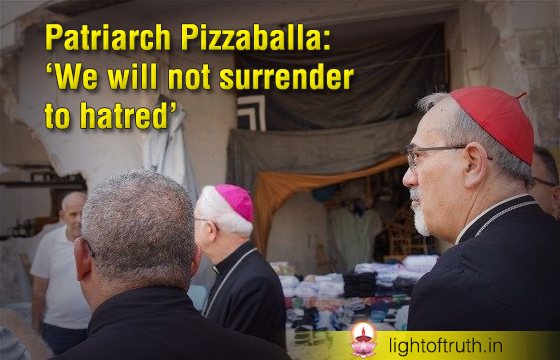
Patriarch Pizzaballa: ‘We will not surrender to hatred’
Cardinal Pierbattista Pizzaballa, the Latin Patriarch of Jerusalem, has sent a letter to Pope Francis to convey the “most sincere gratitude” of Catholic leaders and all the Christian faithful in the Middle East for his closeness and compassion.
On the Day of prayer for world peace and fasting to mark the anniversary of Hamas’ ma-ssacre in Israel and the devasta-ting war that has ensued, the Pope also addressed a letter to the Catholics of the region expressing his closeness to the “small, de-fenceless flock” in the Holy Land “thirsting for peace.”
In his letter, published on Friday by the Vatican’s “L’Oss-ervatore Romano” newspaper, Cardinal Pizzaballa thanks the Pope for this “beautiful gesture of closeness and affection” and also for being “the only world leader” who acknowledges the human “suffering of all” remin-ding us of the need “not to lose our humanity”, even in these tragic circumstances.
Referring to the Day of prayer for peace joined by the Catholic communities in the Holy Land and across the world, the Latin Patriarch of Jerusalem noted that these “weapons of love” are the Church’s response “to the mis-trust that seems to be spreading more and more. “In this context of deeply rooted hatred,” he said, “there is a need for empathy, for gestures and words of love that, even if they don’t change the course of events, bring comfort and consolation.”
Cardinal Pizzaballa recalled that in the past twelve months of war priests, religious men, and women along with volunteers have remained steadfast in serving those in distress, to provide relief and comfort, even at the risk of their lives.
He reiterated the Church’s firm commitment to rebuilding broken relationships and trust between communities and to resist the “logic of evil” that seeks to divide.
“We will not surrender to events that seem to drive us apart, but we will always seek to be thirsty builders of peace and justice,” he said, recalling the example of men and women of all faiths who, even though personally affected by the violence, have had the inner strength to forgive and not to give in “to the logic of hatred.” He expressed his hope that this “small remnant” might provide the starting point for rebuilding relationships.