Pope revises catechism to say death penalty is ‘inadmissible’

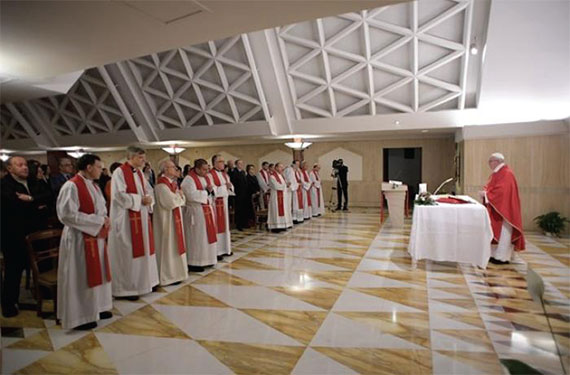
Francis has ordered a revision of the Catechism of the Catholic Church, asserting that “the death penalty is inadmissible because it is an attack on the inviolability and dignity of the person.” He has committed the Church to working for its abolition worldwide.

The catechism’s paragraph on capital punishment, 2267, had already been updated by St John Paul II in 1997 to strengthen its scepticism about the need to use the death penalty in the modern world and, particularly, to affirm the importance of protecting all human life.

The latest change builds on the development of Catholic Church teaching against capital punishment.

Announcing the change on August 2, Cardinal Luis Ladaria, prefect of the Congregation for the Doctrine of the Faith, said: “The new text, following in the footsteps of the teaching of John Paul II in ‘Evangelium Vitae,’ affirms that ending the life of a criminal as punishment for a crime is inadmissible because it attacks the dignity of the person, a dignity that is not lost even after having committed the most serious crimes.” “Evangelium Vitae” (“The Gospel of Life”) was St John Paul’s 1995 encyclical letter on the dignity and sacredness of all human life. The encyclical led to an updating of the Catechism of the Catholic Church, which he originally promulgated in 1992 and which recognised “the right and duty of legitimate public authority to punish malefactors by means of penalties commensurate with the gravity of the crime, not excluding, in cases of extreme gravity, the death penalty.”

At the same time, the original version of the catechism still urged the use of “bloodless means” when possible to punish criminals and protect citizens.

The catechism now will read: “Recourse to the death penalty on the part of legitimate authority, following a fair trial, was long considered an appropriate response to the gravity of certain crimes and an acceptable, albeit extreme, means of safeguarding the common good.

Churches burned and priests killed in the Somali region

Patriarch Matthias I and the Holy Synod of the Tewahedo Orthodox Church of Ethiopia have decided to offer 16 days of fasting and prayer that precede and follow the liturgical solemnity of the Dormition of St Mary Mother of God–(celebrated on August 15), to invoke the gift of peace and reconciliation in Jijiga and in the Somali region, after ethnic violence, which in recent days, exploded in that part of Ethiopia, causing about 30 victims. The Ethiopian Orthodox Church has paid a high price due to the spiral of violence: accord-ing to information by local media, at least seven Orthodox Churches have been attacked and set on fire, and local sources speak of at least six priests and several faith-ful killed.

The clashes began at the end, when armed men of the Liyu militia, of ethnic Somali and under the orders of AbdiIlley (President of the Somali Region) tried to interrupt a meeting between members of the regional parliament and representatives of the city of Dire Daua, with the intent of denouncing the violation of human rights in the region.

Belgium’s euthanasia nightmare

One striking thing about modern Western societies is how quickly bioethical practices that would once have been shocking quickly become un-remarkable. It happened with abortion, it happened with embryo selection, and now it is happening with euthanasia. It emerged that during 2016 and 2017 three children in Belgium were given euthanasia, and the media reaction was one giant shrug. As far as I am aware it has barely been reported outside Christian and pro-life circles.

Pro-lifers who warn against weakening the legal protection offered to all human life are often accused of believing in the supposed “slippery slope fallacy.” But the Belgian experience, over the 16 years since euthanasia was introduced, suggests that logical slippery slopes do exist.

Once you have conceded into law a particular ethical principle – say, “intentional killing is a legitimate treatment option for patients who request it, or whose best interests demand it” – it is very difficult to control the further application of that principle, because of the way the law works, with a high value attached to precedent and equal treatment. By the internal logic of the pro-euthanasia position, any law or ruling permitting some form of euthanasia carries within it the seeds of its own extension. If someone with a prognosis of six months is eligible, why not someone with a prognosis of nine months?

If someone who wants to die because of unbearable physical pain, why not someone with unbearable existential pain? And so on.

The direction of travel in Belgium has been clear for a long time. Euthanasia was introduced in 2002 under fairly liberal conditions – for example, the legislation permitted what Belgian law calls “emancipated minors” to have access to it. The numbers taking advantage, steady for a long time at somewhat under 1,500 per year, have recently started to increase. The law allowing children to be killed was introduced in 2013.

Study: Most US major superiors think women deacons ‘theoretically possible’

A major new study has found that more than three-quarters of the leaders of religious orders of priests, brothers and sisters in the U.S. believe it is “theoretically possible” to ordain women as deacons in the Catholic Church.

Nearly as many, according to the just-released report from the Centre for Applied Research in the Apostolate at Georgetown University, believe the church “should authorize” the ordination of women to the diaconate.

The study was released by CARA on August 2, the second anniversary of Pope Francis creating a commission to study the women’s diaconate. It surveyed all 777 leaders of Catholic men and women religious orders in the U.S., and got responses over a four-month period from 385, or just below 50 percent.

Among the findings:
• 77% believe it is “theore-tically possible” to ordain women as deacons;
• 72% say the church “shou-ld authorize” such ordinations;
• 76% say ordaining women as deacons would be “very much” or “somewhat” “beneficial to the Catholic Church’s mission”;
• 45% believe the church will return to the practice of ordaining women as deacons.

The new CARA study, which focuses only on attitudes of leaders of religious orders, follows an earlier study by the group on the wider attitudes of U.S. Catholic women. That study, released in January, found that 60% of women thought the church should implement a women’s diaconate.

Chinese authorities bulldoze church in Jinan province

A second church has been demolished by authorities in China’s Jinan province — and a third church is expected to suffer the same fate soon.

After Liangwang Catholic Church was demolished on July 17, local Catholics prayed at the site and protested the unreasonable behaviour of authorities.

Shilihe Catholic Church was demolished earlier this year and sources expect Wangcun Catholic Church to soon be reduced to rubble.

All three churches were in normal use and legal churches officially registered with the religious administration, according to a source in Jinan.

Liangwang Church was built in 1920. During the Cultural Revolution, it was classified as a private house. After lengthy legal procedures, the church was rebuilt in 2006.

At noon on July 17, three female church members were on duty at the church when more than 40 people forced their way in, searched the members, took their mobile phones and made them leave the church.

Another 30 people later arrived to help with the demolition, which went ahead despite the church still containing many items.

The church was built on land that was distributed by Liangwang village and had been granted a permit for legal activities. It was demolished because its area in Pian district is to be developed with new buildings and infrastructure. After the demolition, the parish priest and president complained to authorities but have not received any reply.

“The stools, altars and dedication boxes were all pressed into the ruins. The ruins later became a fire and all the items were burned out,” said a church member.

Education still main focus for Sri Lankan archbishop

The now retired Archbishop Oswald Gomis of Colombo faced huge challenges during the takeover of Sri Lanka’s Catholic-run schools by the state in the 1960s. The government policy was “certainly not a good thing” and was intended to hit Catholics, said the 85-year-old archbishop, who was honoured by President Maithripala Sirisena for his outstanding religious and social service at a celebration in Colombo on July 22.

Celebrating 50 years of his episcopate, Archbishop Gomis believes the government should not have taken over church-run schools at that time.

“The government thought they [the schools] were avenues for conversion. But because of that, today all other religions have got whacked,” he said. “I have always believed the Catholic Church has a very important mission in Sri Lanka, and that is education.”

Catholic schools were meant to instil Catholic values in their communities and to encourage their practice through teachings of the religion daily.

Archbishop Gomis founded 15 affiliated schools as branches of established schools during his tenure as archbishop.

Kerala’s Christian community is pride of India: President Kovind

President Ram Nath Kovind on August 9 lavished praise on the Christian community in Kerala, saying it was a symbol of India’s non-negotiable commit-ment to diversity and pluralism. Inaugurating the centenary celebrations of St Thomas College, Kovind said the community’s heritage and history was a matter of “immense pride” for the country.

“The Christian community in Kerala is one of the oldest not only in India but anywhere else in the world. Its heritage and history are a matter of immense pride for the entire country – and a symbol of India’s non-negotiable commitment to its diversity and pluralism,” Kovind said.

Kovind said the real value of education lies in how we learn to help fellow human beings and not in degrees. The greatest service to God is to help another person, to heal another person and to spread the light of knowledge and St Thomas College has been part of this noble culture.

Last year during his visit to Ethiopia, President said he was moved as people there remember-ed the services of Indian teachers, many of them from Kerala and from the commu-nity, who had educated generations of Ethiopian children. The college is the alma mater of two former Kerala chief ministers — EMS Namboodiripad and C Achutha Menon. Spiritual leader Swami Chinmayananda was once a student here, Kovind said.

Indian state ‘treats Christians as terrorists’

All nine Catholic bishops of India’s north-eastern Jharkhand State have sought federal intervention to stop Christians being treated like terrorists as part of alleged state government harassment.

The bishops told governor Draupadi Murmu, who is the representative of the Indian president, that the state government led by the pro-Hindu Bharatiya Janata Party (BJP) had used its Anti-Terrorist Squad (ATS) to probe Christian institutions.

On July 30, three days after meeting Murmu, they also sent a memorandum to federal Home Minister Rajnath Singh seeking his assistance on the issue.

“We are now treated as terrorists and officials of the ATS are after us as if we are involved in terrorist activities,” Auxiliary Bishop Telesphore Bilung of Ranchi, who organized the meeting, told ucanews.com.

He said for the past few months, police had been arresting church people on trumped-up charges and investigators had raided Christian groups in “clear state-sponsored harassment.”

In some cases, the ATS served notices on Christian institutions ordering them to produce financial details within 24-hours, the bishop said.

Ethnic Khasia Christians fight to keep land in Bangladesh

After nearly a decade resisting eviction from ancestral land, ethnic Khasia Christians in Bangladesh are still uncertain whether the land they have lived on for generations will become their own.

About 700 ethnic Khasia from 86 families in two villages have been battling to resist eviction by Nahar Tea Estate in Moulvi-bazar district since 2010.

Most of those affected are Catholics belonging to St Joseph’s Catholic Church, under the predominantly indigenous Sylhet Catholic Diocese in north-east Bangladesh. “The Khasia are peaceful people and they have the right to live in their ancestral land like every citizen of Bangladesh,” Quazi Rosy, a ruling Awami League lawmaker, told ucanews.com.

Rosy was part of a delegation from the Parliamentary Caucus on Indigenous Peoples that visited Nahar 1 and Nahar 2 punjis (forested villages with clustered houses) on July 22. Research and Development Collective (RDC) activists were also part of the delegation to lend their support to the Khasia.

Interfaith charity run aims to build churches in Indonesia

Over 3,500 people, mostly Catholics, joined a charity run organized by Indonesia’s Jakarta Archdiocese to raise money to build churches in various parts of the country.
Jakarta has declared 2018 the “Year of Unity.”

The “Run4U” campaign on July 29, one of a number of Church-led fund-raising runs in recent years, offered people the chance to test themselves with a 2.5-kilometre walk or a more gruelling 5k run in Tangerang, a city in Banten province some 25km from Jakarta.

Participants included priests, nuns, seminarians, elderly and young and people from other religions. “Our main purpose is to raise money to help out with the construction of several churches [that are in need of financial support],” Paskah Widarani, one of the organizers, told ucanews.com.

“Those parishes were chosen as they really need our help right now,” said Widarani.

Official Website

Exit mobile version