- Benny Nalkara, CMI
“But we have this treasure in earthen vessels, to show that the surpassing power belongs to God and not to us” (2 Cor 4:7). This statement of St. Paul reveals his profound self-understanding as an apostle and servant of Jesus Christ, as well as his unwavering trust in God. The Second Letter to the Corinthians opens a window into Paul’s inner life, exposing both his personal struggles and the external challenges he faced. These experiences led him to reflect ever more deeply on the nature and value of his apostolic ministry.
The fourth chapter of the Second Letter to the Corinthians is among the most personal and profound passages in Paul’s writings. Here, Paul defends the authenticity of his apostolic ministry. His opponents questioned his authority because of his weakness, sufferings, and humiliations. In response, Paul presents a deeply paradoxical theology of ministry.
In 4:1–6, Paul speaks about the integrity of apostolic ministry. He understands his ministry as a pure gift received through God’s mercy. Because the ministry belongs to God, Paul strives to preserve its authenticity and integrity. He rejects deception, manipulation, and self-promotion. Unlike false preachers who seek personal glory, Paul proclaims not himself, but Jesus Christ as Lord. He sees himself merely as a servant for the sake of Christ and the community. The heart of his mission is to communicate “the light of the knowledge of the glory of God revealed in the face of Jesus Christ” (4:6). Christ is the definitive revelation of God; in Him, the invisible God becomes visible. Just as God brought light out of darkness at creation, He now illumines human hearts through Christ. Apostolic ministry, therefore, is participation in God’s saving revelation, not a platform for personal prestige.
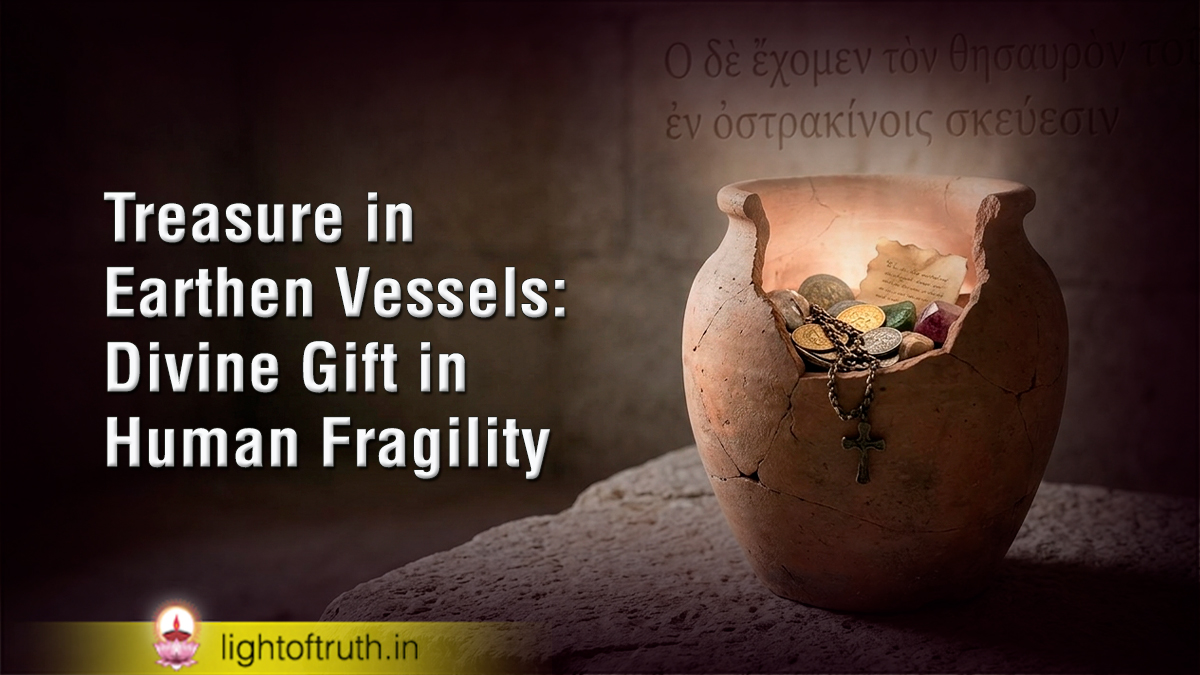
Building on this self-understanding, Paul turns in 4:7–18 to the perils and paradoxes of the apostolate. He presents the paradoxical nature of Christian ministry through the striking image of “treasure in earthen vessels.” The “treasure” (thēsauros- treasure, valuavle) refers primarily to the Gospel of Christ—the light of the knowledge of God’s glory revealed in Jesus Christ (cf. 2 Cor 4:6). It also signifies the ministry entrusted to the apostles and the divine light of salvation itself. This treasure is not a product of human wisdom or merit; it is a divine gift entrusted to fragile human beings. Paul sees himself as the steward of a mystery infinitely greater than himself.
This priceless treasure is entrusted to “earthen vessels,” fragile human beings marked by weakness and suffering. The image of clay jars emphasizes human limitations, vulnerability, and mortality. Yet precisely through this fragility, the extraordinary power sustaining the apostolate is revealed as coming from God and not from human strength. The metaphor of “earthen vessels” (Greek: ostrakinois skeuesin) is deeply significant. In the ancient world, clay jars were common, inexpensive, and easily broken, though they were often used to store precious objects. Paul deliberately chooses this image to describe apostles and ministers. The vessel has no glory of its own; its value lies entirely in what it carries. Through this metaphor, Paul vividly conveys human weakness, mortality, and vulnerability.
For Paul, human fragility, suffering, and limitation are not obstacles to God’s work; rather, they are the very places where divine grace becomes manifest. He describes the many trials endured by apostles—affliction, persecution, rejection, and suffering. Yet despite their outward weakness, they are never abandoned, for divine grace sustains them. The apostolic life thus mirrors the paschal mystery of Christ: carrying within themselves the death of Jesus so that His life may also be revealed.
This verse stands at the heart of Paul’s theology of ministry. Writing to the Corinthian community, he defends the authenticity of his apostolic mission not through human success, prestige, or power, but through the paradox of divine glory manifested in human weakness. Paul’s theology overturns worldly notions of strength and effectiveness. The fruitfulness of ministry does not arise from eloquence, status, or human capability. God works through fragile people, imperfect ministers, and wounded disciples. Christian ministry, therefore, becomes a living testimony that God’s power is most fully manifested through human weakness. The phrase “the surpassing power belongs to God and not to us” underscores the primacy of divine grace and initiative. The fragile vessel itself becomes a sign of divine power, for God’s greatness shines forth precisely because the treasure is carried in weak and vulnerable human beings.
Thus, 2 Corinthians 4:7 becomes both a confession of humility and a proclamation of hope: fragile human lives can become bearers of divine treasure when surrendered to the power of God. For consecrated life and Christian leadership, this text offers a profound spiritual insight. One need not conceal weakness in order to serve God fruitfully. Authentic discipleship is born of humility, dependence on grace, and transparent surrender to God’s action. The Church does not proclaim the greatness of its ministers, but the greatness of the God who works through them.