- Jacob Chanikuzhy
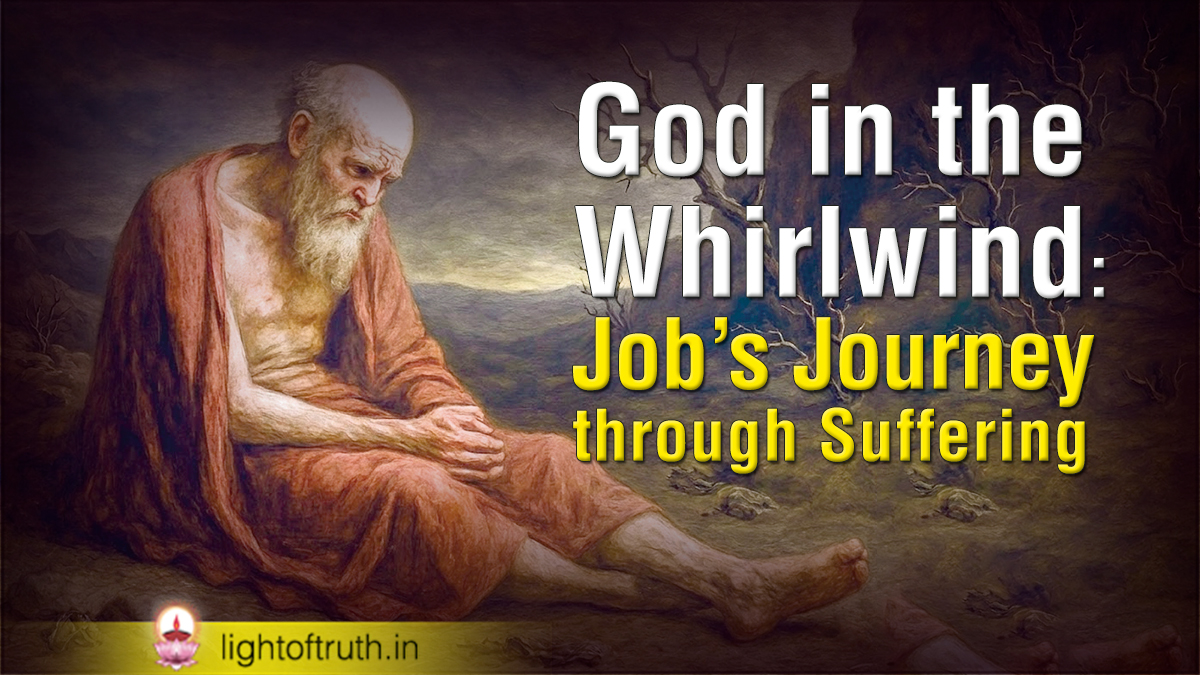
Swirled in the whirlwind of unjustified suffering, the biblical figure of Job yearns for an explanation from God, whom he had faithfully obeyed and trusted throughout his life. The Book of Job has thus become a favourite of believers across generations who are perplexed by unmerited suffering. For the most part, the Book of Job contains reflections on human suffering drawn from the religious wisdom of its time, expressed through the speeches of Job’s wise friends and the responses of Job himself, who remains dissatisfied and unconvinced by their reasoning.
The bedrock of the long poem that constitutes the Book of Job is the idea of retributive justice: God is just, rewarding the good and punishing the wicked. The Book of Job vehemently challenges a simplistic application of this idea because Job, a righteous person, undergoes enormous suffering. In Christian theology, there are reasons other than punishment for sin why God may allow someone to suffer. These reasons include divine discipline, testing, vicarious suffering on behalf of others, or the opportunity to unleash in others the power of charity and compassion towards the victim.
In the end, God appears to Job in a whirlwind, an image quite appropriate to the situation of Job, who has been caught in the vortex of suffering. It is interesting to note that God does not endorse the wise sayings of Job’s friends, even though their words were deeply rooted in convictions about God’s goodness and justice, as well as in the philosophical and religious wisdom of their age. The essence of their approach was that Job must somehow have sinned in order to deserve such punishment from a just God and that, if he sincerely repented, God would restore him to his former glory. A defiant Job, however, maintains his innocence and demands an explanation from God for afflicting him in such a disproportionate manner, even if he were guilty of some inadvertent sins. To the great surprise of the readers, God defends Job against his friends and rebukes them for falsely representing Him in their attempts to justify His actions.
God’s mysterious voice from the whirlwind does not explain the real reason why He allowed Job to suffer. God does not tell him whether He is disciplining, testing, or punishing him. The true reason remains hidden. In His first speech from the whirlwind, however, God asks Job a series of questions concerning the vast panorama of creation, questions that expose the profound ignorance of Job and, indeed, of every human being. God’s second speech describes the terrifying monsters of the sea and His sovereign control over them, illustrating divine might and human impotence. Together, these speeches unveil God’s supreme knowledge, wisdom, and power, by which He creates and governs the entire universe, in sharp contrast to human ignorance and helplessness.
Yet a difficulty remains. If someone causes suffering to another without reason, would the victim be satisfied merely by a display of the wonderful machine the aggressor has manufactured, the awe-inspiring picture he has painted, or the number of people he commands? If not, how can God’s display of His supreme wisdom and power constitute an answer to the problem of Job’s suffering? Nevertheless, Job appears to be satisfied by God’s response. Job wanted to know the reason behind his suffering. Through God’s words, perhaps Job came to realize that he did not know not only the reason for his sufferings but also the reasons behind countless other realities. The fact that Job could not imagine any reason God might have for allowing his suffering did not mean that God had no reason. Allowing God to be God means permitting Him to have His own hidden purposes in what unfolds in one’s life and trusting Him completely, even when those purposes remain beyond human understanding.
In fact, what ultimately seems to satisfy Job is not any particular explanation but an experience. Job says: “I had heard of you by the hearing of the ear, but now my eyes have seen you.” Before the theophany, Job possessed many ideas about God acquired from others, from tradition, and from inherited wisdom. Now, having personally encountered God and seen Him, his inadequate notions of God wither away, and along with them his complaints about his suffering. He discovers a God who is present not only in the gentle breeze but also in the whirlwind, a presence that is soothing and transformative.