- Benny Nalkara,CMI
“For he was a good man, full of the Holy Spirit and of faith. And a great many people were brought to the Lord” (Acts 11:24). This statement about Barnabas, a prominent figure in the early Church, illustrates the truth that the most enduring testimony is often not what a disciple says, but how he lives.
Barnabas is mentioned by name in four books of the New Testament: the Book of Acts, which contains the vast majority of references to his life and missionary ministry (mentioned 24 times between Acts 4:36 and Acts 15:39) and five more times in three other books of the New Testament: 1 Corinthians (9:6), where Paul the Apostle refers to his work and financial self-support; Galatians (2:1, 2:9, 2:13), where he is presented as Paul’s trusted co-worker and partner in the Gospel; and Colossians (4:10), which identifies him as the cousin (or close relative) of John Mark.
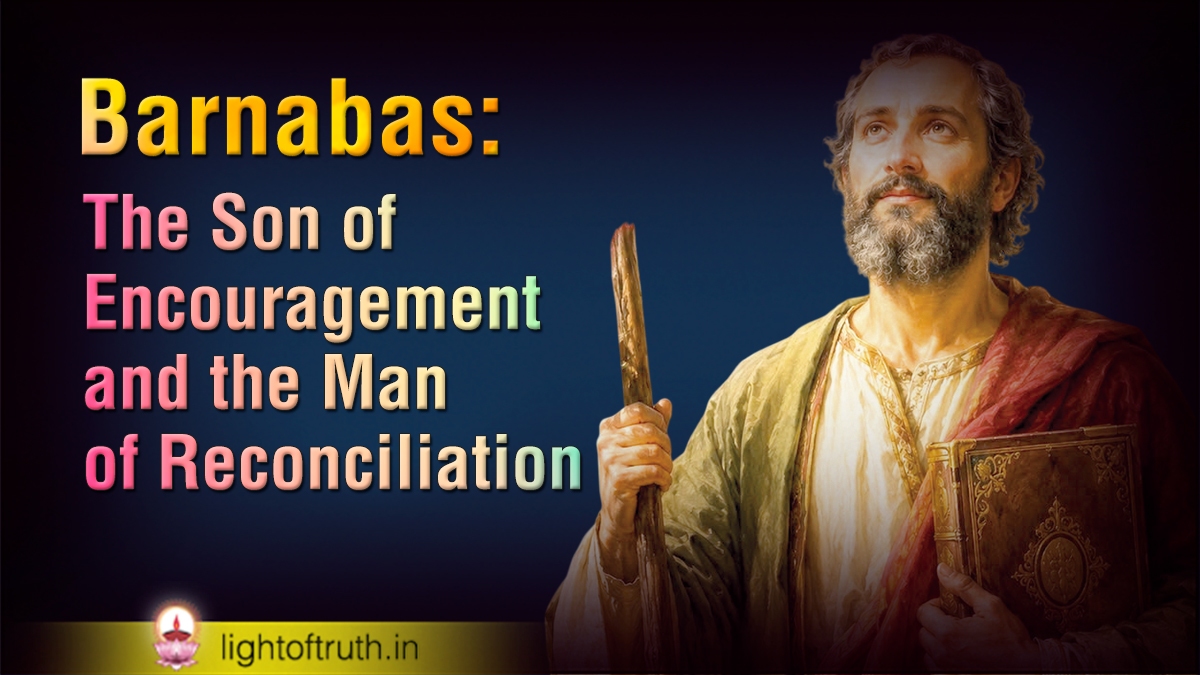
Barnabas (originally named Joseph) was an early Christian leader from Cyprus. His name meant “Son of Encouragement”, he is described in Acts 11:24 as “a good man, full of the Holy Spirit and faith” Barnabas played a pivotal role in the early Church. He demonstrated remarkable generosity and solidarity with the early Christian community by selling a field he owned and placing the entire proceeds at the apostles’ feet for the care of the poor and the needy in Jerusalem. When Paul arrived in Jerusalem, the disciples were afraid of him because of his past as a persecutor of the Church. Barnabas vouched for him and introduced him to the apostles. Sent by the Jerusalem Church to Antioch, Barnabas became a key leader and brought Paul from Tarsus to help teach the growing Gentile Christian community. It was in Antioch that the disciples were first called Christians. Commissioned by the Holy Spirit, Barnabas and Paul undertook a missionary journey through Cyprus and Asia Minor. Barnabas and Paul defended the inclusion of Gentile converts without requiring circumcision.
But later in Antioch, Peter stopped eating with the Gentiles out of fear of offending certain visitors from Jerusalem, and Barnabas followed his example. Paul strongly opposed this behaviour, stating that they were not “acting in line with the truth of the Gospel” (Galatians 2:14). In Antioch, Paul rebuked Peter publicly for his hypocrisy, noting that even Barnabas was influenced by it (Galatians 2:11–13). Later, when planning another missionary journey, Paul and Barnabas disagreed over taking John Mark, who had left them earlier. The disagreement led them to separate: Paul chose Silas and continued through Syria and Cilicia, while Barnabas took John Mark to Cyprus. Little is known of Barnabas’ later ministry, but 1Corinthians (9:5–6) suggests he was still active around 56–57 AD and supported himself financially, indicating that his relationship with Paul had likely remained respectful.
Barnabas exemplifies the ministry of strengthening and supporting others. His life reminds us that the Church grows not only through preaching but also through encouragement, compassion, and mutual care. By selling his field and placing the proceeds at the apostles’ feet, Barnabas demonstrated complete trust in God, selfless concern for the community, and sacrificial generosity—an enduring model of Christian stewardship. His life as an ardent follower of the Word reveals the transforming power of God’s grace and the Church’s mission to reconcile, restore, and embrace repentant believers. As Paul’s companion on the first missionary journey, Barnabas helped open the Gospel to the Gentiles. His ministry reflects the universal mission of Christ and God’s plan of salvation for all peoples.
Barnabas never sought prominence but willingly shared leadership with others. The shift in Scripture from “Barnabas and Paul” to “Paul and Barnabas” illustrates his humility, collaborative spirit, and commitment to God’s mission over personal recognition. Barnabas defended John Mark when Paul considered him unfit for further mission. Though their disagreement led to separate ministries, it highlights the importance of mercy, restoration, and the conviction that God can continue to work through different paths.
The Church at Antioch commissioned Barnabas and Paul in obedience to the Holy Spirit. His life teaches that authentic mission begins with God’s initiative and flourishes through the Church’s discernment and faithful response. Barnabas embodies the Gospel in action. His life illustrates that Christian faith is expressed through encouragement, generosity, reconciliation, humility, collaboration, and missionary zeal. Barnabas’ inclusive ministry reminds the Church today of the importance of unity, cultural sensitivity, and embracing diversity.
The power of the Gospel should make us people who encourage, console and strengthen the fellow workers and who will be the catalyst of reconciliation. Barnabas offers a timeless model for the Church today. He is a powerful reminder of how we can positively influence those around us. His life demonstrates the power of encouraging and mentoring future leaders, bridging cultural divides, practicing radical generosity, and extending grace and second chances to those who have failed. His legacy remains a compelling example of authentic Christian discipleship and mission. His example urges today’s church to build cultures of grace.