Another name was added to a growing Philippine Church casualty list on June 10 when a priest was shot dead as he was about to celebrate Mass in the northern province of Nueva Ecija. Father Richmond Villaflor Nilo of Cabanatuan Diocese was gunned down inside the Nuestra Senora dela Nieve chapel in Zara-goza town. Police said the priest was shot while he was putting on his alb to start the Mass. At least three shots were fired through the chapel’s window.
China plans to remove ‘foreign influence’ from Catholic Church
China has launched a five year plan for the “development” of the Catholic Church, aimed at altering religious principles and practices to coincide with Chinese communist ideals. This plan was approved by the Patriotic Association of Chinese Catholics and the Council of Chinese Bishops, neither of whom is recognised by the Holy See. The goal of this plan is to eliminate “foreign influence” and to ensure governmental control of all religious activities, including a submission of religious leaders to the Communist Party. The groups have not released any specific details, but the five year plan will include “understanding the history of the church” in China, driving theological research, and emphasising evangelism.
Chinese authorities demolish Way of the Cross in Henan
The Way of the Cross at a pilgrimage site in China’s Henan province has been forcibly demolished by authorities in the latest clampdown on religious freedom. Local government officials removed images of Jesus at the well-known Our Lady of Mount Carmel pilgrimage site in Tianjiajing village of Anyang Diocese at 8 pm on June 5.
A source said authorities sent personnel one month ago to tell Bishop Joseph Zhang Yinlin of Anyang that the Way of the Cross must be dismantled, but no specific reason was given.
Nuns living nearby took photographs and videos of the demolition and sent the evidence to chat groups.
A religious source said the Communist Party’s policy appeared to be to “allow Catholicism to exist but not develop.” In 1987, the local government sent troops and armored vehicles to the site after estimating there would be 50,000 pilgrims, the source said.
In 2009, Henan had about 2.4 million Christians, of whom 300,000 were Catholics. By the end of 2011, there were 2,525 Christian churches and 4,002 Christian premises in the province.
41 terrorists arrested over Surabaya church attacks
Jakarta Security Forces have arrested 41 suspected terrorists, linked to a series of bomb attacks in Surabaya, the capital of the province of East Java. Four others were killed during counter terrorist operations, reported local police chief Tito Karnavian last night to local media, adding that the victims had resisted arrest. “After the suicide bombings in Surabaya and Sidoarjo on May 13 and 14, we moved quickly and identified the culprits – he said – A suspected terrorist from Probolinggo (East Java) surrendered to the local police because he could not live in peace, as he was always on the run.” Tito Karnavian also revealed the final toll of the victims of the attacks carried out in Surabaya by two militant families of Jamaah Ansharud Daulah (Jad), a local terrorist group linked to the Islamic State (IS). Attacks on three Christian churches and the local police headquarters have killed 14 civilians and 13 terrorists. Over 40 people were injured.
Hindu leader in Nepal ‘faked assassination attempt’
A self-styled religious leader in Nepal linked to hard-line Hindu nationalists has been accused of faking an attempt on his life by instructing a bodyguard to shoot and wound him. Dinesh Pandit, 25, revered as “Acharya Shree Niwas” by Hindu devotees, was shot on April 8 in the country’s east shortly before he was scheduled to address a mass religious gathering.
Some devotees, seeking to fuel street protests, claimed that it was a premeditated attack by Christians.
The government said it would pay for Acharya’s medical treatment while the main opposition political party called for an upgrading of protection for religious leaders.
Acharya was discharged from hospital after 21 days, but on May 8 police detained him before he could board a flight to India. Subsequently, Acharya was charged with staging his own shooting and attempting to incite communal violence.
The initial investigation carried out by police indicated that Acharya had instructed his bodyguard, Madhav Chaudhary, to shoot him in one arm so that it would look like an assassination attempt. Chaudhary, who was arrested 26 days after the attack, reportedly confessed his role.
The administration office in Morang district remanded Acharya in custody. Some Christians suspect that Acharya’s shooting scam was part of a wider conspiracy to suppress religious freedom and spur attacks on non-Hindus.
BP Khanal, Nepal chapter coordinator of the International Panel of Parliamentarians for Freedom of Religion or Belief, said that despite Nepal being officially secular, the state still encouraged the notion that Nepalis had to be Hindu.
“Religious minorities are often persecuted and attacked,” he said. And in recent years Christians have been victimized over the alleged killing of cattle as well as the distribution of Bibles and conversion of non-Christians. Reverend Joseph Shrestha, chairperson of the Christian Society in Nepal’s Province 7, said that in December 2016 Hindu extremists organized mass protests following the deaths of cows in the Kailali district.
Why missionaries are targeted in India’s northeast
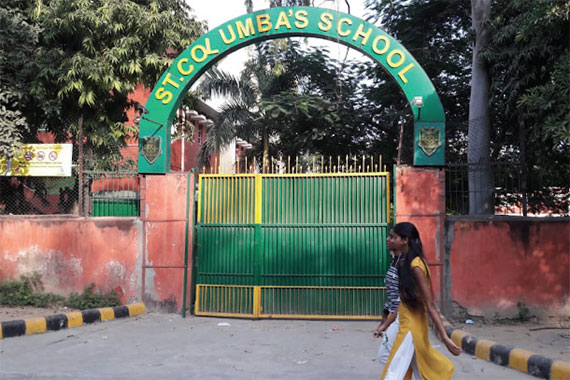
Over 25 years ago a gang of four men took me at gunpoint from a basket-ball court to my school office. They introduced themselves as members of a proscribed organization and made me sit on a chair while they kicked my face.
That was the first attack I encountered on June 14, 1991, in my three decades of working as a Salesian missionary in the north-eastern Indian State of Manipur.
Since then I have been held at gunpoint several times, which is a story quite a few of my confreres working in the field of education can also tell.
Many escape because of sheer luck. At least five have been shot dead in the last 30 years in this this insurgent-infested region where peace seems ever elusive. During the first attack, my abductors wanted me to pay them 400,000 rupees (equivalent to about US$ 11,500 at the time) and give them a video camera and a gun.
As the priest-manager of Don Bosco School, in the State capital of Imphal, I was unable to meet their demands because I had none of those things. And this is something I made very clear to them.
Their reaction was swift and brutal. With a gun in hand, one of them hit me hard on my left cheek. The pain was severe. Later, medical examinations established that the strike had broken my eardrum. The four men then locked me up and made off with the 10,000 rupees (US$280) they found in my office. However, there are about 20 insurgent groups operating in the state and they appear to view Catholic schools as an easy target whenever they want to raise funds to support whatever they are fighting for, which could be for a separate statehood or the goal of establishing ethnic supremacy over other groups. They would spend their time blaming the Catholic schools for a range of imaginary crimes.
Shillong violence: Christian leaders deny communal angle
The leaders of various Churches in north-eastern India have expressed deep pain and anguish at the recent violent incidents that shattered peace in Shillong, capital of Meghalaya State.
Heads of the United Christian Forum and the North East Christian Council met on June 6 in Guwahati to review the situation and seek ways to restore peace and harmony in the city, known as the Scotland of the East.
They met amid attempts by certain section of the media and groups to project the incidents as clashes between Christians and Sikhs in Shillong.
Meghalaya is one of the three Christian-majority states in northeastern India.
The leaders are “concerned at the continued tension that prevails due to fear, mistrust and circulation of fake news,” says a press release issued by Allen Brooks, spokesperson of the Northeast unit of the United Christian Forum.
The Church leaders have requested their people to pray and work for peace. They also appealed to all concerned people to shun violence and “seek the path of dialogue” to find a lasting and peaceful solution to an age-old problem that triggered the latest violence.
The Church leaders also resolved to cooperate and support all efforts at peace building, Brooks told Matters India.
Meanwhile Archbishop Dominic Jala of Shillong too denied that the incidents had any communal color.
“The present disturbed situation in Shillong arose out of an incident that was initially resolved,” the Salesian prelate told Matters India on June 6.
Constitution in danger, human rights trampled: Goa Archbishop
The Indian Constitution is in danger, Goa’s Archbishop Filipe Neri Ferrao has said, adding that a “new trend” of mono-culturalism, which demands uniformity in what and how one eats, dresses, lives and even worships, is putting human rights at risk. In the latest annual pastoral letter to Catholics in Goa, Ferrao also exhorted agencies of the Church in Goa to actively participate in social movements and urged lay Catholics to play an active part in politics.
“At the time of elections, the candidates confuse the minds of many people by making false promises. And the people, on their part, often sell their precious vote for selfish, petty gain. “Today, our Constitution is in danger, (it is a) reason why most of the people live in insecurity,” Ferrao said in his pastoral letter for 2018-19 which was formally released but circulated later. “In this context, particularly as the general elections are fast approaching, we must strive to know our Constitution better and work harder to protect it.”
In the letter, which comes two weeks after Delhi Archbishop Anil Couto warned about an emerging threat to India’s “democratic and secular fabric” Ferrao also alleged that human rights were being trampled in the name of development and mono-culturalism.
“In recent times, we see a new trend emerging in our country, which demands uniformity in what and how we hear, dress, live and even worship: a kind of mono-culturalism. Human rights are under attack and democracy appears to be in peril.
“The various minorities fear for their safety. In short, respect for law is frankly on the decline in this country,” said Ferrao, who is the spiritual and religious leader of Catholics in Goa who account for 26 per cent of the state’s population of 1.5 million.
“People are being uprooted from their land and homes in the name of development. Pope Francis says that ‘the first victim of development is the poor person.’ It is easier to trample upon the rights of the poor, because those who will raise their voice for them are very few.”
Despite criticism, major superiors of India working for the country
The Conference of Religious India held a meeting in Chennai (Tamil Nadu) from 27 to 30 May. Participants agreed that, despite criticism of Christians, they will continue to work together for the good of the country.
Speaking at the event, Msgr Theodore Mascarenhas, secretary general of the Catholic Bishops’ Conference of India (CBCI), reiterated the importance of Church unity, stressing the need for everyone – bishops, Caritas, religious and laity – to work together.
Speaking to AsiaNews, Fr Rayarala Vijay Kumar, regional superior of the Pontifical Institute for Foreign Missions (PIME), said that the meeting provided an opportunity to talk about the country’s political situation, ahead of next year’s general elections.
The venue also gave participants a chance to reiterate “the commitment of the Catholic Church to the needy people of India,” Fr Kumar said, “not only their material needs,” he added, “but spiritual ones as well.” The general assembly of superiors of religious – male and female – congregations is held every three years. About 550 superiors and representatives of Church hierarchies were present at this year’s meeting, including Msgr Giambattista Diquattro, apostolic nuncio to India and Nepal.
“One thing we greatly appreciated was the fact that the nuncio stayed for all four days,” Fr Kumar said. “He spoke to at least with 250 men and women religious. This shows the Vatican’s interest in India.”
Taking a cue from a topic dear to Pope Francis, the Assembly discussed “the Church going forth,” i.e. “the Church going out to the edges (or peripheries) of society,” Fr Kumar explained. “It means finding the Lord in those who thirst for him, the marginalised, and lend a helping hand to those in need.”
With the term edge (or periphery), “we mean being on the margins – the needy, the poor, the sick – but also spiritual, that is, those who live in the misery of the spirit, whether rich or poor.”
Fr V.M. Thomas, a former CRI president, was one of the first to speak. He highlighted the challenges the Indian Church has to face at a very delicate moment in the country’s political life.
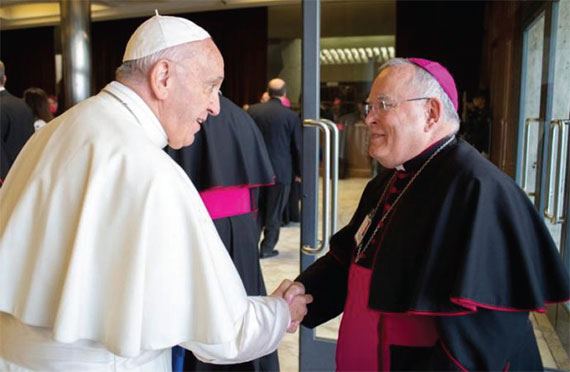
Pope Francis appoints two new bishops for India
The pontiff appointed Father Fulgence Aloysius Tigga as the new bishop of Raiganj in West Bengal state and Salesian Fr Dennis Panipitchai as the auxiliary of Miao in Arunachal Pradesh, according to a press release from the Catholic Bishops’ Conference of India headquarters in New Delhi.
Father Tigga, a priest of Bettiah diocese in Bihar, is currently its vicar general.
Father Panipitchai is currently the parish priest of Mary Immaculate Parish, Chingmeirong, in Imphal archdiocese in Manipur diocese. He is also a consulter of the Salesians’ Dimapur province.