- Prema Jayakumar
 ‘Gaslighting’ is a word that not everyone in my generation knows the meaning of. The older dictionaries do not carry it. It is not all that new, in fact has been around since the first half of twentieth century from a play where a husband controlled the lighting in the house to make his wife doubt her sanity. But though the phenomenon is as old as conversations, it took the sharp eyes and ears of this generation of young people to give the word recognition. When I came across it a number of times, I looked it up. Merriam Webster defines it thus: ‘a form of psychological and emotional abuse in which a manipulator makes a victim question their own memory, perception of reality, or sanity. It is a systematic, often insidious pattern of control used to gain power and make the victim dependant on the abuser’. We’ve all had it said to us. All those, ‘That never happened.’ ‘You are imagining things.’ ‘That’s not what I said.’ Repeated times enough to make us doubt whether what we had seen or heard happen had actually happened.
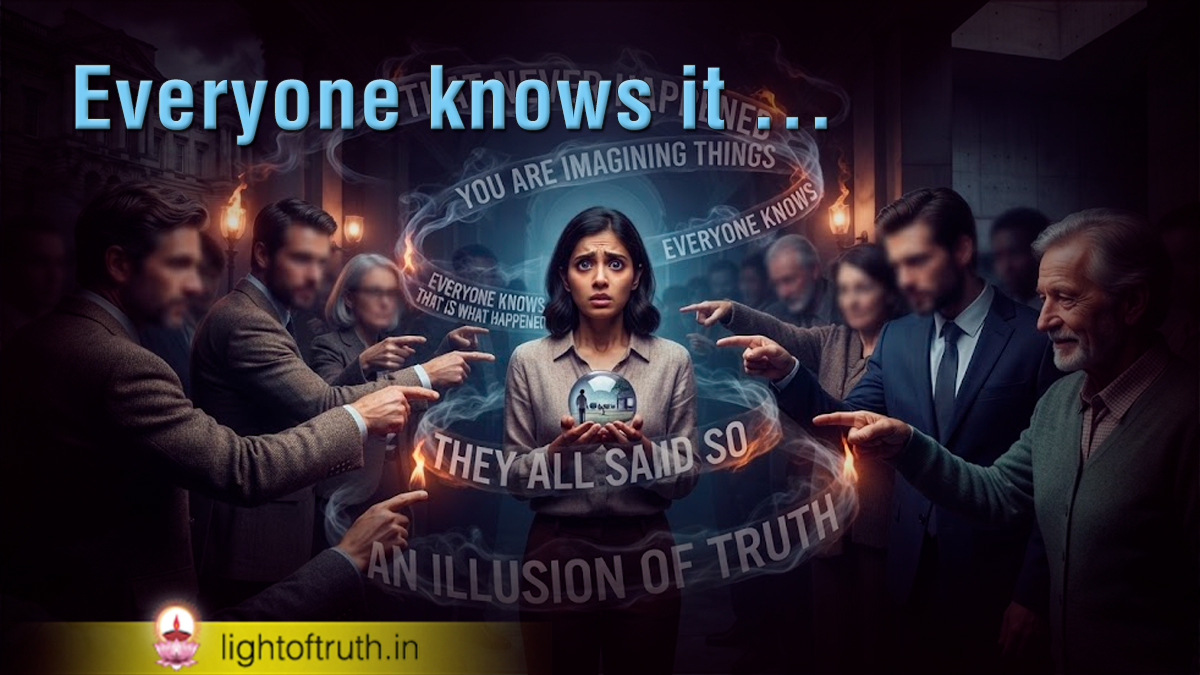
Even worse is the collective gaslighting that goes on in social circles. You question an assumption made by a person loudly about something that they claim happened, and you are told, ‘Everyone knows that is what happened. They all said so.’ When you question further who this large ‘they all’ is, you find that it was what the retired headmaster who lives two houses down who has this completely underserved reputation of omnisience, or a co-worker who has opinions about everything, but not much back-up for those opinions. But because ‘everyone knows’ and ‘they all’ say so and because the rumour aligns with the beliefs of the narrator it is taken for truth, all other narratives dismissed as false, misguided or even at worst, malicious.
As I said earlier, the word has been around since early twentieth century, the phenomenon has been around since mankind could speak. During the Second World War, Goebbels is supposed to have said, ‘if you tell a lie long enough and keep repeating it, people will eventually come to believe it.’ He is supposed to have used the principle in his propaganda machine with great success. The human mind is more likely to believe falsehood simply because it becomes familiar through repetitions. And in the kind of social lying that goes around, it becomes even more familiar because most of the people who repeat the lie or half-truth believe in it themselves. That is, the narrative gives the ‘illusion of truth’.
In 1984, George Orwell’s masterpiece of a totalitarian state keeping its people submissive by propaganda and making words lose their meanings, this situation is brilliantly pictured. He says, ‘political language is designed to make lies sound truthful and murder respectable and to give an appearance of solidity to pure wind’. In Orwell’s ‘doublespeak’ the house of torture is the ‘palace of love’ and enemies are friends and friends are enemies.
I find that this ‘everyone’ who keeps saying controversial things or lies with absolute certainty is around a lot more now than when I was a student. Perhaps because of the speed with which news and rumours spread, there is no time to take a step back, have a look at what is being said, and weigh its likelihood. People believe it because someone on a TV show said it, because it is trending on YouTube, because your colleague or neighbour who had seen the same show says it with certainty. And it is scary. There is hardly time to pause, give the piece of news a hard look, decide whether it could have happened, and even if it could, whether it did.
Language, spoken and written, is a dangerous weapon. Not just in the rumours spread or the lies repeated, for the pejorative nicknames given to groups of people, meant to make them look like a peculiar group, something alien from you. We had thought that political freedom would mean freedom to live as we like as long as we didn’t trouble others. But we are finding out inch by inch, word by word, that freedom to be what you are, freedom to doubt, is something that has to be fought for every day.