- Dr Agnes S Thomas
 According to the World Health Organization, approximately one in six people worldwide experiences loneliness. Social isolation and loneliness significantly affect the health and well-being of people everywhere. Another relevant data point, according to the United Nations High Commissioner for Refugees (UNHCR), is that the number of people forcibly displaced worldwide now exceeds 117 million- roughly one in 70 people. What makes these two realities significant for this reflection is what they reveal about the human experience. Some are visibly displaced and uprooted, while others feel uprooted within their own homes and communities. Both carry a deep longing for connection, safety, belonging, and restoration. Though the causes of their displacement may differ, the human need for home and community remains essential to healing and flourishing.
We cannot create a sense of belonging for others if we do not know where we belong.
This reflection focuses on our calling to embody home and community, to practise radical hospitality toward one another and strangers, and to help those among us who feel uprooted find their footing again. One condition for helping others feel welcome is being grounded ourselves. Where are you rooted? To whom are you connected? What gives you a sense of home? We need to examine our family, school, work, and faith lives to see whether these closely connected spaces are nurturing in us a sense of safety, well-being, and wholeness. If not, why not? How are we fostering the belonging we deeply desire in the places where we live, work, share meals, worship, and build community? Who offers a sense of home in these spaces? Who is being excluded from our homes and communities, and why?
This kind of questioning can make us uncomfortable, and we often look for the next distraction because everything feels overwhelming and beyond our control. So why bother? We see and hear this in both quiet and visible signs of despair across ages, socioeconomic, cultural, and faith backgrounds. What has happened to our deeper instinct to remain together in times of crisis, and to the inner voice that guides us toward trust and urges us to lean on one another in moments of need? All of it points in one direction: something needs to change, and the time is now.
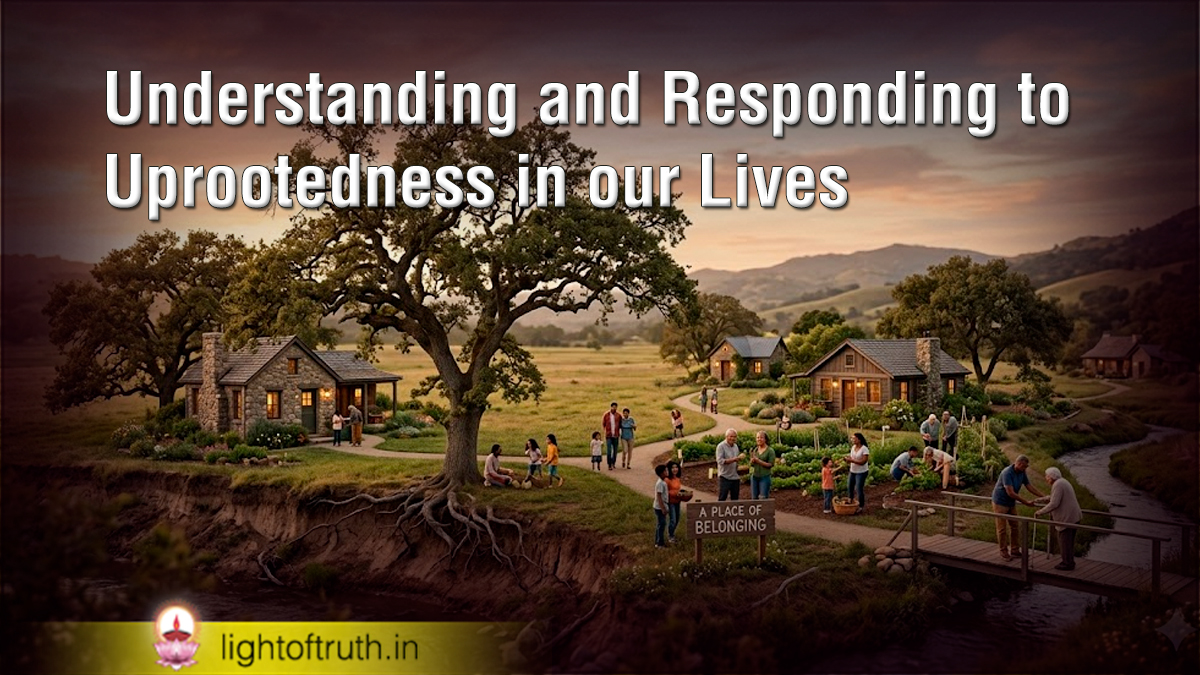
We all need a place to begin, and it is never too late. If you are reading this, then perhaps this moment is yours. Now is the time to step forward and replant what has been uprooted within us, our homes, and our neighbourhoods, so that it may carry outward into the world and ease the turmoil of disruption, pain, and despair. This is not an idealized vision of what might be possible, but a reminder of what is still within our reach.
You may wonder how to break out of this cycle and open a new path. It begins with recognizing our capacity for resilience and hope, and our need for one another. We are strengthened in community, where encouragement, accountability, and belonging help us find our footing again. In a world marked by so much uprootedness, the invitation is simple but profound: To become homemakers, community builders, and peacemakers, creating spaces where both neighbour and stranger can belong.
How can we respond with one small act at a time? It begins with simple, intentional choices in the places where we live and relate to others.
At home
• Offer extra care, time, and attention to the child or adult in your life who is struggling.
At work
• Choose patience and kindness with a difficult co-worker.
• Be a leader who listens, invests in people, and makes room for growth. Work in solidarity with one another
In the practice of Faith
• Practice generosity of spirit toward people you may not feel close to, understand, or naturally welcome.
• Give what you can, even if it feels small, when it helps someone in need.
In our neighbourhood and community
• Be the person who keeps the light on and makes space for the latecomer and the newcomer to feel welcome and included.
• The work of belonging begins with each of us. We are called not to step back, but to step forward as homemakers, peace builders, and practitioners of hope. By extending radical hospitality and making room for one another, we help create the conditions where people can take root again and flourish.