
Catholic Sisters Help Children Living with HIV Build a Better Future
Faith Brings New Hope to Assam Village Once Known for Alcoholism
Cardinal Tagle: Friendship reveals the face of Jesus and the Church
Israel prepares ‘extensive’ West Bank operation after deadly shooting near Tal
Pope: Visit to Türkiye and Lebanon teaches that peace is possible
Thousands protest corruption in Philippines as Church leaders call for accountability
Pope: Nicaea invites Christians to unity in face of violence, conflict
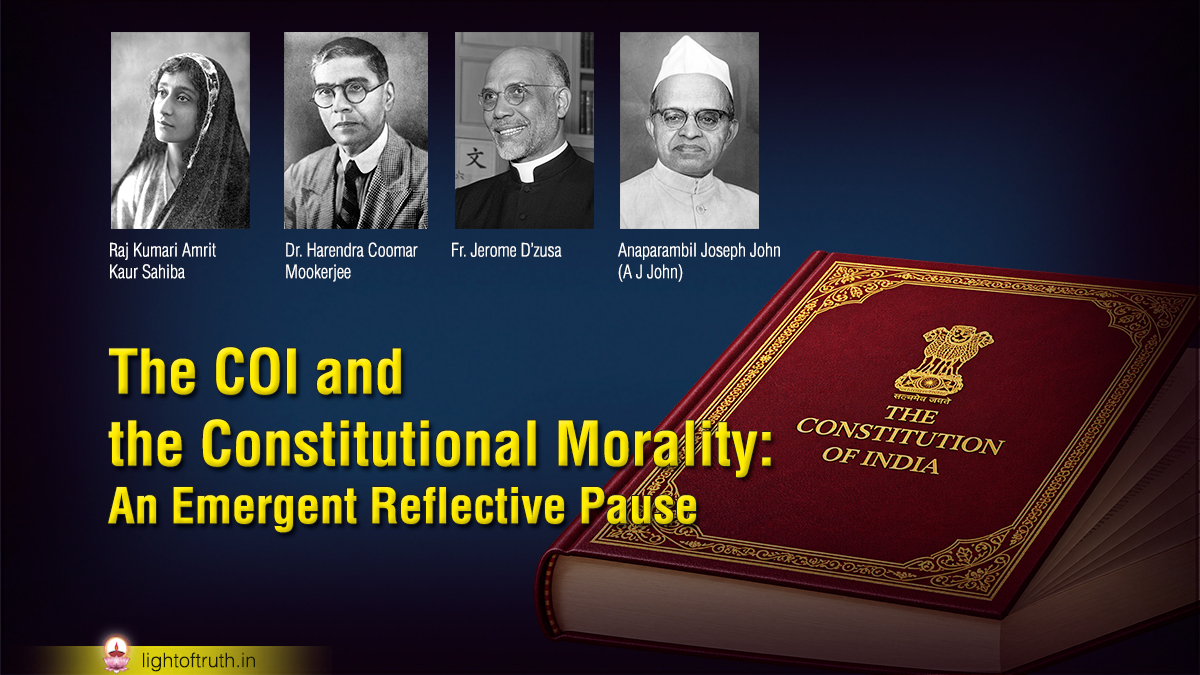
 The Constitution of India is a philosophical and conceptual testament of the ethics of plurality and dialogical democracy. It is so, mainly because the ethical matrix of the COI is Constitutional morality, which stands in contrast to the traditional and religious morality. The Catholic – Christian Philosophy tried its best to stand in dialogue with the idea of Constitutional morality as post-traditional moral stance. The Christian social philosophy stood in intimate negotiation with the Constitution of India in highlighting and affirming certain shared ethical principle, such as, human dignity, democratic pluralism, and social justice. Religious freedom as a constitutional virtue, inherent in the freedom of speech and artistic expression is the post traditional guiding spirit of both civic – political and solidarity rights of the people. Rather than seeking narrow communal safeguards, the Christian Philosophy of the Indian Constitutional spirit, as observed, made the “Christian leaders to champion a Universalist approach to human rights and national integration. This vision deeply mirrored the principles of justice and human dignity found in Catholic and broader Christian social philosophies”.
The seminal interventions in making the COI, Christian leaders like Dr. Harendra Coomar Mookerjee (who argued that what we need is a transformation from a “Christian Communalist” to a “Christian Indian Nationalist”); Fr. Jerome D’Souza, (who is considered the architect of Article 25 (Religious Freedom, Défense of Minority Educational Institutions (Article 30), A Secularism of Amity, Not Separation: Influenced by Catholic jurisprudence. Fr. D’Souza argued against a sterile, Western style of secularism that completely divorces the state from religion. Instead, he advocated for a state that respects all religions equally (Sarva Dharma Sambhava) while remaining neutral and non-discriminatory); and the major voices of the spirit of the Constitution makers like Amrit Kaur, a true Gandhian Christian, Anaparambil Joseph John (A.J. John): A prominent Catholic leader from Kerala, were instrumental in moulding the COI, along with Dr. D R Ambedkar and others.
Constitutional Morality as the post-traditional ethical self-reflectivity, is the stimulating software of the Constitution of India. According to one of the prominent narratives in India that seeks to highlight that the COI is faulty and falls short of its celebrated cultural ideals, the worth of the Constitutional Morality may be debatable and dubious. However, two years ago, on 26th November, Prime Minister Narendra Modi wrote an open email letter to the citizens of India, reminding us that it was a day of immense pride for every Indian. He added that “It was on this very day in 1949 that the Constituent Assembly adopted the Constitution of India, a sacred document that has continued to guide the nation’s progress with clarity and conviction. … It is the power of our Constitution that enabled a person like me, coming from a humble and economically disadvantaged family, to serve as the Head of the Government continuously for over 24 years”. It is because the COI, animated by the Constitutional Morality, modifies and makes many pre-traditional and traditional value systems abruptly and progressively post-traditional.
As Rajiv Bhargava observes in his Politics and Ethics of the Indian Constitution, “In 1950, for the first time in their history, a diverse collection of individuals and groups became the people of a single book, one that reflects their commitment to protect their mutual rights and which articulates a collective identity”. Lord Bhikku Parekh says, the COI is a statement of Indian identity and national identity, as well as the crises associated with it, along with an alternative conception. Historically, the evolutionary genealogy of the COI, as historians like A. R Desai say, qualitatively evolved through several stages. As he points out, the historical evolution of the Constitution has been recognized through several stages of our national movement or freedom struggle. At first, it was a middle-class, bourgeois movement affirming and claiming their commercial mercantile capitalist interest. In the second phase, at the beginning of the 20th century, it was inspired mainly by Bala Gangadhar Tilak, Aurobindo Ghosh, and the Hindu National affirmation. In the third phase, with Mahatma Gandhi, from 1915 onwards, it transformed into a people’s movement with a mass appeal. All the above roll-up to fashion the praxeology of popular, anti-imperial nationalism, which was inclusive of all religions, languages, cultures, regions, a kind of federalism and visualizing federalism in the Constitutional Values.
Eventually, our Freedom movement, as the formative dynamics of the COI, was a struggle against casteism, a fight against the Draconian colonial rules for more affirmative personal liberty and civil rights, and a struggle for freedom of speech and expression. Subsequently, it becomes consolidated that the COI institutionalizes social freedom that presupposes social dialogue and the ability to negotiate rights and the dignity of a human being. The value of social freedom and dialogue is the central virtue of the Constitution of India. It, as the seminal logic of any modern constitution, is post-traditional morality. The Constitution, as a document that can enliven a democratic system, should necessarily uphold a domain of values that cherishes human dignity, freedom, itineraries of rights regime, against traditional moralities and their uncritical, cultural claims.
One of the most important tenors of the COI is constitutional morality. It engenders post-traditional ethical insight. As Ambedkar put it: “Without equality, liberty would produce the supremacy of the few over the many. Equality without liberty would kill individual initiative. Without fraternity, liberty and equality could not become a natural course of things”. If the Geist of the above doesn’t act up, the practice or interpretation of the Constitution would slip into majoritarianism. George Grote, who coined the term constitutional morality, defined it as an institutionalized civic culture of mutual respect and dialogical representation, empowered by the power of public reason. B R Ambedkar and Grote defined Constitutional morality, primarily as the opted moral and ethical standards and their ability to diffuse the pre-constitutional and traditional morality.
It is also interesting to note that though the parliamentary-constitutional philosophy of Nehru, Ambedkar, and Vallabhbhai Patel, was largely in opposition to that of Gandhi, when it comes to Constitutional morality and value, Gandhi’s parliamentary Swaraj, which stood in contrast to the centralized parliamentary constitution adopted by the Constituent Assembly, doesn’t reject the professed import of Constitutional morality. It is curious to read Gandhi’s position in tandem with Charles Taylor’s concept of the play between Democratic Rights and People’s Rights. According to Taylor, Democratic Right and People’s Rights are co-originating. The life and quality of democracy are in the efforts to continue and bridge/challenge these two rights. Democratic Rights are given/granted/gained in the Constitution, but People’s Rights are to be made through self-rule, interpreted further, which is a constant activity. When the ‘agencies’ like Parliament/Executive/Judiciary/the Fourth and Fifth Estates interpret Democratic Rights, People’s Rights are realized in constantly revitalizing the constitutional morality and the reassuring institutionalization of the freedom to talk and listen, freedom of speech, which can be called broadly the enactment of social dialogue and civic culture.
Only Constitutional morality as the tabernacle that inspires the life of the Constitution can brighten up a grassroots level realization of democracy and coexistence. It alone can imagine individuals and communities creatively addressing the principles of dialogue and dissent, both in the institutional and anti-institutional sense.





Leave a Comment