- Dr. Roy Palatty, CMI
Director, Carmel Spirituality Center,
Tennessee, USA
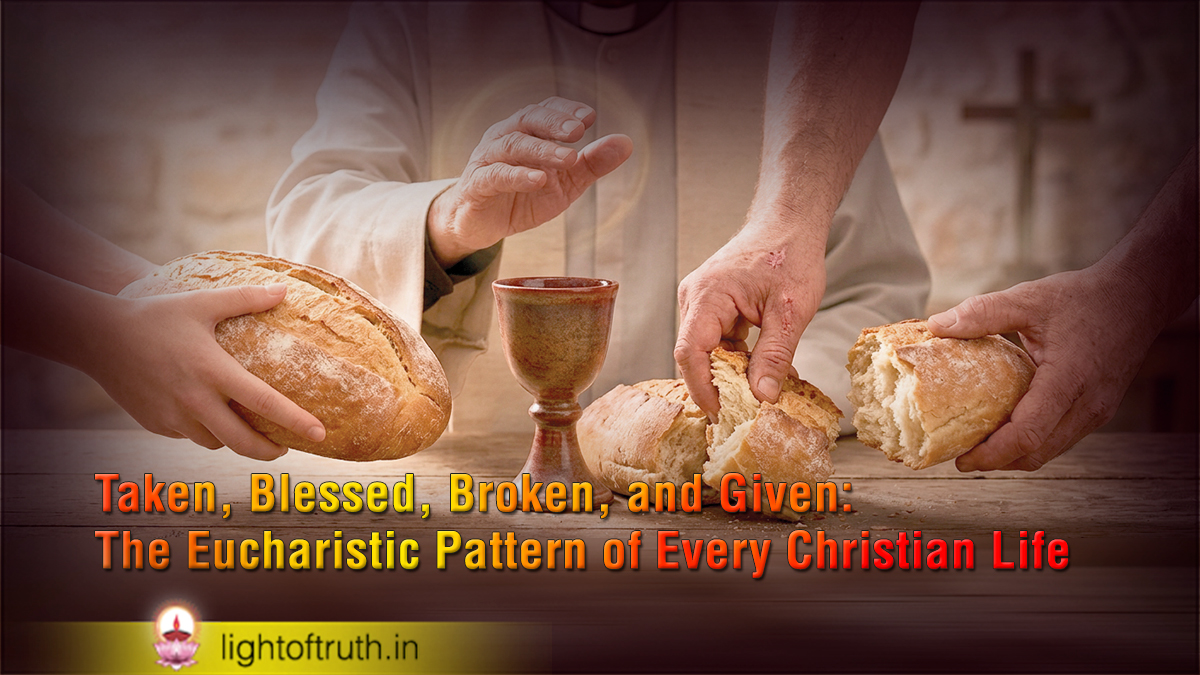
 “When he was at the table with them, he took the bread, blessed and broke it, and gave it to them” (Luke 24: 30).
For a long time, I understood the Eucharist mainly as something we celebrate at the altar. But gradually, I began to realize that to become truly Eucharistic is not merely to participate in the Eucharist; it is to allow the Eucharist to shape the very rhythm of our lives. As Leo the Great beautifully said, “We become what we eat.” Every Eucharist follows four sacred movements: the bread is taken, blessed, broken, and given. These are not merely liturgical gestures performed upon bread and wine, they are the pattern through which God transforms ordinary lives into instruments of grace. Every vocation, every calling, and every spiritual journey passes through these same movements.
The great French Jesuit spiritual master, Pierre Olivaint, once remarked: “In the morning, during the Mass, I am the priest, and Jesus is the victim. But throughout the rest of the day, Jesus is the priest and I am the victim.” What the priest does with the bread during the Eucharist, Christ desires to do with each of us every day. These four movements – taken, blessed, broken, and given – become four stages in our spiritual journey. Sometimes they unfold within a single day; at other times they stretch across years. Yet through each stage, God is quietly at work.
The Taking Stage: The first movement is being taken or chosen. This is often the time of awakening and joy – the moment when a person begins to sense that God has chosen him or her for a purpose. Such awareness gives meaning, direction and motivation to life. When we know we are chosen, many fears lose their power. This stage is often marked by enthusiasm and hope. Others may admire or encourage us. We may discover the hidden talents, new opportunities, or a deeper sense of calling. Yet, alongside joy, there can also be uncertainty, confusion, and even opposition. The one whom God chooses is often misunderstood before being understood. Still, to be chosen by God remains the greatest honors of life.

Origin of the Feast of Eucharist…
The term “Eucharist” is derived from the Koine Greek word eucharistia, which means “thanksgiving,” as Jesus “gave thanks” before breaking the bread. The foundational origin of the Eucharist itself is the final Passover meal Jesus shared with his disciples before his crucifixion. Jesus commanded his disciples to continue this practice, which became the central act of Christian worship, representing his sacrifice and resurrection. As recorded in the Gospels and the epistle to 1 Corinthians Jesus broke bread and shared wine, identifying them as his body and blood (Matthew 26: 26-30, Mark 14: 22-25, Luke 22: 17-20), and 1 Corinthians 11: 23-26).
The Feast of the Eucharist, primarily known as Corpus Christi in the Catholic Church, originated in the 13th century to celebrate the Real Presence of Jesus Christ in the Holy Sacrament. It was established by Pope Urban IV in 1264, through the papal bull Transiturus de hoc mundo, largely influenced by the visions of St. Juliana of Mont Cornelon, suggesting the needed for a special feast day to honouring the Eucharist and there was a Eucharistic Miracle of Bolsena where a German priest doubted the real presence of Christ in the Eucharist, while celebrating Mass the host began to bleed on the altar linens (corporal), solidifying belief and prompting the Pope to act.

I remember attending a retreat during my pre-university years. The talks didn’t inspire me much. But during the Eucharistic adoration, I experienced an indescribable sense of God’s presence. I felt surrounded by a peace and joy I had never known before. After the adoration, I eagerly searched for the Priest who led it and shared my experience with him. He looked at me intently and said, “You are wanted by Jesus; you are chosen by Him.” I felt I had lived my entire life till then only to hear those words. The awareness of being chosen not only changes how we see ourselves; it also opens our eyes to see the chosenness of others.
If you are in the taking stage, your prayer can simply be: “Thank you, Lord.”
The Blessing Stage: After taking the bread, Jesus blessed it. So too, God blesses the lives He calls. This is a joyful time. God surrounds you with family members, supportive friends, elders, formators, trainers, and spiritual masters. Doors open. Relationships deepen.
Success follows in every step. Business expands, ministry widens, and family and friendship grows. We feel strengthened and encouraged. At such moments, it can seem as though both heaven and earth are smiling upon us. Consider Moses growing up in Pharoah’s palace while his own people suffered in slavery. We begin to see fruits in our lives. We love this stage. We may be tempted to halt here. But God does not allow us to settle. Blessings are not meant to be stored; they are meant to be shared. We are too busy to recognize how deeply we are blessed. Some blessings are visible and material; others are hidden and spiritual.
If this is your blessing season, let your heart say: “Hallelujah!”
The Breaking Stage: After taking and blessing, Jesus broke the bread. This is the stage we often try to avoid. Brokenness may come through failure, disappointment, abandonment, rejection, sickness, misunderstanding, death, or even our own mistakes. Each person’s brokenness is as unique as his or her calling. Those whom God uses the greatest are often those who have been broken most profoundly. St. Paul writes, “When I am weak, then I am strong” (2 Corinthians 12:10). True spiritual power frequently emerges not through human strength, but through surrendered weakness. God never wastes a wound.
Two years ago, I came to understand this truth in a deeply personal way. As a priest, I have often stood before the faithful proclaiming the boundless love and providence of God. I had stood before many grieving families offering words of consolation and faith. But suddenly I found myself not as a preacher, but as a grieving son – struggling to hold on to the very truths I preach. My mother died in a sudden road accident. Her life had been marked by simplicity, fidelity in prayer, and a deep, quiet trust in God. The loss was devastating. During her final days in the intensive care unit, I spent long hours in the Chapel, pleading with the Lord for just a little more time – one more conversation, one more smile, one more moment of together. Yet she left us in silence.
What wounded me was not only the separation itself, but the questions that followed. How could someone who prayed faithfully throughout her life meet such an abrupt and painful end? Why did prayer seem to encounter silence? Over time, however, I began to realize something important: when children break something, they often do so carelessly. But when God breaks, He does so with purpose. Without being broken, the bread can never be shared. The mystery of brokenness does not immediately reveal its meaning. Yet in God’s hands, even wounds can become places of grace. As Henri Nouwen once wrote, ‘In God’s hands, even a broken glass can shine.”
If this is your breaking stage, your prayer is simply: “Here I am, Lord.”
The Giving Stage: Finally, Jesus gave the bread. This is the fulfillment of the Eucharistic journey. We are chosen, blessed, and broken so that we may become a gift for others. Human fulfillment is found not in self-preservation, but in self-giving. A joyful life is ultimately a life poured out in love. The bread is broken not to remain on the altar, but to nourish the hungry. Likewise, our lives acquire meaning when they become nourishment, encouragement, healing, and hope for others. In every stage of life, the offering remains in the hands of the Lord – and in His hands, nothing is ever wasted. Often we do not fully understand our brokenness until we begin to give ourselves away. The wounds we once resisted become channels of compassion. The pain we once questioned becomes a source of wisdom and tenderness toward others.
The life of Jesus Himself reflects this Eucharistic pattern. The Father took Him from Nazareth. He was blessed with a powerful ministry of teaching and miracles. He was broken upon the Cross in Jerusalem. And through the Resurrection, He was given the salvation of the world.
Mission, therefore, is not first about what accomplish for God, but about what we allow God to accomplish within us. Only when we permit ourselves to be taken, blessed, broken, and given can our lives truly become Eucharistic – bread broken and shared for the life of the world.
If this is your giving stage, let your prayer be: “Amen.”