- Dr. Sr. Gini Azheparambil
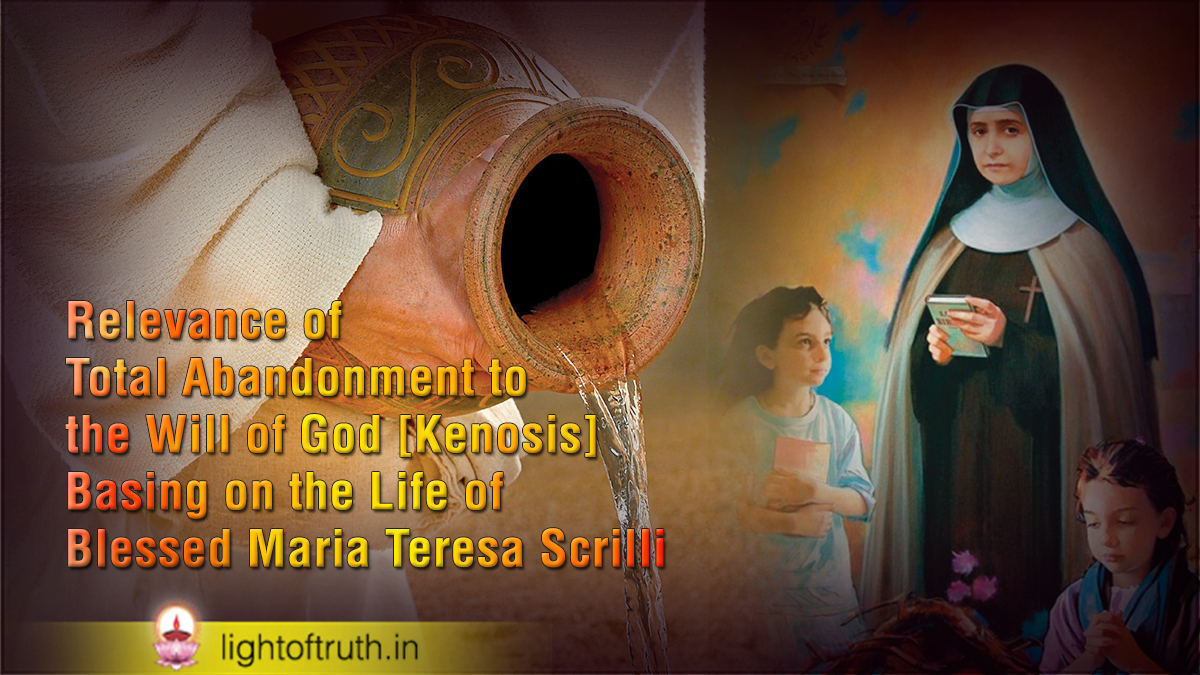
 The spiritual journey of Blessed Maria Teresa Scrilli unfolds in a complex historical period, marked by political evolution, ecclesial changes, and cultural tensions. In Maria’s case, her spiritual journey, we discover how surrender to God’s will leads to true freedom, a profound spiritual life, and a fruitful mission. Blessed Maria Teresa interprets Christian life as a continuous act of self-giving and conformity to Christ’s suffering. Her spirituality is a form of active witness, capable of combining contemplation and action.
Total Abandonment to the Will of God (Kenosis)
The idea of surrender to God’s will is deeply present in the pages of the Scripture. Abraham’s willingness to sacrifice his beloved son, Isaac, Joseph’s acceptance of suffering in Egypt, and Moses’ reluctant but faithful leadership of Israel illustrate lives marked by faith in God. These figures embody early expressions of kenosis, where surrender does not mean defeat, but union with God. The Psalms and prophetic books further echo this theme of surrender to God’s will, often describing it as the path to renewal, guidance, and intimate union with God. St. John the Baptist, who was charged with a prophetic mission, proclaimed the words of self-emptying: “He must increase, but I must decrease” (John 3:30). St. Joseph and Virgin Mary, was a family of mutual sacrifice, the perfect models of kenosis.

In an age marked by individualism and the separation between recognition and self-affirmation, she stands as a prophetic witness to the power of self-emptying love.

Kenosis, meaning “emptying,” in its strict sense is referring to the act of Jesus Christ who “emptied” himself of his divinity to assume the human condition, particularly through his incarnation and passion. Kenosis means intentionally renouncing one’s desires, rights, and comforts to embrace God’s plan. Doing God’s will plays the central role in the life of such persons. Every baptized disciple of Jesus is bound to follow this path of kenosis. Maria Teresa Scrilli, as a Christian and as a consecrated remains a concrete model of this. So the spiritual path followed by her shall be an eye-opening experience not only for the religious congregation she founded but also for the Christian folk who genuinely wish to follow Jesus.”
Maria Scrilli (Maria Teresa of Jesus) born on 15th May 1825 and went to heaven on 14th November 1889 was a Italian sister who founded Sisters of Our Lady of Mount Carmel. Scrilli was an able educator.
With strenuous effort she was able to open several schools. During the period of anti-clericalism she had to leave everything. However, later when opportune time came she could reinstitute the congregation and new schools. She was also compassionate towards the poor. She was known for her enlightened views of a fundamental Christian education.
The deep interiority
From her way of life it was very clear that Maria Teresa Scrilli was a person of profound interiority. Deep devotion to Mary and the Eucharist was the identity of Maria Teresa. Her journey of life was marked by trials, uncertainties, and sacrifices, which she accepted with a spirit of trusting abandonment. Total willingness to give up her dreams to follow what God asked of her in every moment of life is praise worthy. It is precisely this kenosis that led her to establish the Congregation of the Sisters of Our Lady of Mount Carmel, inspired by Carmelite spirituality, Maria Teresa Scrilli’s religious life is founded on a profound spirit of abandonment to God’s will, expressed concretely through the practice of the evangelical counsels. An Important factor one could notice along with that is the commitment and total dedication to the spiritual well-being of others, expressing a radical spirituality of benevolence. As a religious the evangelical counsels she lived was to recognize God as the only true support and a sign of absolute trust in divine providence, love in its fullness by giving entirely to God through universal love and living a path of profound listening to the inner voice of the Spirit. She wrote: “I offered myself as a victim to the will of my God”. Dedication to the spiritual good of others, underlines the apostolic heart of her spirituality. So in her there was a blend of profound Christian spirit and deep religious interiority of a specially consecrated person.
Her Fraternal love was characterized by encouragement, correction, and a profound respect for the freedom and uniqueness of each individual.
The heart of Maria Teresa’s spirituality was contemplative prayer, which became a means of interior transformation and spousal union with Christ. Her sensitivity to the Holy Spirit enabled her to recognize God’s will in every painful circumstance. In a world filled with noise and confusion, this spiritual attentiveness is particularly relevant today. Her life reminds us that God often speaks in silence, through prayer, people, and providential events. Fidelity to prayer, even in moments of spiritual aridity, was the foundation of her ability to discern God’s will, even in the midst of illness, rejection, and misunderstanding.
Spiritual Enlightenment
Sacred Scripture served as Maria Teresa’s spiritual and moral guide. She drew daily inspiration from the Sacred Scriptures. She was able to connect her life to the word of God through an indissoluble bond with it. “Many times I remembered poor Jacob, who, in order to have his beloved Rachel, had to serve for seven years and then renew another seven. But oh, what desire was that? One cannot compare things with things so distant from each other. This was the reason that made the bitter sweet to me; I say, the denial of those secondary things I desired for love of the beloved Object, became pleasing to me, making an offering of them to Him”. The teachings of Saint Mary Magdalene de’ Pazzi and Saint Teresa of Avila, on interior detachment and mystical union provided her with interior insights and a profound mystical strength.
Fraternal Life and Leadership in kenosis
Inspired by Saint Catherine of Siena, Maria Teresa believed that true holiness comes from knowing “who God is” and “who we are.” This true knowledge of God is inseparable from self-awareness and holiness. She was not afraid to act decisively because she was rooted in God’s truth, not in her own strength. Her approach to everything was marked by compassion, understanding, and firm guidance. Through her writings, letters, and personal notes, we understand a leader skilled in administration and policymaking. She valued unity, but not at the expense of truth. Her fraternal love was characterized by encouragement, correction, and a profound respect for the freedom and uniqueness of each individual expressing, “Lord, by myself I can do nothing, and even if I could, I would not want anything, for I desire nothing except that your will be done in me, upon me… Moses, despite his weaknesses, becomes a leader not by desire, but by dependence on God’s power. “Her prayers of intercession, her obedience to divine instructions, and her humility before the people make her a model of a leader emptied of self.
Apostolic zeal and Love for others.
In the Christian educational tradition the integral formation of the human person embraces the harmonious development of all dimensions-physical, intellectual, emotional, moral, and spiritual – of the human being. This, always seeks the good of souls and, in every aspect, an intimate relationship with God and responsibility toward the community. Her pedagogy aimed to form the total person that would lead to live according to the divine will and in service to others. In every student, she saw a soul that needed to orient itself toward God and His will. She wished to form people capable of facing life with resilience and hope, without fleeing from difficulties, but facing them with a heart oriented towards God. Thus, she was not only a teacher, but a maternal figure, a guide and supporter for families. Maria Teresa comprehended education for building up the social and intellectual life along with spiritual and human growth. Her educational vision is a model for today, an invitation to a formation that aims at the integral and profound transformation of the person.
The heart of Christian discipleship and fruit of kenosis, is love. For Maria Teresa, love is sacrificial. Purity of intention – seeking in all things the will of God, the good of our fellow men and self-denial – that everything must be connected to the fulfilment of the obligations of one’s state – is a necessary factor. According to Maria Teresa these all are enough to become a saint.
Transformation through Kenosis
Maria Teresa Scrilli’s life was a journey of profound suffering that brought her closer to Christ. Though she confronted psychological and physical weakness, political and religious obstacles, she believed these hardships were opportunities to draw closer to Christ and align herself with God’s will. Her early life difficulties strengthened her to relate to Christ’s passion and taught her to blissfully accept pain. Actually suffering purified her soul and strengthened her mission. The Passion of Jesus became her passion. Her path reflects that of Saint John of the Cross, who teaches that the soul must pass through the night of purification before it can unite with God in the morning light. Maria Teresa understood that suffering is an integral part of the formative journey. All her writings express this conviction in a simple but very effective way. She states: “Suffer for love”. She writes: “I compared myself to gold in the hands of the goldsmith, and wax in the hand of its worker, ready to assume any form He pleased”. She said: “I was a flame in the open sky, exposed to a thousand winds, which all tried to push me towards the ground, and it was grace if I did not bend in any direction; of this I am certain, and I did not even feel the slightest movement in my affections”. Thus, her spiritual maturity allowed her to experience the love of God even in suffering. Suffering is kenosis and this leads to true love.
Spirituality of Maria Teresa: Hope and mystical union
In her autobiography, she records moments of darkness, emotional desolation, and inner anguish. Along with that she also describes a peace that surpasses all understanding, emerged from her total trust in God. Despite rejection, setbacks, and even the suppression of her institute at one point, she trusted that God’s plan would be realized in time. Maria Teresa’s life culminated in a profound union with the Triune God. Through the Father, she learned discernment. Through the Son, she learned surrender. Through the Holy Spirit, she received wisdom and strength. Her spiritual writings speak of a mystical experience of God’s presence—gentle, continuous, and transformative. Her story is a testimony of hope in faithfulness to God. Maria Teresa Scrilli, was a woman of profound faith, unwavering hope, and apostolic zeal, continues her mission and the mystery of kenosis through her followers, in a profound and real way of true freedom, a fruitful mission for the glory of God and the good of humanity. In an age marked by individualism and the separation between recognition and self-affirmation, she stands as a prophetic witness to the power of self-emptying love. Her holiness is a concrete and living model, encouraging us to seek God’s will with humility, trust, and love, to become, in turn, instruments of transformation in our world. In this sense, Maria Teresa calls everyone to live the authentic spirit of service and abandonment that leads to a life of self-emptying to do God’s will. Her life shows us that holiness is possible when we trust deeply in God, listen attentively, and act courageously. Whether we are called to family life, consecrated life, or professional service, we are all called to kenosis, to empty ourselves before God.