- Dr. Pius V Thomas
(Professor of Philosophy, at the Department of Philosophy, Assam Central University)
 Human dignity, in simple terms, relies on the value of the inherent worth of every individual, which offers respect, dignity, and protection from exploitation and degradation. Human dignity cannot be thought of without referring to the enlightenment values such as liberty, fraternity and equality. Human dignity to dignified life and dignity to all forms of life is a burgeoning insight in contemporary rights discourses. The concept of human dignity mediates and negotiates all other corpus of rights and stands above posing a post -ideological, post-meritocratic and democratic state of mutual choices. It obliges a closely and widely woven network of recognition and democratic inclusion as contemporary critical thinkers presented it. An interesting facet of dignity intuitions that debatably shows its presence is the moral prerogatives of religion in democracy.
Religion in democracy in a post-traditional sense, as we know now, involves a range of secular and post-secular reciprocity, which is truer in India when it comes the Indian understanding of secularism as Sarvadharma Samabhava, as we popularly call it or Sarva Dharma Samanvaya, as Gandhi expressed it. However, the negotiability of the secular and the post-secular becomes meaningful only when it invokes and entertains a post-religious dimension of religiosity. Post-religiosity is the sensibility that religious philosophies are not monolithic but amalgams of different poles of status-quoist, liberationist responses to both secular and post-secular self-understanding of religious philosophies. They generate and have critical self-knowledge as they encounter post-traditional, Democratic and Cosmopolitan value claims.

The crucial message of the encyclical is that the governments should ‘regulate AI companies, protect workers who are displaced by AI, and ensure humans retain oversight of autonomous weapons’. As some of the popular commentaries say, “The primary choice is not between a ‘yes’ or ‘no’ to technology,” the pope wrote, “but rather between constructing Babel or rebuilding Jerusalem”.

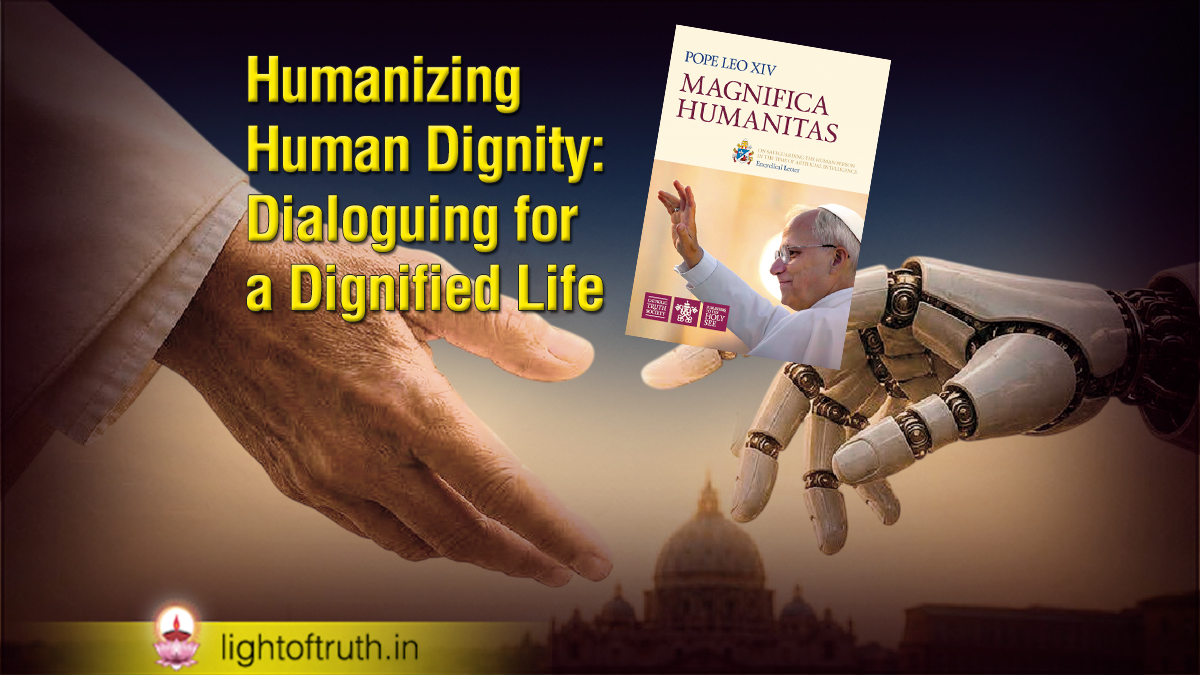
It is in this context the latest encyclical of Pope Leo XIV becomes significant and debatable. Pope Leo came out with his first encyclical, titled Magnifica Humanitas. The crucial message of the encyclical is that the governments should ‘regulate AI companies, protect workers who are displaced by AI, and ensure humans retain oversight of autonomous weapons’. As some of the popular commentaries say, “The primary choice is not between a ‘yes’ or ‘no’ to technology,” the pope wrote, “but rather between constructing Babel or rebuilding Jerusalem”.
As Anna Rowlands, theologian at Durham University, says, Pope Leo XIV’s first encyclical, Magnifica Humanitas: On Safeguarding the Human Person in the Time of Artificial Intelligence, presented at the Vatican on May 25, challenges society to reflect on fundamental questions such as What do we think human life is? Who are we as human beings? What vision and goal are we aiming for in our humanity and in our lives together?” She adds to the above that “He offers us both a very strong set of criticisms,”, “of the false storylines, the false narratives about what it means to be human, particularly those that place power and domination over others, whether in politics, war, conflict, or the economy”. Pope’s answer to the war-mongering and tone world is “a rather beautiful vision of a civilization of love.” Perhaps he would sound that the source of all dignity is unconditional love and, as the encyclical “urges humanity to recover a shared moral imagination, especially a way of seeing one another and the world that recognizes the inherent value of the human person. Summarizing the Geist of the apostolic letter, Anna Rowlands, shares with us that the encyclical “warns against transferring human dignity to technological tools or imagining that AI could somehow become “more human” than humanity itself, while simultaneously diminishing our own humanity.
The apostolic letter, as a document that intends to make dialogue with multitudinous philosophical and ideological perspectives, succeeds to a large extend in imagining a loop of an ecology of thought. Though it is a small document, its core chapters, Chapter 3, 4 and 5, technology and dominance: the grandeur of humanity in light of the promises of AI, safeguarding humanity at a time of transformation: truth, work, freedom, guarding the human person in the time of artificial intelligence and the culture of power and the civilization of love respectively, captures the inner value tendrils of human dignity. It is interesting to read how such a stance can make Pope Leo a moral voice unavoidable in our search for social justice and a harmonious coexistence, as he would remind us that every civilization and culture seem to be presenting a story of growth from disvalue to value, perhaps order out of chaos. When we look closely, it is like a spectrum. The disvalue – value structure ranges from self-aggrandizement to a sense of mystery and a genuine/creative idea of human ignorance, when it comes to the claims of ultimate knowledge (e.g. Socrates) on the one side and from rules and rituals of social formation and structural efforts to control and govern to enlightened ideas and ideals of responsibility, love, and compassion. Our concept of God will tell who we are (even atheists fall into this litmus test, as most of the time atheistic ‘no-god’ statements end up in ‘some other god(s)’). The biggest problem of technological civilization and the presently dominant system of liberal-advanced capitalism is that all their modern functional tools take humanity to a dehumanizing disvalue of ‘profit and domineering’ attitude (Gandhi was a staunch critic of it). Therefore, democracy is not only a mere political system, but it should be also made into a harmonious effort to undo disvalues and create new humanizing values.
It is such a moral courage to make a pacifistic stance against war of all kinds, and as the New York Times reported,“ Amid a growing dispute with the Trump administration over the legitimacy of American attacks in Iran, Leo used a speech on Thursday in Cameroon to express “woe to those who manipulate religion and the very name of God for their own military, economic and political gain, dragging that which is sacred into darkness and filth.” And “Blessed are the peacemakers,” he said, adding: “The world is being ravaged by a handful of tyrants, yet it is held together by a multitude of supportive brothers and sisters.” It gives him the guts to openly condemn waging war as an uncivilized act. In the modern world, it is not at all a solution to any problem, as wars create big, bleeding wounds in the heart of humanity. Since the very beginning of human civilization, the human race has been suffering from such a self-cultured, hostile virus. We miss Mahatma Gandhi, Albert Einstein, Bertrand Russel and Jean-Paul Sartre, Thomas Merton, Pope Francis and the like.
A deep sense of human dignity, dignity of life will also be cautious against slavery of all kinds, along with slavery to violence and wars. As it is almost obvious that uncontrolled greedy manipulation of AI would result in human slavery, the dignity stance foresees it and apologizes by saying Mea Culpa to the irresponsible past, a possible future and the very genealogy of slavery. Leo XIV made a historic apology for the role the Holy See itself played in legitimizing slavery and for having failed to condemn it for centuries, calling the Vatican’s record a “wound in Christian memory”. Past popes have apologized for Christians’ involvement in the trans-Atlantic slave trade. But no pope has ever publicly acknowledged, much less apologized for, the role that past popes themselves played in giving European sovereigns explicit authority to subjugate and enslave “infidels”. It is as Dostoyevsky says “I did not bow down to you; I bowed down to all the suffering humanity”. Human dignity is a value that can make the ability to apologize and propose pacifism as the most fundamental counterfactual stance in imagining democracy.