- Fr. Dr. Jose Puthussery
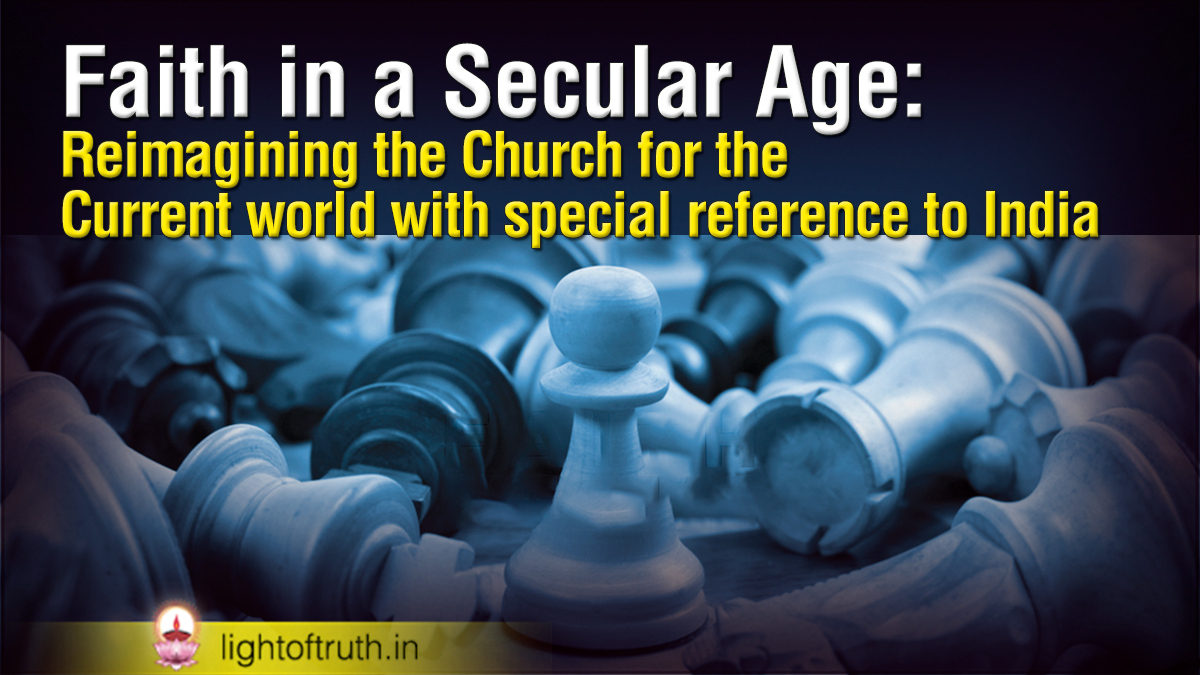
 The contemporary world presents a paradox for religious belief. On the one hand, traditional structures of faith no longer command unquestioned authority; on the other, the human longing for meaning, transcendence, and hope remains as strong as ever. This tension defines what many scholars call the “secular age”—a time not of declining belief, but of transformed conditions of belief. In such a context, the Catholic Church is invited not merely to defend its past but to reimagine its mission with creativity, courage, and fidelity.
This reflection draws inspiration from the insights of Charles Taylor and Karl Rahner, two influential thinkers who, in different ways, explored the relationship between faith and modernity. Their perspectives help illuminate how the Church can engage meaningfully with today’s world—particularly within the unique socio-religious landscape of India.
From a World of Certainty to a World of Choice
In earlier centuries, belief in God was often taken for granted. Society itself was structured around religious assumptions, and faith was woven into the fabric of everyday life. Today, however, belief is no longer self-evident. It is one option among many, existing alongside atheism, agnosticism, and diverse spiritual paths. This shift does not necessarily mean that faith has weakened; rather, it has become more personal, more reflective, and often more intentional.

Today, however, belief is no longer self-evident. It is one option among many, existing alongside atheism, agnosticism, and diverse spiritual paths. This shift does not necessarily mean that faith has weakened; rather, it has become more personal, more reflective, and often more intentional.

Taylor describes this transformation as a change in the “conditions of belief.” Modern individuals live as what he calls “buffered selves”—less open to the transcendent, more focused on autonomy and self-determination. The rise of what he terms “exclusive humanism,” which seeks fulfilment within the boundaries of the material world, has reshaped how people understand happiness and purpose.
Yet this is not the whole story. Even in a secular age, the desire for something beyond the immediate and the material persists. Many experience what might be called a quiet restlessness—a sense that purely immanent explanations of life are insufficient. This opens a space for the Church, not as a dominant authority, but as a companion in humanity’s search for deeper meaning.
The Church as Dialogue, Not Domination
If belief is now a matter of choice, the Church must reconsider how it presents the Gospel. The age of imposing faith through social or cultural dominance has passed. Instead, the Church is called to engage in dialogue—respectful, attentive, and open.
Rahner’s theology offers a profound foundation for this approach. He insists that God’s grace is not confined to explicitly religious spaces but is at work within the whole of human history. Everyday life, with its struggles and aspirations, becomes the arena of God’s self-communication. This insight challenges the Church to recognise the presence of grace even in secular contexts.
One promising way forward is through a renewed emphasis on inculturation. This involves expressing the Christian faith through Indian cultural forms, philosophical categories, and spiritual sensibilities. Rather than presenting Christianity as something foreign, inculturation reveals its capacity to take root in diverse cultural soils.
For Rahner, this requires a “structural transformation” of the Church—a renewal that is both spiritual and institutional. The Church of the future, he suggests, will likely be a “little flock,” not a dominant cultural force but a community of committed believers. Such a Church must be less clerical and more participatory, placing greater trust in the laity and fostering genuine collaboration.
This vision resonates strongly with the pastoral emphasis of Pope Francis, who calls the Church to be a “field hospital” in the world—close to people’s lives, attentive to their wounds, and ready to accompany them with compassion.
Faith and Authenticity: A Shared Quest
One of the most significant convergences between Taylor and Rahner lies in their understanding of the human person. Both recognise that modern individuals are deeply concerned with authenticity—the desire to live truthfully and meaningfully. For Taylor, this involves being true to one’s inner sense of self; for Rahner, it reflects the deeper reality that every person is oriented toward God, even if implicitly.
This shared insight offers a powerful bridge between faith and modern culture. Instead of opposing modern aspirations for freedom and self-expression, the Church can affirm them—while also pointing beyond them. Authenticity, in a Christian perspective, is not closed in on itself but open to transcendence. It finds its fulfilment not merely in self-realisation but in self-gift.
The pastoral emphasis of Pope Francis, who calls the Church to be a “field hospital” in the world-close to people’s lives, attentive to their wounds, and ready to accompany them with compassion.
At the same time, this engagement must remain discerning. Some theologians have warned that excessive accommodation to modern culture can dilute the distinctive message of the Gospel. These critiques serve as valuable reminders that dialogue must be balanced with fidelity. The Church is called both to affirm what is good in modernity and to challenge its limitations—especially tendencies toward materialism, individualism, and indifference.
The Indian Context: A Unique Opportunity
India offers a distinctive setting for this conversation. Unlike Western models of secularism that often emphasise strict separation between religion and public life, Indian secularism is better described as one of “principled distance.” It allows space for religious traditions to contribute to society while maintaining a commitment to pluralism.
For the Catholic Church in India, this presents both opportunities and challenges. On the one hand, the Church has a rich history of service in education, healthcare, and social reform. These contributions have earned it a respected place in society and demonstrate its capacity to engage constructively with the wider world.
On the other hand, contemporary realities—such as rising communal tensions and majoritarian ideologies—pose serious concerns. In this context, the Church is called to be a witness to reconciliation, justice, and peace.
Church is called both to affirm what is good in modernity and to challenge its limitations-especially tendencies toward materialism, individualism, and indifference.
One promising way forward is through a renewed emphasis on inculturation. This involves expressing the Christian faith through Indian cultural forms, philosophical categories, and spiritual sensibilities. Rather than presenting Christianity as something foreign, inculturation reveals its capacity to take root in diverse cultural soils.
This approach also reshapes the understanding of mission. Instead of focusing primarily on numerical growth, mission becomes a matter of presence—living the Gospel authentically in society. It is about witnessing through service, dialogue, and solidarity, especially with the poor and marginalised.
Towards an “Indian Catholic Modernity”
The interplay between tradition and modernity in India suggests the possibility of what might be called an “Indian Catholic Modernity.” This is not a rejection of either heritage or progress, but a creative synthesis of both.
Such a vision recognises that modern values—such as human dignity, freedom, and rational inquiry—are not threats to faith but can be enriched by it. At the same time, it affirms that the Gospel offers something unique: a transcendent horizon that deepens human experience and prevents it from becoming closed in on itself.
An Indian Catholic Modernity would be marked by several key features:
• A commitment to dialogue across religious and cultural boundaries
• A strong emphasis on social justice and ecological responsibility
• Active participation of the laity in the life and mission of the Church
• A liturgical and spiritual life that resonates with Indian sensibilities
Such a Church would not retreat from the world but engage it with confidence and humility, offering a vision of integral human flourishing.
Challenges and the Path Ahead
The journey toward such a renewal is not without difficulties. Internal tensions within the Church—such as debates over liturgy, authority, and reform—reflect the broader challenge of balancing unity and diversity. These tensions, however, can also be opportunities for growth if approached with patience and openness.
Moreover, the rapid pace of globalisation and technological change introduces new questions. Digital culture, shifting social norms, and emerging forms of spirituality require fresh pastoral responses. The Church must continue to listen, learn, and adapt without losing its core identity.
What remains essential is a spirit of hope. The secular age, far from being a threat, can be seen as an invitation—a call to rediscover the heart of the Gospel and to express it in new and meaningful ways.
A Church for Our Times
Ultimately, the future of the Church does not lie in reclaiming past forms of dominance but in embracing a renewed vocation of service and witness. It is called to be a sign of hope in a fragmented world, a community that brings together faith and life, tradition and innovation, immanence and transcendence.
The Church must go forth-into the complexities of modern life, into the joys and struggles of people, into the margins where hope is most needed. It is there that the Gospel becomes alive, not as an abstract doctrine, but as a lived reality.
In the words and spirit of Pope Francis, the Church must go forth—into the complexities of modern life, into the joys and struggles of people, into the margins where hope is most needed. It is there that the Gospel becomes alive, not as an abstract doctrine, but as a lived reality.
The secular age, then, is not the end of faith. It is a new beginning—a time in which belief, freely chosen and deeply lived, can shine with renewed authenticity. For the Church in India, this moment holds immense promise: the opportunity to become ever more truly itself—rooted in Christ, open to the world, and committed to the flourishing of all.