- Fr. Dr. Dijo Olakengal
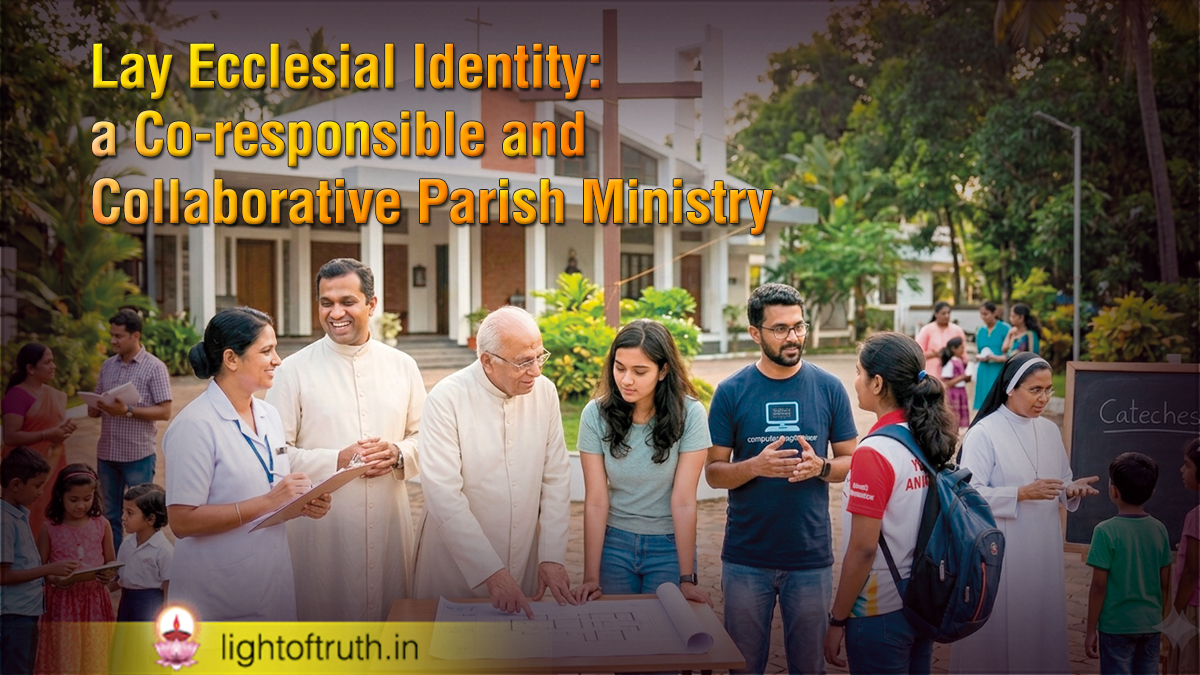
 Church is the People of God. In principle each one has got his service responsibility in the Church. Yet a deeper question remains: Who are the laity in the life of the Church? This question arises because the Laity are the common folk. Though priests and prelates are chosen for the service of the people of God in the matters of responsibility they simply extend the work of the priest. So, are the Laity co-responsible partners in the Church’s mission? This phenomena leads to have a renewed theological understanding of lay identity-rooted in Baptism that helps a way advancing for parish renewal and new outlook on pastoral ministry. The Second Vatican Council’s Lumen Gentium emphasizes that all the faithful share in Christ’s priestly, prophetic, and kingly mission (LG 31). Still, recognizing all these the clerical group is seen as the primary agent of mission and the laity as assistants. This calls for a renewed vision of the Church as a community of co-responsible disciples.
- The Role of the Priest
The parish priest continues to occupy a central and indispensable place within the life of the parish and in the Church, through the proclamation of the Word, the celebration of the Sacraments, and the pastoral guidance of the faithful. The encyclical Evangelii Gaudium, articulates that authentic pastoral leadership calls for a profound “pastoral conversion,” wherein authority is exercised not as control but as service that enables and animates the gifts of others (EG 27). The priest, in this vision, is the one who discerns, coordinates, and fosters the diverse charisms present within the community.
- Lay Ecclesial Ministers
Alongside the ordained ministry, there has emerged a significant and growing presence of lay ecclesial ministers who assume structured and often specialized roles within the life of the Church. Services in the Church is not only about the sacramental and spiritual done mainly by the specially ordained ministers. Still there are a number of other services and ministries. Catechists, youth animation, pastoral association, social works, and parish administration contribute substantially to the vitality and continuity of parish life. These services could be frequently sustained by lay participation with adequate theological formation and pastoral training. Particularly noteworthy is the indispensable contribution of women-both religious and lay-who stand at the forefront of faith formation, education, healthcare, and social outreach. Their leadership, often exercised with quiet perseverance and deep commitment.
- The specific collaborative role of Laity
While structured ministries within the Church are significant, they do not exhaust the meaning of lay vocation. Indeed, the greater part of the laity lives its calling beyond the visible boundaries of ecclesial structures. The teaching of Lumen Gentium underscores this reality by affirming that the laity are called “to seek the Kingdom of God by engaging in temporal affairs and by ordering them according to the plan of God” (LG 31). Catholic teachers play a formative role in shaping not only intellectual competence but also moral and spiritual values among students of diverse backgrounds. Nurses and healthcare professionals embody a ministry of compassion, often serving in challenging conditions with dedication and humility. Professionals across various fields – law, business, public service, social justice – bear witness to ethical integrity and social responsibility. Moreover, the involvement of lay persons in initiatives for advocating for the marginalized, promoting the dignity of women, advancing educational opportunities manifests the Church’s mission in the public sphere. This is not only Collaboration but reveals a co-responsibility as Pope Francis says a Church that walks together.
- Formation for Collaboration
The expanding participation of the laity in parish life, also brings with it a corresponding responsibility. Participation without adequate preparation risks misunderstanding, fragmentation, and even conflict within the ecclesial body. Where formation is lacking, collaboration can easily devolve into confusion of roles, competition for influence, or a superficial activism ungrounded in faith. So Pope John Paul II in the encyclical Christifideles Laici, notes that the lay faithful “must be formed to live out the unity of their lives” (CL 59).
Standing at the heart of this process is Spiritual formation. Without a living and personal relationship with Christ, all forms of ministry becomes merely functional or administrative. Prayer, participation in the Sacraments, and an interior openness to the action of the Holy Spirit are indispensable for sustaining authentic Christian witness.
Intellectual formation is likewise essential. In the complex and pluralistic societies, the ability to understand, articulate, and defend the faith with clarity and depth becomes ever more important. The teachings of the Church, Sacred Scripture, and the rich theological tradition must be appropriated not superficially but thoughtfully.

When these elements – shared leadership, ongoing formation, inclusive participation, and prayerful discernment-are brought together, the parish undergoes a profound transformation. It ceases to be perceived merely as an administrative unit or a provider of religious services. Instead, it becomes what it is called to be: a living and dynamic community of faith.

Pastoral formation equips individuals with the practical skills necessary for ministry and leadership within the community. This includes the capacity for catechesis, accompaniment, administration, and the facilitation of group processes.
Human formation is equally important. The capacity for mature relationships, effective communication, empathy, and teamwork is crucial in any communal endeavor. Without these qualities, even the most well-intentioned efforts at collaboration can falter. Human formation fosters the interpersonal dispositions necessary for mutual respect, patience, and constructive dialogue – qualities essential for a Church that seeks to live as communion.
Clergy are called to ongoing formation, particularly in the area of collaborative leadership and sharing with co-responsibility. A transition toward participatory leadership – marked by listening, discernment, and shared decision-making – is essential. In Evangelii Gaudium, Pope Francis urges pastors to adopt a style of leadership that is “close, compassionate, and enabling” (EG 31). Such leadership does not diminish authority but reconfigures it in a way that fosters the active engagement of all the faithful. Formation serves not merely to prepare individuals for tasks but to shape a community capable of living its identity as the People of God. Church is a communion. This vision, strongly articulated by the Second Vatican Council, emphasizes relationships rather than hierarchy.
- Challenges to overcome
The path toward a fully realized vision of co-responsibility remains marked by deep rooted challenges. These are rooted in theological, cultural, and structural tensions that require careful discernment and sustained conversion.
Clericalism remains one of the most persistent impediments. It manifests not only in overt forms of centralized decision-making but also in more subtle attitudes that equate authority exclusively with ordination. In such contexts, the initiative of the laity may be unintentionally stifled, and their role reduced to implementation rather than participation in discernment. Evangelii Gaudium strongly cautions against this tendency, noting that an excessive clericalism can “limit the development of the baptismal grace of the lay faithful” (EG 102).
Closely related to this is lack of adequate formation, which continues to affect many lay leaders. While participation has increased, access to systematic theological and pastoral training remains uneven, particularly between urban and rural contexts. Without sufficient formation, lay involvement can risk becoming either hesitant or dependent or, conversely, assertive without adequate grounding. Christifideles Laici emphasizes that formation is not optional but intrinsic to the lay vocation itself (CL 57–63).
Leadership within the Church, while retaining its distinct forms, is not meant to be concentrated in a single individual but exercised in a participatory and relational manner. As Evangelii Gaudium emphasizes, the Church is called to a more synodal style, where all the faithful are encouraged to take part in discernment and mission .
Cultural and social structures contribute a further layer. A society, rich in tradition and diversity, also carries inherited patterns of hierarchy-whether based on caste, class, or gender-that can subtly influence ecclesial life. In some communities, decision-making may be dominated by a few, while others -particularly women, youth, or members of marginalized groups -find their voices less readily heard. This reality stands in tension with the ecclesiological vision articulated in Lumen Gentium, which affirms the fundamental equality of all the faithful in dignity and mission (LG 32). At the same time, the rapidly changing dynamics of urban life present a different but equally significant challenge. In cities the pace of life, professional demands, and increasing mobility often limit the time and energy that lay persons can devote to parish involvement.
These challenges, though diverse, are interconnected. Clericalism can discourage initiative; lack of formation can weaken confidence; cultural barriers can limit inclusion; and urban pressures can erode commitment. Addressing them, therefore, a comprehensive approach that is both structural and cultural, both pastoral and theological is required.
Structural reforms – such as strengthening parish councils, expanding formation programs, and creating inclusive participatory spaces-are necessary. What is equally needed is a deeper cultural conversion: a shift in attitudes from control to trust, from passivity to responsibility, from exclusion to inclusion. This conversion must be shared by clergy and laity alike, for collaborative ministry is not the task of one group but the vocation of the entire Church.
- Towards A Communion of Shared Mission
The future of parish life will depend not merely on structural adjustments or increased participation, but on the emergence of a genuinely renewed ecclesial culture – one shaped by communion, co-responsibility, and a shared consciousness of mission. Such a transformation is neither automatic nor superficial; it calls for a deliberate and sustained reorientation of attitudes, relationships, and practices within the parish community. This renewal finds its inspiration from the early Church, where “the whole group of those who believed were of one heart and soul” (Acts 4:32). This scriptural vision presents the Church as a living communion, animated by the Spirit and united in purpose.
A renewed parish culture must, first of all, foster shared leadership. Leadership within the Church, while retaining its distinct forms, is not meant to be concentrated in a single individual but exercised in a participatory and relational manner. As Evangelii Gaudium emphasizes, the Church is called to a more synodal style, where all the faithful are encouraged to take part in discernment and mission (EG 31).The priests, while fulfilling their unique pastoral role, actively collaborate with lay leaders, recognizing their competence and charisms. Shared leadership does not weaken authority; rather, it deepens it by rooting it in communion and mutual trust.
Need for robust and sustained formation. A collaborative Church cannot be built on goodwill alone; it requires formation that shapes both understanding and disposition. As Christifideles Laici affirms, formation is a “continuous process” that enables the faithful to grow in their vocation and mission (CL 57).
In the parish context, this means creating opportunities for all members – clergy and laity alike – to deepen their spiritual life, theological understanding, and pastoral competence.
Equally essential is the commitment to inclusive participation. A renewed parish culture must consciously make space for all voices, particularly those that have often remained at the margins – women, youth, the poor, and members of socially disadvantaged communities. The vision articulated in Lumen Gentium reminds us that all the faithful share a fundamental equality in dignity and are called to contribute to the building up of the Church (LG 32).
Furthermore, a renewed parish must be deeply rooted in prayer and discernment. Without a spiritual foundation, collaboration risks becoming merely organizational. Prayer is not an optional addition to parish life; it is its lifeblood. It is in prayer that the community listens to the Word of God, opens itself to the guidance of the Holy Spirit, and seeks unity in diversity. Discernment, therefore, becomes a shared process of recognizing and ordering these gifts for the common good.
When these elements – shared leadership, ongoing formation, inclusive participation, and prayerful discernment-are brought together, the parish undergoes a profound transformation. It ceases to be perceived merely as an administrative unit or a provider of religious services. Instead, it becomes what it is called to be: a living and dynamic community of faith.
Such a community reflects the deeper mystery of the Church as communion. Each member is not only welcomed but valued; each gift is not only recognized but integrated; each person is not only formed but sent forth. The parish thus becomes a space where faith is not only celebrated but lived, where relationships are not only functional but deeply human, and where mission is not the task of a few but the shared responsibility of all.