- Dr. Midhun J Francis Kochukallanvila, SJ
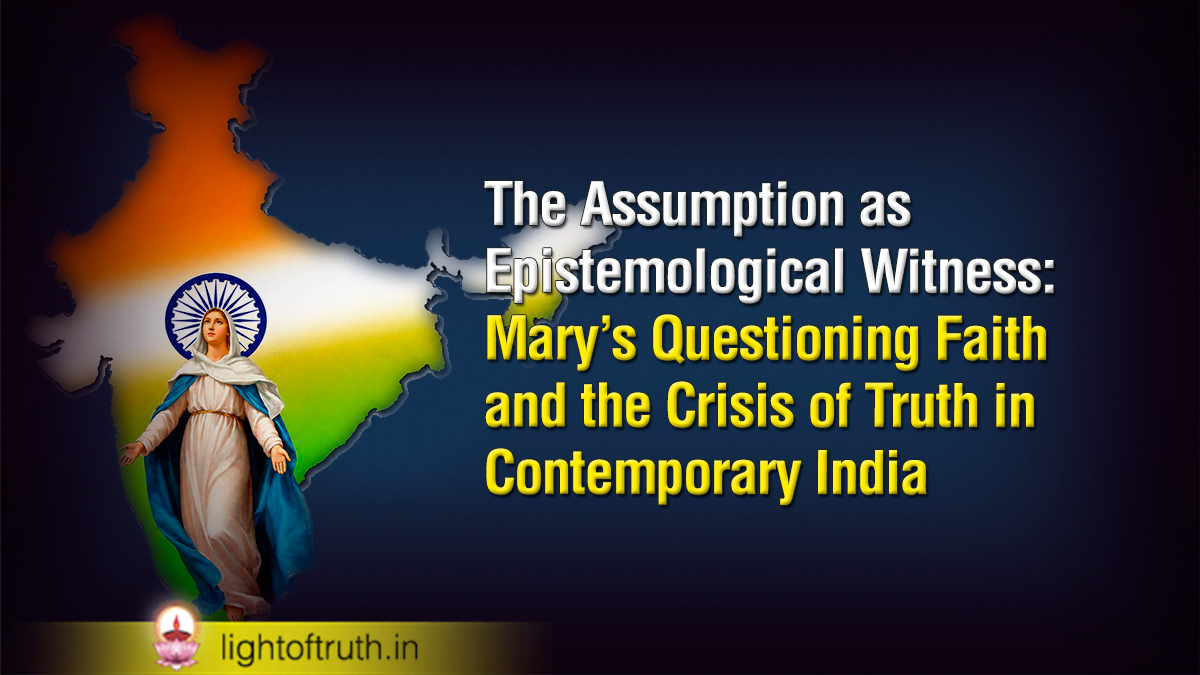
 August 15 has two distinct yet convergent moments for Indian Christians. In 1947, India has achieved political independence from colonial rule and the Assumption of Mary, the affirmation that Mary, the mother of Jesus, was taken up into heaven body and soul (Munificentissimus Deus) is commemorated on the same day. These two events together are to recognize something profound about human dignity, truth-telling, and authentic freedom that speaks with particular urgency to contemporary India. The traditional interpretation of the Assumption has emphasized Mary’s receptivity and obedience (John of Damascus, Homilia I in Dormitionem), but the Gospel and Quranic accounts on ‘Annunciation narrative’ has something different, in which a woman who does not simply accept what she is told but poses searching questions (cf. Luke 1:34; Quran 3:47). Later in her life, we see that she was a mother who refuses to believe false accusations against her son (Mark 3:21; John 7:5), who ponders deeply before accepting truth (Luke 2:19). These actions of Mary in the Gospel witness that is active in her discernment, vigilant in her truth-telling, consciously receptive to God while resistant to falsehood. Thus, these acts of Mary can become a model for the prophetic witness for India and even for the world drowning in WhatsApp rumors, Facebook conspiracy theories, and the systematic weaponization of dignity in service to violence.
The Good News That Demands Answers
Mary does not accept the news brought by Gabriel uncritically. Instead, she asks a question that echoes through centuries and is relevant even now. She asked the angel, “How can this be, since I have no relations with a man?” (Luke 1:34; cf. Quran 3:47). This is not doubt about God and his mission, but she was making a proper discernment to engage with the mission of God. Mary’s question was genuine, as she had to ask how this is possible. By what mechanism will she become pregnant? What does this mean for her life and others? St. Augustine would emphasize that Mary’s questions have intellectual engagement with divine truth, not a rejection of it (Sermon 196.1), which is genuine inquiry. The Quran similarly honors Mary’s interrogation as she asks, “My Lord, how will I have a boy when no man has touched me?” The response from the messenger comes not with rebuke but with explanation. The Quran says that “Thus is Allah; He creates what He wills” (Quran 3:47). Both religious traditions affirm that genuine faith does not bypass the human capacity to understand.

A fabricated video of religious violence travels faster than truth can possibly travel. In villages and cities alike, accusation has replaced genuine listening. Fear has replaced discernment. Tribal loyalty (means my group, my religion, my party) has replaced the search for truth.

This act of questioning since the Annunciation becomes the template for Mary’s entire spiritual journey. She always questioned with discernment, as the Gospels tell us that Mary “kept all these things, pondering them in her heart”; the Greek word used is diatereo, which indicates sustained, contemplative engagement (Luke 2:19). Therefore, she was not passively receiving information but actively seeking comprehension and asked herself: What does this mean? How does this fit with what I know of God? What are the implications for my life and for the world? This pattern of questioning, pondering, and seeking understanding becomes the defining characteristic of her faith.
Mary and the False Accusations: When Questioning Becomes Witness
The crisis in the life of Mary deepens at the birth of Jesus, but when accusations begin to swirl around Jesus. The villages whisper that he is mad (Mark 3:21), that he violates sacred law (Mark 3:1-6; Matthew 12:1-8), that he keeps company with sinners and women of ill repute (Luke 15:2; Matthew 21:31-32), that he is demon-possessed (Mark 3:22; John 7:20; Matthew 12:24). More seriously, religious authorities accuse him of being a threat to national security (John 11:48), of leading the nation astray (Luke 23:2), of plotting against the established order of religious power or government. The witnesses to these accusations against Jesus seem credible, and the evidence, from a certain perspective, appears solid; more than that, the religious authorities who make these accusations carry institutional weight (John 7:32; Matthew 23:1-36), and one must notice that the crowds, once drawn to him, eventually turn against him (Mark 15:11-15; Matthew 27:20-25).
It is important to note what Mary does in this moment of overwhelming social pressure with such bad accusations against her son. She does not accept the accusations, nor does she surrender her judgment to the judgment of the crowd. Instead, she does what she has always done. She questioned the situation of Jesus and pondered over her call to be part of the mission of God; she evaluated the way her son deals with others (cf. Luke 2:19). She weighs the accusations against what she knows from direct observation, intimate knowledge, and spiritual discernment. She has watched her son’s life in the spaces where character reveals itself most authentically. She knows the son as she has seen him in private for almost thirty years. She has also witnessed that the moments of vulnerability occur in contexts where no advantage of his divine sonship is used, which could be gained through deception. She has witnessed his extraordinary tenderness toward those society had designated as unworthy (Mark 6:34; Luke 4:18; John 8:3-11). She also has observed his consistent refusal to use his evident spiritual power for personal advancement or self-protection (Matthew 26:52-54; John 6:15). She has listened to his voice in darkness, in solitude, in the kinds of moments where the truth of a person’s relationship with God becomes unmistakable. Irenaeus recognized Mary’s faith as an exemplary fidelity that parallels her fiat at the Annunciation, which was the faith tested and proven under adversity (Irenaeus, Against Heresies). Mary refused the false narrative and stood against consensus. And this refusal became her greatest witness.
India’s Crisis: When False News Demands Mary’s Questions
Contemporary Indian people face precisely the same way Mary faced in her times, but in a much amplified way, because of the thousandfold amplification by technology, such as WhatsApp, which carries rumors that spread like plague; Facebook algorithms amplify hatred dressed as patriotism. YouTube pop-up videos have fractured many lives, and it becomes a narrative for billions, and they believe it as truth. A false accusation on any religion or people posted at midnight reaches ten million people by morning. A fabricated video of religious violence travels faster than truth can possibly travel. In villages and cities alike, accusation has replaced genuine listening. Fear has replaced discernment. Tribal loyalty (means my group, my religion, my party) has replaced the search for truth. Minority religious communities are accused of plotting the nation’s overthrow. The poor are accused of criminality. Each accusation carries the rhetorical apparatus of legitimacy. It also has the cited sources (fabricated), produced evidence (distorted), and institutional endorsement (manufactured), like the tome of Jesus against Jesus, yet the accumulated effect is to corrupt the capacity for truth-seeking itself, to teach people to accept narratives based on emotional resonance rather than evidence, to make truth itself seem like a matter of opinion rather than reality. This situation demands exactly what Mary practiced: when you receive an accusation, do not accept it simply because it comes from someone with authority or credibility, but investigate, ask questions, and seek evidence; finally, apply discernment. The capacity for the kind of discernment Mary embodied, by asking “How is this possible? Is this actually true? What do I know from direct observation?”, has atrophied.
Toward a Struggle of Independence: Learning Mary’s Method
The Assumption of Mary has to be understood not as reward for mechanical obedience but as affirmation of active fidelity to truth. The Christians in India need to make her model to protect the diversity of India so that her model can become a prophetic response to India’s crisis of unity, in which each one tries to make a small group in the name of religions and political parties, caste, class, and so on. The dogma on Assumption declares that Mary, in her embodied humanity, who has the capacity to questions and to think and judge and discern, in her conscious refusal to accept false narratives, in her willingness to stand alone when necessary (cf. Luke 2:35: “a sword will pierce your own soul too,” understood by tradition as Mary’s suffering at Jesus’ condemnation), was taken wholly into divine presence. Thus, her assumption challenges each one of us that our capacity to know what is real matters eternally. It challenges our willingness to ask questions, to seek evidence, to resist false narratives, to do what Mary did; it is itself what makes you worthy.
Hindu, Christian, and Muslim theologians in India stand at this moment confronted by a shared crisis and a common invitation. All genuine spiritual traditions are ultimately concerned with helping human beings become capable of recognizing and aligning themselves with what is actually real.
India’s need now is to learn what Mary learned in her as you receive accusations. She asked, “How is this possible?” (Luke 1:34; Quran 3:47) with discernment. Hindu, Christian, and Muslim theologians in India stand at this moment confronted by a shared crisis and a common invitation. All genuine spiritual traditions are ultimately concerned with helping human beings become capable of recognizing and aligning themselves with what is actually real. When Mary pondered mysteries, she engaged in what the tradition calls theosis, the divinization of the human person through alignment with divine truth (Athanasius, On the Incarnation, 54). The Quran describes Mary’s questioning and understanding as taqwa, which means God-consciousness rooted in genuine understanding rather than blind obedience. The revolution remains unfinished, which will be completed only when each person knows themselves as possessing the capacity to recognize truth, to resist falsehood, to question assumptions, to stand alone if necessary in defense of what they know to be real. As the Apostle Peter taught and said, “Always be prepared to give a reason for the hope that you have” (1 Peter 3:15), and by implication, to question the despair that others try to cultivate through false narratives. The Assumption of Mary invites us to this work with the integration of conscious receptivity with rigorous discernment, listening with truth-telling (cf. Proverbs 18:15).