Category Archives: National

When Carnatic music calls a nun

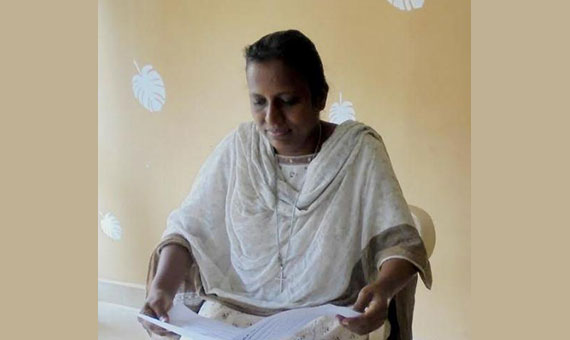
Wearing her veil, congrega-tion’s uniform and sporting a calm smile, Sr Linet Antony SKD would match anyone’s concept of a Christian nun.

But once the Kannur native gets on to the stage and starts singing, the listeners can’t help not being pleasantly surprised. For, she can sign a Vathapi Ganapathi with as much ease as she can belt out a choir song.

The 37-year-old nun, who is a faculty at Chetana Sangeeth Natya Academy in Thrissur, is probably the only professional Carnatic musician of the State from her community. Sister Linet, who did her arangettam way back in 2011, has performed on stages both in Kerala and outside, in the past few years.

As she speaks about her tryst with Carnatic music, Sr Linet remembers how music was always a part of her life, since childhood.

She remembers, “I used to be active in the music circles of church and could also play a keyboard. Moreover, everybody in my family loved music and could sing. My sister and brother were also getting trained in Carnatic music. So, even before I went for my music studies, I was familiar with the various stages like saptha swaras, varisakal, geetham and the like in Carnatic music.”

Assumption nuns’ first Asian head focuses on marginalized

Assumption nun Rekha Chennattu, the first Asian elected to head the global Paris based congregation, says her priority will be to serve people on the margins of society.

Sister Chennattu, an Indian, was elected superior general of the international congregation of the Religious of the Assumption on July 5 at the General Chapter held in Lourdes, France. “It was not my choice and so I believe that it was God’s choice,” said Sister Chennattu, professor of biblical studies and a participant at the Synod of Bishops on New Evangelization at the Vatican.

Focusing on neglected people would be the “identity mark” of the congregation during the next six years of her appointment, Sister Chennattu told ucanews.com.

“All throughout my life, I found God’s choices for me have always been better than mine,” the nun said.

She is part of the Office of Theological Concerns of the Federation of Asian Bishops’ Conferences and an associate faculty member at Jnana-Deepa Vidyapeeth, which is a pontifical institute of philosophy and religion based in Pune, India.

The Assumption congregation was founded in 1839 in France by St Marie-Eugenie of Jesus and now has sisters from more than 40 countries serving in 33 nations of the Americas, Asia, Africa and Europe. In India, they have communities in the States of Kerala, Maharashtra, Bihar and Jharkhand.

Church decries Jharkhand move to cut indigenous benefits

Christian leaders claim that India’s Jharkhand State aims to side-line poor indigenous people who have converted to Christianity.

The state’s legal officers on June 21 gave expert advice to the government that indigenous people who have converted to Christianity have lost their status to merit benefits that the Indian constitution guarantees for the social advancement of indigenous people. The Jharkhand government seems determined to end reservation benefits for those tribal people who have converted to Christianity or other religions, a newspaper says.

Benefits such as job quotas, places in educational institutions and financial assistance for education are reserved for indigenous people following traditional religions. Conversion to Christianity makes them ineligible, the experts told the government, according to local Hindi newspapers.

The move by the state government, run by the pro-Hindu Bharatiya Janata Party (BJP), violates the principles of equality and freedom of religion, Christian leaders say.

“The constitution allowed such benefits for the socioeconomic uplift of these poor people. Their faith was not a criterion for this,” said Bishop Vincent Barwa of Simdega, chairman of the Indian bishops’ office for indigenous people.

Religion will become the basis to discriminate against people suffering disadvantages, the bishop said. It also sends a clear message that one should not change religion to Christianity, or change only to Hinduism, if one wants to enjoy state benefits, he said.

The hidden agenda is to target Christians because the government considers Christians the biggest threat as many are well educated and have begun questioning policies and programs, the Oraon tribal bishop said.
(See Focus)

Indian Catholic priest speaks at British parliament on Yoga

A Catholic priest is telling the British House of Lords of the benefits of yoga to mark International Yoga Day 2018 on June 21. Fr Joe Pereira told AsiaNews that he has been practicing Iyengar Yoga for 50 years, adding that his Kripa Foundation has used it “to help in the rehabilitation of people with alcohol and drug problems.

“The Kripa Foundation offers an intense program of yoga and meditation designed especially for people who undergo treatments and recovery sessions [from drug addiction].”

The Indian priest says that yoga has “the power to help us get in touch with the true inner self and to transcend the world of Prakriti [physical matter] and of materialism and to operate from a level of awareness which brings us to our essential ‘uniqueness’.”

New bishop of Ranchi to strengthen the faith of everyone and support those in need

“I will work to strengthen everyone’s faith,” said Msgr Felix Toppo, whom Pope Francis appointed on June 24 as the new Archbishop of Ranchi, Jharkhand, replacing Msgr Telesphore P. Toppo, who resigned after 34 years at the head of the archdiocese.

“In Jharkhand the faith of Catholics and Christians in general is very strong,” Msgr Toppo said about the pastoral work that awaits him. “I will work for the spiritual care of the population, to improve their living conditions and, as much as possible, strengthen faith even more.” For Msgr Toppo, “it’s still early to say what I’ll actually do. It will depend on the needs of the population. Of course, I want to boost the right practice of faith, support children education, work with young people without neglecting adults. We will continue the spiritual preparation and the catechesis.”

Abetting gang rape charges against priest ‘fabricated’

Police in India’s Jharkhand State have arrested a Jesuit priest on charges of aiding and abetting the abduction and gang rape of five social activists, but church officials say the charges are fabricated.

Father Alphonse Aind, principal of Jesuit-run Stockmann Memorial Middle School in remote Kochang village in Khunti Diocese, was sent to custody on June 22, a day after the June 19 rape case was reported.

The priest, two Ursuline nuns and two teachers were interrogated on June 21. Police released all but the priest.

The social activists and the two nuns were part of a team holding a street play in the school to create awareness about the trafficking of girls at the invitation of priest, who is also the local parish priest.

Six men on motorcycles took the women to a nearby forest area and raped them on June 19.

Police say they have arrested two suspects and are searching for the others. The priest has been “falsely implicated in nine serious charges including abetting crimes like rape deliberately to deny him bail.”

Paralysed man from Kerala is an inspiration to many

Hailing from Kerala’s Thiruvananthapuram, a man named Thaha stands tall in life, in spite of being paralysed.

Thaha never succumbed to self-pity, but instead braved the odds and made a living for himself using social media as his tool.

This specially-abled man has been making umbrellas for the last five years, and with the help of Unni and Manoj Pillai, he has been selling his products through platforms like Facebook and WhatsApp. Thaha says he learned to make umbrellas from the Father in his Church and now earns a living by it.

“I know God is with me, there is nothing to be ashamed of. There is no point of sitting idle because of a disease, we must fight it out and not indulge in self-pity, do what you can best,” said Thaha, who became paralysed a few years ago after meeting an accident.

Apart from umbrellas, Thaha also knows how to make soap powder, jewellery, paper bags, and LED bulbs. He not only sells but also teaches how to make these products. However, Thaha says bed sores are bigger problem for him, but that does not stop him from doing the work.

Thaha also drives an automatic car customized for him with hand-held accelerator and break.

“I drive to many nearby towns and districts. The car has been customised to suit my needs; the accelerator and break are hand-held for my convenience,” he says.

Legislator sleeps at crematorium to bust ghost myth

A legislator in Andhra Pradesh spent night at a crematorium to convince scared construction workers that there are no ghosts or spirits.

Nimmala Rama Naidu, a first time member of the legislative assembly of the southern Indian state, had dinner at the crematorium in Palakollu in the West Godavari district before spending the night there on June 23 night.

His “brave act” won praises from people such as Kerala Chief Minister Pinarayi Vijayan, reports ndtv.com.

Naidu, a member of the Telugu Desam Party, represents Palakollu in the Andhra Pradesh assembly. What bothered the 49-year-old legislator on the first night were not ghosts but mosquitoes, and stench from garbage dumped nearby. The area near the cremation ground had been turned into a dump yard. So for his next sleepover, he came armed with a mosquito net. Images showed the politician sleeping on a bed with a pink sheet, covering himself with a white blanket. The plan was to do this for two to three days to prove to people that no ghost had attacked him.

Why missionaries are targeted in India’s northeast

Over 25 years ago a gang of four men took me at gunpoint from a basket-ball court to my school office. They introduced themselves as members of a proscribed organization and made me sit on a chair while they kicked my face.

That was the first attack I encountered on June 14, 1991, in my three decades of working as a Salesian missionary in the north-eastern Indian State of Manipur.

Since then I have been held at gunpoint several times, which is a story quite a few of my confreres working in the field of education can also tell.

Many escape because of sheer luck. At least five have been shot dead in the last 30 years in this this insurgent-infested region where peace seems ever elusive. During the first attack, my abductors wanted me to pay them 400,000 rupees (equivalent to about US$ 11,500 at the time) and give them a video camera and a gun.

As the priest-manager of Don Bosco School, in the State capital of Imphal, I was unable to meet their demands because I had none of those things. And this is something I made very clear to them.

Their reaction was swift and brutal. With a gun in hand, one of them hit me hard on my left cheek. The pain was severe. Later, medical examinations established that the strike had broken my eardrum. The four men then locked me up and made off with the 10,000 rupees (US$280) they found in my office. However, there are about 20 insurgent groups operating in the state and they appear to view Catholic schools as an easy target whenever they want to raise funds to support whatever they are fighting for, which could be for a separate statehood or the goal of establishing ethnic supremacy over other groups. They would spend their time blaming the Catholic schools for a range of imaginary crimes.

Shillong violence: Christian leaders deny communal angle

The leaders of various Churches in north-eastern India have expressed deep pain and anguish at the recent violent incidents that shattered peace in Shillong, capital of Meghalaya State.

Heads of the United Christian Forum and the North East Christian Council met on June 6 in Guwahati to review the situation and seek ways to restore peace and harmony in the city, known as the Scotland of the East.

They met amid attempts by certain section of the media and groups to project the incidents as clashes between Christians and Sikhs in Shillong.

Meghalaya is one of the three Christian-majority states in northeastern India.

The leaders are “concerned at the continued tension that prevails due to fear, mistrust and circulation of fake news,” says a press release issued by Allen Brooks, spokesperson of the Northeast unit of the United Christian Forum.

The Church leaders have requested their people to pray and work for peace. They also appealed to all concerned people to shun violence and “seek the path of dialogue” to find a lasting and peaceful solution to an age-old problem that triggered the latest violence.

The Church leaders also resolved to cooperate and support all efforts at peace building, Brooks told Matters India.

Meanwhile Archbishop Dominic Jala of Shillong too denied that the incidents had any communal color.

“The present disturbed situation in Shillong arose out of an incident that was initially resolved,” the Salesian prelate told Matters India on June 6.