Category Archives: National

Rose petals for Shiva pilgrims, beatings and arrests for Christians

Whilst acts of hooliganism and violence against Christians intensify in Uttar Pradesh, India’s “secular” authorities continue to show “preferences” for Hindus.

On August 8, senior police and government officials in Meerut threw rose petals from a helicopter to greet Kanwar pilgrims.

A video, shared on social media, shows Additional Director General of Police Prashant Kumar throwing rose petals during an aerial tour. He was accompanied by Meerut’s commissioner. Kanwar Yatra is the annual pilgrimage of devotees of the Lord Shiva. Pilgrims carry water from the Ganges River in pitchers, balanced between their shoulders at both ends of a stick. The pilgrims, called Kanwariyas, walk this way for hundreds of kilometres, barefoot.

Prashant Kumar replied today to charges posted on social media of “favouritism” for throwing rose petals. “No religious angle should be given to this,” he said. “Flowers are used to welcome people. The administration respects all religions and actively takes part even in Gurupurab, Eid, Bakrid or Jain festivals.” Despite denials, police “favouritism” towards Hindu pilgrims is clearly evinced by their nonchalant attitude towards pilgrims’ hooliganism.

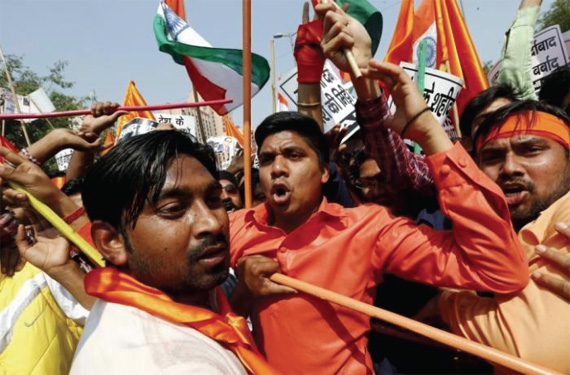
Before, in Moti Nagar, near Delhi, a group of Kanwariyas wrecked a car with sticks and iron bars because the car had tried to cross the road, swarming with pilgrims, inadvertently brushing against one of them.

Child trafficking: India orders inspections for all of Mother Teresa’s orphanages

The Indian government has ordered the inspection of all the orphanages and children’s care homes run by the order founded by Mother Teresa, after a nun was arrested on charges of trafficking in newborn babies.

In a statement released recently, Women and Child Development Minister Maneka Gandhi said that all state governments have been asked “to get child care homes run by Missionaries of Charity all over the country inspected immediately.”

Early this month, police in Ranchi (Jharkhand) arrested Sister Koshleniea, who ran a children’s home, and an employee of the facility, Anima Indwar, who “sold” a newborn to a family in Uttar Pradesh for 120,000 rupees (US$ 1,750).

Minister Maneka Gandhi’s move appears to be an attempt to stop child trafficking and illegal adoptions that see more than 100,000 children disappear in India. Gandhi also asked that all childcare institutions should register and be linked to a central office for adoption within a month. According to government figures, 2,300 institutions have already registered with another 4,000 still pending.

Sister Mary Prema, superior general of the Missionaries of Charity, has already stated that the congregation would investigate something that “goes against our moral convictions,” and that they would take steps to prevent anything like this happening in the future.

The Catholic Bishops’ Conference of India, however, expressed doubts about the case involving the Sisters of Mother Teresa in Jharkhand, that it is being purposefully blown out or proportion by “some people” trying to frame the organisation founded by Mother Teresa. West Bengal Chief minister, Mamata Banerjee, who is great admirer of the saint of Calcutta, spoke in defence of the order founded by Mother Teresa.

Indian state accused of harassing Christians

A Catholic leader has sought Indian Prime Mini-ster Narendra Modi’s inter-vention to stop harassment of Christians after Jharkhand State ordered a probe into the funding of more than 80 Christian organizations.

The eastern state on July 19 asked police to probe foreign donations received by non-governmental organizations managed by dioceses and religious congregations such as Jesuits, Salesians and several groups of nuns, accusing them of diverting the money for religious conversion. “This is another sign of how the Jharkhand government is harassing Christian institutions,” Bishop Theodore Mascarenhas, secretary-general of the Catholic Bishops’ Conference of India, told ucanews.com.

“We appeal to Prime Minister Narendra Modi to keep the state government under control. We hope that the prime minister will intervene and stop this harassment.”

Modi’s pro-Hindu Bharatiya Janata Party, which has run Jharkhand’s government since 2014, has been accused of moving against the Christian community, with police arresting nuns, priests and lay Christians on trumped-up charges.

Dalits, minorities victims of organized killing: Amartya Sen

Nobel laureate Amartya Sen is known worldwide of making sense in his arguments. Taking this further about his previous argument on ‘India taking a quan-tum leap in the wrong direction after 2014’, he stood by his point and added that ‘Dalits and minorities have become victims of organised killing’ at a televised face-off with NITI Aayog Vice-Chairman Rajiv Kumar on a television channel recently.

In the face-off, televised on NDTV, Sen said, “Dalits and minorities have become victims of organised killing” and the government has to take responsi-bility. Mobocracy and despotism make people live in fear. It is a terrible thing to happen, whether or not it affects the economy. The central issue is that of liberty and democracy.”

However, Sen’s comments were not welcomed by Kumar and he responded back saying that the Nobel laureate has not done any good by ‘spreading this talk of living in fear, because you are the one who is quoted’. To which Sen replied, “India is a great country. There are people in India who feel that government action is not adequate, that the government has not done enough to make minorities and Dalits to feel comfortable, then India will cease to be a great country.” But, with impeccable knowledge on economics, Sen reverted back saying that demonetisation was a despotic decision.

Ecumenism needs renewed interfaith outlook: Asian theologian

“The ecumenical movement needs renewed interfaith orientations when conflicting theological assumptions and presuppositions are posing challenges to authentic gospel values and Christian witness,” said internationally renowned ecumenical theologian Dr S. Wesley Ariarajah at the Asian Ecumenical Institute (AEI) of the Christian Conference of Asia (CCA) being held at the Payap University in Chiang Mai, Thailand.

Delivering a series of lectures on topics related to the theme of the AEI-2018, ‘Wider Ecumenism in a Pluralistic Asia’ at the month-long ecumenical formation and leadership development training, Ariarajah, an emeritus professor of Drew University in the U.S.A. enthused the prospective ecclesiastical and ecumenical leaders.

“Inter-religious dialogue is an attempt to understand people of other faith, not as people opposed to us or competing with us, but as partners within a pilgrimage. It is in the course of the pilgrimage and in the spirit of partnership that we share the message of Christ with copilgrims,” Ariarajah said.

“Dialogue challenges us to change and renew. It beckons us to a whole new world of relationships. It urges us to re-examine our theology. It calls us not to give up our faith but to grow in our faith by living it with humility,” he reminded the participants.

Adoptive parents nervous after raids of Missionaries of Charity homes

Theodore Kiro held 13-month-old Navya on her return to his family after they were separated for a week. The crying baby happily clung to Kiro, whom she knows as her grandfather.

Navya is one of the four babies whose fate became entangled in the recent child trafficking scandal broke at Rachi’s Nirmal Hriday (Tender Heart) home, run by the Missionaries of Charity. A five-member district child welfare committee decided it was not fair for the foster mother and the child to be separated for long and ruled they should be united conditiona-lly. The welfare committee asked the foster parents to take the child before the committee every week and keep it informed of the child’s schedule.

“The child and the mother were in trauma after separation, so the committee members decided compassionately to unite them. But this status has been fixed for the next two months only,” said Kiro, a local political leader using his clout to prepare legal papers for adoption of the toddler. Navya was brought to their home in Ranchi just after her birth and was reclaimed by the child welfare committee as one of the babies who allegedly was sold illegally by an employee of the Missionaries of Charity home.

Though the parents confess that there was no exchange of money yet, the officers are investigating the process of adoption without proper paperwork. This makes Anuka Tigga, another adoptive mother of a 4-year-old, jittery.

Ranchi, children sold by sisters of Mother Teresa Sr. Prema: ‘We are shocked’

The Ranchi police (in Jharkhand) have arrested an employee of a hospital run by the Missiona-ries of Charity, the order founded by Mother Teresa, and placed two nuns in custody on charges of selling children.

The Indian Express reported that the three women took newborns from single mothers and then sold them to other couples. In a note issued by the Generalate [in Calcutta] Sr Mary Prema, superior of the congregation, says: “We are completely shocked by what has happened in our home. It should never have happened.”

The arrest is happened. Shyamanand Madal, head of the Kotwali police station, reports that a case has been opened against Anima Indwar (the employee) and the two nuns according to section 370 of the Indian Penal Code [which punishes those who traffick human beings, ed. ]. Then he adds that “clear evidence was collected against one of the nuns, who could be arrested soon.”

Suspicious, the social workers questioned the nuns: at the end one of them said that the child was taken away by his mother after she was discharged from the structure. “We contacted the woman – continued Tiwari – who instead told us that the child was not with her.

Jharkhand: 16 Christians arrested for ‘forced conversions’ of tribals

Police in Jharkhand arrested 16 missiona-ries on June 8, on charges of converting tribal Adivasi by force to Christianity, the Press Trust of India reported.

Speaking to AsiaNews, Sajan K George, president of the Global Council of Indian Christians (GCIC), said that “In Jharkhand, extreme right-wing groups systematically persecute members of religious minorities, especially Christians.”

The arrests took place in the District of Dumka, after Ramesh Hembrom, village chief in Phoolpahari, filed a complaint.

Seven women were among those taken into custody. Police Superintendent Kishore Kaushal said that those arrested were part of a group of 25 “preachers” held hostage “by an angry mob of tribals living in the village.”

According to the policeman, the Christians were held for two days by residents in the Shikaripara area, who accused them of insulting a place of tribal worship.

The police did not disclose the names of the Christian missionaries involved in the case of alleged forced conversions. “We are verifying the allegations,” Kaushal said.

The officer noted that in his complaint, Hembrom claimed that the attempt to convert the tribals to Christianity had been going on for several months.

In eastern India, radicals expel ten Christian families

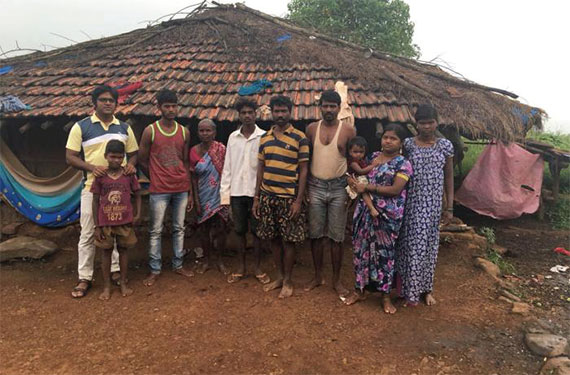
Several Christian families have been assaulted and expelled from their village by local extremists for refusing to renounce their faith, drawing protest from an American group who says the attack violates the families’ rights under Indian law. “We here at International Christian Concern are deeply concerned to see that 10 Christian families have been beaten and displaced for merely exercising their religious freedom rights,” William Stark, regional manager at International Christian Concern, said July 3.

International Christian Concern, a non-denominational Christian NGO based in the U.S., reports that 10 Christian families in the eastern Indian State of Jharkhand have been driven from their homes for refusing to renounce their faith.

On June 5 the ten Christian families from Pahli village in Latehar district were summoned to a meeting with local radicals. The radicals told them to renounce their faith or leave. After the families refused, they were beaten and driven from their village.

Lack of evaluation will disintegrate religious congregation: Montfort scholar

Reclaiming the charism and spirituality has to be a top priority if religious congregations in India have to survive, says Montfort Brother Paul Raj. Addressing a gathering of the local unit of the Conference of Religious India (CRI) in Bangalore on July 1, the Brother said that equally important is the creation of new apostolate and promotion of cultural formation in the congregations. Some 500 sisters, priests and brothers attended the gathering and a local CRI general body that followed.

Paul Raj is a former director and principal of Vidya Deep College of Theology in Bangalore. He also served as the Congregation of the Montfort Brothers of St Gabriel’s International executive secretary for the Desk on Justice, Peace and Integrity of Creation in Rome.

Quoting French Jesuit Ray-mond Hostie, the Montfort Brother noted that the religious congregations go through different stages, such as foundation, consolidation, expansion, growth, stabilization, dissatisfaction, decline and death. Several congregations in the west are going through difficult transitions and many of them are declining or dying or already dead, he said.