Category Archives: National

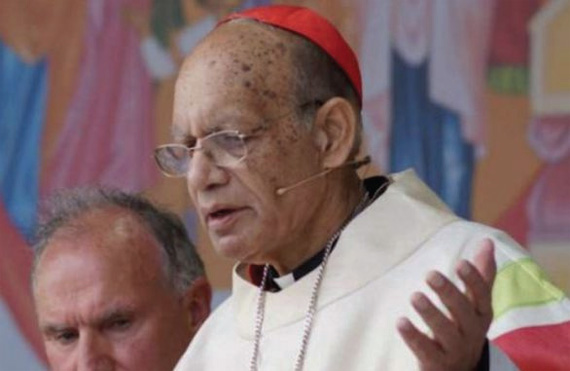
Constitution in danger, human rights trampled: Goa Archbishop

The Indian Constitution is in danger, Goa’s Archbishop Filipe Neri Ferrao has said, adding that a “new trend” of mono-culturalism, which demands uniformity in what and how one eats, dresses, lives and even worships, is putting human rights at risk. In the latest annual pastoral letter to Catholics in Goa, Ferrao also exhorted agencies of the Church in Goa to actively participate in social movements and urged lay Catholics to play an active part in politics.

“At the time of elections, the candidates confuse the minds of many people by making false promises. And the people, on their part, often sell their precious vote for selfish, petty gain. “Today, our Constitution is in danger, (it is a) reason why most of the people live in insecurity,” Ferrao said in his pastoral letter for 2018-19 which was formally released but circulated later. “In this context, particularly as the general elections are fast approaching, we must strive to know our Constitution better and work harder to protect it.”

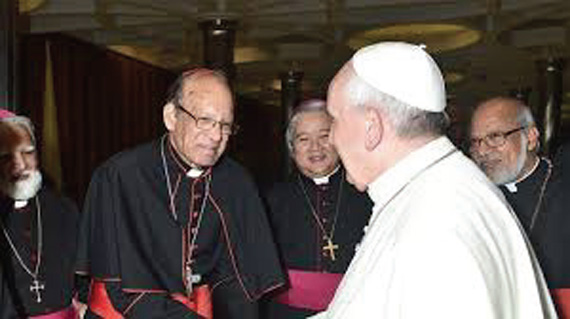
In the letter, which comes two weeks after Delhi Archbishop Anil Couto warned about an emerging threat to India’s “democratic and secular fabric” Ferrao also alleged that human rights were being trampled in the name of development and mono-culturalism.

“In recent times, we see a new trend emerging in our country, which demands uniformity in what and how we hear, dress, live and even worship: a kind of mono-culturalism. Human rights are under attack and democracy appears to be in peril.

“The various minorities fear for their safety. In short, respect for law is frankly on the decline in this country,” said Ferrao, who is the spiritual and religious leader of Catholics in Goa who account for 26 per cent of the state’s population of 1.5 million.

“People are being uprooted from their land and homes in the name of development. Pope Francis says that ‘the first victim of development is the poor person.’ It is easier to trample upon the rights of the poor, because those who will raise their voice for them are very few.”

Parents abandon infant at church, father held

A man was arrested June 2 for abandoning his newborn baby in a church in Kerala.

Police said they traced the parents of the two-day old baby based on CCTV footage that went viral on social media platforms.

The baby’s father will be charged under various sections of IPC and Juvenile Justice Act, police said. CCTV footage aired by television channels and circulated on social media showed a couple leaving the child at one of the temporary erected confessionals in the premises of St George Forane Church in Edapally, a suburb of Kochi, Kerala’s commercial capital.

The church’s security staff noticed the child at around 8:30 pm on June 1 and immediately alerted the police.

The recently renovated church draws thousands of visitors and devotees daily.

Police traced the child’s parents to Wadakancherry in Trichur district, some 90 km north of Edapally.

In the CCTV footage, the couple along with another child of around 3 years old, was seen walking into the church premises around 8:15 pm with the baby wrapped in an orange sheet. The father kissed the baby on its forehead before carefully placing the infant on the ground.

Dead nun’s congregation should get compensation: Court

The Madras High Court has allowed a Women’s Religious Congregation to claim compensation for a nun, who died in a road accident 16 years ago.

The Madurai bench of the court asked Tamil Nadu State Transport Corporation to pay the compensation, dismissing their argument that the congregation was not the legal heir of the nun.

The Motor Accidents Claim Tribunal in 2009 ruled in favour of Auxilum Sisters’ Congregation after a member of the congregation was hit and killed by a bus owned by the corporation in 2002. However, the corporation appealed against the tribunal verdict in the High Court arguing that the nun had no heirs, and no dependents.

Justice A M Basheer Ahamed on June 2 dismissed the appeal saying that the congregation suffered loss due to the death of the voluntary worker in the accident.

The transport corporation contended that the relationship between the deceased nun and her congregation was that of employee and employer and the employer cannot be held to a legal heir to claim compensation.

Nationalists complain against Hindu temple in Tamil Nadu that let nuns visit the site

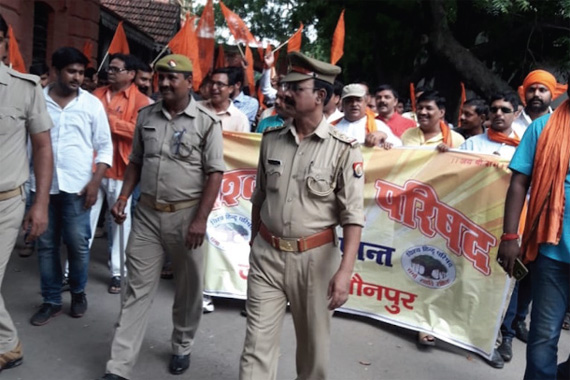
Leading members of the Hindu nationalist Bharatiya Janata Party (BJP) and other nationalist groups have filed a complaint against the administration of a Hindu temple in Tamil Nadu for allowing a group of Catholic nuns to visit the site, this according to The Hindu, one of India’s foremost daily newspapers. According to the plaintiffs, the presence of nuns in their religious attire in a Hindu place of worship hurt the religious feelings of Hindu believers and was meant to mock the temple’s sanctity.

The complaint was filed by Sethu Aravind, a member of the BJP state executive committee, and representatives of militant Hindu fundamentalist movements: Vishwa Hindu Parishad (VHP), Hindu Alaya Meetpu Iyakkam and Anaithu Hindu Iyakkam.

The incident occurred on 8 May at the Sri Ranganathaswamy Temple in Srirangam, an island in the city of Tiruchirappalli. The nuns were part of a group of tourists from Kerala. The visit sparked the fury of the radicals when their social media began spreading the rumour that the nuns had taken rosaries out of their pockets and started to pray inside the Hindu temple.

Pictures of the nuns were posted on online messaging platforms showing them walking near the Thousand Pillar Mandapam, a theatre like structure made from granite.

Following the publication of the images, some devotees criticised the temple administration and filed a complaint with the Srirangam police. “The temple of Srirangam in Tiruchirappalli is one of the temples which does not permit Christians to enter,” said Fr Sebastian Michael, adviser to the Pontifical Council for Interreligious Dialogue.

“Even today, in a globalised world, it is their right not to permit people from other religions. We cannot go against their belief,” he added.

“Despite this, we continue to believe in dialogue. There is a lot of good will and cooperation between religions. Many Hindu religious leaders invite us to their religious meetings and we do the same,” he noted.

Delhi archbishop’s prayer for nation triggers BJP rebuke

The archbishop of Delhi has called for a prayer campaign until the next general election in an unprecedented political inter-vention, citing a threat to the country’s secular fabric, trigger-ing angry reactions from the ruling Hindu nationalist party.

“We are witnessing a turbulent political atmosphere which poses a threat to the democratic principles enshrined in our Constitution and the secular fabric of our nation,” Archbishop Anil Couto wrote in a letter issued this month to all parish priests and religious institutions in the archdiocese of Delhi.

The letter became public, bringing to fore tensions between Christians and Hindu nationalist hardliners who form the bedrock of Modi’s Bharatiya Janata Party (BJP).

Christians constitute less than 3% of Hindu-majority India’s 1.3 billion people. India is officially secular, but four-fifths of its population profess the Hindu faith. The BJP said the letter was akin to calling people to vote along communal lines, and that it was unfortunate. The next election has to be held by next May.

The Evangelical Fellowship documented at least 351 cases of violence against Christians last year, mainly in states ruled by the BJP. Between 2014 and 2015, Couto and other Christians in the national capital region of Delhi told Singh how violence had picked up after Modi came to power, detailing at least five cases of attacks on churches in New Delhi following which extra police had been deployed to protect 240 churches in the capital. Responding to Delhi archbishop’s letter, home minister Rajnath Singh on said in India minorities are safe and no one is allowed to discriminate on the bases of caste and religion. “I have not seen are safe and no one is allowed to discriminate on the basis of caste and religion,” Singh said.

Indian state imposing patriotic slogan worries church leaders

A directive for government school students in India’s Madhya Pradesh State to and with a patriotic slogan called ‘Jai Hind’ (hail India) during attendance roll calls has been criticized by Catholic Church leaders.

On May 15 the education department said the government had decided to make the slogan compulsory for government schools from the start of a new academic year in June.

“This is a misplaced idea of patriotism,” said Archbishop Leo Cornelio of Bhopal, head of the bishops’ council in the region.

The commonly used slogan Jai Hind emerged during India’s independence struggle and continues to be raised at the end of national anthem. However, Hind is a shortened form of Hindustan (land of Hindus) that excludes India’s religious minorities such as Christians and Muslims.

The central Indian state’s government, run by the pro-Hindu Bharatiya Janata Party (BJP), has exempted privately managed schools such as Church schools from the new practice.

But an official source seeking anonymity told the government exempted private schools fearing a backlash as state elections are due in December this year. The nine Catholic dioceses in the state run some 500 schools.

“But in this case, a particular ideology is promoted in the name of patriotism,” he said.

‘Honour’ killing in Catholic family shocks Indian state

The victim’s father and wife told media that they had approached police soon after he was kidnapped but officers refused to entertain them, saying they were busy arranging security for a visit by Pinaryi Vijayan, the state’s chief minister.

Neenu named her brother Shanu Chacko and 11 people as responsible for the crime. Most gang members belong to the Democratic Youth Federation of India (DYFI), a youth wing associated with Kerala’s ruling communist alliance.

The crime comes amid allegations that Communist Party of India leaders use police to meet their ends.

However, police have arrested some DYFI members in connection with the murder.

The government is to suspend local police officers including Kottayam district police chief V.M. Mohammad Rafik.

Widespread protests have been held by Dalit Christian groups in the state recently against the discrimination they face from upper-caste Christians, commonly known as Syrian Christians because of their ancient link with the Syrian Church and its liturgy.

A Syrian Christian bishop recently rattled the community by saying that discrimination against Dalit Christians was due to the “myth” that their forefathers were upper-caste Brahmins.

Kerala court quashes case against Cardinal in land scam

Priests in India are pinning their hopes on the Vatican after the High Court of Kerala dismissed a case against Cardinal George Alencherry over a land deal that has rocked the church for more than a year. Chief Justice Antony Dominic dismissed the case on May 22 on grounds that the court made jurisdictional errors in allowing the investigation against the cardinal and petitioners had rushed to the court before waiting for a police investigation.

The court’s move has “not given us any justice. The moral and ethical violations and the related frustrations continue,” said Father Kuriakose Mundadan, secretary of the presbyteral council, a canonical body of priests in the cardinal’s Ernakulam-Angamaly Archdiocese.

The court dismissed the case, filed by lay Catholic Shine Varghese, on grounds of legal infirmity because the petitioner approached the court complaining of police inaction within hours of filing a police complaint. “The court has not quashed the police complaint. It has not said there is no case against the cardinal, nor that the police should not investigate. However, we continue with the problem without a solution,” Father Mundadan said.

Indian govt accused of ignoring religious violence

The United States Commission on International Religious Freedom has accused the Indian government of doing little to prevent violence against religious minorities and socially poor Dalit people.

The commission’s latest report, released on April 25, said the government run by the pro-Hindu Bharatiya Janata Party (BJP) has not addressed the problem of sectarian violence despite government statistics showing that sectarian violence has increased sharply over the past two years.

It categorized India in its Tier 2 countries along with Afghanistan, Azerbaijan, Bahrain, Cuba, Egypt, Indonesia, Iraq, Kazakhstan, Laos, Malaysia and Turkey.

Tier 2 countries are those with at least one of the elements of the “systematic, on-going and egregious” standard in a set of criteria the commission uses to gauge violations of religious freedom.

Ten countries including Pakistan are in the worst category.

The report noted that at least 10 Indians were lynched by Hindu groups in the name of cow protection.

“In 2017, religious freedom conditions continued a downward trend in India. India’s history as a multicultural and multi-religious society remained threatened by an increasing exclusionary conception of national identity based on religion,” the report said.

Hindu nationalist groups working to turn India into a Hindu-only nation stepped up their actions through violence, intimidation and harassment against non-Hindus and Hindu Dalit people. Both public and private actors pursued this effort, the report said.

About one third of state governments enforced “anti-conversion and/or anti-cow slaughter laws against non-Hindus, and mobs engaged in violence against Muslims or Dalits whose families have been engaged in the dairy, leather or beef trades for generations, and against Christians for proselytizing,” stated the report.

Even government records, presented on Feb. 6 in parliament, show increased sectarian violence. In 2017, 111 persons were killed and at least 2,384 injured in 822 communal clashes across the country.

In 2016, 86 persons were killed and 2,321 injured in 703 incidents. In 2015, there were 751 incidents.

India’s indigenous people rally for religion

Thousands of indigenous people marched through the streets of Gumla town in India’s Jharkhand State demanding recognition of their traditional religions.

The rally of about 10,000 people on April 24 aimed to put pressure on the eastern state’s government run by the pro-Hindu Bharatiya Janata Party (BJP), which considers indigenous people as Hindus and refuses to give official status to the animist Sarna religions.

Church leaders and acti-vists working for indigenous people said the rally succeeded in bringing together indigenous people of diverse groups and religions.

The government is counting Sarna followers as Hindus as part of a political game, said Father Cyprian Kullu, vicar general of Gumla Diocese, which supported the rally.

“It is certainly a positive move because this was the first time in the region that indigenous people of all religions have come on a single platform and demanded their rights,” Father Kullu told ucanews.com.