Category Archives: National

Ideological dogmatism posing “danger” to scientific temper: Christian philosophers

The current trends of ideo-logical dogmatism are posing “danger” to India’s scientific temper, said the Association of Christian Philosophers of India (ACPI).

“India’s contribution to science has been immense. There has been a scientific temper down the ages, which is in danger of being diluted by current trends of ideological dogmatism, whereby the distinction between fact and fiction, history and mythology are blurred,” an ACPI statement said.

“Indigenous sciences and democratized applications of the same need to be encouraged. The spirit of a healthy scientific tem-per needs to be protected from vested corporate interests and the dysfunctional influences of caste, gender, class and religion,” the statement read.

The press statement was issued at the end of the 44th annual research seminar of the ACPI at the St Joseph Vaz Spiritual Renewal Centre in Old Goa, on Oct. 23 to 25. As many as 87 participants attended it.

Indian nuns call for women’s ‘due place’ in church leadership

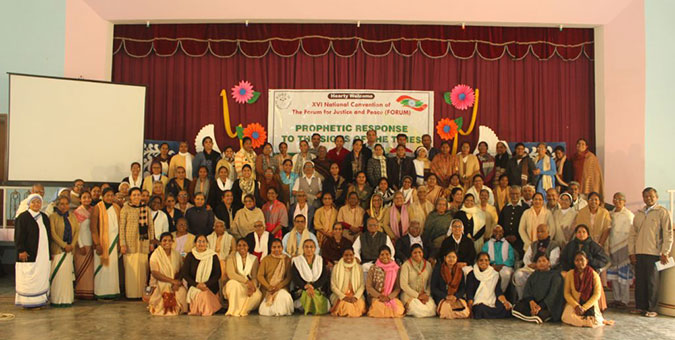
About 100 Catholic women religious in India have called for a place at the table in church leadership and asked that canon law be amended to make it more relevant and inclusive.

They stressed these and other points at a “Women in the Church” consultation held on October-4-6 at Ishvani Kendra Pune, the cultural capital of Maharashtra.

The participants said in the statement that the consultation helped them embark on “a journey to challenge ourselves to bring about transformation in ourselves and in the church in keeping with the vision of Christ.”

They have resolved to restore equality in the church and create a consciousness to negotiate partnership in the church.

The meeting also stressed developing “feminist consciousness” to read the signs of the time, critically evaluate current structures, values and practices and build solidarity across gender, class, caste and other divides to help transform lives.

The women religious noted that caste and class along with “toxic masculinity and femininity affect the church consciously and unconsciously.”

Patriarchy, the basic organizing principle of society, thrives by dividing men and women, giving power and status to the males and leaving caring and nurturing to females, the statement notes.

Mulakkal case: Christian women condemn Church inaction

The Indian Christian Women’s Movement (ICWM) has criticized the Church for its inaction as the survivor nun in the Mulakkal case continues to face harassment and slander. The ecumenical women’s group offered solidarity and support to the alleged victim of rape by Bishop Franco Mulakkal of Jalandhar.

The ICWM “stands solidly, every step of the way, with the survivor nun in her quest for justice in the Franco Mulakkal case,” says a statement the group’s national team issued on October 25. The bishop stood trial from November 11 in the District Court of Kottayam, Kerala.

On October 19, the survivor nun had filed a complaint alleging that Malayalam YouTube channel Christian Times harassed her at the behest of Bishop Mulakkal.

The survivor also wrote to the Kerala State’s Women’s Commission, and the National Women’s Commission that she has been experiencing humiliation because of the slander campaign against herby Bishop Mulakkal and his followers. “After filing the complaint against Bishop Franco, a YouTube channel called Christian Times has been constantly maligning me and my fellow sisters. We suspect that the channel is run by Bishop Franco and his fellow workers,” said the survivor’s letter.

Incidents of violence, discrimination not conforming to India”s legal protections for minorities: US

Incidents of violence and discrimination against minorities, including attacks on Dalits and Muslims by cow vigilantes, are not in keeping with India”s legal protections for minorities, a top US diplomat told a Congressional subcommittee on Oct. 22.

“Incidents of violence and discrimination against minorities in India, including cow vigilante attacks against members of the Dalit and Muslim communities, and the existence of anti-conversion laws in nine states are not in keeping with India”s legal protections for minorities,” Acting Assistant Secretary of State for South and Central Asia Alice G Wells told Subcommittee on Asia, the Pacific, and Non-proliferation of the House Foreign Affairs Committee.

She said the US calls upon the Indian government to “fully” uphold the universal right to religious freedom and protect vulnerable individuals, “including the 1.9 million people in Assam at risk for statelessness because of questions about their citizenship; condemn all incidents of violence; and hold perpetrators accountable.”

Last May, 68% of eligible Indian voters went to the polls for an historic election, Wells said, adding Indians of every religion, caste, sect, and socioeconomic background participated in the remarkable display of parliamentary democracy, which also witnessed a record turnout of women voters.

Church needs to address crises with transparency, accountability

Transparency and accountability are necessary while addressing crises in the church, stressed the Association of Moral Theologians of India (AMTI) in its latest meeting.

The recent crisis in the Church, especially due to the abuse scandal, according to many is the biggest in the history of the Church. Some others would say that it should be considered at least as the biggest crisis since Reformation. Although it began as an issue in the Western countries, it is becoming clear that no part of the world is immune to this crisis, said Father Shaji George Kochuthara, president of AMTI.

Christians in India are “living in fear,” says Catholic bishop

Christians across India are “living in fear” because of acts of state-led violence and oppression, says the bishop of a region still recovering from one of the country’s worst outbreaks of persecution. Speaking to leading Catholic charity Aid to the Church in Need, Bishop Kishore Kumar Kujur of Rourkela described how the government in India is “causing problems” – with support from “right-wing” groups hostile to Christians and other minorities.

He said: “Christians are living mostly in fear at present – much more in the north, where they are a minority.”

Underlining the severity of the threat, the bishop said his safety would be put at risk if he released key details about the oppression and persecution suffered by Christians and other minorities.

Bishop Kujur’s diocese covers part of Odisha state (formerly Orissa), where an anti-Christian pogrom in 2008 left 100 or more dead, 50,000 homeless, with attacks on 4,500 houses and 250 churches.

Future priests, nuns need to follow Pope Francis: Franciscans

Future priests and nuns in India need to have the mind and heart of Pope Francis to work for and with the poor, says an association of Franciscans in India.

“Today’s youth who are joining us for Religious formation in various stages throughout the country must understand and effectively disseminate the vision and mission of Pope Francis in the Indian context with special focus on those at the periphery, with other religions and cultures and with the whole creation,” says a press note issued at the end of a five-day national seminar in Vailankanni.

It was organized by the Asso-ciation of Franciscan Families in India (AFFI) along with the Bengaluru-based National Biblical Catechetical Liturgical Centre (NBCLC), Sept 25- 29.

“We shall guide our candidates who wish to be future priests and nuns to be in solidarity with those in periphery and the discriminated ones under top priority through interactions in slums and rural areas,” the press statement added.

Mother Teresa author gets Albanian Nation’s Ambassador Award

A Mother Teresa of Calcutta research scholar in the United Kingdom was honoured with a prestigious award from Albanian government in London on 2nd October 2019.

The Ambassador of Albania to the UK, His Excellency Qirjako Qirko, handed over the Albanian Nation’s Ambassador Award, bestowed by the Prime Minister of Albania Edi Rama and the Minister of State for Diaspora Pandeli Majko, to Mother Teresa author Dr Gëzim Alpion of the University of Birmingham.

Mother Teresa was born as Gonxhe Agnes Bojaxhiu to ethnic Albanian parents in Skopje, Macedonia, on August 26, 1910. At 18, she left home and joined the Sisters of Loreto in Ireland and arrived in India on 6 January 1929.

Ambassador Qirko told that the reasons for conferring the award include: “Professor Alpi-on’s 20 years of scholarly dedication to Mother Teresa’s life, work and legacy; his lobbying for the canonization of Mother Teresa from 2014 to 2016; and his ongoing lobbying for the construction of the Arbëri High-way, which will shorten considerably the distance between Skopje, Mother Teresa’s birthplace, and Tirana, and will benefit Albania, as well as Macedonia, Kosova and Bulgaria. Professor Alpion’s contribution in this respect is valued by the Government of Albania.”

Separate religion and government: Priest

Religion and government are now identified with each other in India, a situation that prevailed in Europe before the separation of Church and State, Father George Pattery, head of Jesuits in South Asia, said.

He stressed the need for a “mature, secular society” that would help India “separate religion from politics and religion from government”.

“The secular idea helps religion not to have control over society. Remember, in Europe we had Church and State identified with each other — we are moving towards that kind of a situation in India. Religion and government here are now getting identified,” Reverend Pattery told.

The Telegraph after delivering the keynote address at the inauguration of a two-day conference of Jesuit-run institutions in India, Sri Lanka, Nepal and Bangladesh.

The conference is being held at the Jesuit-run St Xavier’s College, Calcutta.

Father Pattery said Indians “seem to be going backward” by failing to separate religion from the government, adding that the trend had to be stopped.

“Religion’s hold on politics should be diversified. The secular idea is preciously that —to separate religion from the government. But we seem to be going backward. Therefore, that has to be stopped.”

Christian federation opposes government siding with any religion

No government of the country can identify itself in favour of any religion, said Prabhakar Tirkey, president of the Rashtriya Isai Mahasangh (National Christian Federation) in Ranchi.

“India is a secular state, and the country has no religion,” he said.

He was speaking at the end of the two-day national executive meeting with leaders’ conference.

Explaining Article 15 and 25 in the Constitution, Tirkey said that no government can deprive any citizen within the country of one’s fundamental right based on religion, caste and race.

All religions are equal and the right to religious freedom and the right to propagate it freely for one’s religion have been provided under the Constitution, he stressed.

Despite the Constitutional guarantee, religious minorities in India such as Muslims and Christians are being tortured only for political selfishness.

The National Christian Federation believes that the promotion of religion is a constitutional right. It is illegal to stop the Christian community from preaching and registering cases against them in the name of conversion, Tirkey said.

“The Constitution of India is the code of conduct of every citizen of this country. Following this code of conduct is the ultimate duty of every citizen of the country irrespective of any distinction,” he added.

In the Constitution of India, provisions have been made for the protection of every person living inside the country and their tradition and religious beliefs. All citizens are equal in terms of the constitution, Tirkey reiterated.

The focus of the conference was to create awareness on the rights of Scheduled Tribes provided by the Constitution and the Government of India.