
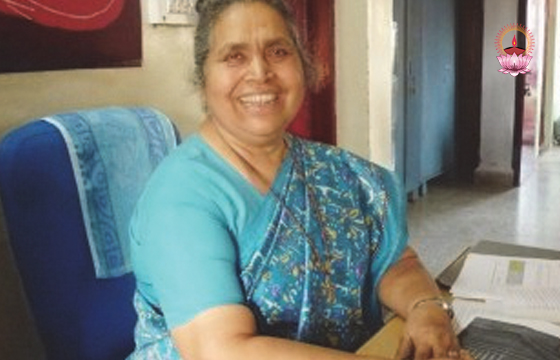
An Austrian magazine has listed a Catholic nun from India among 100 people, who influenced the world the most during the crises-ridden 2020.
The “OOOM” has placed Sister Lucy Kurien, founder director of the Pune-based Maher, 12th in the list, just above the Dalai Lama and Pope Francis.
The magazine says 2020 was a year no one ever expected. “The world today is different than it was 12 months ago. Which people have inspired, motivated and excited us most in this 2020 crisis? To whom do we owe leadership on the way to a better future? For the fifth time, OOOM presents the large ranking “OOOM 100: The World’s Most Inspiring People.”
“The OOOM editors and a prominent jury – including star designer Stefan Sagmeister, London’s Serpentine Galleries director Hans Ulrich Obrist, world-class geneticist Josef Penninger, gallery owner Thaddaeus Ropac and wallpaper manager Gilles Massé – contributed to the ranking. Every ranking is subjective. But it shows which people actually impressed us over the past year.”
The list is topped by Ugur Sahin, a German scientist and developer of the Covid-19 vaccine co-founder and CEO of BioNTech, who gave the world a new hope. His vaccine is a key component in the battle against a virus that has already claimed 1.7 million lives. The research he conducted with his wife Özlem Tureci has led to the most important medical development of our time. The second in the list is Kamala Harris, future Vice President of the United States, followed by Joe Biden, 46th President of the United States.
She said the Covid-19 lock-down was a challenging time for her organization. She said approximately 40 women, some with children, arrived at Maher seeking asylum as the lockdown began in India on March 25.
“We have to take care of four walls in this period — physical strength, emotional strength, mental strength and spiritual strength — to counter any exter-nal threat to our well-being,” the member of the Sisters of the Cross of Chavanod told.
Category Archives: National
Indian state criminalizes conversion for marriage
Madhya Pradesh State in central India has replaced its more than 50-year-old anti-conversion law with a new and more stringent one that can criminalize even conversion for marriage.
The law notified on Jan. 9 says any attempt to convert a person from one religion to another through misrepresentation, allurement, use of threat or force, undue influence, coercion or by marriage is a punishable offense.
Violators can be jailed for up to 10 years under the new law called the Madhya Pradesh Freedom of Religion Ordinance 2020. Those abetting or conspi-ring such conversions can also be punished.
The new law replaces the Madhya Pradesh Freedom of Religion act of 1968. However, it allows the reconversion of a person to one’s parental religion without violating the law’s provision.
Leaders of the state government-run by the pro-Hindu Bharatiya Janata Party (BJP) hold that Hinduism is the parental religion of religious minorities in the country such as Christians and Muslims.
In effect, the law allows Hindu groups to convert Christians and Muslims to Hinduism. But those Hindus who convert to Islam or Christianity for marriage can be punished along with their spouses, who can be accused of abetting and conspiring the con-version.
“This law is one-sided and against fundamental rights guaranteed in the Indian constitution,” said Father Maria Stephan, public relations officer of the Catholic Church in Madhya Pradesh.
Police on alert after conversion claim in Indian state
Police in an Indian state have directed officers to keep a watch on prayer gatherings after five Christians were arrested on a charge of religious con-version. Vishwa Hindu Parishad (VHP), a hard-line Hindu group, handed the five Christians to police in Shahjahanpur district of Uttar Pradesh State, which is run by the pro-Hindu Bharatiya Janata Party (BJP).
“It is just an allegation from the fanatic groups and if they are sure about it, let them prove it. People are free to express their views in a democratic country,” Father Harold D’ Cunha, vicar general of Bareilly Diocese, told.
“As far as the Catholic Church is concerned, it does not promote or propagate religious conversion in the diocese as well as in the country.
“Occasionally, these groups blame us for conversions, but until now there is no record of any religious conversion where the Church is involved.”
He said the Church is engaged in many charitable works that can be construed as allurement to conversions, “but it is not true.”
S. Anand, superintendent of Shahjahanpur police, told the Press Trust of India that after the alleged religious conversion activities, officers have been asked to keep a watch on religious gatherings.
“We have directed concerned police officials to take strict action if anyone is found guilty of religious conversion activities,” he said.
Why is India denying prisoners spectacles and straws?
But in recent weeks, jail authorities in India have been called out for being especially cruel to prisoners, particularly the govern-ment’s critics who are described as “human rights defenders” by international rights groups.
Earlier this month, the Bombay High Court reminded officials of Mumbai’s Taloja jail that they needed to show some “humanity” while dealing with the needs of inmates.
“We need to conduct workshops for jailers. How are such small items denied? These are all human considerations,” Justices SS Shinde and MS Karnik said.
The “small items” here were spectacles that jailed activist Gautam Navlakha had been denied.
The judges’ comment came after his family told the press that his spectacles were stolen in prison and that when they sent a fresh pair, the authorities refused to accept them.
“He was allowed to call me on 30 November, three days after his glasses were stolen. He’s 68, he needs a high-powered lens and without them, he’s nearly blind,” his partner, Sahba Husain, told me.
Since the start of the pandemic in mid-March, India has stopped all visits by family or lawyers to jail. Inmates are not even allowed to receive parcels.
Husain says Navlakha told her that he had spoken to the jail superintendent and had been assured that he would receive his spectacles.
Husain, who lives in Delhi, quickly got a new pair made and posted them on 3 December.
“I checked three-four days later and realized that the parcel had reached the jail on 5 December, but had been refused and returned.”
It was only after the judges read out a lesson in “humanity,” and subsequent outrage on social media that jail authorities provided a new set of spectacles to Mr Navlakha.
A former secretary of the non-governmental organisation People’s Union for Democratic Rights, Navlakha is no ordinary prisoner. He’s spent a lifetime working for civil liberties and is respected globally.
He’s been in jail since the middle of April in connection with what is known as the Bhima Koregaon case.
He’s among 16 activists, poets and lawyers who have been arrested over the past two years on charges of instigating caste violence at a Dalit rally in Bhima Koregaon village in the western State of Maharashtra on 1 January 2018. They all deny the charges against them.
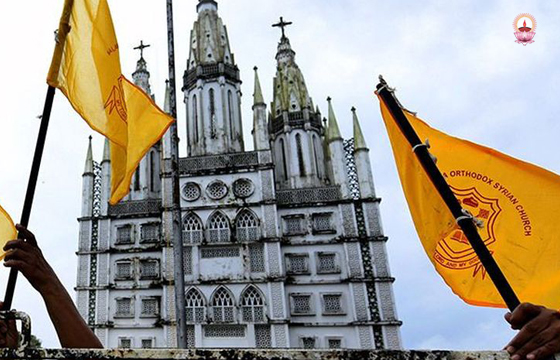
PM to help sort out Kerala church issues
With differences between Orthodox and Jacobite factions in widening, Prime Minister Narendra Modi will talk to both groups to find a lasting solution to some issues, said Mizoram Governor P S Sreedharan Pillai. The governor, also hailing from Kerala, said he had briefed the Prime Minister about all issues and sought his intervention to help solve them. He said leaders of both factions will be met separately and later to joint meeting will be called. Pillai also said he will also discuss the issue with Home Minister Amit Shah.
The growing friction between the two factions has invited enough embarrassment for the community and often created big law and order problems in the state. Earlier Chief Minister Pinarayi Vijayan also tried to broker peace between two but failed to make much headway as both sides stuck to their stands.
“There is a complaint that central funds for minority welfare are not distributed proportionately between different communities in the state. The Church has been raising its concern in this regard for quite some time. So the PM will hear their woes also,” Pillai said.
“We hope the PM’s intervention will help us get justice,” said Jacobite Church trustee Joseph Mar Gregorios. “We are ready to go by any agreement that is bound by law of the land and decision of the apex court,” said Orthodox Church secretary Biju Oommen. Recently, a tiff between the two spilled over to the streets inviting enough embarrassment for believers.
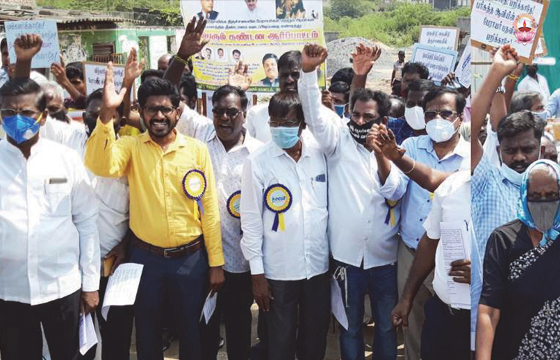
Dalit Christians hold protest march in southern India
Dalit Christians in the southern Indian state of Tamil Nadu have held a protest in march against discrimination faced by Dalits in 45 Catholic parishes of Pondicherry-Cuddalore Arch diocese.
Protesters submitted a memorandum to parish priests on Dec. 20 and requested them to forward it to Archbishop Giambattista Diquattro, India’s apostolic nuncio. “The memorandum contains Dalit Christians’ long-standing common demand for equal rights for all,” M. Mary John, president of the Dalit Christian Liberation Movement (DCLM), told UCA News.
“They fervently appeal to the nuncio and the Holy See for their urgent intervention to secure them justice and equal rights. DCLM has been vigorously pursuing these demands with the Catholic hierarchy in India as well as with the Vatican for years.
“The current protests follow a peaceful sit-in by 40 Dalit priests at the archbishop’s house in Puducherry from Nov. 29 to Dec. 4 demanding a dialogue with the archbishop and the administrators.”
John said Dalits have long faced caste discrimination and continued denial of key administrative posts in the archdiocese and in leadership of ministries.

Meat issue: Goa Church writes to chief minister
The Church in Goa has urged the state chief minister to urgently intervene to resolve meat shortage that has severely affected people’s protein intake and tourism industry.
The Council for Social Justice and Peace (CSJP) wrote to Pramod Sawant that the western Indian state started experiencing the shortage after neighboring Karnataka State passed a bill to ban cattle slaughter.
The Goa archdiocese’ social action wing says its December 15 memorandum is sent on behalf of meat traders and consumers as well as in the interest of the tourism industry in the state.
“This intervention is requested on behalf of the vast majority of beef consumers as well as for the benefit of the culinary business in Goa and for the benefit of tourism in the state,” says the letter signed by the council’s executive secretary Father Savio Fernandes. The Church body wants the Goa chief minister to “urgently intervene in the matter with Karnataka on behalf of Goa asking it not to notify the bill in their state in order to safeguard the livelihood of hundreds of meat traders who along with their employees are totally dependent on this trade for their survival.”
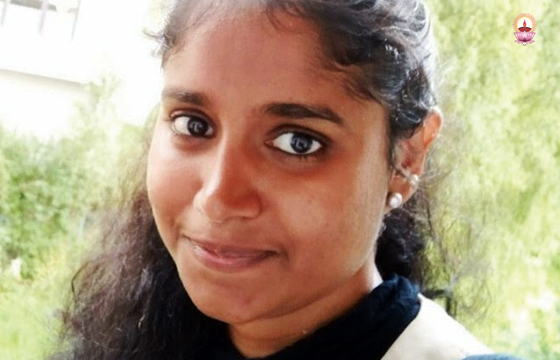
YOUCAT India gets new national director
The Conference of Catholic Bishops of India has appointed Maria Francis from the Archdiocese of Bangalore as the new national director of YOUCAT India.
She will coordinate the ministries of the Youcat India Missionary Movement and will guide its members in India.
Youcat, short for Youth Catechism of the Catholic Church, also styled as YOUCAT, is a 2011 publication that aims to aid youth to better understand the Catechism of the Catholic Church.
Francis is an engineer by profession and a member of the Holy Redeemer Parish, Hennur, Bengaluru, the capital of Karnataka State in southern India.

A bleak winter for the Church in India
The Church in India has never been under such stress as in the Christmas season of 2020.
Starved of finances under a harsh law that regulates inter-national donations and the near absence of worshippers in the Covid-19 curfew, the Church cutting across denominations is pummelled by accusations from political foes and the seething anger of a section of the faithful outraged at exposes of corruption and moral turpitude, sometimes in the highest echelons of the clergy.
As the largest denomination, claiming a full 60 percent of the Christian population of about 30 million among 1.25 billion Indians, the Catholic Church gets more than its share of the torment from within and outside.
For the Episcopal, Evangelical, Pentecostal and independent churches, while some of the bigger groups have leaders facing serious charges of financial bungling and alienation of property — the polite word for selling off churches, graveyards or institutional lands — the main threat remains from the laws against religious conversion, once confined to a mere six states but now rapidly legislated in many more provinces by the Hindu nationalist Bharatiya Janata Party [BJP] which rules the country and controls two-thirds of the states. It does not seem too far away when it will be operational across the country.
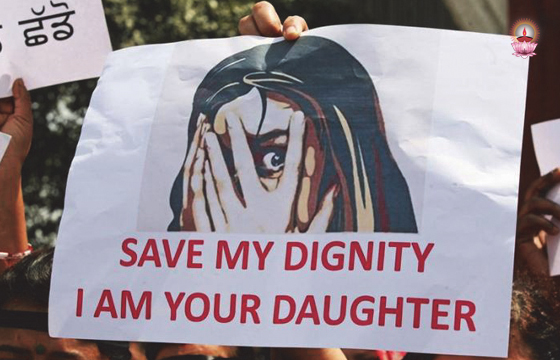
6-year-old Dalit child raped and murdered in magic ritual
A 6-year-old Dalit girl has been found dead in Kampur (Uttar Pradesh). The little girl had disappeared on the eve of the Deepavali festival (last November 15) from the Ghatampur area. She was found with signs of torture, rape, with an open ribcage and stolen lungs. Police say the little girl’s lungs were removed to perform some magical rituals, with the belief that this could help a woman give birth to a son. The suspects – Ankul Kuril, 20, and Beeran, 31, were arrested and confessed to giving the victim’s lungs to Parshuram Kuril to perform the ritual. The latter’s wife was also arrested because, despite knowing about the murder, she said nothing to anyone.
India is considered one of the country’s most at risk for women. According to official statistics, there is one rape every 15 minutes. In 2019, crimes against women grew by 7.9% compared to the previous year. But it is above all little girls who fall victim.
On November 16, also in Uttar Pradesh, in the district of Fatehpur, the bodies of two Dalit sisters aged 8 and 12 were found in a pond. Their family claims that their daughters went to the fields in the afternoon to pick vegetables, but they never came back. They were killed after a failed rape attempt. Both bodies have eye wound marks.
“These unspeakable attacks on girls have become a ‘chronic disease’,” says Msgr. Felix Machado, Secretary General of the Indian Bishops. “Our girls – he continues – are the most vulnerable in society and our Dalit girls are the most exploited and weakest in society and these violations are extremely worri-some. This is a Spiritual failure.”