
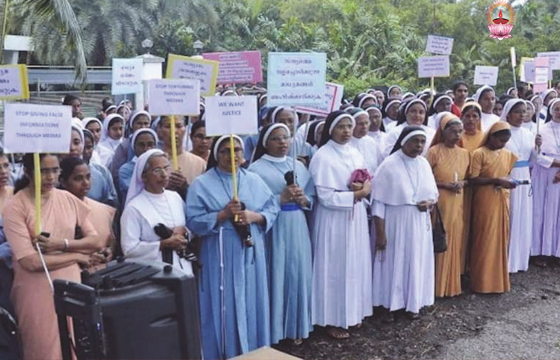
Catholic religious congregations in Kerala are to challenge a state court’s order which withdrew tax exemption that religious priests and nuns enjoyed as employees of government-aided educational institutions for decades. The court in the southern Indian state refused to accept their argument that they do not take their salaries for their personal use but instead they go to their respective religious societies.
“We have now decided to appeal against the order before the Supreme Court of India,” said Father Jacobi Sebastian, president of the Kerala Conference of Major Superiors.
Father Sebastian, a member of the Oblates of St. Joseph, told on Aug. 9 that they are also planning a larger meeting of church officials, major superiors and financial consultors on August 16 to chart the next steps.
The court quoted the Bible to say “Render unto Caesar the things that are Caesar’s, and unto God the things that are God’s.”
“We are reminded of the above teachings of Jesus Christ … while we consider an engrossing question on the liability of tax deduction at source from the salary paid to teachers who are nuns or priests of the religious congregations,” the court said.
The legal clash began in 2014 after the federal Income Tax Department ordered an end to tax exemption given to the Catholic religious priests and nuns since 1944. It asked the government treasury to deduct tax before paying salaries.
Three priests and a nun challenged the order soon after it was issued. A single bench of Kerala High Court dismissed their demand for exemption and upheld the Income Tax Department’s order.
The petitioners appealed before a higher bench of the court along with 49 others, but the court dismissed their demand on July 13.
The lawyers of the petitioners also quoted from the Church’s canon law to say that people who take “a perpetual vow of poverty” undergo a civil death and thereafter they are not considered persons under the Church’s laws.
Category Archives: National
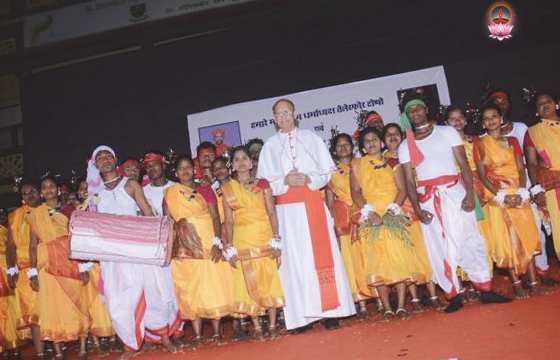
Card Gracias: Tribal groups suffer ‘injustice and exploitation’ around the world
In his morning Mass online, the Archbishop of Bombay (Mumbai) – and is also president of the Catholic Bishops’ Conference of India (CBCI) – spoke about his participation two years ago in the Synod of Bishops for the Pan-Amazon region, enjoined by Pope Francis.
On that occasion, the cardinal realised that “challenges faced by Indigenous people in South America were similar to the challenges faced by Tribals in India.”
Card Gracias also spoke about Fr Stan Swamy, who gave his life for indigenous tribes in India, and mentioned the many men and women religious who work among the Adivasis.
“We are present in Bihar, Chotanagpur and Raighad, to give them hope, education,
dignity and a future,” the prelate said. “But tribes around the world suffer injustice and exploitation.”
For the past three days, the CBCI has been holding webinars to mark the International Day of the World’s Indigenous Peoples, noted Father Nicholas Baria, executive secretary of the CBCI Tribal Affairs Committee.
On paper, the clergyman acknowledges that “The Constitution guarantees the rights of tribal people; in practice, how-ever, their land rights are not recognised” by the authorities.
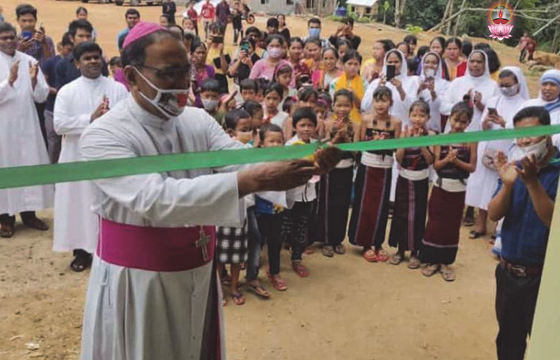
Bishop inaugurates first Jesuit residence in Indian state
Jesuits in India have opened their first residence in the north-eastern state of Tripura.
The Arrupe Inn in Jamtalibari was inaugurated in the presence of faithful by Bishop Lumen Monteiro of Agartala on July 31, the feast day of Jesuit founder Ignatius of Loyola.
“We welcome them to our diocese and wish them our prayers and support as they enter into new ministries. They will be engaged in social, pastoral and education fields in the diocese,” Bishop Monteiro told.
In 2018, two Jesuit missionaries, Babu Paul and James Morias, came to Jamtalibari from the southern state of Kerala.
“As we celebrate the 500th anniversary of the conversion of St. Ignatius, it is an important occasion for Jesuits to refocus on their life and mission,” said Father Irudaya Jyothi, who was part of a Right to Food campaign in West Bengal state before he joined the mission in Tripura.
“The Arrupe Inn is dedicated in a special way to the implementation of the universal apostolic preferences of the Society of Jesus.”
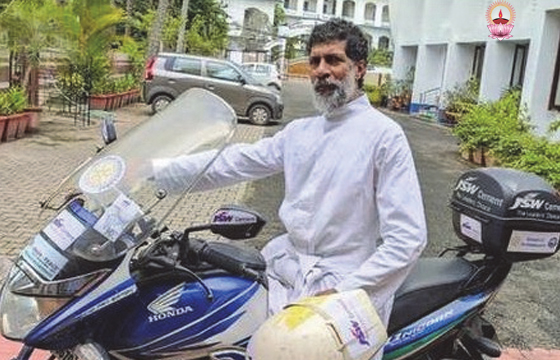
Priest’s all-India journey to promote peaceful, green world
Throughout his career as the principal of Sacred Heart College, in Kochi’s Thevara suburb, since 2010, he was known to use a bicycle to travel short distances, trying to inculcate a sense of ecological responsibility among his students and the general public. In fact, he has been known among people in Thevara as the “padiri” who rides his bicycle.
He has also been part of green activities in the southern Indian city of Kochi, promoting organic agriculture, garden-ing and creating concern for nature in young generation.
The 56-year-old member of the Carmelites of Mary Immaculate retired from his academic career earlier this year. He will now undertake a tour of India on his favorite motorbike. He said he was not using a car since it consumed too much fuel. “Using a motorbike is better, because it was lighter on the environment,” he said as he prepared to set out on the Trust-Green-Peace journey from August 10.
Father Palakkappilly was instrumental in acquiring about four acres of paddy fields in Arayankavu, near Kochi, under the aegis of the Sacred Heart College, as a center for biodiversity where students could be introduced to the basics of nature.
He said he was a “sanyasi” who would be available for any duty to be performed on the orders of his superiors.
The solo bike ride will be flagged off from Thevara and will reach Kottayam on the same day. He will cover Kashmir and Kolkata, Kutch and Konkan as the journey progresses over a period of two months.

Churches in north-eastern India pledge to fight human trafficking
Representatives of various Christian denominations in north-eastern India on July 30 pledged to fight human trafficking in the region.
“Human trafficking is a serious concern all over the world. It is a sad truth that the northeast region has become the hub of cross-border human trafficking,” said Reverend Roger Gaikward, the former president of the National Council of Churches in India and present presbyter at Christ Church, Guwahati.
He was addressing an online meeting to mark the World Day against Trafficking in Persons. It was convened by the United Christian Forum of North East India, an ecumenical organisation.
Moderating the webinar, Reverend Gaikward said, “Listening to victims’ voices will lead the way to helping the region out of this sad reality.”
Among those present were representatives of Presbyterians, Baptists, Evangelicals, Church of North India and Catholics.
Reverend Gaikward points out that northeastern India’s proximity with international borders makes it easy for the human traffickers.
Many trafficked victims never see their homes again. More than 80 percent of them are pushed to flesh trade. Lack of education and awareness on the issue and poverty make the northeastern Indian youth soft targets, Reverend Gaikward added.

Movie titles referring to Jesus spark anger in India
A Muslim filmmaker’s two new movies with references to Jesus in their titles have taken a communal turn in southern India’s Kerala state, with a section of Christians viewing them as part of a larger plan to belittle Christ and Christians. Director Nadirsha began to face opposition after he announced his movie Eesho (Not from the Bible). Eesho and Yeshu stand for Jesus in the state’s Malayalam language. “We will not let this movie be screened anywhere in Kerala,” said politician P.C. George in a video post on Aug. 5, projecting it as part of a “well-orchestrated and deep-rooted conspiracy to malign Christianity.”
Some 30 Christians arrested under Uttar Pradesh’s anti-conversion law
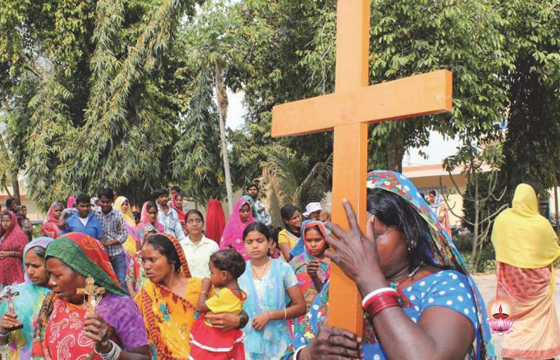
Police recently arrested nine Christians in Uttar Pradesh for allegedly violating the state’s controversial anti-conversion law, which criminalises religious conversion and denies bail to those accused.
The case is cited in a study by International Christian Concern (ICC), a Christian advocacy group, which reports a recent rise in anti-Christian complaints.
The document quotes one of the Christians, Sadhu Srinivas Gautham, who said that about 25 Hindu radicals stormed a prayer meeting last Sunday in Gangapur town, accusing those present of forcibly converting Hindus to Christianity.
“They raged against me,” Gautham said. “It was as if they wanted to kill me on the spot. However, police arrived and escorted us to the police station” where he and six other Christians were charged with violating the anti-conversion law. “They told us we should renounce our Christian faith and go back to Hinduism.”
According to the anti-conversion law, approved last February, “Ghar Wapsi” (homecoming), the reconversion to Hindu-ism, is not forced conversion, even if it is often accompanied by threats and intimi-dation.
According to the ICC, 30 Christians were arrested so far this month; that is up from previous months.

Tripura Church celebrates first World Day of Grandparents
Many parishes of Agartala diocese in the north-eastern state of Tripura on July 25 celebrated the first World Day of Grandpa-rents, declared by Pope Francis.
“Our parishes have traditionally been celebrating the Senior Citizens Day on the Sunday prior or after the feast of Saints Joachim and Anna, the grandpa-rents of Jesus. This year we are celebrating it as World Day of Grandparents and elderly people as suggested by the Holy Father, Bishop Lumen Monteiro of Agartala told Matters India.
Pope Francis instituted the world day for the elderly through a letter dated May 31. The Pope wants the annual celebration on the fourth Sunday in July, close to the feast of the Blessed Virgin’s parents.
Assuring the senior citizens, the Pope said, “I am well aware that this Message comes to you at a difficult time: the pandemic swept down on us like an unexpected and furious storm; it has been a time of trial for everyone, but especially for us elderly persons.”
Pope also said he wanted to celebrate the day, in this particular year, as a long period of isolation ends and social life slowly resumes. “May every grandfather, every grandmother, every older person, especially those among us who are most alone, receive the visit of an angel.”

Catholic priest arrested in Tamil Nadu for hate speech
A Catholic priest in Tamil Nadu’s Kanniyakumari district was arrested July 24 for spreading hate and enmity between religious groups. Father George Ponnaiah, parish priest from Panavilai, triggered a row by allegedly making disparaging remarks about ‘Bharat Mata’ and Hindu religion. The Kuzhithurai diocese condemned his comments made on July 18.
Addressing a meeting at Arumanai in protest against the closure of churches, the ban on conducting prayers in houses and the denial of permission for renovating or constructing churches on private ‘patta’ lands, he alleg-ed remarked about Prime Minister Narendra Modi and Home Minister Amit Shah.
According to Father Ponnaiah, M.R. Gandhi, a Bharatiya Janata Party legislator from Nagercoil, was responsible for the Mandaikaadu communal riots in 1982. He said the DMK’s victory in the assembly election was the “alms given by the Christians and the Muslims.”
His speech was condemned, among others, by State Minorities Commission chairman S Peter Alphonse.

Muslim businessman aids church construction in Abu Dhabi
An Indian Muslim billionaire businessman, based in United Arab Emirates, has come forward to help build a Protestant church in its capital city of Abu Dhabi.
Yusuff Ali Musaliam Veettil Abdul Kader, popularly known as M A Yusuff Ali on July 23 donated 500,000 dirhams (US$136,147 or 10,138,771 Indian rupees) for the construction of a worshipping centre of the Church of South India in Abu Dhabi. Ali is the chairperson and managing director of Lulu Group International, a multinational conglomerate company that operates a chain of hypermarkets and retail companies. Church of South India parish in Abu Dhabi Father Lalji M Philip received the check from Ali.
The church will be built on 4.37 acres of land donated by Sheikh Mohamed bin Zayed Al Nahyan, the Crown Prince of the Emirate of Abu Dhabi, Deputy Supreme Commander of the United Arab Emirates Armed Forces and the de facto ruler of Abu Dhabi.