
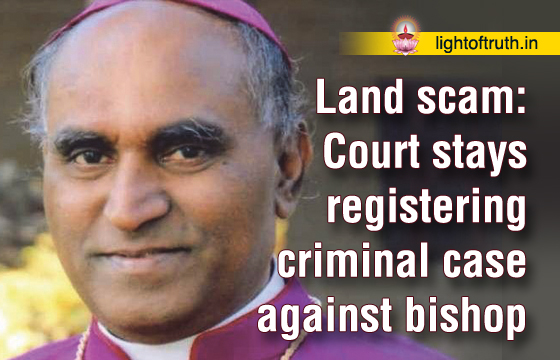
A court in Karnataka, south-ern India, has spared a Catholic Bishop from facing police inquiry into a land dispute.
The Sessions Court in Chik-magalur’s September 1 order observed the accusation against Bishop Thomasappa Anthony Swamy of Chikmagalur and a priest was false. A group of priests and lay people had earlier accused the prelate and Father A Shantharaj of selling a property attached a Church school by fabricating documents.
V T Thomas, the prelate’s lawyer, challenged the case and explained to the court that the plot in dispute was “never sold” and no manipulation of documents had been done.
Presenting proof of documents and minutes of the St Joseph’s Education Society that controls the property, the lawyer pleaded that the case filed by Michael Sadananda Baptist against the Bishop was “fabricated and without evidence.”
Thomas, the lawyer, told that a criminal case has also been filed with city police against Baptist “for cheating, tampering documents, mischief, and criminal conspiracy to tarnish the name of the Bishop and the Diocese.”
Category Archives: National

Crisis deepens in India’s Eastern Church over liturgy
The liturgical dispute in India’s Eastern-rite Syro-Malabar Church has deepened after a section of priests opted not to follow a synod decision to have a uniform liturgical celebration in all 35 dioceses.
Some 300 priests of Ernakulum-Angamaly Archdiocese, the seat of the church’s Major Arch-Bishop, Cardinal George Alencherry, met their archiepiscopal vicar, Archbishop Antony Kariyil, on Aug. 28 and explained their decision, said Father Jose Vailikodath, a priests’ council member.
“We met Archbishop Kariyil and urged him to get a dispensation from Pope Francis over the synod decision so that we can continue with our traditional mode of celebrating Holy Mass, facing the congregation,” Father Vailikodath told on Aug. 31.
The bishops’ synod, the church’s supreme decision-making body, on Aug. 27 asked parishes in all dioceses to implement a uniform mode of Mass from Nov. 28. The synod had decided on a uniform liturgy in 1999 but the decision was not implement-ed in some dioceses following opposition from priests and laity.
Bishops who find it difficult to implement the decision should do it in a phased manner “through effective catechesis.” All dioceses should complete the process by next Easter Sunday, April 17, said the synod of the church based in southern India’s Kerala state in an official circular.

Indian bishops launch handbook on ecumenism
A handbook on a better understanding of ecumenism has been released by Archbishop Leopoldo Girelli, the apostolic nuncio to India and Nepal, in India’s capital New Delhi.
The book titled May They All Be One: Ecumenism in Catholic Perspective has been compiled by the Conference of Catholic Bishops of India (CCBI) to help re-establish unity among all Christians. “The book proposes a common call for Christian unity made by the Second Vatican Council through prayer and dialogue. Adequate formation for the ecumenical dialogue needs to be fostered among all the churches in India,” Archbishop Girelli said during the book’s launch on Aug. 31.
Addressing members of the clergy, laity and faithful from different church denominations, the Vatican ambassador said that “the Church is open to ecumenical endeavor for the witness of unity among all people.”

Judge bats for cow as India’s national animal
The observations of a high court judge in calling for the cow to be declared India’s national animal have evoked mixed reactions from social activists.
Justice Shekhar Kumar Yadav of Allahabad High Court in the northern state of Uttar Pradesh made the observations on September 1 while denying bail to Javed, a Muslim man accused in a cow slaughter case.
Fifty-nine-year-old Javed was jailed in March for slaughtering a cow but his lawyer told the court that his client had been implicated in a false case.
“All circumstances must be considered and the cow should be declared as a national animal and cow protection should be made the fundamental right of Hindus,” the judge is reported to have said. Human rights activist A.C. Michael told that there is nothing wrong in declaring the cow as a national animal. “In fact, it should be whole- heartedly welcomed. The government of the day should immediately imple-ment the law to protect the cow.”
Michael, a former member of Delhi Minorities Commission, said Indians do worship the cow and depended on it for agri-culture and allied economic activities. The judge seemed neutral in his observations but the judiciary must also recognize the rights of those consuming beef.
“The law must not be misused by cow protection activists or private cowsheds built to show off and doing little to protect the cow, as the judge himself observed,” the Christian lay leader said.
Justice Yadav had said that the cow is known as the mother in the country and is worshipped as a goddess. “Cows give milk, which is needed for a strong and healthy constitution. It gives cow dung for fertilizers and urine that kills germs … It produces calf and oxen, which help in agriculture when they grow up,” he said.
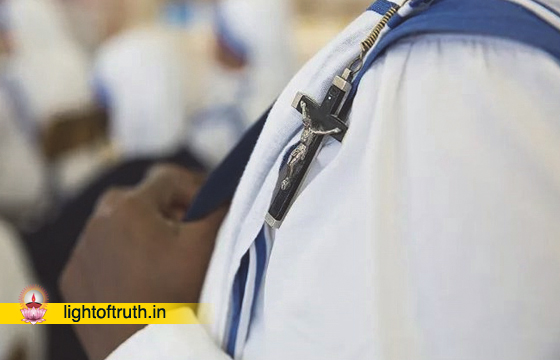
Missionaries of Charity and 14 disabled children from Kabul arrive at Rome airport
Religious sisters from the Missionaries of Charity and 14 disabled children from an orphanage in Afghanistan arrived safely on Aug. 25 at Rome’s international airport.
A Catholic priest and five sisters from the order founded by Mother Teresa arrived on one of two evacuation flights from Kabul that landed in Rome on Aug. 25 carrying a total of 277 people.
Fr Giovanni Scalese, the ecclesiastical superior of the Catholic mission in Afghanistan, also arrived on the flight. He spent eight years in Kabul, offering daily Mass for foreign residents in the city at the only Catholic church in Afghanistan, located inside of the Italian embassy.
“I would never have returned to Italy without these children,” Fr. Scalese told the Italian newspaper La Repubblica. We could not leave them there.”
The children, aged between six to 20 years old, were residents of an orphanage founded in 2006 by the Missionaries of Charity in Kabul, which has now been forced to close due to the Taliban’s takeover of the city.
Sr Bhatti Shahnaz, another Catholic religious sister who arrived in Rome on the evacuation flight, also worked with disabled children in Afghanistan with her community, the Sisters of Charity of St. Jeanne Antide.
“The 50 intellectually disabled children we looked after are still there,” she said with tears in her eyes.
Fr Matteo Sanavio, the president of the NGO For the Children of Kabul, was at the airport to welcome the Catholic arrivals from Afghanistan.
“The first moments we shared were smiles under our masks,” Sanavio told Vatican News.
“We were able to embrace, and the first words we said to each other were: ‘We praise the Lord because He has done great things.’”
Italy has welcomed 2,659 evacuated Afghans, about a third of them children, according to the Italian Defense Minister Lorenzo Guerini.
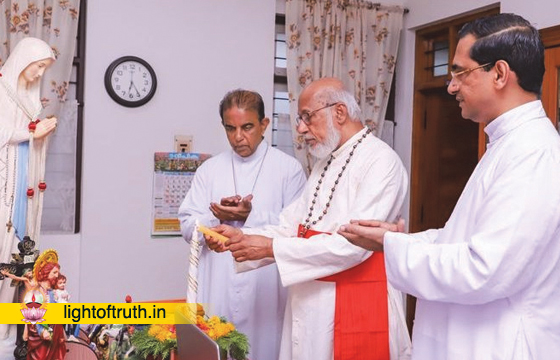
Syro-Malabar synod alters order of Mass
Priests, who lead the Mass, will face the congregation for the introductory session and delivering the sermon, but for the rest the of worship, will face the tabernacle, beginning November 28, it was decided at the 29th Synod of the Syro-Malabar Church that was held online and concluded on Aug. 27 evening.
This change in the order of worship must be implemented in all parishes, latest by April 17 next, Easter Sunday, the Synod said.
The Bishops, who constitute the Synod, expressed concern at what they termed as attempts being made to overlook the contributions that Christians had done for nation building. While stressing the need to uphold freedom of expression, they condemned repeated attempts by persons in the socio-cultural spheres and the film sector to portray Christianity in bad light. Social issues affecting Christians had been taken up with members of the ruling front and that of the Opposition, they said.
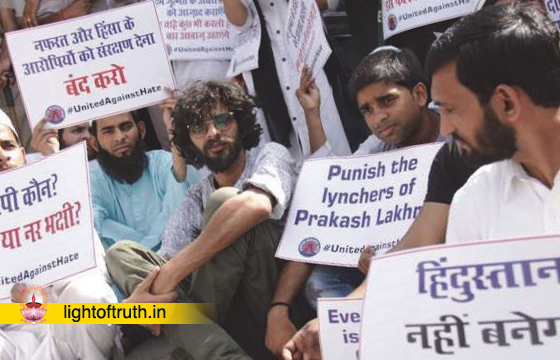
Activists seek prevention of hate speech in India
Social activists in India have filed a plea before the Supreme Court seeking the prevention of hate speech in public places.
The move comes in the wake of reported hate speeches made against Muslims by Hindu Rakshak Dal (Save Hindu Forum) at a rally in capital Delhi on Aug.8.
Syeda Hameed, a former member of the Planning Commission of India, and Professor Alok Rai, a former faculty member of Delhi University, filed the public interest litigation on Aug. 16, urging the apex court to recognize that public authorities have a “duty of care” to prevent such speeches.
he petitioners asked the court to define the contours of liability when authorities willfully allow hate speech in contravention of constitutional and statutory laws.
Pointing out that it was the fifth such rally to be held in three months across the national capital region and neighboring Haryana state, the petition underlined how “speeches calling for direct action against Muslims were made.”
Video footage of the Aug. 8 rally circulating on television and social media showed mobs openly calling for the killing of Muslims. Delhi police later made some arrests after failing to take preventive action, which was against the guidelines issued by the Supreme Court, the petitioners pointed out.
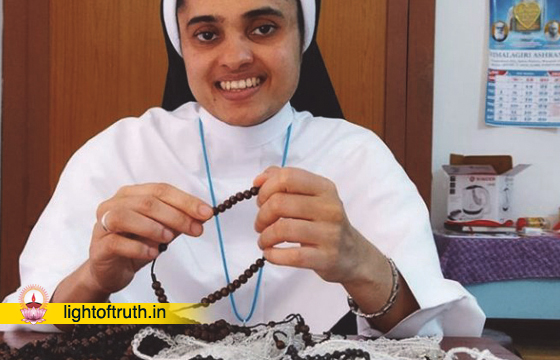
Nun braves debilitating disease to manage “rosary bank”
Sister Rini Rose was diagnosed with multiple sclerosis when she was 26. As a result, she has become physically weak, which limits and slows down her movements.
Rose made her first profession at the age of 20 as a member of the Sisters of the Adoration of the Blessed Sacrament, a congregation based in the southern Indian state of Kerala. The debilitating disease hit her as she was completing a three-year nursing course in Andhra Pradesh, another southern Indian state.
Now, after 15 years, Rose spends most of her time inside a convent in Ambalavayal, a village in Wayanad, a district in northern Kerala. She prays for others and receives prayer requests from people both known and unknown to her. She also makes rosaries and deposits them into the rosary bank she created until she gives them to people who need them.
“ I was diagnosed with multiple sclerosis in 2005, just before I could start working as a nurse. Since then, I have been on medication.
I was sad and distressed when I was told I was suffering from MS. But my strong faith in God helped me overcome my sorrows and lead a fulfilling life.
According to my doctors, MS affects the central nervous system, especially the brain, spinal cord and optic nerves. This can lead to a wide range of symptoms in the body.
After my diagnosis, I began to feel my health deteriorating. I also began to experience more limited physical movements. Now, I need double the time and effort to do my daily regular activities. I also need to use extra energy to move around that causes physical strain and tiredness. Even to move around within the convent, I need help from others. My sisters always lend me a hand.” “Praying for others and surrendering my suffering to the Lord gives me great joy.”
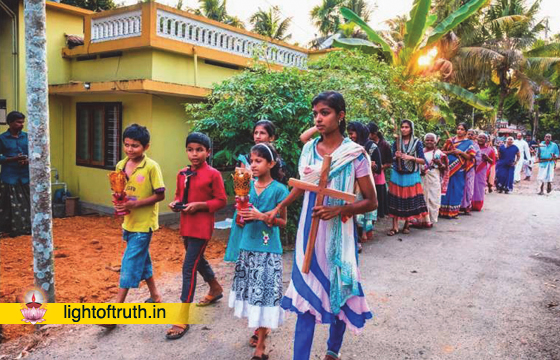
Extinction rebellion: Indian Catholics urged to have bigger families
Catholic bishops want Christian families in Kerala to have more children after the national census recorded a drastic decline in the community’s population in the southern Indian state.
The Christian population in the state declined from 24.06% in the 1950s to 18.33% in 2011, according to the census report.
“Fifty years ago Christians in the state accounted for one-fourth of the total population but now we are on a drastic decline,” Father Jacob G. Palackappilly, deputy secretary-general of Kerala Catholic Bishops’ Council (KCBC), told.
“If this trend continues, the day is not far off when the Christian community will face a threat of extinction in the state.”
The KCBC at an online meeting last week emphasized the need for promoting large Catholic families and asserted the pro-life stand of the Church.
However, they agreed with the government’s policy to control the population in the country.
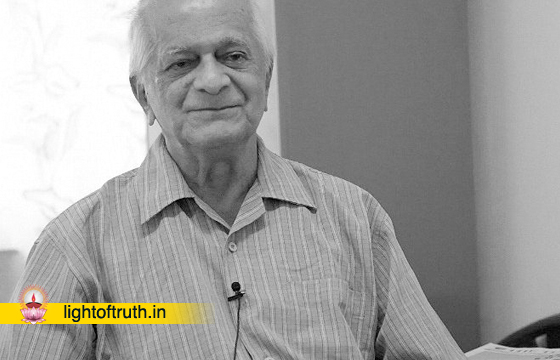
Catholic press body mourns death of last surviving founder
The Indian Catholic Press Association (ICPA) on August 26 mourned the death of its last survivor earlier in the day.
Monsignor Benedict Aguiar had led the organisation as its president from 1969 to 1978.
“In his death the ICPA has lost a father-figure. His long and illustrious life and legacy as priest, communicator, historian, author and organizer will continue to inspire us and the posterity for sure. The zeal and consistency he maintained in his convictions and actions make him an all-time role-model for everyone.”