
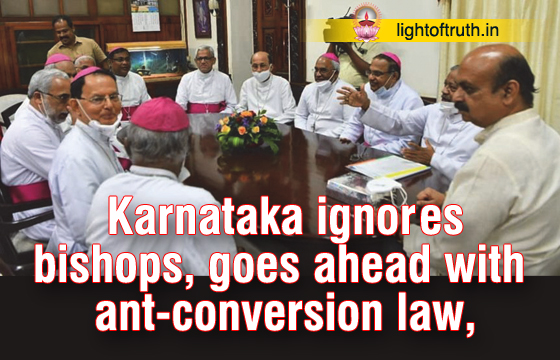
The government in Karnataka has issued an order to check “forced conversions” in the southern Indian state.
State Chief Minister Basa-varaj Bommai on September 28 instructed the district deputy commissioners to become vigi-lant about the conversions in their respective jurisdiction and puni-sh those violating the rule.
The order came five days after the Catholic bishops in the state governor to express their concern about the proposed Anti-Conversion Law in the state.
Bommai said he has received complaints about the forced conversions during his recent visits to various districts and that such activities cannot be tolerated. He reiterated the government plan to bring in a legislative ban on conversions in the state.
Father Faustine Lobo, the director of the regional Pastoral Centre in Bangalore, says the Catholic Church does not involve in any forcible conversions, although it cares to more than 30% of the population with schools and hospitals.
“If we really wanted to con-vert people through our schools or hospitals, we could have done it easily,” the priest told Matters India September 29. He also challenged the government to prov4e if any such incidents had been reported.
However, he expressed concern that an anti-conversion law might result in people taking law into their hands and harassing “Christian workers and our institutions.”
Category Archives: National
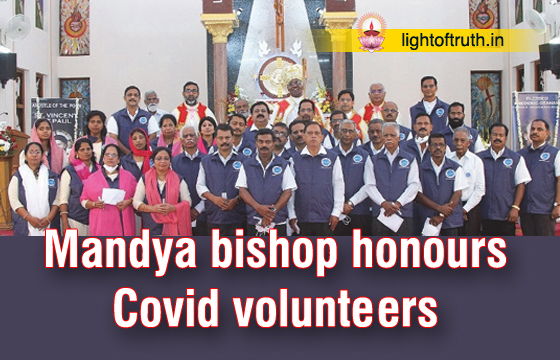
Mandya bishop honours Covid volunteers
Bishop Sebastian Adyanthra-th of Mandya has hailed the Covid volunteers for their exceptional service to mankind during the coronavirus pandemic.
“Covid posed a serious crisis in Bengaluru and the Catholic laity under the Vincent De Paul Society have played a remarkable role as frontline warriors,” the Syro-Malabar prelate said.
Bengaluru is the capital of Karnataka where Covid19 claim-ed more than 8,500 lives.
The bishop was speaking at the silver jubilee celebrations of the St. Vincent De Paul Society at St. Thomas Church, Jalahalli in Benglauru, capital of Karna-taka. The parish unit of the St. Thomas Church that celebrated the jubilee on September 27 decided to build five houses for the Covid-19 victims as jubilee gifts.
The bishop called upon the society members to imbibe the Vincentian spirituality and increase charity activities in all the parishes of Mandya diocese.
Tom Thomas, a pioneering member of the unit, said his most gratifying moments in life came when he reached out to the needy.
The parish unit of the Vincent De Paul Society worked round the clock to transported Covid patients to hospitals in their ve-hicles, supported their treatment and provide food to their fami-lies. The main tasks included reaching food and medicines to the affected families, help orga-nize hospital admission for those requiring hospital care, assist in swab collection from people with symptoms, provide oxygen cyli-nders, oximeter, masks, gloves, sanitizer and other items irres-pective of people’s cast or creed.
“For us, the work was wor-ship and we experienced the Christian life more meaning-fully,” said Tom Thomas, who has led the lay movement in the parish for more than two decades as the founder president.

Indian police probe Christian wedding over conversion claims
Police have launched an investigation into the marriage of a Protestant couple after Hindu activists claimed the bride was a Hindu converted to Christianity in the central Indian state of Madhya Pradesh.
Hindu extremists barged into the marriage reception in Indore town on Sept. 29 evening and disrupted the function.
Even though the families of both bride and groom denied the allegations, the ruckus led to the police being summoned.
“The couple and their family members were taken to the police station. The allegations of the Hindu activists were found to be false and they were let off,” Pastor Patras Savil, who is based in Indore, told on Sept. 30.
“The newly wedded couple are Christians and their marriage reception was disturbed based on a false allegation of religious conversion.”
No one from either family spoke to the media about the incident, apparently out of shock and fear. Police have started a probe into the marriage based on a complaint from an office bearer of Vishwa Hindu Parishad and Bajarang Dal, right-wing Hindu organizations opposed to Christians and their charitable work.

Christians decry profiling of faith leaders in central India
Christians in Madhya Pradesh state, central India, are outraged after government agencies began profiling Christian religious leaders working among indigenous people.
A revenue department official in the tribal-dominated Jhabua district summoned Christian leaders and asked them to provide personal information such as their appointment as a priest and the document related to their conversion. The official letter also asked them to certify if they were converted through allurement or force as the government wants to initiate legal proceedings against illegal conversions.
A state law criminalizes religious con-version through allurement or force, making it an offense punishable with up to 10 years in prison. The letter issued on Sept. 13 has also directed them to present details regarding their work in person before the official on Sept. 22 at noon.
“Our 16 pastors have received similar letters,” said Auxiliary Bishop Paul Muniya of Protestant Shalom Church in the district.
Christian leaders say their people face increased hostilities from right-wing Hindu groups opposed to their work in the district in their work among tribal people.
Earlier on Aug. 26, the additional superintendent of police, in a letter to police stations under him directed to assist activists from Vishwa Hindu Parishad (VHP), a right-wing Hindu outfit in their drive to close illegal Christian prayer halls and to contain illegal religious conversion activities in the district.

Christians appeal to India’s president for protection
Christians in the central Indian state of Madhya Pradesh have called on India’s president to provide protection amid open threats from Hindu activists to demolish their churches.
“Hindu activists mostly from Vishwa Hindu Parishad (VHP—world Hindu Council] have set a deadline to demolish our churches on Sept. 26, alleging they are illegal structures,” said Auxiliary Bishop Paul Muniya of the Protestant Shalom Church based in the state’s Jhabua district, which is dominated by tribal people.
VHP has also issued threats to the indigenous Christians against practicing Christianity and are forcing them to return to Hinduism, he told on Sept. 20.
“We handed over a memorandum to Indian President Ram Nath Kovind through the district collector on Sept. 17 seeking his urgent intervention to ensure the safety and security of the indigenous Christians,” the prelate said.
Bishop Muniya further alleged that local administrators were siding with the right-wing groups and harassing Christians who make up 4 percent of the one million population in the district, leading to a rise in anti-Christian violence.
Father Maria Stephan, public relations officer of the Catholic Church in Madhya Pradesh, said both the revenue and police administration of the district were biased against Christians.

Christians face ostracism in India’s Jharkhand state
Christian families in the eastern Indian state of Jharkhand have been ostracized by their village for embracing Christianity. The three families from Mangapat Sirsai village in West Singhbhum district, who became Christian a year ago, are being pressurized to return to the tribal Sarna belief system centered on the worship of nature.
The gram sabha or village council on Sept. 17 decided that the converted families will not be allowed to use common properties for free movement or grazing cattle. They will also not be invited to any social gatherings in the village and nobody will interact with them.
Gabbar Singh Hembrom, district president of the Adivasi Ho Samaj Yuva Mahasabha, a youth organization of local tribal people, warned the villagers to abide by the decision or end up paying a fine.
A meeting will be held every Sunday to check if the decision to ostracize the Christian families was being followed strictly by everyone.
Hembrom said: “The entire village follows the Sarna religion except for Raut Bankira, Rajendra Bankira and Hiralal Bankira, who converted to Christianity along with their families a year ago. We are ready to accept them if they return to our faith, but they refused.”
Mangapat Sirsai has nearly 200 households with a population of around 700 people.
Hembrom alleged that some Christian missionaries were luring the tribal people with land and money to convert them.
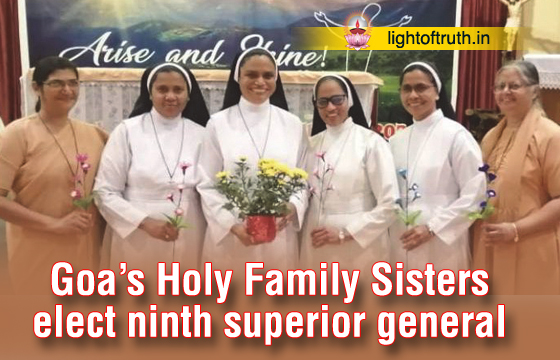
Goa’s Holy Family Sisters elect ninth superior general
The Goa-based Sisters of the Holy Family of Nazareth has elected Sister Berna Rodrigues as their ninth superior general. The election took place September 8, the last day of the congregation’s 12th ordinary general congregation held at St. Joseph Vaz Spiritual Centre, Old Goa.
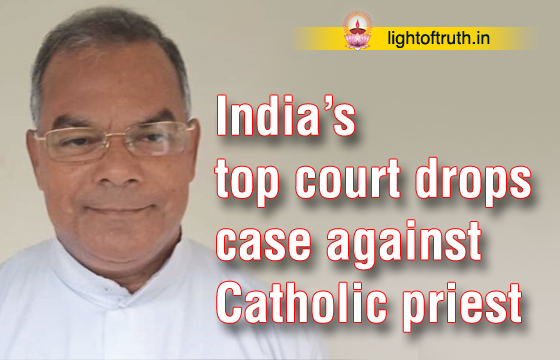
India’s top court drops case against Catholic priest
India’s top court has dis-charged a Catholic priest from a religious conversion case, registered against him in central Indian Madhya Pradesh state three years ago.
Father George Mangalapilly, a professor at St. Ephrem’s Theo-logical College in Satna diocese, was charged with converting Dharmendar Dohar, a Hindu, to Christianity by offering him a bribe of 5,000 rupees (some US$70) and other benefits back in December 2017.
“Apart from the testimony of the witness, there is nothing else on record which could potentially be relied upon against the appellant,” wrote the top court in its order while discharging the priest from the case. The priest along with his 32 seminarians and another priest were taken into police custody on Dec. 14 as they were on their way to sing Christmas carols while visiting Christian homes, a tradition they followed for decades. The Hindu activists, mostly members of the Bajarang Dal, also blocked officers of the police station and demanded action against the priests and all the seminarians for attempting to convert Hindus and.They also alleged ulterior motives to carol singing.

Salesians launch international school of social communications
More than 400 Salesian priests, brothers, sisters and young people spread over 19 regions are attending online the Salesian School of Social Communication (SSSC).
The program was opened on September 24 by Father Gildasio Mendes, the general councillor for social communication. 82 members of 12 Salesian provinces of South Asia region attended the online training session.
Introducing the vision and objectives of the year-long program, Father Mendes highlighted September 24 as a historically significant day for Salesian congregation. “We are commencing an important journey keeping in mind the evangelization mission of the Church to be achieved effectively through communication.”
As emphasized by different general chapters of Salesian Congregation, he said, communication is a priority dimension for Salesians. The Salesian School of Social Communication, an initiative of the Social Communication Department of the Congregation, Rome, envisages training all those involved in the social communication ministry, keeping in mind the priorities of the Church and the congregation.
The project further aims at preparing the participants to communicate from the Salesian perspective. The topics to be covered during SSSC are Biblical Dimension of Communication, Synodal Dimension of Communication, Salesian Dimension of Communication, Institutional Dimension of Communication and Youth Pastoral Dimension of Communication.
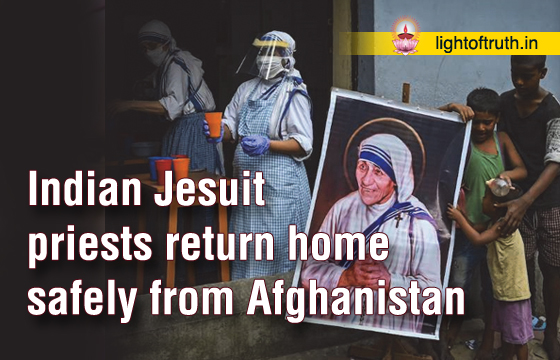
Indian Jesuit priests return home safely from Afghanistan
Four Missionaries of Charity nuns and two Indian Jesuit priests stranded in trouble-torn Afghanistan after the Taliban took control have been moved to safety.
Missionaries of Charity, a religious order of women founded by St. Mother Teresa of Kolkata, has thanked people for their continued prayers and support leading to the safe evacuation of the stranded nuns from the strife-torn country.
The Taliban took control of Afghanistan on Aug. 16, much earlier than expected by the international community. Among the four nuns, one of them is from India. Missionaries of Charity nuns started their mission in Afghanistan in 2004, three years after US-led forces freed the country from the clutches of the hardline Islamist group.
“Our four nuns have been shifted out of Afghanistan and are safe,” Sister Christy, based in Kolkata, the headquarters of the congregation, told on September 8. “We thank everyone who prayed and supported us in the hour of crisis.”
She refused to divulge any further details of the rescued nuns and their current location except to say that they are not in India.
However, Catholic News Agency report-ed that the nuns and 14 disabled children in their care were taken to Rome on Aug. 25 along with 277 other people on two evacuation flights.
“The children, aged six to 20 years old, were residents of an orphanage founded in 2006 by the Missionaries of Charity in Kabul, which has now been forced to close due to the Taliban’s takeover of the city,” CNA reported. Two Indian Jesuit priests — Father Jerome Sequeira, the head of the Jesuit mission in Afghanistan, and his assistant Father Robert Rodrigues — have returned to India from Afghanistan.
“Yes, our priests have safely returned to India,” a Jesuit priest told on Sept. 8. “They have completed their quarantine as per the Covid-19 protocol and are taking rest now.”