

Pope Francis will canonize Devasahayam Pillai, together with six others, during a canonization Mass in St Peter’s Basilica on May 15, 2022.
The announcement was made November 9 by the Congregation for the Causes of Saints. It follows the Ordinary Public Consistory of May 3 this year whereby the Pope had authorized the canonizations, without however setting a date for the ceremony because of the health emergency caused by the Covid-19 pandemic.
Blessed Lazarus (Devasahayam)
Blessed Lazar is the only martyr among those set to be canonized.
Blessed Lazarus, known as Devasahayam, was a Nair caste in India. Converted to Catholicism by a Jesuit priest in 1745, Devasahayam Pillai took the name Lazarus.
Category Archives: National
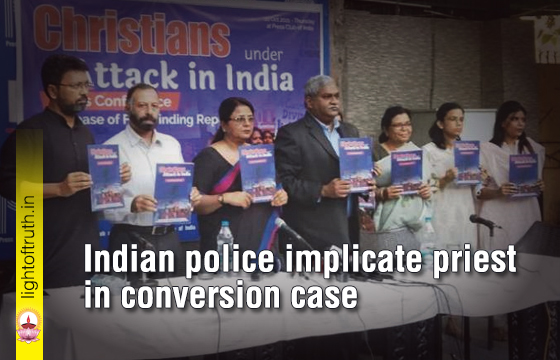
Indian police implicate priest in conversion case
A Catholic priest who tried to help two nuns illegally detained in last month’s Mau incident reported from the northern Indian state of Uttar Pradesh is planning to approach the high court to save himself from likely arrest.
“I am planning to move the state’s top court to discharge me from the case I was not involved in any way,” Norbertine Father Bartholomis Minj said, referring to the alleged violation of the anti-conversion law in Mau for which police took several Christians into custody following a complaint by a pro-Hindu group on Oct. 10.
Sisters Gracy Monteiro and Roshni Minj of the Ursuline Franciscan congregation were at the local bus stop when they were accosted by Hindu activists and forcibly taken to the police station on suspicion they were part of a Protestant group suspected to be involved in religious conversion.
Father Minj rushed to the police station after learning about the nuns’ illegal detention. “When asked, I told the officers that I was principal of St. Joseph School and left the place after meeting the nuns,” he told on November 11.
The priest later learned that the police had registered a case against a school principal with-out naming him. To his shock, a couple of days ago an officer came to his office and interrogated him for over an hour, prompting him to file for anticipatory bail before the district court.
The nuns were released the same day after the detained Protestants told police they were not part of their group.
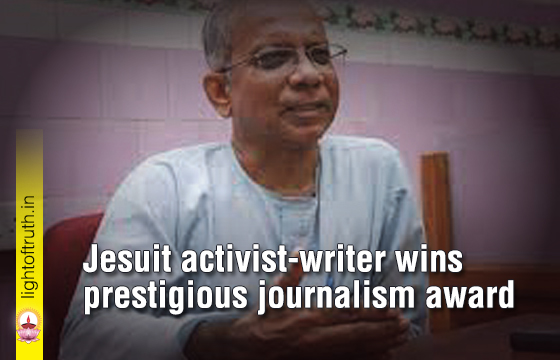
Jesuit activist-writer wins prestigious journalism award
Jesuit Father Cedric Prakash has won this year’s “Louis Careno Award” for excellence in journalism.
The Indian Catholic Press Association, the national body of Catholic print media persons, on November 8 selected Father Prakash for the annual award in recognition of his bold writings against communalism and fundamentalism gaining ground globally.
The association will confer the award on the 70-year-old Ahmedabad-based Jesuit on Decem-ber 1 during its 26th National Convention of Christian Journalists.
Father Prakash’s “incisive, thought-provoking writings on various subjects have broken new grounds. His razor-sharp analysis of sociocultural and political issues, especially relating to communalism and fundamentalism, has led to soul-searching debates in the civil society and the secular world,” says a press release signed by the association president Ignatius Gonsalves and secretary Capuchin Father Suresh Mathew.
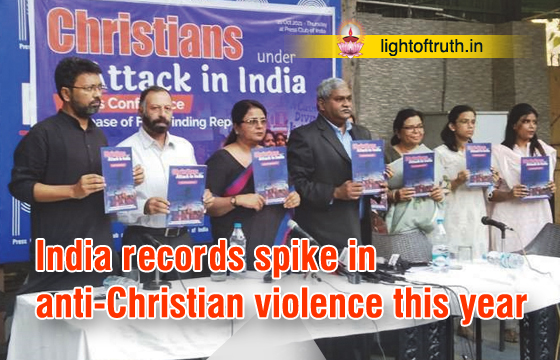
India records spike in anti-Christian violence this year
India has witnessed a significant rise in violence against Christians this year with 305 incidents recorded across 21 states during the past nine months. Surprisingly, official cognizance of the targeted violence was lax with only 30 complaints registered by police so far.
September had the highest number of incidents with 69, followed by 50 in August, 37 in January, 33 in July, 27 each in March, April and June, 20 in February and 15 in May. These figures were published in a fact-finding report by the Association for the Protection of Civil Rights (APCR) and United Against Hate and United Christian Forum (UCF) and released at a press conference in New Delhi on Oct. 21
Christian Prio Sadhana Lanse and her daughters Pearl and Eva from Roorkee presented horrific details of the attack they suffered.
Eva recalled how an armed mob of around 200 shouting slogans like “Jai Shri Ram” (Hail Lord Ram) and “Vande Mataram” (I bow to thee, motherland) barged in, vandalized a prayer house and manhandled the Christian faithful on Oct. 3.
“We feel unsafe there and fear for our lives,” she said, adding that police made no arrests despite naming the main attackers in their complaints with evidence of the violence and destruction they caused.
Uttar Pradesh in northern India ruled by the pro-Hindu Bharatiya Janata Party (BJP) topped the list with 66 incidents of attacks this year, followed by Congress-ruled Chhattisgarh (47), tribal people’s Jharkhand Mukti Morcha-ruled Jharkhand (30) and BJP-ruled Madhya Pradesh (26).
Karnataka in the south, also ruled by the BJP, witnessed a spurt in violence against Christians with 32 incidents.
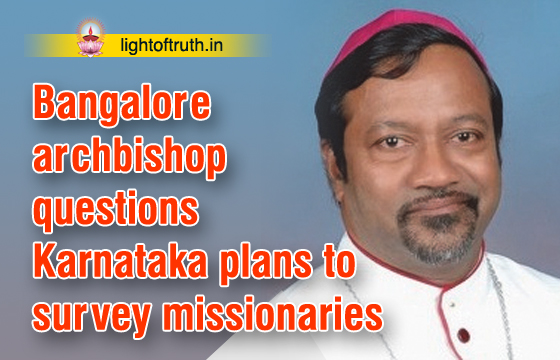
Bangalore archbishop questions Karnataka plans to survey missionaries
Archbishop Peter Machado of Bangalore has condemned the continuous harassment on the Christian Missionaries in the state and questioned the wisdom behind conducting a survey on their presence and activities in Karnataka.
The Backward Classes and Minorities Welfare Department in Karnataka has ordered the officers to conduct a survey of both official and non-official Christian missionaries in the southern Indian state, following a discussion on Christian conversions in the state on October 13.
“Why is the government interested in making survey of the religious personnel and places of worship only of Christian community?” asked the Bishop in a statement issued October 15.
Instead, “let the government take the count of education institutions and health centers run by the Christian missionaries, which will give a fare idea of the service that is rendered by the Christian community to the nation building and how many people are converted in these places and institutions,” he challenged.
“We consider this exercise as futile and unnecessary. There is no good that will come out of it,” stated the archbishop. In fact, in the background of the conversion boggy and anti-religious feelings that are being whipped up, it is dangerous to make such surveys, he added.
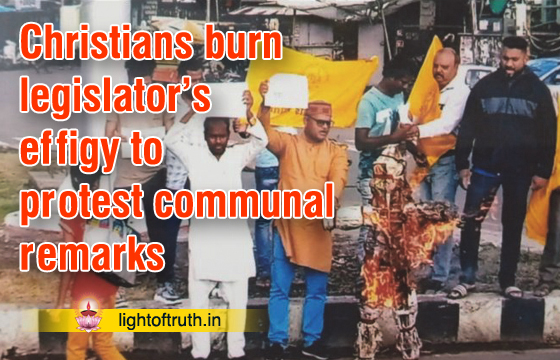
Christians burn legislator’s effigy to protest communal remarks
Some young Christians have burnt the effigy of a Hindu law maker in the central Indian state of Madhya Pradesh to protest against his unsavoury statement against Christians and Muslims.
Rameshwar Sharma, a legislator belonging to the ruling pro-Hindu Bharatiya Janata Party, urged Hindus at a religious gathering “to stay away from Father (referring to Christians) and Chadar (referring to Muslims) and Peer Baba (a Sufi Muslim saint).”
The law maker cautioned Hindus that the company of company of Christians and Muslims “will destroy you.”
The legislator’s communal remarks provoked some Christians, who on October 18 burnt his effigy at Lilly Talkies Square in the state capital of Bhopal.
“This time we burnt Sharma’s effigy at a public place to caution him,” Jerry Paul, the national president of the Sarva Isai Mahasabha (grand council of all Christians), told Matters India, October 22.
“If the legislator repeats the same, we will not hesitate to burn his effigy in front of his house and lodge police case against him for creating communal discord among people on religious lines,” Paul warned.
Sharma believed to have made the remarks at a Dussehra celebration on October 15 in Bhopal. It came to light through a video clipping on social media two-days later.
The legislator further urged Hindus to stop using “good morning” (apparently referring to European culture and Christianity) and instead use “Jai Shree Ram” (hail Lord Ram) to greet people.
Meanwhile Archbishop Leo Cornelio of Bhopal condemned the legislator’s divisive remarks. “An MLA representing the people of a state should have a sense of what to speak and what not to speak in public forum,” the prelate said.

Indian pastor injured after mob barges into church
A pastor of a Protestant church was held by the police after a mob of pro-Hindu activists barged into a church in the Indian state of Karnataka and began singing bhajans or Hindu devotionals as a protest against alleged forced religious conversions.
A video clip of the incident reported from Hubbali town on Oct. 17 showed activists of the Vishwa Hindu Parishad (World Hindu Council) and its youth wing, the Bajrang Dal, forcibly entering Bairidevarkoppa Church and singing devotionals.
Pastor Somu Avaradhi and some of his associates reportedly sustained minor injuries in a scuffle but Arvind Bellad, a local member of the legislative assembly belonging to the ruling Bharatiya Janata Party (BJP), blocked a highway along with his supporters demanding their arrest.
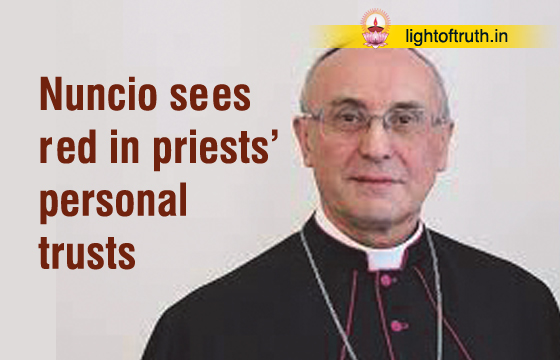
Nuncio sees red in priests’ personal trusts
Apostolic Nuncio to India Archbishop Leopoldo Girelli has pulled up Tamil Nadu bishops for “a tendency” among priests to set up and manage independent trusts violating the canon law. The nuncio says the existence of such trusts in Tamil Nadu came to his attention during his recent visit to the diocese of Kottar in the southernmost tip of India.
“Even if the aim of such trusts may appear to be praiseworthy, all too often those trusts become financial and political power bases for the priests involved,” says the nuncio’s October 8 letter addressed to the Catholic bishops of Tamil Nadu.
The letter, shared widely in social media platforms, quotes various sections of the canon law to urge bishops of dioceses with such trusts to regulate them guided by the bishops’ conference.
“Priests and religious should not be directly associated with any independent or standalone trusts or societies or For/Not-for-profit companies, unless their involvement has specifically been approved by” the local bishop, the nuncio asserts.
The Vatican representative wants bishops to follow the canon law to punish the offenders according “to the gravity of their offence.”
He has recommended the Tamil Nadu bishops’ conference to formulate “clear guidelines on the subject,” if they are non-existent.
He wants every bishop to ascertain the details of the personal trusts held by any of his priests and instruct holders of existing personal trusts to close them immediately. He also wants the bishops to ensure that no new trust is opened by his priests.
The nuncio wants the diocesan trust or the diocesan social services trust to bring under its control personal trusts of priests that “are of genuine benefit to the life and mission of the diocese.”
The Vatican official urges the bishops to resolve that no trust is set up under “the sole control of a single member of the clergy.”
The nuncio concludes the letter saying his recommendations are for the well-being of the Church in Tamil Nadu. In response to the nuncio’s letter, Bishop Thomas Aquinas of Coimbatore, one of the 18 dioceses in Tamil Nadu, wrote to his priests on October 16 that he is aware of “a couple of priests” who have trusts.
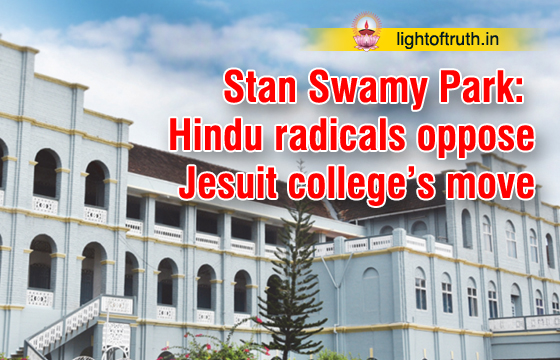
Stan Swamy Park: Hindu radicals oppose Jesuit college’s move
Some right wing Hindu groups in the southern Indian state of Karnataka have objected to naming a private park after Jesuit Father Stan Swamy, who died in judicial custody three months ago.
The park is situated inside the campus of 140-year-old St Aloysius College in Manga-luru, a port city in the state.
The college is part of a network of educational institutions administered by the Society of Jesus in India.
The Mangalore college recently decided to name their park after Father Swamy, who is revered by many for sacrificing his life for the poor tribal communities in Jharkhand, eastern India.
However, Hindu groups on October 6 condemned the college’s decision threatened to protest if the management goes ahead with its plan.
The opposing groups are the Akhil Bharatiya Vidyarthi Parishad, the students wing of the Bharatiya Janata Party (BJP) that heads the federal and several state govern-ments, including Karnataka, Vishwa Hindu Parishad (World Hindu Council) and Bajrang Dal (the party of the strong and stout).
Sharan Pumbwell, VHP zonal secretary, told reporters that Father Swamy was arrested under India’s anti-terror law — the Unlawful Activities(Prevention) Act – as he had faced serious allegations like promoting terrorism and Maoism.
“It is an insult to society if the park is named after him,” he added. He also said the Hindu groups would protest if the management goes ahead with its plan. The groups have also submitted a memorandum to the deputy commissioner in this regard.
The ABVP secretary suggested that the college could name the park after renowned politicians and college’s alumni such as Oscar Fernandes or George Fernandes, who, he said had contributed to society.
Oscar died September 13 this year, aged 80, while George passed away on January 29, 2019, when he was 88.
Some Catholic leaders say the controversy is unnecessary and urge groups to keep away from the internal matters of private institution.
“The political groups have no rights to interfere with the internal matters of St. Aloysius College,” asserts Jesuit Father Joe Xavier, the director of the Indian Social Institute, Bengaluru, where Father Swamy had served as a trainer and director for years.
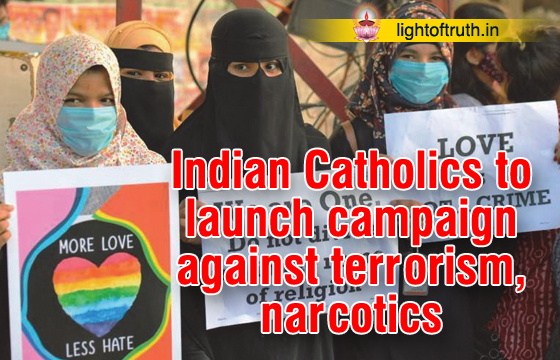
Indian Catholics to launch campaign against Terrorism, Narcotics
The laity council of the Catholic Bishops’ Conference of India (CBCI) will launch a nationwide awareness campaign against terrorism and the use of narcotics on Oct. 1.
The Save the People camp-aign will see students and youths, religious, political organizations and sociocultural movements participate in a “conscientization process” over a period of three months, said V.C. Sebastian, the laity council secretary, in a press release issued on Sept. 24.
Programs through social media against narcotics and te-rrorism, seminars, discussions, family visits, and formation of local solidarity groups will be part of the campaign, the press release said.
Sebastian said the campaign “will rouse the general consci-ence against the glaring threats of narcotism and terrorism getting worse across the nation and making the common man increasingly worried.”
The anxiety shared by certain political parties about the fast spread of a terrorist agenda to the higher education sector is to be viewed seriously, he said.
The CBCI is the apex decision-making body of the Indian Church. The 14 regions of its laity council, 174 Catholic dioceses, various churches and lay organizations will collaborate in the campaign, ensuring the in-volvement of different religious denominations, people’s representatives and sociocultural leaders.