
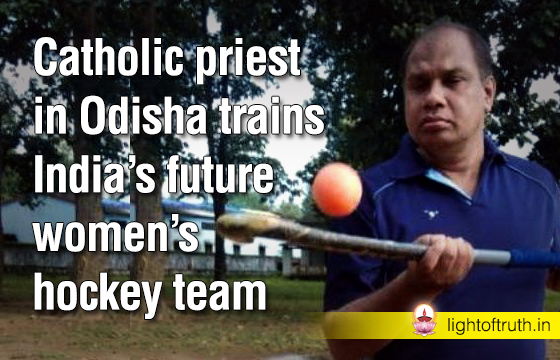
A Catholic priest in Odisha hopes to achieve his childhood dream of playing hockey for India. He now trains women to become the country’s future hockey team and his main supporter is his bishop.
“I always wanted to become a member of India’s A team, stay in a sport hostel and play for my nation. But God willed otherwise,” Father Rajendra Kumar Kujur of Sambalpur Catholic diocese told Matters India. A documentary film “The Mountain Hockey” made on the priest’s resolves and love for the games was released a few months ago on OTT platforms such as Disney Hotstar, MX Player, Fearless, Amazon Prime Video and DcuBay in more than 170 countries.
The Odia language film, directed by Avinash Pradhan and Debasish Mohapatra, gives a glimpse of the cradle of Indian hockey by focusing Amlikha-man, a small village surrounded by mountains in Odisha’s Sambalpur district.
The inspirational figure in the film is Father Kujur, who is currently the headmaster of Upper Primary Mission School in Amlikhaman, some 90 km northeast of Sambalpur.
Fr Kujur’s dram soared high when hockey and Odisha drew national attention when the Indian women team reached Olympics semi-final. All of them were trained in the eastern Indian state.
Now the 46-year-old priest wants his women to win the gold in future. Fr Kujur training students Along with studies, his school provides hockey training to the students, especially girls with coach Dominic Toppo another hockey enthusiast who could not make it to the top because of lack of guidance and opportunities in childhood.
Category Archives: National

Religious polarization targets voters in Indian polls
For Indian politicians, it is time again for temple runs as five crucial states, including the largest, Uttar Pradesh in the north, prepare to go to the polls in the first quarter of 2022.
And besides making a public display of offering flowers and milk to a plethora of gods, the usual election talk to polarize the electorate into majority Hindus and minority Muslims will carry on full steam in the coming months.
The Taliban takeover of Afghanistan in August is proving handy for the ruling Bharatiya Janata Party (BJP) and the pro-Hindu outfits aligned with it while warning voters to resist any attempts to Talibanize India.
Such rhetoric and the resulting public mood suit Prime Minister Narendra Modi’s BJP, which has high stakes in these provincial elections. It rules all but one of the five states.
The northern state of Punjab is the only state ruled by Congress, the main opposition party. The repeal of three farm laws in November in the face of sustained agitation by Punjab’s farmers was an unusual retreat by the Modi regime known for its macho-Hindu politics. The BJP could also face some tough challenges in retaining power in Uttar Pradesh, as it may in Uttarakhand in the north, Goa in the west and Manipur in the northeast, where it rules in alliance with regional parties.

Indian politician promises free pilgrimage to Velankanni
Delhi Chief Minister Arvind Kejriwal has added Velankanni Church in the southern Indian state of Tamil Nadu to his govern-ment’s promised free pilgrimage scheme for senior citizens.
“We were getting requests from our Christian brothers and sisters to include some of their pilgrimage sites to the scheme, so we have decided to include Velankanni Church,” Kejriwal said at a virtual press conference on Nov. 24.
The provincial government of India’s national capital will be launching its free pilgrimage scheme on Dec. 3 with a group of 1,000 senior citizens boarding a train for Ayodhya in Uttar Pradesh, known as the birthplace of Hindu deity Ram. It has also announced free tours to other religious spots like Ajmer Sharif and Shirdi temple.
“India is a secular country where all religions, castes and creeds are respected. If Delhi government is implementing the scheme for other faiths, why not consider Christians too?” Father Savarimuthu Sankar, spokesperson of the Archdiocese of Delhi, told. He, however, cautioned Christians to “be careful about the promises made by politicians” as they may not always come true. “Several states in India are due for assembly elections early next year, hence political party leaders are busy trying to woo voters with such promises,” the priest said.
A.C. Michael, a national coordinator of the United Christian Forum, told that the scheme would benefit over 300,000 Christians, mostly Catholics, in Delhi.
“It will be good if he [Kejriwal] could include pilgrimage centers of other denomination churches too,” he added.
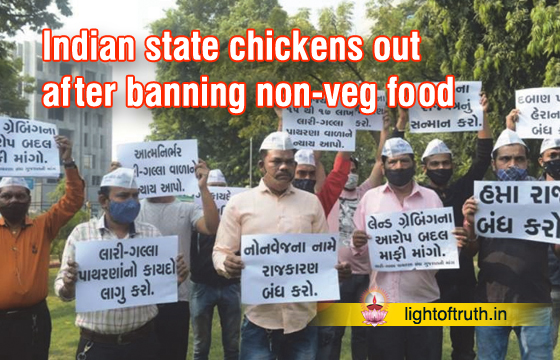
Indian state chickens out after banning non-veg food
The provincial government in the western Indian state of Gujarat was compelled to roll back a ban on serving non-vegetarian food by street vendors after the poultry industry mostly run by Hindus objected to it.
The municipal authorities of four major cities — Ahmedabad, Rajkot, Vadodara and Bhavnagar — had imposed the ban and started evicting street cart ven-dors and roadside stall operators citing “vegetarian sensibilities” of the majority Hindu and Jain religious communities.
The official orders stated that food containing meat, chicken and eggs should not be sold at public places within a 100-meter radius of religious places, gardens, public places, schools and colleges.
They cited complaints from local residents that the “foul smell” of non-vegetarian food was offending their religious sentiments and affecting children.
The authorities were forced to withdraw the order after criticism that it was biased against businesses of minorities, especially Muslims, serving non-vegetarian food. It was clarified that the rollback on Nov. 16 was effected considering the impact it had on the poultry industry at the peak of the winter season when demand for chicken and eggs is high.
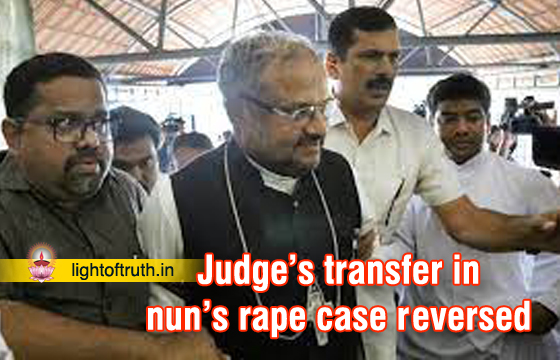
Judge’s transfer in nun’s rape case reversed
After rigorous public charges of foul play and sabotage, Kerala’s High Court in Kochi Nov. 20 overruled a move to transfer the trial judge from the high-profile case against a bishop in the alleged rapes of a nun.
Critics said the transfer of Judge G. Gopakumar, announced Nov. 12, would have stymied the completion of the three-year-old case against Bishop Franco Mulakkal of Jalandhar that oversees the accuser’s convent.
Gopakumar, who heads the district trial court in Kottayam, was the first to reject the bishop’s attempts to dismiss the case against him. Mulakkal’s subsequ-ent appeals to the appellate High Court and the Supreme Court in New Delhi were also denied. For months, trial proceedings have been closed to the public and news coverage is forbidden.
“The trial is in the final stage, and transfer of the judge at this stage is no doubt a body blow to the case. We are happy that the [state’s] top court has considered our demand,” Fr. Augustine Vattoly, said, calling the transfer timing abnormal. Vattoly, a priest in the Ernakulam-Angamaly Archdiocese, is a supporter of the survivor and five nuns who stay with her.
The Kerala government, with High Court approval, directed Gopakumar to take a new post in Thiruvananthapuram, the state capital, 90 miles south of Kottayam. The High Court’s weekend order requires that Gopakumar complete the trial before a transfer can take effect. The rape survivor and both her supporters and Mulakkal’s had urged the court to keep Gopakumar in place to finish the rape trial.

Jesuits get court nod to prove Father Swamy innocent
The Bombay High Court has permitted the Jesuits to initiate separate proceedings to clear Father Stan Swamy’s name from accusation in the Bhima Koregaon Elgar Parishad case.
The Jesuit Adivasi activist died July 5 under police custody at Holy Family hospital in Mumbai, western India. The National Investigation Agency arrested him October 8, 2020 from his residence near Ranchi, the capital of the eastern Indian state of Jharkhand.
Father Swamy was arrested the 16th civil liberties activist to be arrested under the Unlawful Activities Prevention Act for alleged anti-national activities.
The NIA accused 84-year-old Jesuit of being a member of banned Maoist group that conspired to overpower the Indian government.
On November 24, the bench comprising Justices Nitin Jamdar and Sarang Kotwal heard Jesuit Father Frazer Macarenhas’ interim application that sought to clear Father Swamy’s name from the allegations.
The plea from the former principal of Mumbai’s Saint Xavier’s College urged the court also urged the court to order a mandatory judicial inquiry under section 176 (1-A) of the Code of Criminal Procedure into his elderly confrere’s death, reported Live Law, a website that reports legal matters.
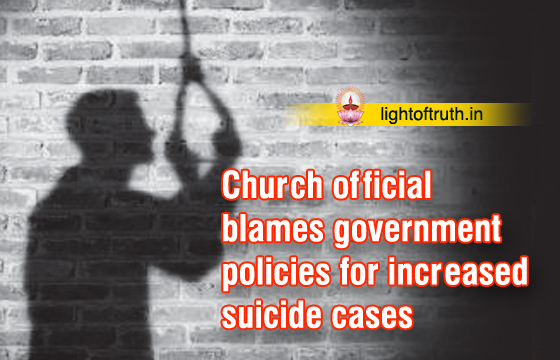
Church official blames government policies for increased suicide cases
Church officials in India say suicide cases in India have increased mainly because of government’s wrong economic reforms and insensitive policies.
“Many have come to a rock-bottom with no jobs, no income and no hope for a better tomorrow,” says Father Faustine Lobo, regional director of social apostolate of bishops in Karnataka, a southern Indian state.
The priest, who is engaged in grassroots works, also says demonetization and increasing fuel prices on a daily basis has hit the common man directly.
According to the recently released Indian government data, an average 30 suicide cases took place daily in the country in 2020, allegedly due to “joblessness, bankruptcy and poverty.”
The report published by the National Crimes Records Bureau says as many as 10,662 suicide cases in 2020 were directly linked to poverty — 5,213 due to bankruptcy, 3,548 suicides joblessness and 1,901 cases from other forms of poverty. “The increase in deaths by poverty went up by 69 percent from the previous year, while suicides from joblessness hiked by 24 percent,” says the report as quoted in the Times of India.
Father Lobo says the hike suicide case indicates the frustration people go through because of the government’s pro corporate policies and actions that are “totally against common man’s welfare in the country.” He said bankruptcy and joblessness contribute to poverty and the crime bureau’s report indicates a state of “utter hopeless situation” people now face.
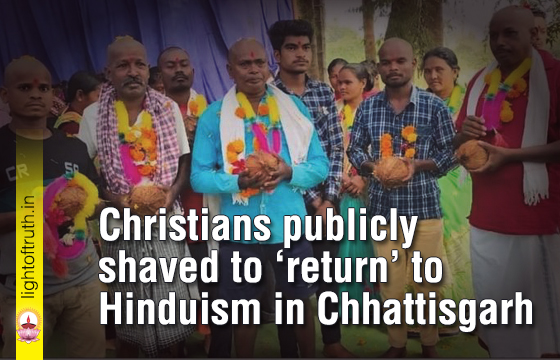
Christians publicly shaved to ‘return’ to Hinduism in Chhattisgarh
To achieve this goal, Hindu extremists shaved their heads and put coconuts in their hands as part of a Hindu religious ritual.
Such acts were accompanied by the threat of seizing land, homes and properties owned by Christians and having them denied access to publicly owned forest land if they did not comply.
“This is a barbaric act and an evident forced conversion,” said Sajan K. George, president of the Global Council of Indian Christians (GCIC).
This, George explained, is “A violation of the fundamental right to religious freedom and respect for the dignity of every person”.
It is “also a way to publicly humiliate, mock and insult Christians, whose daily life is constantly in the crosshairs of right-wing extremist nationalist groups.”
What is more, it “is not an isolated incident. Christians in Chhattisgarh live constantly in fear of Ghar Wapsi campaigns, as conversion to Hinduism is called.”
Already last July in the nearby district of Sukma, the police superintendent Sunil Sharma had issued a circular asking officers to raise the level of attention towards the activities of Christian missionaries who, he wrote, “are continuously travelling to the interior and influencing local tribals by luring them with perks to make them accept Christianity.”
“In Chhattisgarh,” Sajan George said, “anti-conversion laws were made tougher in 2006. But an amendment expressly provides that the ‘return’ to the ‘ancestral’ religion should not be considered a conversion.”
In reality, the vast majority of tribal people have never really professed the Hindu religion.
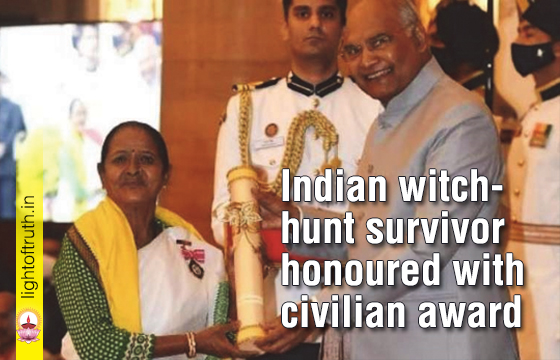
Indian witch-hunt survivor honoured with civilian award
Tribal Christians in the eastern Indian state of Jharkhand are delighted after the federal government awarded one of its highest civilian awards to Chutni Mahto for her campaign to end witchcraft.
Mahto was presented with the Padma Shri (noble one in blossom) by Indian President Ram Nath Kovind in the national capital New Delhi on Nov. 9.
Mahto, herself a victim of witch-hunting, has campaigned to create public awareness against the inhuman practice in her home state since 1995.
Data from the federal National Crime Records Bureau (NCRB) shows that between 2000 and 2016 more than 2,500 people were killed in witch hunts. An average of 156 people, mostly women and children, are killed each year across India due to the practice of witchcraft.
Rights activists say the actual numbers could be much higher as many cases are not reported to police or are reported wrongly to save those involved.
Murder driven by the belief in black magic is common in Jharkhand. In 2019, the state reported 27 deaths related to allegations of witchcraft. Up to September 2020, 19 deaths had taken place over alleged witchcraft, according to police data.
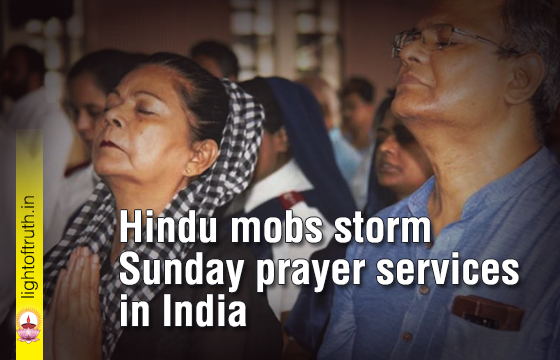
Hindu mobs storm Sunday prayer services in India
Hindu activists have disrupted Sunday prayer services in two Indian states alleging forced religious conversions that were denied by Christians.
The first incident was reported on Nov. 7 from the southern state of Karnataka, where members of the Sri Ram Sene (Ram’s army) barged into a Christian prayer hall in Maratha Colony in Belgavi (formerly Belgaum) and locked in the devotees.
Police had to rush to open doors of the locked-up hall and asked those inside to go home.
Sene members alleged that Pastor Lema Cherian was con-verting poor Hindus to Chri-stianity by organizing prayer services. Pastor Cherian denied the allegation. “We have been organizing prayer services every Sunday and all are free to join,” he said.
He said that the local police were informed about the Sun-day meeting and nobody was forced to attend it. “We are free to practice any faith of our choice and it is our fundamental right. No one can infringe upon it,” the pastor added. But Assistant Commissioner of Police Ajjol Chandrappa told media that a Hindu man who attended the prayer service had filed a complaint alleging conversion. The police were verifying the facts and may register a case, he said.