

Leading media figures have urged India’s top constitutional bodies “to step in and uphold their mandate” amid rising threats to religious minorities, especially Muslims.
They issued a statement condemning the alarming rise in “open calls from various quarters for attacks on India’s religious minorities, especially Muslims” and said that “silence is not an option.”
Senior journalist and writer Mrinal Pande, N. Ram, former editor-in-chief of English daily The Hindu, R. Rajagopal, editor of The Telegraph, and Vinod Jose, executive editor of Caravan magazine, were among the 28 media persons who signed the March 23 statement.
“Sometimes the occasion is an election, at other times it is a political gathering, a so-called Dharam Sansad [religious parliament], or a controversy over clothing, or even the screening of a movie,” they stated, adding that “these calls for violence — which have been widely reported in the media — have been met with a cold and calculated silence from the country’s top leaders.”
Referring to the latest controversy in Karnataka state over the hijab or veil worn by Muslim girls, the journalists highlighted the systematic hate being propagated against Muslims under the pretext of Covid-19, including calls by legislators for their socioeconomic boycott.
“Disturbingly, the term ‘corona jihad’ was fabricated and amplified by sections of the media establishment,” they said.
Category Archives: National

Pondicherry archbishop’s appointment: Dalits hoist black flag
Dalit Catholics in Tamil Nadu have pro-tested the appointment of a non-Dalit as an archbishop in the southern Indian state.
The Dalit Christian Liberation Movement, which leads the protest, on March 20 hoisted a black flag in the Church of Our Lady of Fatima in Vrithachalam parish of Pondicherry-Cuddalore archdiocese.
A day earlier, the Vatican announced the transfer of Bishop Francis Kalist of Meerut to Pondicherry-Cuddalore in Tamil Nadu as its archbishop, ignoring Dalit Catholic groups’ demand for a prelate from their community.
Although the Archbishop-elect is Tamil, he is a non-Dalit who has been serving a northern Indian diocese for decades. The Dalit groups also posted a hashtag on Twitter, “FRANCIS KALIST GO BACK.”
What has upset the Dalits is that Bishop Kalist has ignored their plea to him to not accept the new post.
A rumor spread in Tamil Nadu weeks earlier indicated Bishop Kalist coming to Pondicherry. S Anandaraj, the movement’s communication secretary, on March 1 wrote to Bishop Kalist warning him that the Dalit Christians would not allow him to take charge if he agreed to the Vatican proposal. “We shall continue to fight,” he wrote.

Indian pastor accused of converting tribal people
A Hindu organization has been joined by a Sikh group in demanding the arrest of a pastor for organizing faith-healing sessions to lure tribal people into Christianity in the eastern Indian state of Jharkhand.
The Vishwa Hindu Parishad (VHP) or World Hindu Council accused Pastor Ravi Singh and his wife of conducting a Changai Sabha (healing ministry) from their home in Nanak Nagar in Jamshedpur city’s Golmuri area.
The VHP and a Sikh organization, Jhar-khand Gurdwara Management Committee, staged a protest against Pastor Singh on Feb. 27 and accused Chief Minister Hemant Soren of failing to take action against him
Media reports said state police briefly detained Pastor Singh that day but released him in the evening.
Ratan Tirkey, a member of the Jharkhand government’s tribal advisory council, denied the allegations of religious conversions against the pastor.
“As per information from our sources, Pastor Singh embraced Christianity some time back and is involved in spreading awareness among the youth about the importance of education and their rights,” he told.
“Pastor Singh is being misunderstood by Hindu activists as a missionary indulging in religious conversion activities. We have no information about his converting anybody.”
He said Hindu activists often accuse Christian missionaries of conversion activities without any basis or proof. “The VHP and other fanatic groups need to read the constitution of India to know about religious freedom granted to the citizens of this country,” the Catholic lay leader said.
Tirkey said Christians would not be a small minority group in Jharkhand if conversions were rampant as alleged by the Hindu organizations.

Dalit woman is youngest mayor of India’s Chennai city
Priya Rajan, a Dalit woman, has become the youngest mayor of Chennai, the fourth-largest city in India with a population of around 10 million. Rajan, 28, a postgraduate in commerce, was sworn in on March 4 as the 49th mayor of the city.
She is said to be a member of the Evangelical Church of India (ECI), which has congregations in at least 10 states.
Welcoming the appointment, Father Vincent Chinnadurai, the former spokesperson of the Tamil Nadu Bishops’ Council, said it was a remarkable moment for Dalit women.
“We appreciate the state government for this bold move. I am sure more women will feel inspired by Priya Rajan,” he added.
Chennai, the state capital of the southern state of Tamil Nadu, is a hub for education, health, information technology and automobile industries.
Considered the second-oldest city council in the world after London, the Greater Chennai Corporation was formed in 1668 by the erstwhile East India Co-mpany, which founded it in 1640 as a trading post.
The state’s ruling DMK (Dravida Munnetra Kazhagam or Dravidian Progressive Front) under the leadership of Chief Minister Muthuvel Karunanidhi Stalin, 68, won a landslide victory in the polls held on Feb. 19 after a gap of 11 years.

Indian probe against Mother Teresa nuns falls apart
The much-publicized case of religious conversion against Missionaries of Charity (MC) nuns in India’s western state of Gujarat has come a cropper with the prosecution admitting there was no serious basis to proceed against them. The prosecution gave a written undertaking to a court in Vadorara city that it would not pursue the case any further, although the first information report written by police to set the investigation in motion has yet to be quashed.
The prosecution’s undertaking meant an end to the adverse publicity and unnecessary harassment of the nuns from the Kolkata-based organization founded by Mother Teresa which ran a shelter home for the destitute in Vadodara.
In a related development, the court also dropped the hearing of an anticipatory bail application filed by two MC nuns, who did not want to be identified, ending their nearly three-month ordeal to avoid likely arrest for a crime they never committed.
“Indeed it is happy news and vindication of our stand from the very beginning,” said Father Cedric Prakash, a Jesuit priest and rights activist based in Gujarat.
He confirmed that the local court decided to drop the legal proceedings on March 3 after the government prosecutor admitted in writing that there was no serious basis to proceed against the nuns.
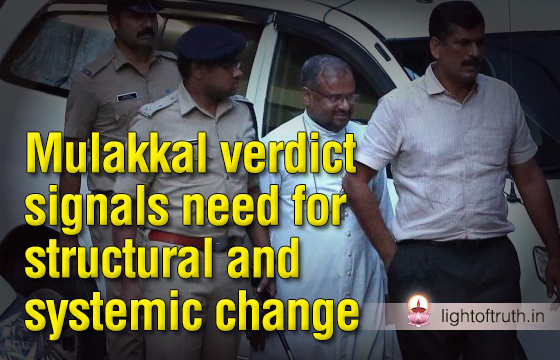
Mulakkal verdict signals need for structural and systemic change
The verdict acquitting Bishop Franco Mulakkal in the much-awaited case of the sexual abuse of a religious sister has been disappointing to many of us, and has made us suspicious.
“I write this for many reasons; first, because I have journeyed with this case from a distance; and because I feel the need for speaking up in defense of our sisters, and sounding a wake-up call for us as women religious.” Wrote Dorothy Fernandes
What has pained me more than anything else is that some women religious that I know have rejoiced about the verdict of acquittal of a Bishop who was accused of nothing less than rape — and worst of all, he happens to be the patron of that local congregation. We all know now that at Kottayam the Additional District and Sessions Court Judge G. Gopakumar acquitted Franco.
Some women religious raise very naive questions: Why was she silent for all these years? Why was there such a delay in reporting the crime? I am afraid those who say that lack empathy and can’t imagine the trauma she has been going through. As women religious, some think: “He is a Bishop — he obviously cannot do it!” Wait a minute, he is also a human being, a man invested in power.
For too long we women in the church have accepted dominance and hierarchy and never questioned this because of the socialization processes we have gone through. Right from our childhood and into our teens we have been taught to accept everything without questioning. Because “they” know and you don’t; this is internalized and every institution in our society has reinforced this belief.
I know that a very small number of sisters in India have moved out of institutions and are living among or working with those on the periphery. I have been living by myself for more than two decades in Patna, and many priests who know me say “not everyone can be like you.” As if finding my space was so easy! I have often been perceived as “aggressive,” and my responses are “assertive.” So – it seems our institutional church does not want assertive women.”
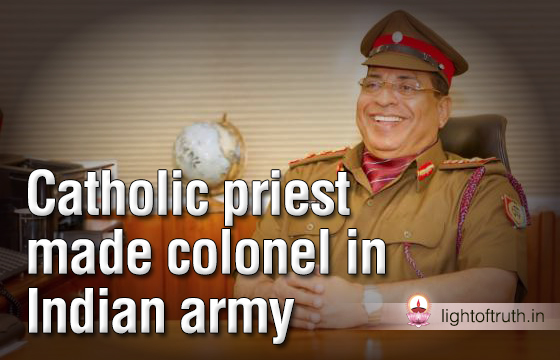
Catholic priest made colonel in Indian army
A Carmelite of Mary Immaculate priest was on February 26 conferred the honorary title of Colonel Commandant by the federal Ministry of Defense.
Father Abraham Mani Vettiankal, who serve as the vice chancellor of the Christ University in Bengaluru is the first Indian Catholic priest to get the honour for his outstanding contributions to the promotion of National Cadet Corps and National Service Scheme in the Christ University in the past decade.
The official piping was performed by Lt General Gurbirpal Singh, the director general of NCC at a ceremony conducted at the Parachute Regiment Training Center, Bengaluru, the capital of the southern India state of Karnataka.
Awarding this honor, Singh said the recognition was conferred to Father Abraham in recognition of being the first university in the country to introduce NCC as a credit course and for promoting its students to join the Indian Defense Service.
“The Christ University has promoted NCC as a priority program resulting its members joining the armed and paramilitary forces in significant numbers as well as for providing infrastructure and facilities for NCC training at the University Campus,” said the director general.
53 anti-Christian incidents registered in 45 days
As many as 53 incidents of violence against Christians were registered in the first 45 days of 2022, says an ecumenical group based in New Delhi.
The United Christian Forum on February 15 said the incidents were recorded by its toll-free helpline number launched seven years ago. The 53 incidents were recorded as on February 14.
‘There has been a steady rise in incidents of violence against Christians,” says a press note from A C Michael, the forum’s national coordinator.
The helpline number (1-800-208-4545) aims to help Christians in distress, especially those who are not aware of the law of the land and the system. It guides people on how to reach out to the authorities, besides providing the way to legal remedies.
The helpline registered 505 cases last year.
A press release from the forum says its data is not exhaustive as many case have not been reported.
However, the helpline recorded 127 incidents in 2014, 142 in 2015, 226 in 2016, 248 in 2017, 292 in 2018, 328 in 2019, 279 in 2020, and 505 in 2021.
Michael narrated a mob violence in 2021. A group of radicals interrupted the Sunday service by loud abuse and physical assault at Wajidpur, Tendui, Gaya, Bihar.
“On July 11, 2021, a group of 20 attacked around 90 people praying together in a house. The victims sustained injuries and warnings that they should not conduct religious gatherings. The pastor fled the house to save his life. It took three months to file a complaint with the various government officials in the area,” Michael added.
Christians form just 2.3 percent of India’s population, according to the 2011 Census.
The forum released the data as elections are underway in five Indian states. None of the political parties in the fray has guaranteed protection for minorities, the forum regrets.
“We appeal to the government and all political parties as they contest elections in various states to ensure rights of all minorities within the framework of the Constitution of India,” the forum says.
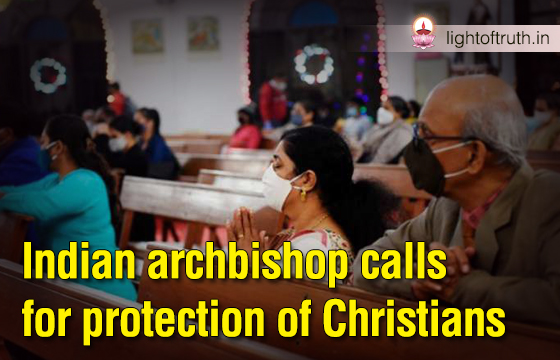
Indian archbishop calls for protection of Christians
A Catholic archbishop in southern India has appealed to the provincial government to protect Christians, their places of worship, religious symbols and sacred structures.
Archbishop Peter Machado of Bangalore said the Feb. 15 demolition of a statue of Jesus and Stations of the Cross at Gokunte in Kolar district of Karnataka state “had not only affected the sentiments of the Christian community but also the people of other faiths.” “It was heartbreaking to see hundreds of people shedding tears,” Arch-bishop Machado said in a press statement on Feb. 17. A dispute over the possession of the land was pending in Karnataka High Court but officials went ahead with the demolition even before the court could pass a final order. The archdiocese had also filed a petition in the high court challenging the demolition of the Christian structures on Feb. 19.
Archbishop Machado noted that in the past two years the state had “seen demolitions occurring at six such places on the hills and systematic attacks on churches across the state.”
These religious places were patronized and maintained as places of devotion in Bangalore and its surroundings for decades, he said. “We only fear that many more such harsh, orchestrated and insensitive attacks are sure to happen in the coming days,” the prelate added.
Archbishop Machado hoped and prayed that the government will protect Christian places of worship, religious symbols and sacred structures.

India government destroys 20-foot Jesus statue in Christian village
Officials have destroyed a 20-foot-tall statue of Jesus that has been standing in a village in India for 18 years.
The local administration said the statue was built on land reserved as an animal pasture, and claims its destruction was ordered by the High Court. However, Christian leaders from the region say the case was still pending.
The statue was destroyed on early Tuesday in Gokunte village in Karnataka state, in south-western India.
“We demolished the statue based on the High Court order. After seven to eight hearings, the High Court had ordered the demolition of the statue as it was constructed on government land. We had issued a notice to the church regarding the demolition. We had to submit the compliance report to the High Court on Wednesday and hence it was demolished,” said a local official.
Father Theres Babu, who is also a lawyer, said that the demolition letter was never shown to them.
“The government has been repeatedly saying that the demolition letter was issued. We have been asking her to show the demolition order. It is not clear if it was a judgement. But [the government official] never show-ed us the order. She has been claiming that the government advocate has sent her an email, saying that the High Court has given an order and based on that she went ahead and demolished the statue,” Babu told journalists.