

Tribal people including Christians will undertake a grueling 200-kilometre march against the creation of an army firing range at Netarhat in eastern India’s Jharkhand state.
The march will begin at Tattapani in Latehar district on April 21 and reach the state capital of Ranchi on April 24.
“We will meet Jharkhand governor Ramesh Bais on April 25 to press our demand for cancellation of a notification on the firing range,” Ratan Tirkey, one of the organizers of the march, told.
The struggle against the firing range goes back to the early nineties when the state government issued a notification ear-marking 1,471 square kilometers in the Netarhat Hills in Gumla and Latehar districts for field firing practice by the Indian army.
The project could have dis-placed over 200,000 tribal people in about 250 villages but for the strong resistance from the tribal communities that forced the government to defer the action.
The area was notified for periodical field firing and artillery practice in 1992 and again in 2002. As the deadline for renewal of the notification nears in 2022, the tribal communities are revamping their struggle.
But tribal communities in areas surrounding the firing range complained that the government ignored their rights and grievances for 27 years
Tirkey, a member of the Kendriya Jan Sangharsh Samiti (forum for people’s struggle) that led the struggle, said: “We are not sure what is in the mind of the current government but the previous Congress and Bharatiya Janata Party regimes repeatedly betrayed the tribal people.”
Jerald Jerome Kujur, secretary of Kendriya Jan Sangharsh Samiti, said tribal communities are afraid that the state government led by Jharkhand Mukti Morcha (Jharkhand Liberation Front) may extend the notification.
Category Archives: National
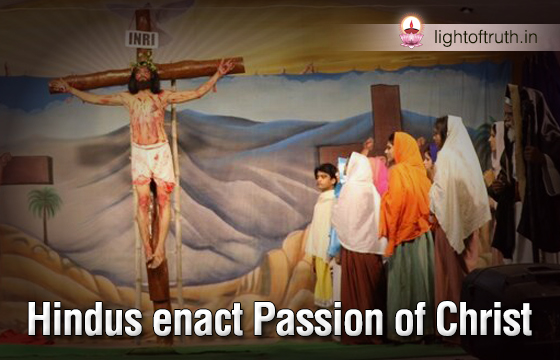
Hindus enact Passion of Christ
A group of 40 Hindu men and women on April 15, Good Friday enacted the Passion of Christ in the northern Indian city of Varanasi, the heartland of Hinduism. “Varanasi presented a soothing picture of religious harmony, peace and love amid a gloomy scenario of communal polarization,” says Father Anand Mathew, the brain behind the program who directs Vishwa Jyoti Communications in Varanasi.
An estimated 12,000 people watched the play staged at Matri Dham Ashram, the renowned spirituality center where thousands of people from various faith communities gather in large number.
“The most unique aspect of this passion play was that it was performed as part of the Good Friday liturgy, substituting the traditional passion reading,” Father Mathew, a member of the Indian Missionary Society, told on April 16.

Indian Christians condemn call to boycott halal meat
Church leaders have joined political parties and the Muslim community to condemn a call by Hindu groups to boycott halal meat during the traditional New Year celebrations in the southern Indian state of Karnataka. The state celebrated the Ugadi festival followed by Hosa tadukua, which is supposed to be a day of non-vegetarian feasting, on April 2-3. The call to boycott halal meat came close on the heels of Karnataka High Court’s ban on wearing the hijab in educational institutions and a ban on Muslim traders at Hindu temple premises and fairs.
Hindu groups actively campaigned last week to pursue majority Hindus to stop buying halal meat, saying that “as per Islam, halal meat is first offered to Allah, and the same cannot be offered to Hindu gods.”
Local media reported that Hindu activists assaulted a chicken shop owner and attacked a hotelier, leading to a few arrests, but their call went largely unheeded by the state’s Hindus.
Father Faustine Lucas Lobo, spokes-person of the Karnataka Catholic Bishops’ Council, said the pro-Hindu Bharatiya Janata Party (BJP) government in the state had done nothing to address unemployment or arrest rising fuel prices and inflation and so wanted to polarize the electorate on religious lines. “Why only target a particular group considered as second-class citizens by the ruling governments in New Delhi and Karnataka?”
“The state is going to have its assembly elections next year, so the government is trying to convince Hindu voters that it is the savior of their religion and culture,” he told. “It is a well-planned tactic to corner minorities who they think do not vote for a Hindu party.”
He said that “it all started with the hijab controversy and now halal meat, then there were other issues like love jihad. It is all game plan for the forthcoming election, which it does not want to lose.”
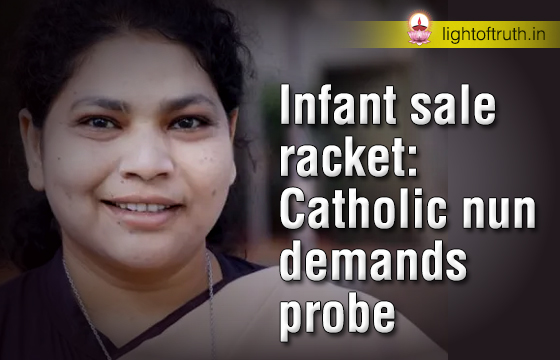
Infant sale racket: Catholic nun demands probe
A Catholic nun working among the poor, especially Dalits, has expressed shock at the expo-sure of an infant selling racket in the southern Indian state of Andhra Pradesh.
Poverty alone is not the rea-son for the “rather unfortunate” racket, asserts Sister Manju Devarapalli, secretary of the National Dalit Christian Watch (NDCW).
The Carmelite Missionaries nun was responding to an April 6 report in the Hindu newspaper about poverty-hit mothers selling infants in Andhra Pradesh.
In two cases reported in Eluru and Mangalagiri in the first week of April, women stated that their family members had sold babies unable to care for them.
“Earlier, we have seen cases of childless couples resorting to illegal adoptions and purchasing babies. But now infants are put up for sale in the market by some gangs in the state. This is pathe-tic,” the report quoted a child protection officer as saying.
Sister Devarapalli, who is also a lawyer-activist based in Vijayawada, a major city in Andhra Pradesh, says the government and agencies should study the problem thoroughly and find ways to end it.
The report could only be “the tip of” a rampant malaise prevalent across India, not just in Andhra Pradesh and Telangana states, she told on April 7.

Father Earl Fernandes, son of immigrants from India, named next bishop of Columbus, Ohio
Father Earl K. Fernandes says that when he was growing up in Toledo, Ohio, his mother used to pray that he’d become “a good boy, a tall boy, and a doctor like my dad.” God had other plans for his profession.
On April 2nd, the Vatican announced that Pope Francis has appointed the 49-year-old Cincinnati pastor, the son of Indian immigrants, to be the next bishop of the Diocese of Columbus, Ohio.
The first Indian-American to head a U.S. Roman Catholic diocese, Fernandes succeeds Bishop Robert J. Brennan, who now leads the Diocese of Brooklyn. Fernandes’ episcopal ordination and installation is scheduled for May 31.
In a press conference Saturday morning in Columbus, the bishop-elect spoke at length about the example of his immigrant parents, the experiences he has had being the victim of racial discrimination, and his “synodal” approach to his new role.
“The Pope wants a synodal Church, a Church that walks together. I look forward to walking together with the people, the priests, the deacons, and religious — actually, the whole people of God — in the Diocese of Columbus,” Fernandes said.
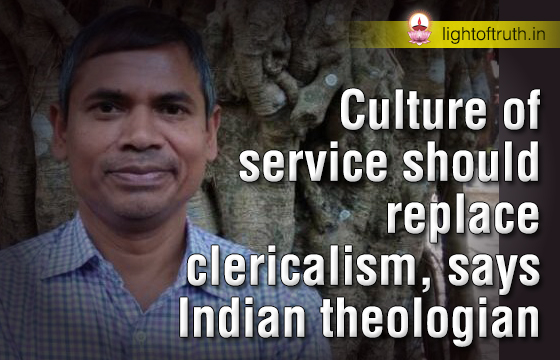
Culture of service should replace clericalism, says Indian theologian
Clericalism, which Pope Francis calls “a perversion of the priesthood,” operates also among some Catholic priests and bishops in India, says a Jesuit moral theologian.
Clericalism is largely center-ed on one’s access to power and wealth in the Church, which in turn gives some priests and bi-shop the taken-for-granted immunity, explains Father Stanislaus Alla, professor of moral theology at Delhi’s Vidyajyoti College of Theology.
The theologian was sharing his reflections at an April 2 webinar on “Clericalism” in the background of the essay titled “Hierarchicalism” by American Jesuit James Keenan, which was published in the latest issue of Theological Studies.
The Secretariat for Service of Faith of the Jesuit Conference of South Asia organized the webinar.
According to Fr Stanislaus, while the importance and impact of the culture of ‘clericalism’ came to light by the expose of child-abuse in the West, it can be noticed equally in many forms in India.
Fr Stanislaus quoted Peter Daly of the Washington who re-gularly contributes to the National Catholic Reporter and discusses clericalism.
Bishops and priests — the clerics — “are often trained to think they are set apart from and set above everyone else in the Church. Their word is not to be questioned. Their behavior is not to be questioned. Their lifestyle is not to be questioned” says Father Daly.
Father Stanislaus says people have lived with and have known “dedicated, simple, holy, humble and service-minded priests and bishops.” But at the same time, they also come across pastors with clericalism-mindset.
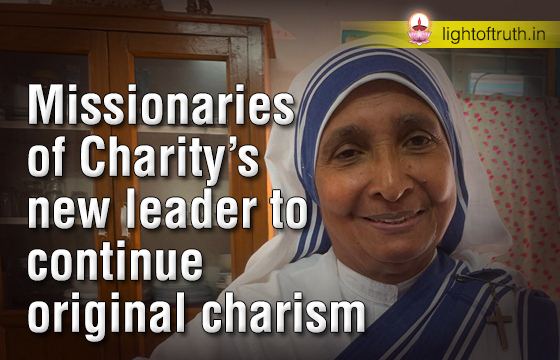
Missionaries of Charity’s new leader to continue original charism
Sister Mary Joseph, the newly elected superior general of the Missionaries of Charity, says her global congregation will continue its original mission of serving the poorest of the poor, despite numerous hurdles.
She also asserts that religious conversion is not their agenda as alleged by some hardliners.
Sister Joseph cannot speak for a long time because of some vocal cord problems. Despite the difficulty, she on April 2 shared with Sunil Rosario, Matters India Special Correspondent in Kolkata, how she will lead the congregation founded by Saint Mother Teresa of Kolkata.
“I experienced fear and deep shock when my name was announced to take up the leadership. It was not easy to digest. I had never dreamt to lead the congregation one day. I felt I was not the one for the task. That night was a nightmare to me. However, I allowed God to speak to me in silence and prayer. In that dark night, I had the assurance of God that He was calling me to take up the position. It was not my choice, but His choice, at this particular time of history. Thus, I accepted the challenge.” Sister Mary Joseph said “We are not social workers. Our charism is to live for Jesus and for the poor. “When I was hungry, did you feed? When I was thirsty, did you give me a drink of water?” This we do in charity. We utterly depend on God’s providence. God takes care of us.” “Conversion is not our agenda in service of the poor and the under privileged. Only God can convert, as Mother would hold.”
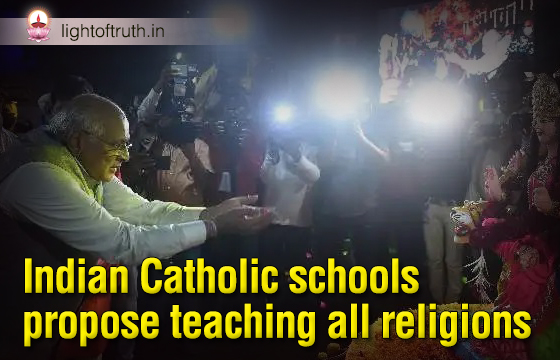
Indian Catholic schools propose teaching all religions
Catholic schools in the western Indian state of Gujarat have sought to include all major religious scriptures along with the Hindu scripture Bhagavad Gita in their academic curriculum.
The provincial government in Gujarat had last week announced the teaching of the Bhagavad Gita in classes 6-12 across the state for the new academic session.
“We are not against teaching the Bhagavad Gita but want the government to introduce the sacred texts of other major religions to uphold the secular and democratic credentials of the nation,” said Father Teles Fernandes, secretary of Gujarat Education Board of Catholic Institutions.
Father Fernandes told on March 22 that the Catholic institutions have approached Gujarat Chief Minister Bhupendra Patel to apprise him of their concerns.
The pro-Hindu Bharatiya Janata Party (BJP) government in the state said it wanted to promote a sense of pride and connection with India’s rich traditions through the teaching of the Bhagavad Gita.
The Catholic institutions in a memorandum sent to the chief minister on March 18 said the introduction of Hindu scriptures in the school curriculum was “not an issue in itself” but given the diversity and religious plurality of India “it would be imperative that impressionistic minds of the young students are also given the taste of other holy scriptures of major world religions.”
The memorandum mentioned the Quran, Bible, Guru Granth Sahib, Avesta, Tripitaka and Agamas among others. “All these holy books speak of the language of love, brother-hood/sisterhood, kindness, charity, tolerance, forgiveness, etc. We are all children of the same God. This will instill harmony, broadmindedness, acceptance, sensitivity and oneness in our society,” it added.
The Catholic institutions further lauded the government for its decision to introduce the English language as a compulsory subject from Class 1 onwards, calling it “a move in the right direction as India is fast becoming a global player and the English language is an international accepted mode for trade and communication.”
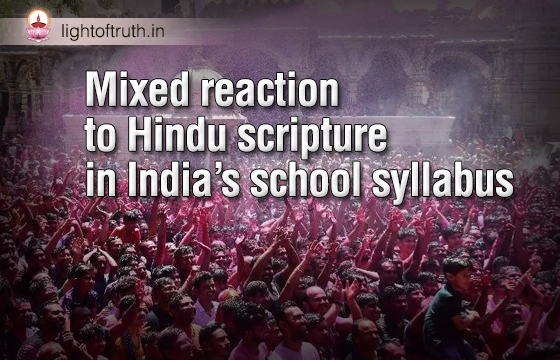
Mixed reaction to Hindu scripture in India’s school syllabus
A Catholic priest and human rights activist from the western Indian state of Gujarat has welcomed the inclusion of a Hindu scripture, Bhagavad Gita, in the school syllabus but warned against growing majoritarianism.
“The study of any and every religious or holy book needs to be welcomed all at all times. However, introducing only the study of Bhagavad Gita smacks of majoritarianism, which is violative of the secular fabric of the country,” Jesuit Father Cedric Prakash told.
The provincial government in Gujarat announced on March 17 that the Hindu scripture will be taught to students from classes 6-12 to cultivate a sense of pride and connection with their traditions.
The government in southern India’s Karnataka state has also hinted at introducing Bhagavad Gita to its school syllabus. Both states are ruled by the pro-Hindu Bharatiya Janata Party (BJP).
Father Prakash said the decision “though not totally unexpected” was “yet another step toward the establishment of a Hindu Rashtra (Hindu nation).”
The Catholic priest said the government must reconsider and instead introduce a well-planned course involving the study of all major world religions and their holy books including the Bible, Quran, Guru Granth Sahib, Avesta, Tripitaka, Agamas and others along with the sacred Hindu scriptures.
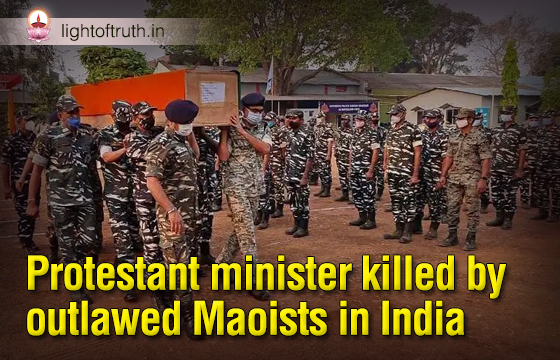
Protestant minister killed by outlawed Maoists in India
Christians are concerned for the security of the family of a Protestant minister who was brutally stabbed to death by outlawed Maoist rebels in the central Indian state of Chhattisgarh.
The bloodsoaked body of Pastor Yalam Shankar, who was in his fifties, was found in the Maoist-infested South Bastar forests in Bijapur district on March 17.
Local news outlets quoted a statement from the Maoists claiming responsibility for the killing and alleging the deceased pastor was a police informer working against the interests of the outlawed rebels since 2018 in the area falling under the jurisdiction of Madded police station.
The armed outlaws reportedly forced their way into Pastor Shankar’s house and dragged him out before stabbing him to death. They justified their action by saying the pastor was warned many times in the past but to no avail.
Police denied the Maoists’ claim that the pastor was their informer but the incident shocked the Christian community in Chhattisgarh.
“We are shocked to know about the murder of the pastor,” said Guruvinder Singh Chadda, president of Akhil Bharati Isai Samudaya Adhikar Sangathan, an organization working for the welfare of Christians in Chhattisgarh.