
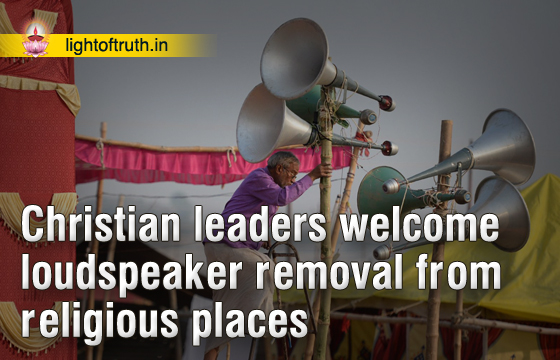
Some Catholic leaders in Uttar Pradesh have welcomed a government drive to remove loud speakers from religious places in the northern Indian state. “If the government is doing it in a non-partisan way and without religious prejudices, it is to be appreciated,” says Father Anand Mathew, who quoted some reports to point out that majority of the loudspeakers removed in the past decades were from the Hindu temple tops.
The Uttar Pradesh government on April 25 began a statewide drive to remove unauthorized loudspeakers from religious places and set the volume of others within permissible limits.
Additional Director General of Police (Law and Order) Prashant Kumar told re-porters that by May 1 morning they have removed a total of 53,942 loudspeakers and set the volume of 60,295 loudspeakers within permissible limits.
Kumar clarified that they are removing the loudspeakers from all religious places without any discrimination.
Meanwhile a senior home department official confirmed that the drive will continue in the coming days.
Those loudspeakers which have been placed without taking due permission from the district administration or the ones which are placed in excess of the permitted numbers are categorized as unauthorized, Kumar explained.
He said the administration also considered the High Court order regarding loudspeakers. After a 2017 government order on the matter, the High Court had asked it if loudspeakers at religious and public places were installed after taking permission in writing from authorities referring to the Noise Pollution (Regulation and Control) Rules, 2000.
Category Archives: National
Karnataka faces loudspeaker controversy
People in Karnataka began from May 9 to get up at 5 am to pray, sing or curse.
Muslims in the southern Indian state start their day with Azaan announced through loud-speakers fit atop mosques. Hindus, on the hand, use the public address system to counter the Muslim call to prayer with “Suprabhata” and “Hanuman Chalisa” (hymns in praise of Lord Hanuman).
Pramod Muthalik, founder of the Sri Ram Sena (army of Lord Ram), on May 9 opened the Hindu prayer at 5 am in temples of Mysore temples. More than 1,000 Hindu temples in the state also did the same, he claimed.
A controversy over Muslim using loudspeakers to announce Azaan was reported from states such as Uttar Pradesh and Maharashtra. They have enacted laws to control the use of loud-speakers by any religious group. The Uttar Pradesh government of the Hindu nationalist Bharatiya Janata Party (BJP), has removed 54,000 unauthorized loudspeakers from religious places.
The Karnataka government, led also by the BJP, is yet to en-act a law on loudspeakers. How-ever, it has succeeded in controlling Muslim girl students wearing veil in schools. Muslim traders are reportedly barred from Hindu festival while people are urged to avoid food prepared according to Muslim customs or Malls owned by Muslims.
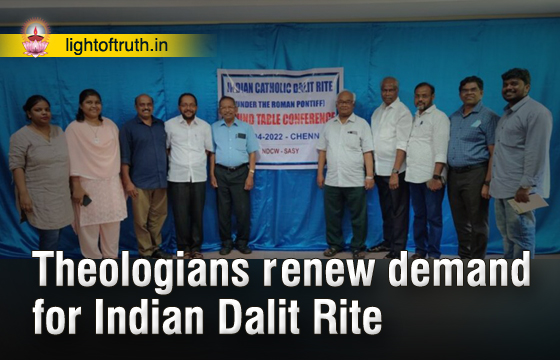
Theologians renew demand for Indian Dalit Rite
The demand for a Dalit Rite in the Catholic Church in India was reiterated at a conference of theologians, biblical scholars and canon law experts from the community. Caste is a stark reality and caste-based discrimination is rampant in the Catholic Church’s hierarchy, parishes and institutions, bemoans Reverend Vincent Manoharan, a theologian, while introducing the April 28-29 conference at St. Thomas International Centre, Chennai.
Dalits, he pointed out, are totally neglected in the Church despite the Dalit Empowerment Policy of the Catholic Bishops’ Conference of India that demanding to set it right.
The bishops issued the policy on December 13, 2016, that acknowledged that “caste discrimination is a grave social sin” and committed to ensuring that the practice of untouchability will not be tolerated within the Church. Reverend Manoharan also added that the Dalit representation is abominable in the Catholic Church and their voices are not heard adequately.
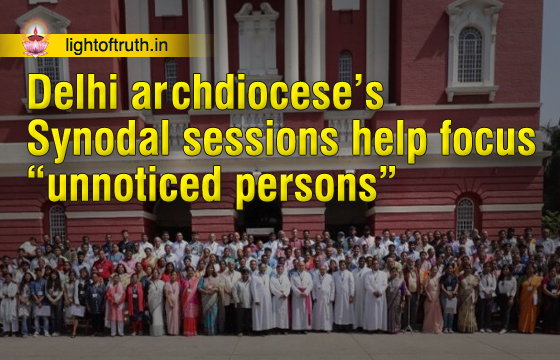
Delhi archdiocese’s Synodal sessions help focus “unnoticed persons”
Thousands of Catholics have attended the Delhi archdiocesan consultation meetings to prepare for the Rome Synod that began more than six months ago.
While Jesuit Father Stanislaus Alla, a theology professor, finds the process “truly historic,” Abp Anil J Couto of Delhi, who initiated it, says the Church in the archdiocese will not be the same after the exercise ends.
Father Alla, who teaches in Delhi’s Vidyajyoti College of Theology, has read through hundreds of pages of reports from various groups in the archdiocese and drafted the “Diocesan Syn-thesis” with his colleague, Presentation Sister Shalini Mulackal.
The latest archdiocesan Pre-Synodal meeting at the cathedral campus in New Delhi was attend-ed by 8-month-old Ayston Jez and 85-year-old Emeritus Abp Vincent Concessao of Delhi among more than 200 participants.
Archbishop Couto opened the April 29-May 1 with a prayer and inaugural address. Auxiliary Bishop Deepak Tauro of Delhi presented an overview of the proceedings. The meeting ended with a Mass on May 2.
8-month-old Ayston Jez with Leena Sunny, a Core Committee member, and Archbishop Anil Couto of DelhiThe archdiocese launched the Synodal process October 17, 2021, with a Mass led by Archbishop Couto.
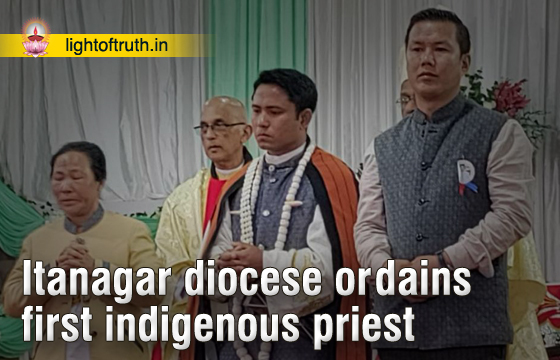
Itanagar diocese ordains first indigenous priest
Itanagar diocese in the north-eastern Indian state of Arunachal Pradesh May 7 ordained its first priest of indigenous origin
Bishop John Thomas of Itanagar ordained Father Roshan Bamin Peter, a member of the Apatani tribe, at Mary Immaculate Church, Hapoli, Ziro, his home parish in Lower Subansiri district.
“It is a proud moment for all of us in the diocese especially to the people of Apatani tribe,” Nani Yase Teresa, the president of Apatani Catholic Women Asso-ciation of Itanagar diocese. “It will inspire many young people of all tribes to become priests and nuns,” she added.
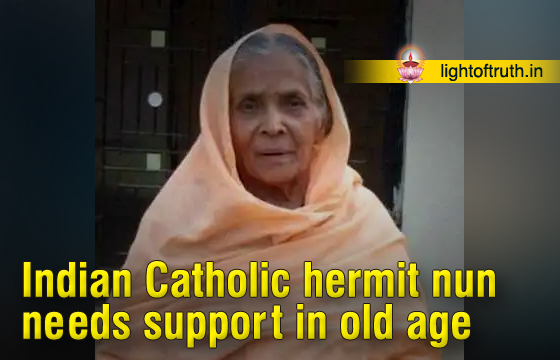
Indian Catholic hermit nun needs support in old age
An aging Catholic nun, who adopted Hindu ascetic life during the movement for inculturation of the Indian Church some five decades ago, now lives under the care of a parish priest in western India.
The 88-year-old Sister Prasanna Devi lived alone for around 40 years in a forest around the sacred hill of Girnar in Junagadh district of Gujarat known for its Jain and Hindu temples dating back to centuries.
The surrounding forests happen to be the only natural habitat of the Asiatic lions and are home to leopards, jackals, striped hyena and the Indian fox besides several species of mammals, birds and reptiles.
Sister Prasanna Devi lived in the midst of this wildlife inside a hut-like hermitage from 1974 until September 2014 when she had a fall that caused her to move out of the forest to the annex of St. Ann’s Catholic Church, located six kilometers away and falling under Rajkot Diocese.
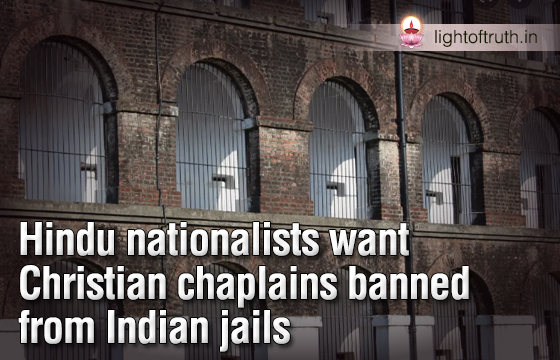
Hindu nationalists want Christian chaplains banned from Indian jails
Hindu nationalists in India want Christian chaplains banned from visiting prisons, claiming they are trying to convert the prisoners.
The Vishwa Hindu Parishad (VHP) and Bajrang Dal groups complained to police in the southern Indian state Karnataka about the distribution of Bibles to the prisoners in the Gadag district jail and demanded the immediate suspension of all Christian prison chaplains in the state.
The April 6 declaration came after a Hindu chaplain had met a prisoner and seen a Bible in the jail. According to the complaint, a seven-person team of Christian evangelists visited Gadag District Prison on March 12 to pray with prisoners and distribute copies of the New Testament.The Hindu activists alleged Christian chaplains were trying to carry out religious conversions and said they should not have been permitted to distribute religious texts, despite the fact that Hindu religious literature is often distributed in jails. Archbishop Peter Machado of Bangalore said the complaint looks like a double standard.
“If Hindu preachers are allowed to meet Hindu prisoners, what is wrong with Christian preachers meeting Christian prisoners. If there’s evidence of forceful or fraudulent conversions of others, let them take action according to the law, with proofs of conversion at hand,” he told Crux. Karnataka is ruled by the Bharatiya Janata Party (BJP), which has also ruled India since 2014. The BJP is linked with the the Rashtriya Swayam-sevak Sangh (RSS), a Hindu nationalist group.Hindu nationalists often accuse Christians of using force and surreptitious tactics in pursuing conversions, and such “illegal conversions” can be punished with fines and jail time.Christians leaders have noted that despite the fear-mongering of some Hindu groups, the percentage of Christians is actually going down in the country. According to the government’s census data, the percentage of the Christian population in India in 2001 was 2.34%, but in 2011 it had dropped to 2.30%. A similar decrease was noted in Karnataka, where the percentage dropped from 1.91% to 1.87%.
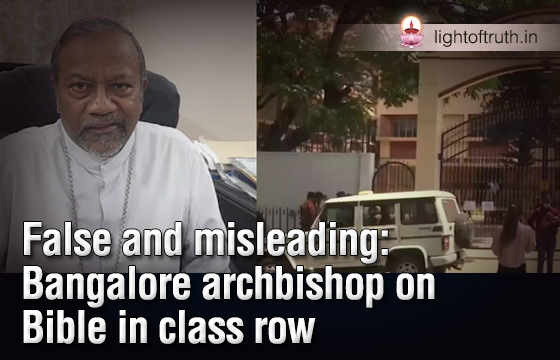
False and misleading: Bangalore archbishop on Bible in class row
Archbishop Peter Machado of Bangalore on April 26 dis-missed as false and misleading the media reports that some Catholic schools in the southern Indian city force children to buy Bibles and bring them to class.
According to an ndtv.com April 25 report a row erupted in Karnataka after a Catholic school in Bengaluru, the state capital, had allegedly taken an undertaking from parents that they would not object to their wards carrying the Bible to class.
The news portal also said the Hindu Janajagruti Samiti (Forum to awaken Hindus) accused Clarence High School of making it mandatory for students to carry the Bible.
The group’s state spokesperson Mohan Gowda alleged that the school has asked non-Christian students to compulsorily carry and read the Bible adding that it violated Articles 25 and 30 of the Constitution.
“It has been brought to my notice that the Christian Institutions are once again being target-ed for conversion in the allegation of the children being forced to buy Bibles and bring them to Schools in Bangalore. This allegation is false and misleading,” asserts Archbishop Machado in a press statement.
The prelate says Clarence High School’s management has clarified that such a practice existed in the past but since last year, no child is required to bring the Bible to the School or asked to read it by force.

Be vocal about minority rights: Nuncio
Apostolic Nuncio to India Archbishop Leopold Girelli has urged the Indian Catholics to speak up for the rights of all minority groups in the country.
“In this kind of struggle, if you want to call it that, we should remember that we are not standing up for just our rights as Catholics. We are standing for all minorities and the rights provided to minorities under the Indian constitution,” the Pope’s ambassador told a gathering of priests and Catholics April 23 in Bengaluru, southern India.
The nuncio was on a two-day pastoral visit to the capital of Karnataka state that ended April 24. It was his first visit to the city of gardens.
Archbishop Peter Machado of Bangalore presided over the event.
Indian Christians appeal for peace after communal clashes
Indian Christians have appealed for peace after sectarian clashes broke out in national capital New Delhi, leaving many people and police officers injured. Police arrested 23 suspects after violence erupted on April 16 during a Hindu religious procession in Jahangirpuri, a predominantly Muslim suburb. Residents said the situation remained tense on Easter Sunday in Jahangirpuri, the home of some 10,000 Muslim families who reportedly migrated from Bangladesh.