

The first “Dalit” Cardinal in history, Archbishop Anthony Poola of Hyderabad who will be created a cardinal at the August 27 Consistory, says his mission had been “to help as many poor children as possible.”
Derived from Sanskrit, the word “Dalit” means “broken” or “downtrodden,” and refers to those so low in ýsocial status ýthat they are considered outcasts or outside the four-tier caste system of Hindu society. Often referred to as “untouchables,” these people have been greatly exploited and subject to atrocities.
In a wide-ranging interview with Vatican News, the 60-year-old future cardinal reflects on how the caste system, even if technically abolished, still has remnants, what it is like serving India’s ‘untouchables’, and the current state of religious freedom for India’s small Christian minority. “I was in shock. It was like surprise news for me, that I never expected. I never dreamt. But for me, I feel it is the grace of God and it is His will through Pope Francis, that I receive the call. Pope Francis, our Holy Father. I deem it as a great opportunity for me to serve the people, to serve the people in South India and all sectors of the people, especially Telugu States of Telangana and Andhra Pradesh.”
“The caste system [was] abolished, we can say, but there are some social factors. Well, we cannot completely say that they’ve been abolished. But the real situation and the ground reality, as for your question, there are some differences. There are some people who are really fighting for recognition of their talent and the different activities they are doing. Long ago, there was no possibility for Dalit, “the untouchables” to have access to school or education. But now the government in India, especially in our states, Telangana and Andhra Pradesh where I come from, there are greater opportunities given to these marginalized, poor and Dalits, which also respect and encourage the poor people to go to school and pursue studies. Some become well-educated and are looking for a life. But they are treated differently as they aren’t ‘locals.’ There is a little bit of jealousy among human nature. I think what I expect from the people and what we try to practice, is raising awareness about people and situations, also these good situations, and trying to bring equality among all people.”
Category Archives: National
Bomb explodes in Catholic school premises in Manipur
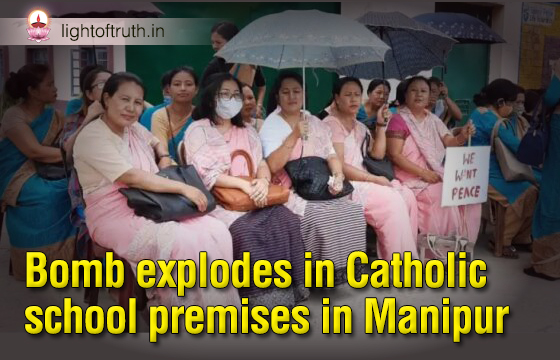
All Catholic educational institutions in Manipur will close June 7 to protest an explosion on the premises of a Church school in Imphal, capital of the north-eastern Indian state.
The decision was taken during an emergency meeting with the Catholic Educational Society Manipur (CESM) executives and Archbishop House Curia officials following the incident in one of the leading Christian missionary schools, said Rev Father Stephen Touthang, Director of CSEM.
A powerful bomb exploded June 5 inside Little Flower School.
According to Father Touthang, around 3:10 am on June 5 some unidentified miscreants exploded the bomb, damaging some portions of the school building, shattering window panes.
No one has claimed responsibility for the blast so far, the priest told reporters.
A sit-in-protest was held June 6 by the staff and students in front of the Little Flower School as a mark of protest. The pro-testers demanded the state government to ensure safety for the students and make the school a “violence-free zone.”
The protesters held placards with slogans that read among others, ‘We condemn the bomb attack on our school,’ ‘Allow us to grow without fear,’ ‘Ensure our safety,’ ‘Spare us, we just survived the pandemic.’
Sikh leader calls for countering conversion to Christianity
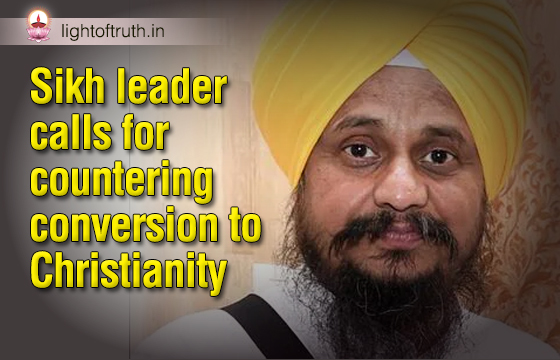
A top Sikh leader on June 6 expressed concern over churches and mosques being built in large numbers in rural Punjab and urged Sikh preachers to reach out and counter this trend of conversion, particularly in the state’s border areas.
Akal Takht (seat of power) acting jathedar Giani Harpreet Singh said at his customary address to the community at an event organized to mark the 38th anniversary of Operation Bluestar at Golden Temple, the holiest Sikh shrine, in Punjab’s Amritsar.
“Today, we (the Sikhs) are facing a lot of challenges. Christianity is being spread in Punjab on a large scale to weaken us (Sikhs) religiously. Churches and mosques are being built in large numbers in the villages of Pun-jab, which is worrisome for us,” he said added, “I appeal to Sikh preachers to launch a drive against this on a large scale and count-er this trend of conversion. Let us strengthen Sikhi in villages again.”
The Sikh leader also said the most affected was the border belt and called for paying special attention there. “This is the time to shed comforts of life and work tirelessly in this direction,” he added.
Meanwhile, Church of North India Bishop Pradeep Samantaroy dismissed Giani Harpreet Singh’s concern of conversion programs in Punjab.
Late Indian Jesuit honoured with rights ‘Nobel Prize’
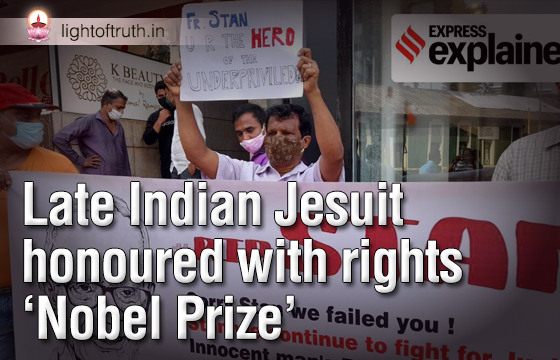
Father Stan Swamy, the late Indian Jesuit priest and tribal rights activist, has been posthumously awarded the Martin Ennals Award, regarded as the Nobel Prize for human rights defenders.
Eighty-four-year-old Father Swamy, who was arrested in the Bhima Koregaon case and died in custody in July 2021, was accorded the honour by the Martin Ennals Foundation based in Geneva, Switzerland.
Though the award was presented posthumously, the priest was chosen for it while he was still alive. “Father Stan was nominated for the award in spring 2021, but he sadly passed away before it could reach him,” said Hans Thoolen, chair of the award jury.
The jury wished to shine a light on the priest’s many contributions to human rights, which “cannot be eclipsed by his unjust incarceration by Indian authori-ties,” Thoolen added.
Father Xavier Soreng, a social activist and colleague of the late Jesuit, accepted the award in Geneva on June 2. Three other rights activists — Dr. Daouda Diallo from Burkina Faso, Pham Doan Trang from Vietnam and Abdul Hadi Al-Khawaja from Bahrain — were also honored.
Father Soreng narrated a brief life sketch of Father Swamy and his pioneering work for the welfare of the indigenous people of eastern India’s Jharkhand state. “It is true Father Swamy became an irritant in the eyes of the pro-Hindu Bharatiya Janata Party for his stand against uprooting indigenous peoples from their habitats and had to pay with his life”
Catholic priest kidnapped, robbed in Karnataka
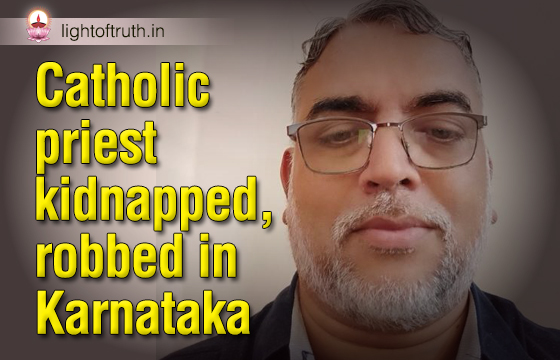
A Catholic priest says he has not overcome the trauma of kidnap and robbery even a week after the incident.
“I am alive today only because of God’s grace. I was afraid the gang would kill and bury me at a place that nobody would find out,” says Father Dominic Pulickapadavil, a member of the Society of Montfort Missionaries, who was kidnapped by an armed gang on June 1 near Madikkeri in the southern Indian state of Karnataka.
The 60-year-old priest, on transfer from Mysore to their mission in Kerala’s Kasargod district, was going to his new place in the car of his cousin Tomy Isaac, who lives in Mysore. “My cousin offered to drive me to the new place in his car. We had a pleasant journey to Madikkeri.”
However, when they were proceeding to Sulliya Road on the way to Kerala around 10:30 am, a gang of nine armed men overtook their car and blocked it. Masked men armed with gun and knives then broke the car’s windows and pulled out the priest.
The men, who spoke Tamil and Malayalam, snatch the priest’s mobile and laptop before pushing him to their car blindfolded. “I had no idea about my cousin. After a long distance, in a remote village, they brought my cousin by another car. We both were taken together to some remote places and somebody brought our car at Hirisave,” Father Pulickapadavil told Matters India June 8.
Indian Catholics welcome Pope’s move on religious brothers
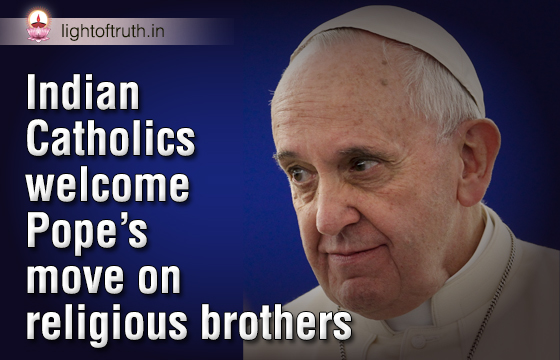
Indian Catholics, both lay people and religious, have welcomed Pope Francis ushering in equality and fraternity in religious congregations that have priests and brothers as members. “It is not a small technical or legal change but a profound shift with enormous theological and spiritual implications,” Delhi-based Jesuit moral theologian Father Stanislaus Alla told on May 19, a day after the Pope promulgated a rescript that offers dispensation from a Church law that stipulates that only priests could head such religious congregations.
The Pope’s move, the Jesuit theologian adds, “distinguishes the power of ordination and the ability to lead and govern and recognizes them as different spiritual gifts. Put simply, it overcomes discrimination in religious life and serves as a great equalizer,” explains the priest who teaches in Delhi’s Vidyajyoti College of Theo-logy.
For Capuchin Father Suresh Mathew, the rescript is “a much awaited reform” and “a sign of equality and true fraternity” that his congregation has been requesting the Vatican for long.
Father Mathew’s congregation has both priests and brothers and the new change gives lay brothers “equal responsibility in religious congregations. It will also put an end to clerical domination. Fraternity now will go beyond words to action. Synodality speaks of walking together. Until now, brothers have been left behind.”
Chhotebhai, convener of Indian Christian Forum, a laity group, sees “a natural progression that non-clerics (Brothers) be accepted as major superiors of men’s religious orders.”
The lay leader recalls the Montfort Brothers getting per-mission from the Vatican in 1990s to ordain some of their members as priests to minister to their community. In another development, the Conference of Religious India elected Christian Brother Philip Pinto as its president, a post until reserved for priests. “Now an Apostolic Carmel sister is the CRI President,” he points out.
Salesian Brother P.A. Jose welcomes the papal gesture as “an overdue change.” The historic decision “will help us Salesians live and work together really as brothers sharing Salesian life as equals,” he told.
Karnataka governor ignores Christians’ pleas, signs anti-conversion ordinance
The Karnataka government has passed an ordinance to abolish religious conversions in the southern Indian state ignoring resistance from the Catholic Church and other groups.
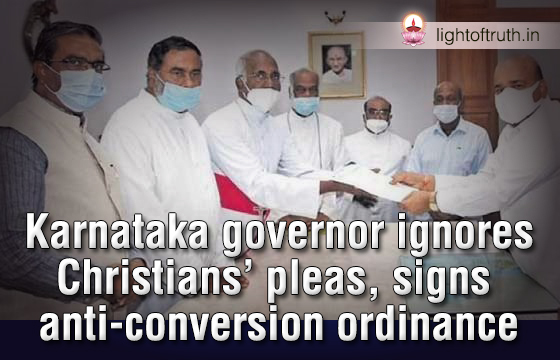
Karnataka Governor Thaawar Chand Gehlot ordinance on May 17 signed the ordinance a day after a Catholic delegation headed by Archbishop Peter Machado of Bangalore appealed against the ordinance through a memorandum.
Father Faustine Lobo, the spokesperson of the Regional Bishops Council in Karnataka, said the governor signing the ordinance is a dark day for democracy in the state. “We are really saddened about this ordinance,” he told.
“It is not about conversion or no conversion, it is all about the government ignoring the contributions by the Christian community to the people of Karnataka,” said the priest who called the ordinance a “back door enactment.”
Father Lobo said a delegation of Catholic bishops had submitted a memorandum signed by Abp Machado to the governor on May 16 and “he had promised to study the ordinance before considering it for signing.”
“But he signed it today,” lamented Father Lobo who addressed a group of journalists on the matter.
The Karnataka governor gave his assent to the ordinance on the controversial Karnataka Protection of Right to Freedom of Religion Bill, 2021, popularly known as the anti-conversion bill.
With the governor’s approval, the ruling Bharatiya Janata Party is expected not to waste time to implement the bill which proposes stringent measures on religious conversion activities.
The bill was passed by the state legislative assembly but it was yet to be presented in the legislative council, where the ruling party is one seat short of majority. It is in this context, the government decided to go ahead with the ordinance.
Only 10% Indians have 25,000 rupee monthly income
The latest State of Inequality in India Report indicates a vast income distribution disparity in the country.
The report prepared by Economic Advisory Council to the prime minister shows the need to address gaps to help the country achieve social progress and shared prosperity.
India has proved the overall condition of households, with access to necessities and adequate water supply and sanitation. However, the measures for in-come parity, poverty, and employment needs to be improved significantly, the report adds.
Top 1% of India’s population accounts for 5-7% of the national income whereas 15% of the country’s working population earns less than 5,000 rupees a month.
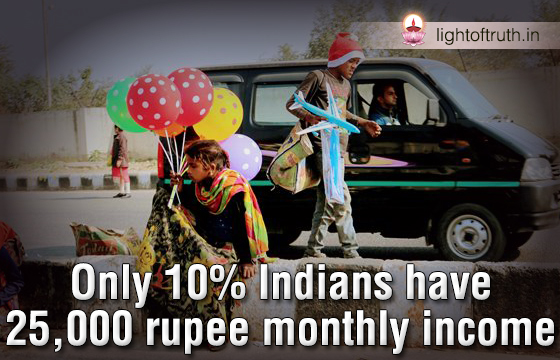
Those earning an average of 25,000 rupees a month fall into the top 10% of the total wages earned bracket, which accounts for about 30-35% the total income.
In another revelation on the inequality in India, the income of the top 1% shows a growing trend while that of the bottom 10% is shrinking.
According to the National Family and Health Survey (NFHS) 2015-2016 data, there is a huge gap in household wealth between rural and urban spaces.
Notably, more than 50% of the households fall in the bottom proportion of wealth concentration (about 54.9%).
Peace activist launch interreligious prayer in Varanasi
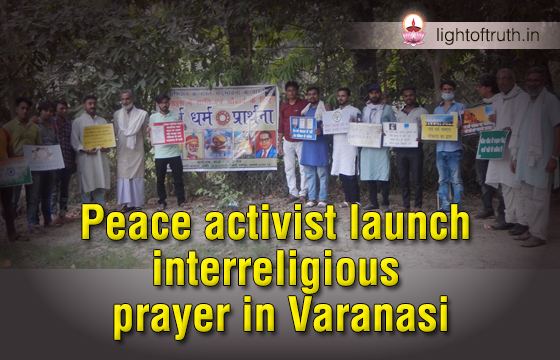
Peace activists from various religions have launched a series of interreligious prayer services at different parts of Varanasi as sectarian tension over the Gyan Vapi mosque controversy gripped Hinduism’s most sacred city.
“These prayers are taken from ten different religious sources namely Hindu, Tao, Jewish, Zoroastrian, Jain, Buddhist, Christian and Muslim faith tra-ditions. They were sung regularly by Mahatma Gandhi in his ashrams along with his disciples and satyagrahis,” Father Anand Mathew, a cultural activist in Varanasi, told on May 23.
The Indian Missionary Society priest further said they use the Hindi version of those hymns translated by renowned Gandhian Narayan Desai. Father Mathew also distributed among the public those songs printed in a pocket size booklet
The prayer campaign was first launched May 20 in the cam-pus of Benares Hindu University on, with students who support peace, secularism and dialogue as participants. Later prayer meetings were also held in Maidagin and Shaheed Udyan Sigra.
Jagriti Rahi, a Gandhian who attended the prayer meetings, says common people of Varanasi do not want any more riots and curfews. The entire city now debates whether a stone found in the pool of ablutions in the mosque premise is a shivling (the phallic image of Lord Shiva) or an abandoned fountain.
She recalled the experiencing the pain from the wounds of riots immediately after the Babri Masjid violence and the consequent month-long curfew three decades ago.
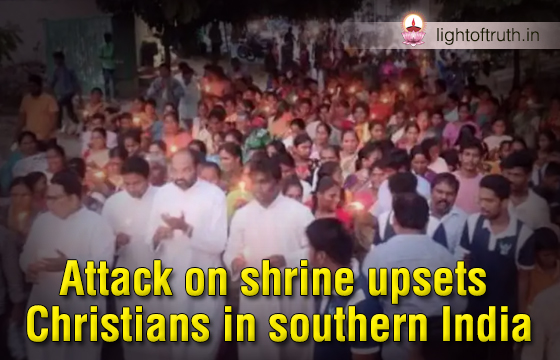
Attack on shrine upsets Christians in southern India
Unidentified vandals destroy-ed statues of Mother Mary, Infant Jesus and the Sacred Heart of Jesus at a hill shrine in the southern Indian state of Andhra Pradesh causing shock among the local Catholics. The incident happened on the intervening night of May 14 and 15. “We came to know about it through some Catholics who had been there early morning,” said Father Bala Subash Chandra Bose who is in charge of the shrine.
The newly constructed shrine complex at Edlapadu in the Guntur district was being readied for an inauguration, Father Bose told on May 18.
“Christians here are in a state of shock and disbelief,” the Guntur diocesan priest said. “We organized a protest march on May 15 evening to press for speedy investigations.”
However, three days after no one had been arrested and the priest said a peace march had been planned on the morning of May 19 to be followed by another protest march on May 22.
The shrine had become an unlikely religious flashpoint in 2021 with the pro-Hindu Bharatiya Janata Party (BJP) claiming it was being illegally erected at a spot where a carving of the Hindu deity Narasimha and footprints of Sita Maa (the wife of Hindu god Ram) existed originally. The claim made by Sunil Deodhar, BJP’s national secretary in charge of Andhra Pradesh, on Twitter was debunked by the Guntur district police, which also issued a video showing how the Catholic shrine and the Hindu deity existed on “two different hillocks” located around half a kilometer away from each other.