

The recent Hunger Watch Survey reveals an alarming state of food insecurity and economic distress in India.
The study was conducted by the Right to Food Campaign India along with a number of associated organizations and the results were released February 23 at the Press Club of India, New Delhi.
According to the study, close to 80% of those surveyed report-ed some form of food insecurity. A staggering 25% reported severe food insecurity for six months after the devastating second wave of the corona pandemic.
The survey also revealed that more than 60% were unable to eat healthy or nutritious food, or could eat only a few varieties of foods in the month preceding the survey.
The survey says that about 45 percent respondents reported that their households ran out of food in the month preceding the survey. A third of the respondents reported they or someone in their household went to bed hungry.
Other findings are:
As many as 66% said their income decreased as compared to the pre-pandemic period.
Overall, 40% households with working members, and 31 percent of the total Hunger Watch-II sample reported that current incomes are less than half the pre-pandemic levels.
The report says, close to 45% households had some outstanding debt. Around 21% respondents have a total debt of more than 50,000 rupees.
Category Archives: National
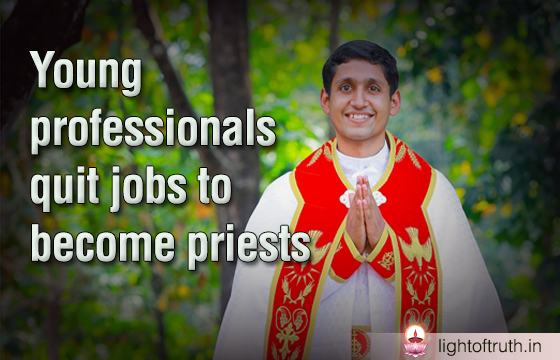
Young professionals quit jobs to become priests
Fr John Purakkattuputhenpura was among several young professionals who are being ordained Catholic priests this year as the Church in India struggles with clergy abuse and other scandals.
These young men have ignored negative reports about priesthood to leave their lucrative and promising careers. All that mattered to them was their inner call, says Father John, who joined the seminary while working as a software engineer (iOS developer).
He was among the 12 deacons who are being ordained priests this year for the diocese of Palai.
Bishop Joseph Kallarangattu of Palai ordained John January 14 in his native parish St Thomas Church, Cheenkallel under the Syro-Malabar diocese.
Sr Lissy Maruthanakuzhy, a special correspondent of Matters India, spoke to Father John. “My course was Electronics and Instrumentation which had a lot of job opportunities in India and overseas. Many of my colleagues are now working abroad. Unexpectedly during campus selection, I was the only one selected. Again it was May 16. God kept his promise. I believed God was giving me the opportunity to reflect and prepare myself for my future.” “ As long as a human being is in need of God, Catholic priesthood is relevant. Jesus said, “Do this in memory of me.” Only a priest can do it. A priest is the heart, and mind of Jesus in the world. People love priests. What they hate are the actions that do not go along with the priesthood.”

Catholic women demand transparency in Church handling clergy abuse
The Sisters in Solidarity, a national forum of Catholic women in India, on February 6 demanded “absolute transparency and accountability” in the way the Church handles sex abuse cases.
The group, comprising religious and lay women, stresses revising canon law and the “theology of priesthood” to cleanse the Church of “elements that breed clericalism, which is an enabler of clerical sexual abuse.”
Such steps would prevent the recurrence of sexual harassment, abuse and abuse in the Church, asserts the solidarity in a letter sent to the Church hierarchy in the Vatican and India. The letter is written in the backdrop of the acquittal of Bishop Franco Mulakkal of Jalandhar in the historic nun rape and the continued victimization of the accuser and her supporters.
The letter, signed by 15 women and endorsed by 1,263 men and women from around the world, expresses their deep concern and shock at the judgement and the court casting “aspersions on the character of the Sister survivor.”
Judge G Gopakumar of the Additional Sessions Court in Kerala’s Kottayam town on January 14 acquitted Bishop Mulakkal saying the prosecution had failed to prove the prelate’s guilt.
The accuser, a former superior general of the Missionaries of Jesus, a congregation under the diocese of Jalandhar, in June 2018 filed a police complaint alleging the bishop had sexually abused her multiple times between 2014 and 2016.
The group urges the Church authorities to keep Bishop Mulakkal away from any administrative responsibilities and spiritual leadership until the case is decided in appellate courts.
The defence lawyers in the case and groups such as the Save Our Sisters plan to appeal against the verdict in the Kerala High Court within two months’ time given by the trial court.
The group also also want the Church to keep Bishop Mulakkal away from Jalandhar lest he uses his “powerful influence to intimidate the sister survivor and her companions.”
All this will uphold the integrity and credibility of the Catholic Church, the women assert. They regret that the judgement over-looked that the bishop was “within a fiduciary relationship of power and authority over the victim as the patron of her congregation.”
The group says the judgment does not take into account the accuser’s “multiple vulnerabilities as a religious nun .Minor discrepancies in her statement are relied upon to project the survivor as a manipulator and a power hungry person who has filed a false complaint only to tarnish the image of the bishop at the instigation of his rivals.” Thereare are 1263 signitaries.
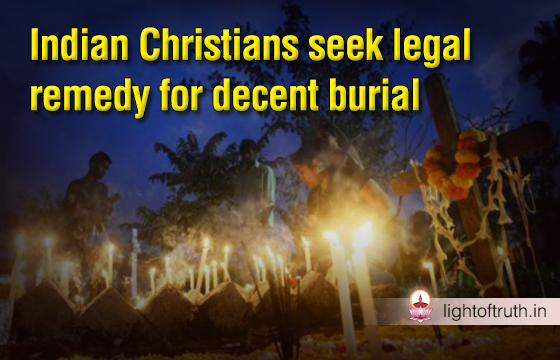
Indian Christians seek legal remedy for decent burial
The top court in the western Indian state of Maharashtra has served notices on government officials seeking an explanation for the lack of burial grounds for Christians in Thane district.
The officials have been directed to file their replies on the contention that local Christians lacked sufficient space for burying their dead made in a public interest litigation by Melwyn Fernandes, a member of the Association of Concerned Catholics.
The bench of Chief Justice V.G. Bisht of Bombay High Court in its Jan. 31 order asked the officials to file their affidavits on or before March 11.
Christians in Thane, adjoi-ning the state capital Mumbai, formerly Bombay, are facing a severe lack of burial grounds, though some 10 plots of government land are earmarked for Christian cemeteries, Fernandes told on Feb. 2.
A right to information query filed by him revealed the reserved plots were located in Kalwa, Kopari, Navpada, Dawale and Daighar under the Thane Municipal Corporation, which had failed to allot them to the community.
Fernandes said these plots were now “either encroached by slum dwellers or handed over to builders, apparently in connivance with the government officials.” Christians, he said, approached the local authorities for releasing these reserved plots to the community but to no avail. “I was thus forced to move the high court seeking its intervention,” he said.

Removal of Christian hymn from India’s Republic Day ‘hurtful,’ archbishop says
Christian leaders in India have lamented the dropping of the hymn “Abide With Me” from the annual celebrations marking Republic Day. The song is traditionally played during the Beating Retreat that takes place on Jan. 29, three days after Republic Day, which is observed Jan. 26.
The Beating Retreat is a special performance by military bands common in former British colonies belonging to the Commonwealth of Nations.
“Abide With Me” – written by Scottish composer Henry Francis Lyte in 1847 – was the favorite Christian hymn of Mahatma Gandhi and has been a fixture in the Beating Retreat ceremony since 1950. It is famous for being played at Elizabeth II’s wedding to Prince Philip in 1947 and is said to have been played by the band on the Titanic as the ship sunk in 1912.
The Christian hymn was dropped by Hindu nationalist Prime Minister Narendra Modi in favor of Kavi Pradeep’s “Aye Mere Watan Ke Logon,” a patriotic song written after the 1962 India-China war.
Government officials have said there was no reason to play a British hymn 75 years after independence, despite its connecting to Gandhi. Archbishop Emeritus of Guwahti, Thomas Menamparampil, told Crux that an average Indian would “be severely hurt at any effort to downgrade the image of Mahatma Gandhi,” who popularized “Abide With Me” in India. “And yet there is fringe element in Indian society today that is dead set on doing precisely this.
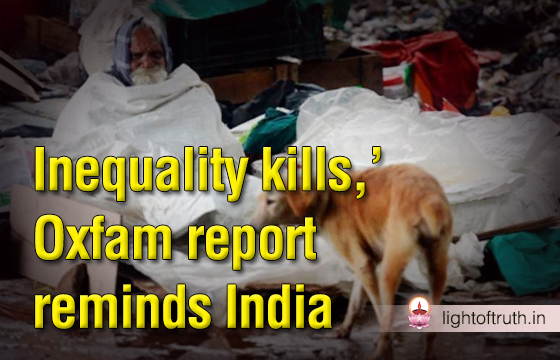
Inequality kills,’ Oxfam report reminds India
The poor became poorer while the rich became richer in India during 2021, says a survey by Oxfam International.
Indian billionaires increased their wealth by 39 percent in 2021 and are getting richer at a much faster pace, but the poor saw their annual income drop by 53 percent and are still struggling to earn a minimum wage and access quality education and health care, the report revealed. Titled “Inequality Kills: India Supplement 2022,” the report said that the richest 98 Indians own the same wealth as the bottom 555 million people.
Indian billionaires grew from 102 in 2020 to 142 in 2021 even though the country witnessed yet another year of pandemic. This was also the year when the share of the bottom 50 percent of the population in national wealth was a mere 6 percent.
The combined wealth of the richest 100 Indians on the Forbes list stands at more than half a trillion US dollars. There were only three women among the 100 richest Indians.
India had the third-highest number of billionaires in the world, just behind China and the United States. It now has more billionaires than France, Sweden and Switzerland combined; indeed, there was a 39 percent increase in the number of billionaires in India in 2021. In 2020, India’s top 10 percent held close to 45 percent of the country’s national wealth. The Oxfam report once again confirmed that while India is one of the fastest-growing economies in the world, it is also one of the most unequal countries with inequality continuing to rise sharply for the last three decades.
Since 2015, more and more of India’s wealth has gone to its richest one percent. Globally, too, wealth increased during 2021 to make the world’s billionaire elite richer when common people struggled against the pandemic for the second consecutive year.
“The massive gap between rich and poor will continue to increase to unimaginable proportions if the elected representatives of people in parliament do not take their job seriously,” said A.C. Michael, convener of the United Christian Forum. This deliberate inequality was bound to continue, said Michael, a former member of Delhi Minorities Commission.
“The massive gap between rich and poor will continue to increase to unimaginable proportions if the elected representatives of people in parliament do not take their job seriously,” said A.C. Michael, convener of the United Christian Forum.Top of Form
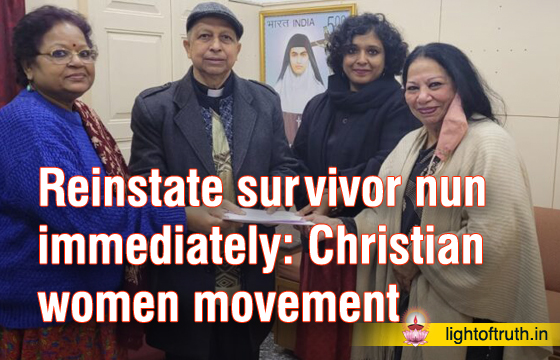
Reinstate survivor nun immediately: Christian women movement
The Delhi chapter of the Indian Christian Women’s Movement (ICWM) has demanded immediate reinstatement of the rape survivor nun in her congregation.
The movement, representing women from various Christian denominations across the country, on January 22 met Archbishop Anil J Couto of Delhi to present him a statement to pass on to Apostolic Nuncio Archbishop Leopoldo Girelli.
The statement refers to the victim in the historic nun rape case where Bishop Franco Mulakkal of Jalandhar was accused of raping a nun multiple times inside a convent in Kerala, southern India.
A court in Kerala on January 14 acquitted the prelate saying the prosecution failed to prove his guilt.
The ICWM-Delhi statement asserts that the movement “stands in complete solidarity with the victim/survivor nun who broke the silence against continuous abuse and exploitation by Bishop Franco Mulakkal” of Jalandhar.
“As women, we are feeling completely outraged and humiliated by having to prove our pain and trauma, time and time again. We are sick and tired of proving why there was a delay in filing a report. Why there was a delay in speaking up? How could we endure it for such a prolonged period of time? Because it has been instilled in us to respect the men of cloth.”
The statement points out that the bishop and nuns have “a fiduciary relationship” and the prelate should have protected those serving the Lord under him. “Instead, women in the Church are feeling unsafe and vulnerable, open to abuse in their congregations and Churches. Anyone who dares to speak against the powerful men of cloth are isolated, neglected and targeted for speaking up,” the statement bemoans.
Observing that “this travesty of justice and denial of respect to women in the Church has gone on long enough,” the movement demands an end to “inappropriate behaviour by priests, Bishops and any other in power.”
Nun rape case: ICWM’s open letter to Indian Churches
The Indian Christian Women Movement, an ecumenical group, has issued an open letter addressed to the leaders of various Churchesin the country.
We, as women of the Chur-ches, waited for the verdict impa-tiently, we were so sure that the accused will be indicted.
In our estimation, all evidence pointed to the guilt of Franco Mulakkal. All that remained was for the guilty verdict and for the Church to acknowledge its connivance and announce, in no uncertain terms, its agreement with the strongest punishment that he deserves.
But, this was not to be. Mulakkal was acquitted of all charges; and the survivor Sister was left to deal with the consequences of crimes she did not commit.
In the text of the judgment, as submitted to the court, words have been written about the nun; intimate details enumerated which should shame every Christian woman, let alone a sister who has dedicated her life to obedience and submissiveness to authority in the church.
Her defence was downplayed and she was left in the lurch by the Church. This has been the most difficult – feeling let down by the Church to which she had avowed allegiance.
For us as women of the Church this betrayal has been the most painful to accept. We call on the leadership of the Church to account for their attitude ever since the survivor Sister courageously spoke out about her ordeal. The Church did not react as it should have – letters of appeal she sent to the leadership of the Church were ignored; the church remained silent in the face of her humiliation in the court.
Nun arrested after hostel girl dies by suicide in Tamil Nadu
A Catholic nun was arrested in the southern Indian state of Tamil Nadu after a 17-year-old girl died by suicide.
The girl took poison January 9 at her hostel at Michaelpatti in Thanjavur district, and died 10 days later.
Sister Sahaya Mary, the 62-year-old hostel warden, was arrested under the Juvenile Act apart from charges of abetting suicide. The place is near Poondi Madha shrine that comes under the diocese of Kumbakonam.
A report in ndtv.com says the girl took poison alleging abuse by her hostel warden and an attempt to convert her family to Christianity.
“In an unverified video that has surfaced after her death, the girl says she may have been harassed and abused because her family refused to convert to Christianity,” the report says.
The ndtv.com report says the news organization could not independently verify the video that surfaced after the girl’s death. Jesuit Father Arockiasamy Santhanam, spokesperson for the National Lawyers Forum of Religious and Priests, says the First Information Report does not mention conversion. “It is the cook up story by the Hindutva elements,” he told on January 21.
According to him, the police had gone to the hospital to collect the girl’s statement.
The priest also explained that the girl had lost her mother eight years ago and her father married another woman.
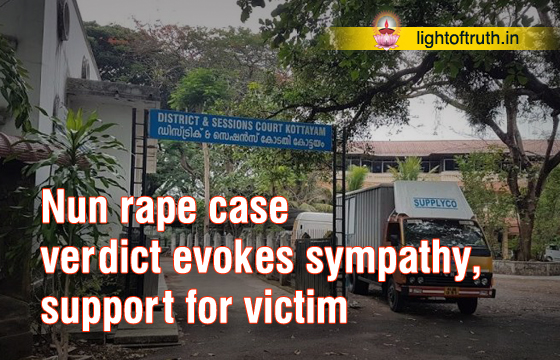
Nun rape case verdict evokes sympathy, support for victim
Support and sympathy for a Catholic nun continue to pour in even a week after a court in Kerala dismissed her case against a bishop.
Additional District and Sessions Court Judge G. Gopakumar on January 14 acquitted Bishop Franco Mulakkal of Jalandhar in the historic nun rape case, saying the prosecution had failed to prove the charges against him.
The nun, a former superior general of the Missionaries of Jesus, a Jalandhar diocesan congregation, had in June 2018 accused Bishop Mulakkal of raping her 13 times between 2014 and 2016.
“When it is not feasible to separate truth from falsehood, when grain and chaff are inextricably mixed up, the only available course is to discard the evidence in toto,” said Judge Gopakumar in his verdict.
“In the said circumstances, this court is unable to place reliance on the solitary testimony of a rape victim and to hold the accused guilty of the offences charged against him. I accordingly acquit the accused of the offences,” the judge added.
After the verdict was pronounced, Bishop Mulakkal came out of the court saying, “Praise God.” His supporters hail the verdict as a victory for the Church since those behind the case were its enemies. The prelate reportedly offered Mass in a charismatic retreat center and visited people who had supported him in the media.
However, the verdict sent shock and disbelief among women across the country.
Astrid Lobo Gajiwala, a Mumbai-based woman theologian, says that the judgment is “a huge deterrent to rape survivors coming forward to seek justice, especially in the Church.”
“It tremendous courage for a Catholic nun to go public about being raped by a bishop, in a Church that claims its hierarchy is divinely instituted,” explains Gajiwala, who claims to be aware of “the prolonged physical, psychological and financial toll that this case has taken on the survivor and her supporters. It is unimaginable that she would go through this if it were not true.”