
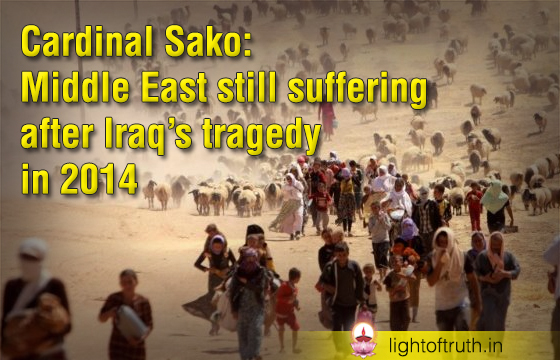
As Iraq marks the 10th anniversary of the Yazidi genocide by the so-called Islamic State group, and of the subsequent tragic Christian exodus from Iraq, Cardinal Louis Raphael Sako the Chaldean Patriarch of Baghdad has urged Christian, Muslim, and Jewish leaders “to stand together” against those who continue to fuel “hatred and extremism” threatening to inflame the entire Middle East. They “must raise their voices loudly,” the Chaldean Patriarch said in a message for the occasion.
Early in August 2014, the self-proclaimed Islamic State of Iraq and Syria (ISIS) launched a campaign of mass atrocities to achieve the religious and ethnic cleansing of religious minority groups in the two countries. ISIS militants first rampaged through the Yazidi heartland of Sinjar, murdering men, abducting and enslaving women and children, and destroying homes and businesses, affecting tens of thousands of people.
More than 3,000 Yazidi men, women and children were killed, and at least 6,800 more — for the most part women and children — were abducted. Then, on the night of August 6, ISIS went after Iraqi Christians, forcing 120,000 to flee Mosul and the Nineveh Plains.
Ten years on, “people in the Middle East are still living in fear and despair,” Patriarch Sako noted, including in the Holy Land, where the “escalation of war has reached its peak.”
He warned that unless the international community does something to stop the conflict, which is claiming thousands of lives, destroying homes and infrastructure, the people in the region will continue to live “in catastrophic conditions”. According to the Chaldean Patriarch, “Today, more than ever, we need to learn lessons from the past so that we never allow tragedies to happen again,” because, as Pope Francis has repeatedly said, “war is never a solution” and, in fact, with war, “everyone loses.” “We must work to achieve peace and stability by overcoming evil with good; war with dialogue and understanding; exclusion with respect for the rights of people, self-determination and respect for international law!” he emphasized.
For their part Christian, Muslim and Jewish religious leaders should join their forces to fight those who incite hatred and extremism that fuels wars. Concluding his message, Patriarch Sako called upon all Churches in the Middle East to bear witness to hope ahead of the 2025 Jubilee, which will have hope as its overarching theme. He also invited Christian and Muslim religious leaders to organize special prayers for peace mosques and churches.
Category Archives: International
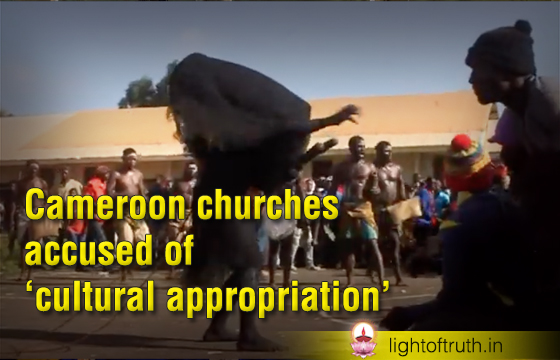
Cameroon churches accused of ‘cultural appropriation’
The Wimbum people in the Diocese of Kumbo, in the north west of Cameroon, have petitioned the Vatican over an alleged “desecration of their culture by the Church”.
In letter addressed to the Dicastery for the Doctrine of the Faith dated 17 July, Wimbum leaders said their cultural heritage was threatened by the Church’s “cultural appropriation” of their rituals. “Recent actions by the Catholic Church have incorporated elements from our secret societies … into their processions. These processions are outright copyrights of our traditional sacred societies and artefacts,” they said. “By appropriating our sacred practices within Church premises, Catholic priests inadvertently usurp the authorities of our kings.”
The appeal came days after the Nso people of the same diocese complained to Bishop George Nkuo of Kumbo of similar practices in their community. Videos on social media show church groups in the Wimbum and Nso communities employing traditional masquerades in their processions. Tah Nformi Emmanuel Kongyu, a former pastor and who now practices traditional religion, said that the Church had had lived peaceably with traditional practices until recently. “What’s happening right now is that the African traditionalists are protesting that the Church is overstepping their bounds in the practice of inculturation,” he said.
Fr Eboka John, communications director for the Diocese of Mamfe in south-west Cameroon, said the inculturation of Christianity had several facets. “Inculturation means that we let the Gospel values shed light on culture,” he told. He said this can only happen when Church leaders understand both Gospel values and the values of a particular culture. “For instance, in the Nso culture, we need to ask the question: what is the use of masquerades? If we are to practice good inculturation in Nso, we are supposed to know what the masquerade means for the Nso man, so that if we must bring masquerades to Church in the name of inculturation, we should know what message we are passing across.” He said Catholic priests were taught about African traditional religions in their training and formation.
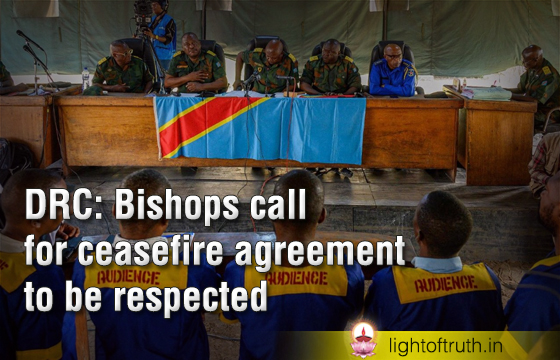
DRC: Bishops call for ceasefire agreement to be respected
The Democratic Republic of Congo, particularly its eastern regions, has been subject to conflict for decades. Violence between local militia and foreign rebel groups has led to widespread displacement and instability. According to the Vatican’s Fides News Agency, reporting from Kinshasa, the Bishops’ Conference of the Democratic Republic of Congo (CENCO) has called for peace and the implementation of the ceasefire signed in Luanda, Angola on July 30.
The agreement, signed by the governments of Congo and Rwanda, called for a ceasefire to be put into effect at midnight on August 4. However, the bishops said they were concerned that this new ceasefire might not be respected. They said that “all previous agreements have been violated without effort and the various reports on this have not led to any sanctions.”
This prompted the bishops to intervene, expressing their condemnation and insisting on the need for both parties to respect the agreement.
CENCO highlighted the need to raise global awareness of the conflict in this region, comparing its importance to that of the Russo-Ukraine war.
This is a conflict with severe consequences on the local population, including the displacement of 1.7 million people, according to the UN, bringing the total number of internally displaced persons in Congo to over 7 million.
UNICEF representative Grant Leaity says hundreds of thousands of children are prevented from attending schools and are being forced to flee their homes because of the violence.
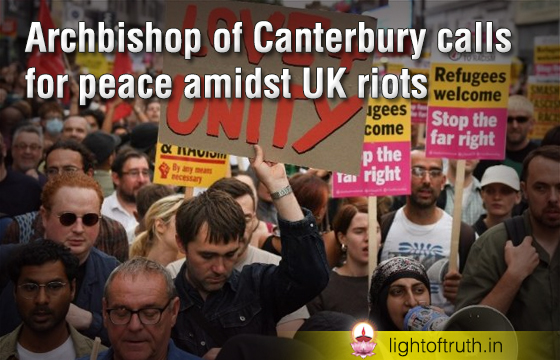
Archbishop of Canterbury calls for peace amidst UK riots
In the wake of recent events in Britain, which has also seen some of its worst levels of antisemitism in the first half of any year, UK faith leaders continue to condemn violent anti-Muslim riots across the country.
They have united against the hatred and brutality, saying that every British citizen “has a right to be respected and a responsibility to respect others”.
The Archbishop of Canterbury, Justin Welby, said he joins them in prayer, spreading hope for peace to all the communities affected, for those left injured, the police seeking to restore public order, and for places of worship and people of faith and goodwill.
“Violent protest turns people away from the cause,” Archbishop Welby affirmed in an interview with BBC Radio 4, emphasizing that “peaceful protests will have ten thousand times more impact” than criminally violent riots regardless of the cause.
The message follows concerns for safety in several UK regions that continue to rise as more people riot and take to the streets of London, Birmingham, Yorkshire and Merseyside, all seeing mass violence and of arrests.
The official agency of the Catholic Bishops’ Conference of England and Wales for domestic social action (CSAN) recently expressed their solidarity, saying the Church seeks to bring hope and agency to the marginalised communities which have fallen victim to the violent outbreaks.
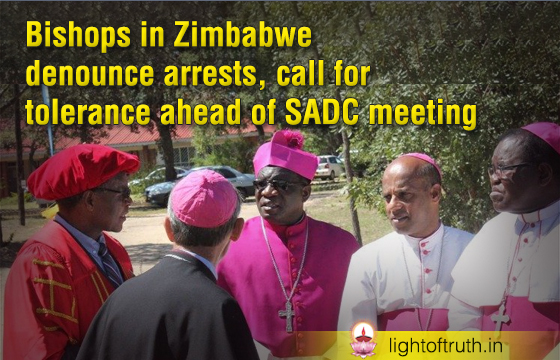
Bishops in Zimbabwe denounce arrests, call for tolerance ahead of SADC meeting
In an attempt to calm rising tensions in Zimbabwe, Catholic Bishops have issued a Pastoral Statement denouncing arbitrary arrests and calling for tolerance and restraint in the country.
“Recently, we have seen the wanton arrests of citizens under frivolous charges. Some of the arrested have been denied bail. Surely, even those who ‘have committed crimes’ deserve to be treated in a just manner. They cannot be denied their fundamental rights. Here, the adage, ‘justice delayed is justice denied,’ rings true. Let us safeguard the human rights enshrined in our Constitution,” reads the Bishops’ Statement.
The Bishops say they have observed that in preparation for “this important meeting, we are seeing the resurgence of some ugly vices. This is sad, for in a democratic nation that knows the value of human dignity, freedom of association and speech, such vices have no place as they contradict some of the fundamental values that form the bedrock of our national Constitution,” the Bishops assert. Amnesty International issued an Urgent Action appeal urging the Government of President Emmerson Mnangagwa to end the crackdown and silencing of activists as well as members of the Opposition.
Over 160 activists, political party members, student union activists and civil society members have been arrested on charges relating to disorderly conduct, criminal nuisance and plotting to incite protests. Some of those detained were said to have been severely tortured and sustained injuries that required hospitalisation.
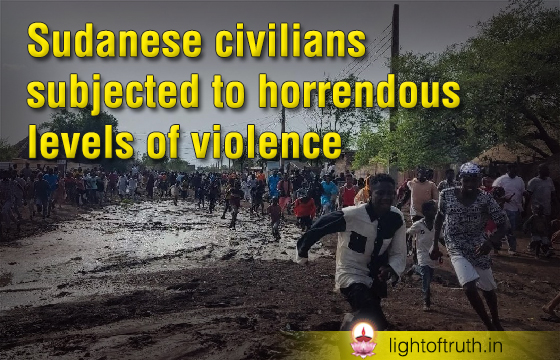
Sudanese civilians subjected to horrendous levels of violence
The political dispute between two Sudanese military generals who took to arms because they opposed being integrated, according to a transition plan to free elections following the ousting of long-ruling autocrat Omar al-Bahsir in 2019, has resulted in what is widely acknowledged as “the largest internal displacement crisis in the world.”
With agriculture in ruins and the country’s banks robbed and emptied, famine is a reality, with many vulnerable people already dead from starvation, including babies, while relief efforts remain blocked by fighting.
A report by the aid group Medecins Sans Frontiers, that accused the warring parties – the Sudanese Armed Forces and the paramilitary Rapid Support Forces – of “blatant disregard” for human life and international law, detailed the horrendous levels of violence suffered by Sudanese civilians since the beginning of the war in April 2023.
MSF teams that managed to reach thousands of war wounded in areas affected by bombing, shelling of residential homes and essential infrastructure, said the physical and mental wounds of violence have been exacerbated by the collapse of the health system and the lack of an international humanitarian response.
They said that across Sudan, people’s access to lifesaving care has been drastically affected due to shortages, widespread obstruction and looting of medical supplies, insecurity and attacks against patients and medical staff, as well as damage to healthcare infrastructure.
15 months into the widely ignored conflict, survivors reportedly tell of pervasive sexual, gender-based and ethnic violence, of stories of inhuman treatment perpetrated by armed groups on civilians, of forced evictions, looting and arson amid a total lack of protection services. All mediation efforts have failed to bring a halt to the hostilities.
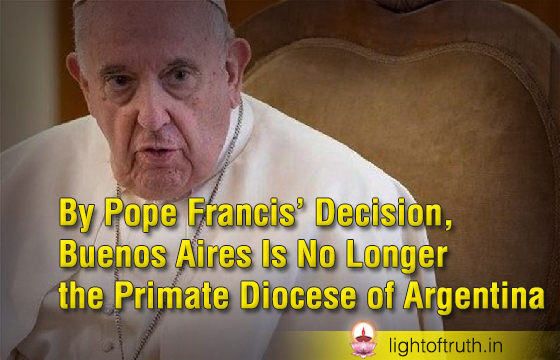
By Pope Francis’ Decision, Buenos Aires Is No Longer the Primate Diocese of Argentina
By Pope Francis’s decision, made public on Monday, July 22, from August 25, 2025, Buenos Aires, Argentina’s capital, will lose the title of the country’s Primate Archdiocese. Days later, from September 7, the Diocese of Santiago del Estero will begin to bear the title of Primate Archdiocese of Argentina. The Holy Father’s decision was communicated jointly by the Archbishop of Buenos Aires, Monsignor Jorge Ignacio García Cuerva, and the Bishop of Santiago del Estero, Monsignor Vicente Bokalic Iglic, in a letter to the faithful of their respective dioceses. A Primate Diocese is a diocese that has a pre-eminent position or leadership in the Catholic Church in a region or country. This special position is occupied by a Bishop who bears the title of “Primate.” The term and function of a Primate Diocese can vary according to the ecclesiastical tradition of each country.
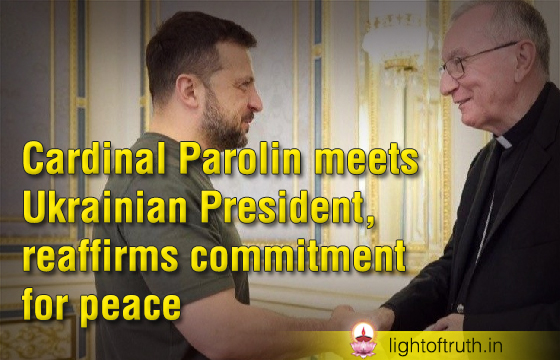
Cardinal Parolin meets Ukrainian President, reaffirms commitment for peace
The institutional meetings held by the Vatican Secretary of State Cardinal Pietro Parolin with Ukrainian leaders culminated on July 23 in Kyiv with the meeting between the Cardinal Secretary of State and President Volodymyr Zelenskyy.
Following the meeting, in a post on X, the Secretariat of State announced that the Cardinal reaffirmed “the Pope’s solidarity and the commitment to finding a just and lasting peace for war-torn Ukraine.”
Zelensky had already received a papal envoy in June last year. Pope Francis had asked the Cardinal of Bologna and head of the Italian bishops, Matteo Zuppi, to visit the war-torn nation and meet with the Ukrainian President.
Over the years, Zelensky has had several opportunities to speak with the Pope. The last occasion was on June 14, 2024, on the sidelines of the G7 meeting in southern Italy. Prior to that, on December 28, 2023, Zelensky reported on his X account about a phone conversation he had with Pope Francis for Christmas greetings. On that occasion, he wrote, the emphasis was on a “just peace for all of us” and the Vatican’s appreciation for the presidential peace plan.
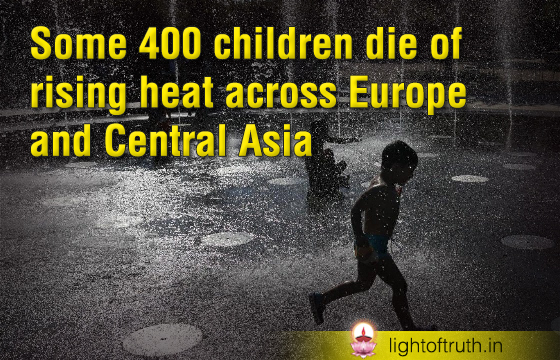
Some 400 children die of rising heat across Europe and Central Asia
An estimated 377 children were killed in 2021 by rising temperatures across Europe and Central Asia. This was the disturbing finding revealed on 24 July, by UNICEF in a new analysis of data from 23 countries.
In the report ‘Beat the heat: child health amid heatwaves in Europe and Central Asia,’ the UN Children’s Fund documents that half of these children died from heat-related illnesses in their first year of life. UNICEF’s Regional Director for Europe and Central Asia, Regina De Dominicis, cautions that “around half of children across Europe and Central Asia – or 92 million children – are already exposed to frequent heatwaves in a region where temperatures are rising at the fastest rate globally.” She warns that the increasingly high temperatures can have serious health complications for children, especially the youngest ones, even in a short space of time. “Without care,” she says, “these complications can be life-threatening.” According to UNICEF, heat exposure has acute effects on children, even before they are born, and can result in pre-term births, low birth weight, still-birth, and congenital anomalies.
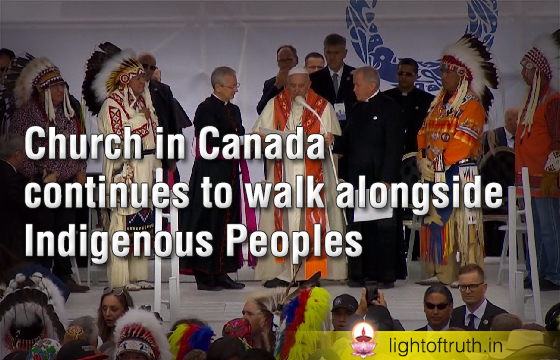
Church in Canada continues to walk alongside Indigenous Peoples
Two years on from Pope Francis historic “penitential pilgrimage” to Canada, the nation’s bishops say they “remain committed to walking in solidarity and listening to the experiences of Indigenous Peoples to guide the path forward.”
In a Letter addressed to “The People of God,” the bishops say they continue to reflect “on the profound sorrow Pope Francis expressed for the devastating effects of the residential school system on Indigenous communities, and on the journey of reconciliation and healing we have embarked on together.”
The bishops go on to highlight some of the initiatives undertaken by the Church in Canada since the Pope’s visit. The first involves financial support for Indigenous priorities, with the Bishops pledging to raise thirty million Canadian dollars over the course of five years for projects aimed at supporting healing and reconciliation. Over half of that amount has already been raised, with funds going to initiatives identified by local Indigenous com-munities and overseen by the Indigenous reconciliation fund.
The bishops have also committed them-selves to “transparent access” to mission, sacramental, and burial records, as well as other documentation. “Pope Francis emphasized the significance of uncovering and recognizing truths about the historical injustices faced by residential school survivors and their families,” the bishops say, adding, “Truth must come before recon-ciliation.”
Finally, the bishops acknowledged “the many difficult conversations around the country regarding our painful legacy.” Recognizing that “this deep desire for truth and transparency resides first with Indigenous communities and residential school survivors,” the bishops encourage dioceses and all Catholics to support local indigenous communities as they delve into the painful history of the residential schools.