
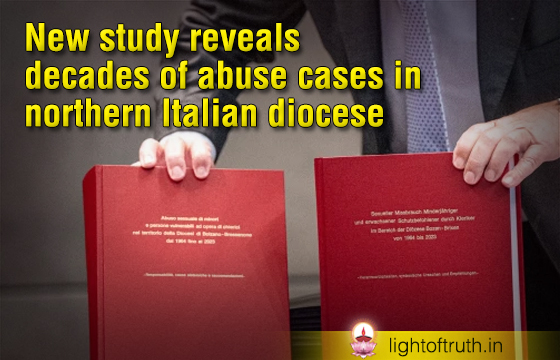
A pioneering probe into clerical abuse in northern Italy’s Bolzano-Bressanone Diocese has uncovered 67 cases involving 59 victims over a nearly 60-year period, according to a study released on Jan. 20.
The 635-page report examined cases from 1964 to 2023 in the northern Italian region of Alto Adige-Südtirol and identified 41 clergy members as alleged per-petrators. However, researchers could definitively confirm alle-gations against only 29 of the accused, while claims against the remaining 12 clergy could not be verified with sufficient certainty.
In what researchers called a “surprising” finding, more than 51% of the victims were female, while only 18% were definitively identified as male. This pattern marks a significant departure from similar studies in Germany, where male victims predomina-ted, reported CNA Deutsch, CNA’s German-language news partner.
The study, conducted by Munich-based law firm Westpfahl Spilker Wastl, noted that the diocese’s handling of abuse cases has improved since 2010. Resear-chers particularly praised former Bishop Karl Golser (2008–2011) for establishing the diocese’s list-ening centre – described as “an absolute novelty in Italy” – though they noted that before 2010, diocesan leadership had “mostly reacted inadequately or inappro-priately.”
The report acknowledged sincere efforts by current leader-ship – Bishop Ivo Muser since 2011 and Vicar General Eugen Runggaldier since 2018 – to improve the diocese’s approach to abuse cases and support for victims.
Category Archives: International
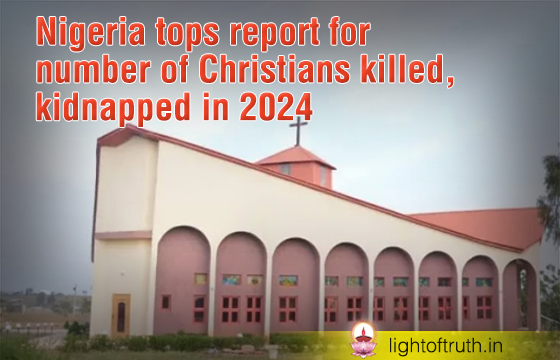
Nigeria tops report for number of Christians killed, kidnapped in 2024
Nigeria was the country with the most Christians killed and kidnapped in 2024, according to the latest report from advocacy group Open Doors.
The World Watch List, re-leased Jan. 15, found that 3,100 Christians were killed and 2,830 Christians were kidnapped in Nigeria in 2024, far more than other countries in the same year. The report also said the country with the most Christians arrested in 2024 was India, at 2,176, and Rwanda experienced the most attacks on Christian churches or buildings with 4,000.
The Open Doors watch list confirmed that Christian persecution continued to grow “in absolute terms” among the about 100 countries the group monitored in 2024, with 13 countries classified at “extreme levels” of Christian persecution. The group estimates over 380 million Christians worldwide experienced at least a “high level” of persecution and discrimination because of their faith.
North Korea, Somalia, Yemen, Libya, and Sudan are the report’s top five countries for Christian persecution in 2024. Nigeria ranks No. 7 on the watch list. Eritrea, Pakistan, Iran, Afghanistan, India, Saudi Arabia, and Myanmar round out the top 13 countries, all classified as having “extreme” levels of anti-Christian persecution.
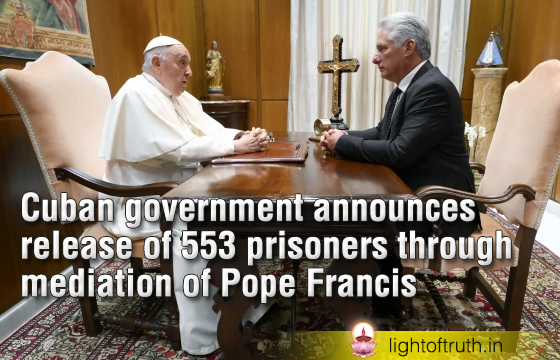
Cuban government announces release of 553 prisoners through mediation of Pope Francis
The Cuban government announced the release of 553 prisoners through the mediation of Pope Francis “in the spirit of the Ordinary Jubilee of 2025. “President [Miguel] Díaz-Canel sent a letter to the supreme pontiff in which, in the spirit of the Ordinary Jubilee of 2025 declared by His Holiness and which has just begun, he communicated the decision to benefit by granting freedom to 553 people sanctioned in due process for various crimes established by law … [These people] will receive their respective benefits gradually,” the Cuban Ministry of Foreign Affairs said in a statement dated Jan. 14.
Cuba’s statement refers to Pope Francis’ call to release prisoners during the 2025 Jubilee Year of Hope, which began on Dec. 24, 2024, at the Vatican. In the bull Spes Non Confundit, with which he convoked the jubilee year, the pope proposed that “governments undertake initiatives aimed at restoring hope, forms of amnesty or pardon meant to help individuals regain confidence in themselves and in society.”
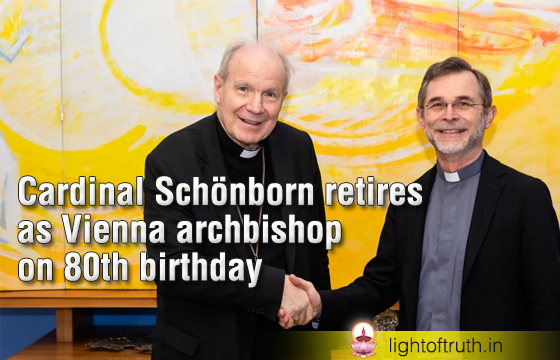
Cardinal Schönborn retires as Vienna archbishop on 80th birthday
Cardinal Christoph Schönborn, OP, concluded his term as arch-bishop of Vienna, Austria, on Jan. 22, his 80th birthday, when Pope Francis accepted his resignation.
Schönborn, a theologian who led Austria’s most populous archdiocese for three decades, helped write the Catechism of the Catholic Church and chaired the Austrian bishops’ conference for 22 years. He is currently chair-man of Pope Francis’ Council of Cardinals.
The Vatican announced Jan. 22 that Pope Francis had accepted Schönborn’s resignation and appointed an apostolic admini-strator, Father Josef Grünwidl, to oversee the Vienna Archdio-cese until the appointment of Schönborn’s successor.
“The fact that Rome has created an interim solution shows us that Pope Francis has appare-ntly not yet made a decision on who should be the next archbishop of Vienna. Since the process is already well advanced, we hope for a decision in the coming weeks,” archdiocesan spokesman Michael Prüller said in a state-ment on Jan. 22.
Schönborn remains a member of the College of Cardinals, to which he was elevated in 1998, but at 80 years of age, he is no longer eligible to vote in a con-clave.
In a video message to Vienna’s Catholics, Schönborn said: “Above all, I have to thank God and I have to thank you all. The decisive experience in my almost 30 years in office has been: Church only works together, society only works together.”
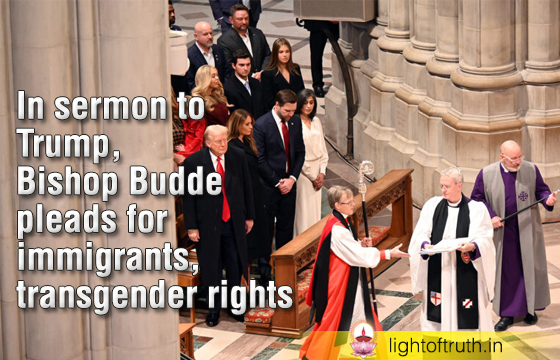
In sermon to Trump, Bishop Budde pleads for immigrants, transgender rights
President Donald Trump attended the inaugural prayer ser-vice at the Washington National Cathedral Tuesday morning (Jan. 21), finishing off the festivities marking the beginning of his second term with an interfaith service filled with prayers and hymns – and a sermon that offered a religious challenge to his administration’s stated goals.
About halfway through the service, Trump, seated in the front row, heard a sermon that fun-ctioned as one of the first public criticisms of his second admini-stration. After beginning her homily by exploring the difficulty of forging a “kind of unity that fosters community across diver-sity and division, a unity that ser-ves the common good,” the Rt. Rev. Mariann Budde, the Epis-copal bishop of Washington, singled out three foundational principles for the task: honouring the inherent dignity of every hu-man being, honesty and humility.
Near the end of her sermon, Budde directed her remarks to Trump himself, noting the declaration in his inaugural address that he believes he was “saved by God” from an assassination attempt last year. She then expressed concern for LGBTQ people who may feel targeted by his administration.” “Millions have put their trust in you. As you told the nation yesterday, you have felt the providential hand of a loving God. In the name of our God, I ask you to have mercy upon the people in our country who are scared now,” Budde said in her sermon. “There are gay, lesbian and transgender children in both Democratic, Republican and independent families who fear for their lives.”
Budde also made a plea for immigrants, a group under fire from Trump’s incoming admi-nistration, saying they include people who “pick our crops” and “work the night shift in hospitals,” among other vital roles.
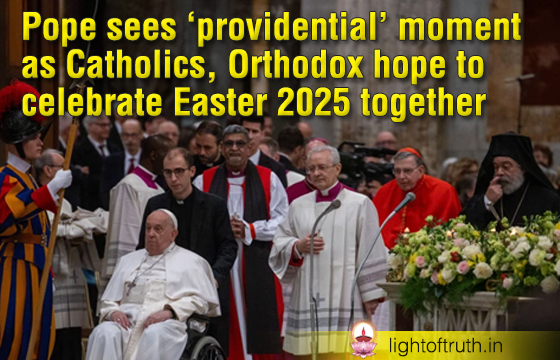
Pope sees ‘providential’ moment as Catholics, Orthodox hope to celebrate Easter 2025 together
Pope Francis posed Jesus’ profound question “Do you believe this?” to Christians worldwide during an ecumenical vespers service on Jan. 25th evening as momentum builds for Catholics and Orthodox to consider celebrating Easter on the same date in this historic anniversary year.
Speaking at the Basilica of St. Paul Outside the Walls at the conclusion of the 58th Week of Prayer for Christian Unity, the pontiff reflected on Christ’s encounter with Martha following the death of Lazarus, emphasizing that hope “rises from the ashes of death.”
“This tender encounter between Jesus and Martha teaches us that even in times of deep desolation, we are not alone and we can continue to hope,” the pope said during his homily, which centred on the week’s theme “Do You Believe This?” from John 11:26.
The celebration on Jan. 25 marked the solemn conclusion of this year’s Week of Prayer for Christian Unity, which the pope linked to the ongoing jubilee year. “This message of hope is at the heart of the jubilee we have begun,” Francis said, citing the Apostle Paul’s words to the Romans that “hope does not disappoint us, because God’s love has been poured into our hearts through the Holy Spirit” (Rom 5:5).
At the vespers service, the pope noted that this whole jubilee year’s focus is on hope and “providentially” coincides with the 1,700th anniversary of the Council of Nicaea. He emphasized that the council’s profession of faith “transcends all the divisions that have riven the body of Christ over the centuries.”
Cardinal Kurt Koch, prefect of the Dicastery for Promoting Christian Unity, addressed the Holy Father before the apostolic blessing. He recalled the pope’s historic 2014 visit to Ecumenical Patriarch Bartholomew I in Constantinople (modern-day Istanbul), where Francis had affirmed that “the Catholic Church does not intend to impose any requirements except the profession of common faith” for achieving full unity. This hope for unity has gained momentum in recent months. Last November, Ecumenical Patriarch Bartholomew of Constantinople confirmed ongoing conversations between Church representatives about establishing a common Easter date, potentially beginning in 2025.
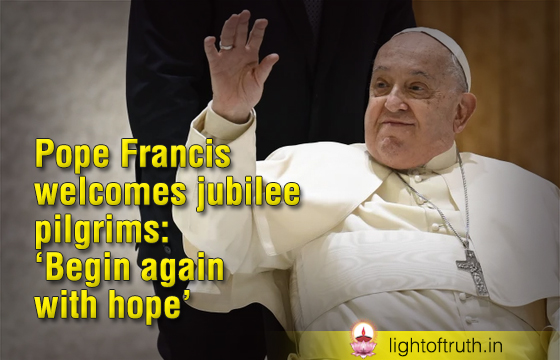
Pope Francis welcomes jubilee pilgrims: ‘Begin again with hope’
Pope Francis kicked off the first Saturday jubilee audience of 2025 by urging pilgrims to embrace hope as a divine strength that enables new beginnings, drawing inspiration from St. John the Baptist. Speaking to pilgrims gathered in the Vatican’s audience hall on Jan. 11, the pontiff emphasized that hope is not merely a character trait but rather a theological virtue that represents “strength to be asked for” from God. “Many of you are here in Rome as ‘pilgrims of hope,’” Pope Francis said. “Indeed, the jubilee is a new beginning, the possibility for everyone to start anew from God. With the jubilee we start a new life, a new phase.”
The pope highlighted how the Latin word “virtus” means strength, explaining that hope, therefore, comes as a gift from God rather than existing as a mere habit or personality characteristic. The Catholic Church teaches that hope is one of the three theological virtues – along with faith and charity – which God pours into the hearts of the faithful. Drawing connections to the feast of the Baptism of the Lord, Francis reflected on John the Baptist as a “great prophet of hope,” noting how people flocked to him “longing for a new beginning.”
“Just as we today pass through the Holy Door, so John proposed to cross the river Jordan, entering the Promised Land as Joshua had done the first time,” the pope said, connecting the biblical narrative to the current jubilee year.
The jubilee audience marked the beginning of regular Saturday gatherings that will welcome pilgrims from around the world throughout the 2025 Jubilee Year. The first major calendar event of the 2025 holy year is the Jubilee of the World of Communications, scheduled for Jan. 24–26. The Vatican expects thousands of journalists and media professionals from around the world to come to Rome for the occasion.
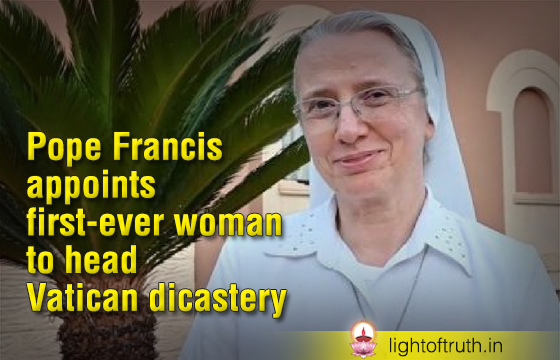
Pope Francis appoints first-ever woman to head Vatican dicastery
Pope Francis has named for the first time a woman, Sister Simona Brambilla, to head a dicastery of the Roman Curia, continuing to add to the number of women in leadership roles at the Vatican, a hallmark of his pontificate.
The 59-year-old Brambilla, a member and former superior general of the Consolata Missio-nary Sisters, has been secretary of the Vatican department for religious and consecrated life since October 2023.
Sr Brambilla will lead the Dicastery for Institutes of Con-secrated Life and Societies of Apostolic Life together with Card-inal Ángel Fernández Artime, who was named pro-prefect on Jan. 6. A Spaniard, the 64-year-old Fernández concluded a decade as rector major of the Salesians last year. The appointment of an ordained bishop as pro-prefect of the same dicastery was necessary because Church law calls for ordi-nation in order to carry out certain governing powers.
Brambilla, who trained as a nurse before entering religious life, was a missionary in Mozam-bique in the late 1990s. She then returned to Italy, where, with her advanced degree in psychology, she taught at the Pontifical Gre-gorian University in its Institute of Psychology. She was head of the institute of Consolata Missio-nary Sisters from 2011 until May 2023.
Brambilla joins several other religious and non-religious lay-women appointed by Pope Francis to important posts in the Vatican, including Franciscan Sister Ra-ffaella Petrini, the first woman to hold the second-ranking post in the government of the Vatican City State.
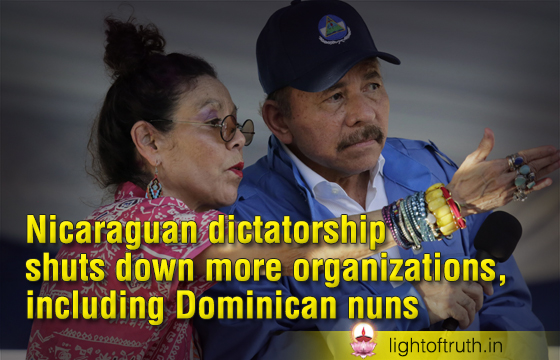
Nicaraguan dictatorship shuts down more organizations, including Dominican nuns
The new year has seen the Nicaraguan dictatorship cancel the legal personhood of 15 non-profit organizations, adding to the more than 5,400 nongovernmental organizations shut down since 2018 by the regime of President Daniel Ortega and his wife and “co-president,” Rosario Murillo.
The official government newspaper La Gaceta announced on Jan. 8 the “voluntary dissolution” of 11 of these organizations, including Save the Children and the Dominican Nuns Foundation of Nicaragua. According to its website, Save the Children has been working in the Central American country since 1986. “Save the Children’s work in Nicaragua centres on four program areas: education, health and nutrition, child rights governance, and child protection in addition to having the ability to respond to potential humanitarian situations,” the organization indicated, adding that it had 46 people working in Managua and Matagalpa.
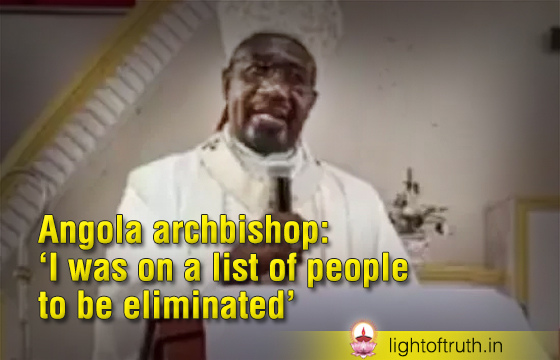
Angola archbishop: ‘I was on a list of people to be eliminated’
Archbishop José Manuel Imba-mba of the Archdiocese of Saurimo in Angola has revealed that he was once on a list of people targeted for assassination for defending truth and justice.In an interview with Radio Ecclesia on Jan. 7, the day he turned 60, Imbamba recalled the dangers he faced in 2003 following Angola’s post-election conflict.
“My priestly life has been full of misunder-standings. I was ordained during a time of intense war in Luena, and I faced many difficulties,” the archbishop recounted. “In 2003, during the post-electoral conflict, I was on a list of people to be eliminated,” he said.
Angola’s first elections in 1992 were marred by violence, leading to a civil conflict that ended in 2002. “I have been threatened face to face by people due to my for-thright discussions. These threats aim to intimidate and tarnish my image and that of the Church. However, I take full responsibility for everything I say. I am not anyone’s mouthpiece,” said Imbamba, who also serves as the president of the Bishops’ Conference of Angola and São Tomé and Príncipe. He emphasized his mission to advocate for the rights of the marginalized and uphold human dig-nity, saying: “For the poor, marginalized, and those deprived of their rights, I will continue to fight in the name of the Gospel, of which I am a servant.” Despite the sacrifices and challenges he faced in his 33 years of priesthood, Imbamba described the ministry as a “beautiful and rewarding vocation.”