
Pope Francis kicked off the first Saturday jubilee audience of 2025 by urging pilgrims to embrace hope as a divine strength that enables new beginnings, drawing inspiration from St. John the Baptist. Speaking to pilgrims gathered in the Vatican’s audience hall on Jan. 11, the pontiff emphasized that hope is not merely a character trait but rather a theological virtue that represents “strength to be asked for” from God. “Many of you are here in Rome as ‘pilgrims of hope,’” Pope Francis said. “Indeed, the jubilee is a new beginning, the possibility for everyone to start anew from God. With the jubilee we start a new life, a new phase.”
The pope highlighted how the Latin word “virtus” means strength, explaining that hope, therefore, comes as a gift from God rather than existing as a mere habit or personality characteristic. The Catholic Church teaches that hope is one of the three theological virtues – along with faith and charity – which God pours into the hearts of the faithful. Drawing connections to the feast of the Baptism of the Lord, Francis reflected on John the Baptist as a “great prophet of hope,” noting how people flocked to him “longing for a new beginning.”
“Just as we today pass through the Holy Door, so John proposed to cross the river Jordan, entering the Promised Land as Joshua had done the first time,” the pope said, connecting the biblical narrative to the current jubilee year.
The jubilee audience marked the beginning of regular Saturday gatherings that will welcome pilgrims from around the world throughout the 2025 Jubilee Year. The first major calendar event of the 2025 holy year is the Jubilee of the World of Communications, scheduled for Jan. 24–26. The Vatican expects thousands of journalists and media professionals from around the world to come to Rome for the occasion.
Category Archives: International
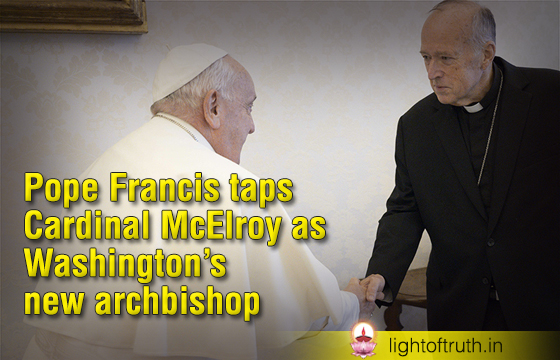
Pope Francis taps Cardinal McElroy as Washington’s new archbishop
Pope Francis has tapped Cardinal Robert McElroy as the new archbishop of Washington, D.C., appointing one of his top U.S. allies, one of the American church’s most forceful defenders of migrants and a sharp critic of Donald Trump’s first administration just days before Trump takes office a second time.
McElroy of San Diego will succeed retiring Cardinal Wilton Gregory, 77, who has led the Washington Archdiocese since 2019, where he became the city’s first African American archbishop. In 2020, Francis elevated him to the College of Cardinals, making him the first Black U.S. cardinal.
Over the last decade, McElroy has become one of the most vocal champions of Pope Francis’ pastoral agenda among the U.S. hierarchy. He has frequently echoed the pope’s prioritization of migrants and refugees, environmental concerns and a more welcoming approach to LGBTQ people.
The pope’s selection of a prelate who has not shied from implicit criticism of Trump comes just after Trump announced his selection of a sharp critic of Francis to be the U.S. ambassador to the Holy See – which also marks a contrast to the warm relations the pontiff has enjoyed with President Joe Biden.
McElroy, 70, was first made an auxiliary bishop of San Francisco in 2010 by Pope Benedict XVI and then named bishop of San Diego by Francis in 2015. In 2022, the pope made him a cardinal. He has a bachelor’s degree from Harvard University, and a master’s in U.S. history and a doctorate in political science from Stanford University, among other degrees.
In the U.S. church, McElroy has struck a contrast to many of the more traditionalist bishops in the U.S. and has become one of the leading proponents of Francis’ push for synodality, which focuses on greater lay involvement in the life of the church.
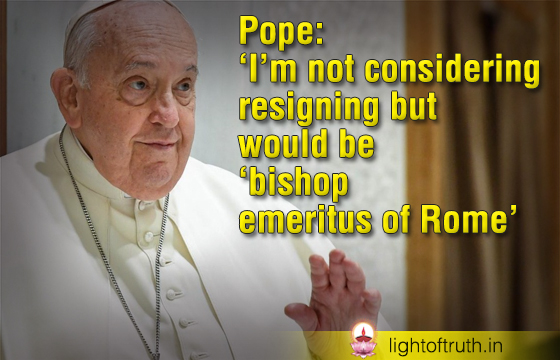
Pope: ‘I’m not considering resigning but would be ‘bishop emeritus of Rome’
The Italian newspaper “Corriere della Sera” releases several passages from Pope Francis’ autobiographical book entitled “Life. My Story in History,” written with Vatican journalist Fabio Marchese Ragona, set to be released on March 19 by HarperCollins.
In the passages released, the Pope clarified that were he to resign, he would not choose to be called “Pope Emeritus” but simply “Bishop Emeritus of Rome.” In that case, he would live in the Basilica of St. Mary Major “to return to being a confessor and bring communion to the sick.”
The Pope clarified this possible scenario in case of his resignation, which, however, he emphasized, “is a distant hypothesis” because there are no “so serious reasons” to consider this possibility, which he said he never considers, “despite moments of difficulty.” There are no “conditions for a resignation,” according to Pope Francis, unless “a serious physical impediment” arose, in which case a “letter of resignation” deposited in the Secretariat of State signed by Bergoglio at the beginning of his pontificate would apply. He added that the possibility remains remote, since the Pope “is in good health and, God willing, there are many projects still to be realized.”
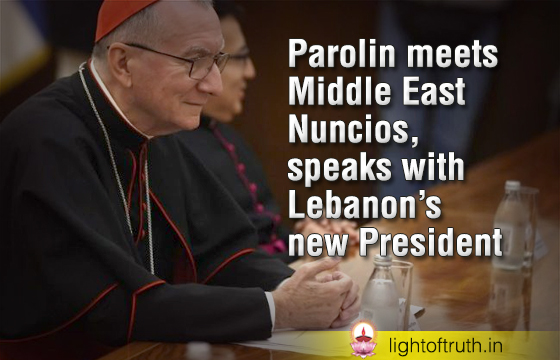
Parolin meets Middle East Nuncios, speaks with Lebanon’s new President
The Vatican Secretary of State, Cardinal Pietro Parolin, presided over a meeting on Jan-uary 13 with the Apostolic Nun-cios in the Middle Eastern region in Jordan’s capital of Amman, where he travelled for the conse-cration of the Church of the Baptism of Jesus along the banks of the Jordan River.
According to a statement issued by the Holy See Press Office, the meeting was attended by the papal representatives accredited to the Kingdom of Bahrain, the Arab Republic of Egypt, the United Arab Emirates, the Hashemite Kingdom of Jordan, the Islamic Republic of Iran, the Republic of Iraq, the State of Israel, the State of Kuwait, the Republic of Lebanon, the Sulta-nate of Oman, the State of Pale-stine, the State of Qatar, the Syrian Arab Republic, and the Republic of Yemen.
In an interview with Vatican News in Jordan following the Church’s consecration, the Vati-can Secretary of State expressed his hopes for positive develop-ments in Syria and with the ele-ction of the new president of Lebanon.
During the meeting, the statement explained, “the ongoing crises in the region, the political and ecclesial situation in each country, signs of hope in some areas, and the severe humani-tarian conditions affecting popu-lations most impacted by conflicts were discussed.”
The statement continued, “It is hoped that the ceasefire on every front will come soon and that the Middle East can become a land of peace, where Christians remain an essential component for fraternal coexistence among religions and for the progress of their respective countries.”
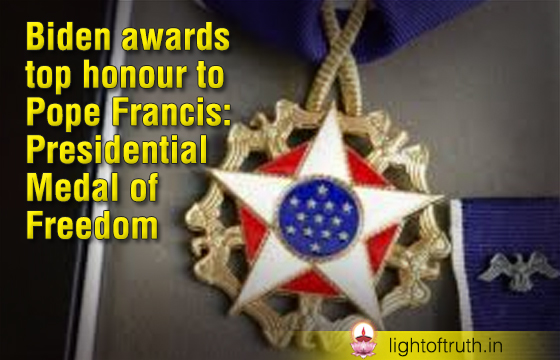
Biden awards top honour to Pope Francis: Presidential Medal of Freedom
In a historic announcement on January 11, President Joe Biden awarded Pope Francis the Presi-dential Medal of Freedom with Distinction, the highest civilian honour in the United States. This marks the first time President Biden has bestowed this exce-ptional level of recognition since taking office, emphasizing the profound impact of Pope Francis on global peace, humanitarian values, and the promotion of unity across cultures and religions. Biden telephoned the Pope on Saturday, January 11, and inform-ed him of this recognition.
The Presidential Medal of Freedom honours individuals who have made extraordinary contri-butions to society, whether throu-gh enhancing prosperity, safe-guarding security, or fostering world peace. The “with Distinct-ion” designation, an exceptionally rare honour, underscores the unparalleled influence of Pope Francis in addressing issues such as poverty, climate change, and the need for compassion in a divided world. President Biden praised the Pontiff’s relentless efforts to champion the dignity of all individuals, saying, His Holi-ness Pope Francis embodies the moral clarity and humility that inspire not only Catholics but people of all faiths around the world. He is a beacon of hope and a reminder of the transforma-tive power of love and service.”
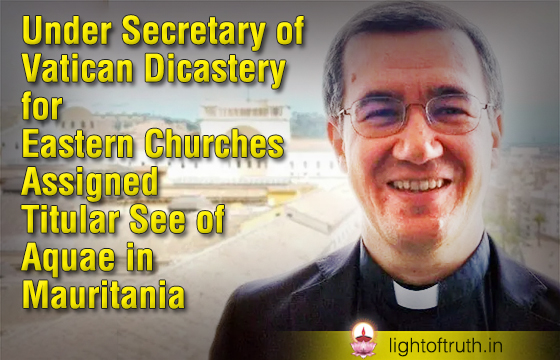
Under Secretary of Vatican Dicastery for Eastern Churches Assigned Titular See of Aquae in Mauritania
Pope Francis has assigned the Under Secretary of the Vatican Dicastery for Eastern Churches, Mons. Filippo Ciampanelli, the Titular See of Aquae in the Northwestern African nation of Mauritania. The assigning of Mons. Ciampanelli the Maurita-nian Titular See was published by the Holy See Press office on Sunday, January 12. Born in July 1978 in the Catholic Diocese of Novara in Italy, the Under Secretary of the Vatican Dicastery for Eastern Churches was ordained a Priest for the same Diocese in June 2003.
A participant in the Synod on Synodality, the multi-year XVI Ordinary General Assembly of the Synod of Bishops, which Pope Francis officially inaugurated in 2021 and later extended to 2024, Mons. Ciampanelli was a member of the Synod on Synodality Study Groups.
The Vatican official, who read Pope Francis’ spiritual reflection on “the passion for evangeli-zation,” when the Pontiff was having health complications in November 2023 has been assigned the Titular See that was esta-blished in 1933.
Titular Sees are Episcopal Sees that once existed but no longer function as such due to historical circumstances, such as Catholic and Christian population shifts or suppression.
The Catholic Culture, describes Titular Sees as “some two thousand ancient Catholic dioceses and archdioceses whose titles are now given to those bishops who do not occupy residential sees” including Auxiliary Bishops, Coadjutor Bishops, Vicars Apostolic, as well as “officials of the Roman Curia.”
Often located in Asia Minor, North Africa, the Balkans, and parts of Europe such as Greece, these territories became extinct “after the Moslems had destroyed the Church in these lands”, the Catholic Culture has explained.

Pope Francis’ 2024 travels: historic visits to Southeast Asia, Oceania, Belgium, and Corsica
Despite health challenges that led to a cancelled trip to Dubai for COP28, Pope Francis maintained an ambitious travel schedule in 2024 that saw him draw large crowds in Asia and make his first-ever visit to Corsica as well as visiting Belgium and Luxembourg. The now-88-year-old pontiff’s longest apostolic journey was the 12-day tour of Southeast Asia and Oceania in Sept., where thousands of faithful attended papal events.
In Indonesia, Francis visited the grounds of Jakarta’s Istiqlal Mosque, where he joined Muslim leaders in discussing global challenges and signed a joint declaration condemning religious-based violence. “The path of inter-faith collaboration is essential to addressing global crises,” Francis told his audience. About 100,000 faithful later attended an outdoor Mass where the pope emphasized Catholic engagement in pluralistic societies.
In Papua New Guinea, Francis focused on Indigenous communities while blessing a new hospital for underserved populations. The pope’s message of hope reached its numerical peak in Timor-Leste, where an estimated 750,000 people – nearly two-thirds of the nation’s population – gathered for Mass in Dili.
September also brought some controversy during the pope’s visit to Belgium, where Prime Minister Alexander De Croo strongly criticized he pontiff’s comments on abortion.
During his in-flight press conference, the pope had called abortion “homicide” and referred to doctors who perform the procedure as “contract killers,” prompting De Croo to call such remarks “absolutely unacceptable.”
The dispute distracted from the actual focus of the Belgium visit: the 600th-anniversary celebrations of the Catholic universities of Leuven and Louvain-la-Neuve. Earlier in Luxembourg, Francis had challenged Catholics to evangelize an increasingly secular Europe, noting that “having wealth includes responsibility.” The papal travel year concluded on a historic note Dec. 15 in Corsica, where Francis became the first pope to visit the French Mediterra-nean island. His participation in a diocesan conference examining popular piety empha-sized the continued importance of local devotions in maintaining Catholic identity.
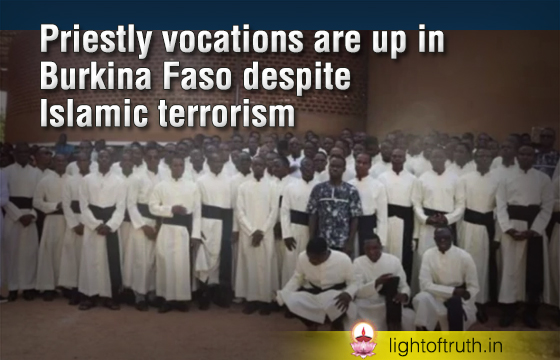
Priestly vocations are up in Burkina Faso despite Islamic terrorism
Despite constant terrorist attacks suffered by Catholics in Burkina Faso from Islamic fundamentalists, vocations to the priesthood have increased in recent years, especially in dioceses located in “danger zones.” Nearly 40% of seminarians come from these localities, which are the most affected by terrorism and violence.
According to the pontifical foundation Aid to the Church in Need (ACN), just at Sts. Peter and Paul Seminary alone, the number of candidates for the priesthood rose from 254 in the 2019-2020 academic year to 281 in 2024-2025. Terrorist violence began to wreak havoc in the African country in 2019. Father Guy Moukassa Sanon, the seminary rector, explained that during the holidays not all students can return home. Doing so would mean “mortal danger,” so they are taken in by diocesan centres, by host families, or are simply invited by their classmates to spend the holidays in safer areas.
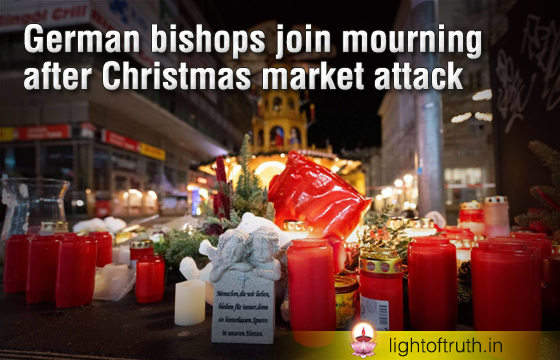
German bishops join mourning after Christmas market attack
The president of the German Bishops’ Conference and the Bishop of Magdeburg expressed their shock and offered prayers after a car attack at a Christmas market in eastern Germany on Friday, December 20 left five people dead and more than 200 injured.
Bishop Georg Bätzing of Limburg, the conference presi-dent, said the “attack in Magde-burg leaves us speechless. The horror, grief, and sympathy are felt today by many people through-out Germany and worldwide.”
He continued: “Our thoughts and prayers are in Magdeburg during these hours. As churches, we mourn with the relatives of the victims of this terrible attack and pray for the injured and the deceased, as well as for their relatives who now fear for their loved ones.”
Bishop Gerhard Feige of Magdeburg issued a statement immediately after the attack on Friday evening. “I think of those affected, their relatives, and the emergency services and include them in my prayers,” he said. “Especially in these days and before a feast where the message of God’s love, human dignity, and the longing for a healed world particularly move us, such an act is all the more frightening and abysmal.” Feige also said the attack presented “a challenge for our society to counter any extremism even more decisively and to work even more for peaceful coexistence.”
German Chancellor Olaf Scholz and Interior Minister Nancy Faeser visited the city earlier in the day to meet local officials and pay their respects at the site of the attack.
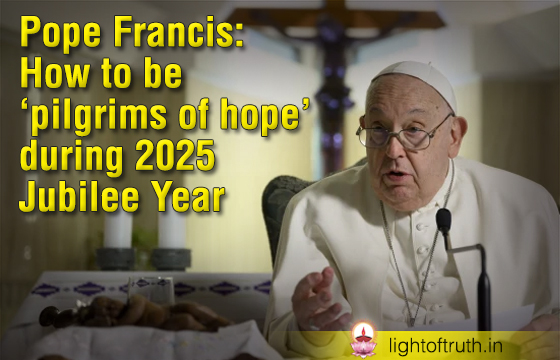
Pope Francis: How to be ‘pilgrims of hope’ during 2025 Jubilee Year
Pope Francis called on Ca-tholics to become “pilgrims of hope” in a BBC podcast on 27 December, emphasizing that “hope and kindness touch the very heart of the Gospel.”
Speaking just days after the opening of the 2025 Jubilee Year, the pope emphasized that “kindness is not a diplomatic strategy” nor “a set of rules to ensure social harmony or to obtain other advantages” but rather “a form of love that opens hearts to acceptance and helps us all to become more humble.”
“Wars, social injustices, and the many forms of violence we are exposed to every day should not dishearten us nor draw us toward skepticism and discouragement,” the Holy Father said in the audio message published Dec. 27.
The pope referenced G.K. Chesterton, noting that the British writer “was also held in high esteem by the Argen-tine poet Jorge Luis Borges.” Francis highlighted Chester-ton’s autobiographical invi-tation to “take the elements of life with gratitude and not for granted.”
Speaking about the recently begun jubilee year, Francis concluded with “a wish for hope, which is a theological virtue, together with faith and charity,” praying that “the new year bring us peace, fellow-ship, and gratitude.”