
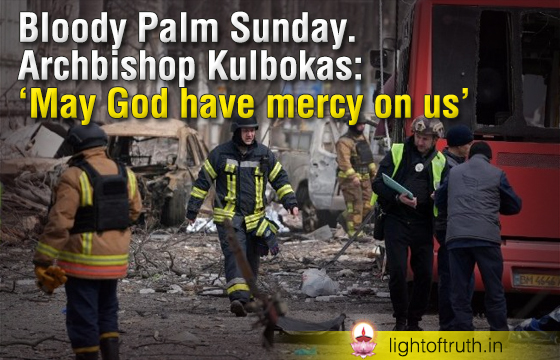
Palm Sunday, 13 April, marked yet another horrific chapter in the ongoing war in Ukraine. On what should have been a sacred and peaceful day of worship, tragedy struck the city of Sumy in northeastern Ukraine, turning Palm Sunday into a day of mourning and devastation. Just 50 kilometres from the Russian border, Sumy became the site of a deadly missile strike, as two Russian ballistic missiles landed in the city centre around 10 a.m., right as the faithful were making their way to church. The attack reportedly killed at least 34 people, including children, and injured over 100. The victims, many of whom were preparing to celebrate the beginning of Holy Week, instead found themselves caught in a carnage.
In a brief statement to Vatican News, the Apostolic Nuncio to Ukraine, Archbishop Visvaldas Kulbokas, conveyed a sense of helplessness in the face of such senseless violence. ”There’s nothing left but to turn to the Lord to defend us, because it seems that no other force is capable of protecting peace and life,” he said. The Vatican Nuncio noted that in this moment of shared Christian observance–this year, Easter, according to both main calendars Gregorian and Julian falls on the same date,–the attack becomes even more symbolic, cutting into the heart of a nation already under siege.
Category Archives: International
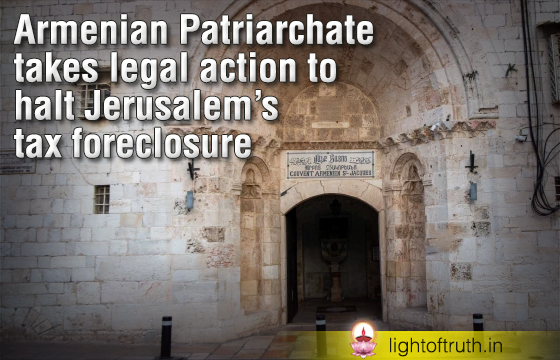
Armenian Patriarchate takes legal action to halt Jerusalem’s tax foreclosure
Tensions have continued to escalate between the Armenian Patriarchate of Jerusalem and the Jerusalem municipality with the latest skirmish over a demand for significant property tax payments called the “Arnona tax” – a levy imposed on property owners in the municipality.
The dispute began two years ago and reignited in February, when a hearing session was scheduled before a district court about an alleged debt of 21 millions shekels (about $5.7 million) and with the threat of foreclosure on patriarchate properties.
CNA spoke with Bishop Koryoun Baghdasaryan, the director of the real estate department of the Armenian Patriarchate who, since Jan. 11, 2023, has been in charge of all the real estate properties in the Holy Land – Israel, the Palestinian Authority, and Jordan. “We received tax bills 12 days after I was appointed, in January 2023, together with the noti-fication that the execution bureau was instructed to be-gin foreclosure proceedings due to the alleged Arnona de-bt,” Baghdasaryan explained.
The Patriarchs and Heads of the Churches in Jerusalem have issued a statement expressing “great concern” over the incident and voicing their solidarity with the Armenian Patriarchate. “This reckless move,” they wrote, “jeopardizes the Orthodox Armenian Patriarchate and sets a perilous precedent that could imperil Christian institutions throughout the Holy Land.” Thanks to public pressure as well as adverse weather forecasts, the hearing was once again postponed until further notice. “At the moment, the situation is on hold,” Baghdasaryan explained, but the situation remains tense, since “it could rise again at any time.”
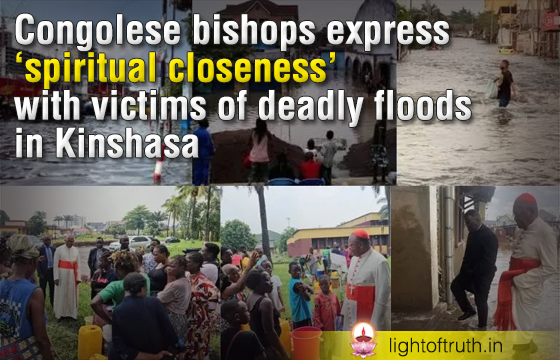
Congolese bishops express ‘spiritual closeness’ with victims of deadly floods in Kinshasa
Catholic bishops in the Democratic Republic of Congo (DRC) have expressed their “spiritual closeness and solidarity” with victims of the recent floods and landslides that struck the capital city of Kinshasa and surrounding areas, leaving scores dead and causing widespread destruction. At least 33 people were reported dead and thousands displaced following the April 5-6 flooding that cut access to over half of the capital. The floods reportedly occurred when the N’Djili River, which runs through the city of an estimated popu-lation of 17.8 million, burst its banks and submerged major roads.
In a statement shared with ACI Africa, CNA’s news partner in Africa, on April 9, members of the National Episcopal Confe-rence of Congo (CENCO) con-veyed their compassion and assured their prayers for those affected by the devastating natural disaster, which followed torrential rains during the night of April 4-5. “We are deeply saddened by the tragic events caused by the torrential rains … resulting in the loss of human lives and significant material damage,” CENCO members said in their statement.
They expressed their “spi-ritual closeness and solidarity” with Cardinal Fridolin Ambongo, archbishop of Kinshasa, and Bishop Jean-Crispin Kimbeni of Kisantu. “With them, we share in the suffering of all those in the heavily affected areas,” they said. “As shepherds of the people, we welcome the measures taken by the Congolese government and the arrangements put in place to assist and shelter those living in the flooded zones,” the statement said. They also appealed to “humanitarian organizations and to the solidarity of all people of goodwill to support the victims of these disasters.”
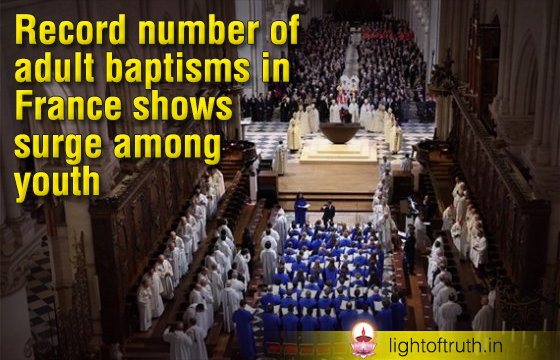
Record number of adult baptisms in France shows surge among youth
France’s Catholic Church will welcome more than 10,384 adult catechumens at Easter this year, marking a 45% increase from 2024 figures, according to data released by the French Bishops’ Conference. The French report reveals the highest numbers ever recorded since the survey began over twenty years ago. Even more striking is the demographic shift – young adults now constitute the largest segment of converts. “The great challenge that presents itself to us now is to make disciples,” wrote Archbishop Olivier de Germay of Lyon in his assessment of the findings. ”We must not simply imagine some procedures for ‘after’ baptism, but our entire parish communities must become aware of their collective mission.”
The 18-25 age group, composed of students and young professionals, now represents 42% of adult catechumens, surpassing the 26-40 demographic that had historically dominated conversion statistics. This youth-driven spiritual awakening represents a significant shift in the Church’s evangelization landscape. Addi-tionally, adolescent baptisms have surged, with more than 7,400 teenagers between 11 and 17 years old preparing to receive the sa-crament. Dioceses across France report a 33% increase in adole-scent catechumens compared to last year. The French Bishops’ Conference intentionally conne-cted this year’s data to the Jubilee of Young People in Rome, des-cribing the event as “a meeting place for young catechumens from around the world.”

New Decree clarifies discipline on Mass Intentions and collective offerings
In a Decree approved by Pope Francis on Palm Sunday, April 13, 2025, the Dicastery for the Clergy has promulgated revised norms governing the discipline of Mass intentions. The updated legislation, which enters into effect on Easter Sunday, April 20, seeks to safeguard both the spi-ritual integrity of the Eucharistic sacrifice and the faithful’s trust in the Church’s handling of their offerings.
Building upon the existing canon law and the 1991 de-cree Mos iugiter, the new norms emphasize that while the faithful may continue to offer stipends for Masses to be celebrated according to specific intentions, this sacred tradition must remain free of any semblance of commercial exchange. The decree reaffirms the value of such offerings as a form of spiritual participation and support for the Church’s mission.
The decree permits “colle-ctive intentions”–a practice where multiple offerings are united in a single Mass–only under strict conditions: the donors must be explicitly informed and must freely consent. The decree further restricts the frequency of such collective celebrations, aiming to preserve the normative link between each offering and a distinct Eucharistic celebration.
The norms also prohibit any substitution of promised Masses with simple mentions during liturgies, categorizing such pra-ctices as gravely illicit. Empha-sizing justice to the faithful and the avoidance of simony, the Dicastery calls for vigilance from bishops, who are instructed to catechize the faithful, monitor implementation, and ensure accurate record-keeping of int-entions and offerings.
Pastoral concern remains central to the decree. Priests are encouraged to celebrate Masses for the poor, even without offer-ings, and diocesan bishops may redirect surplus intentions to mission territories or parishes in need. The Holy See’s action seeks to renew fidelity to the Church’s long-standing tradition, protect the dignity of the Eucharist, and promote greater transparency and trust within the People of God.
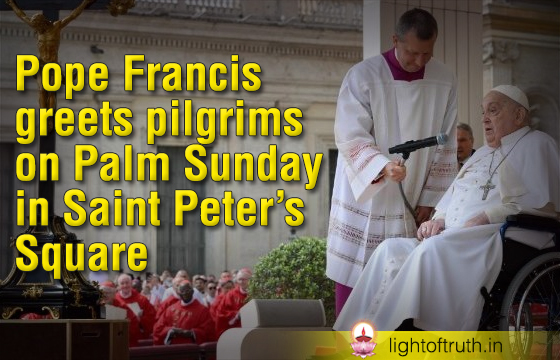
Pope Francis greets pilgrims on Palm Sunday in Saint Peter’s Square
Pope Francis wished a “Happy Palm Sunday and Happy Holy Week” to all those gathered for the Palm Sunday of the Lord’s Passion celebration in Saint Peter’s Square. The Pope came out into the Square from the Basilica for around ten minutes, immediately following the final blessing of the Mass where he offered his good wishes and then visited in his wheelchair among the faithful. Pope Francis’ latest visit marked another public occasion among the people, following his presence last Sunday April 06 at the Jubilee of the Sick and the World of Healthcare and his visits to Saint Peter’s Basilica last week and visit to the Basilica of Saint Mary Major on April 12 to pray before the Marian icon of the Salus Populi Romani.
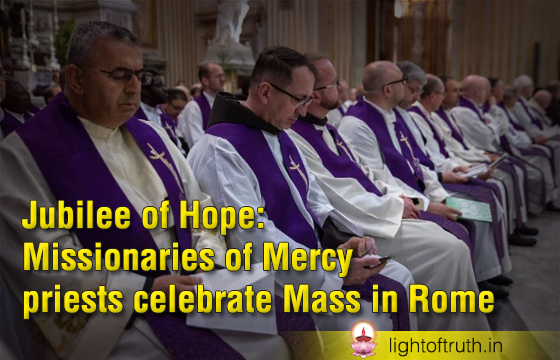
Jubilee of Hope: Missionaries of Mercy priests celebrate Mass in Rome
The Holy Mass for the Jubilee of Priests instituted as Missionaries of Mercy was celebrated on March 30 at the Basilica of Sant’Andrea della Valle in Rome. Hundreds of “Missionaries of Mercy” – priests with the authority to “pardon sins reserved to the Holy See” (Misericordiae Vultus, 18) – gathered in Rome’s basilica dedicated to St. Andrew the Apostle to concelebrate Mass with Archbishop Rino Fisichella, pro-prefect of the Vatican’s Dicastery for Evangelization.
In his homily, Fisichella reminded missionaries of mercy priests that they are “special instruments of reconciliation” who offer God’s great love to those who come to the sacrament of confession in search of forgiveness for their sins. Fisichella encouraged the priests to be confessors who open their hearts and minds to “welcome those who approach us” but to also go out in search of those who are still far from the Church.
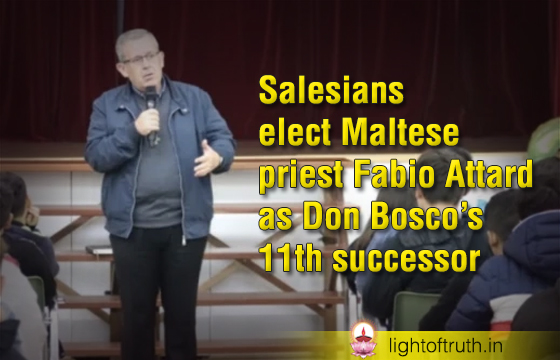
Salesians elect Maltese priest Fabio Attard as Don Bosco’s 11th successor
Maltese priest Fabio Attard was elected as the new rector major of the Salesian congregation during its general chapter in Turin, Italy, becoming the 11th successor of St. John Bosco. The new superior general of the order founded in 1859 succeeds Spanish Cardinal Ángel Fernández Artime, who became prefect of the Dicastery for Institutes of Consecrated Life and Societies of Apostolic Life in January.
According to the Salesians, the new rector major did not participate in the Salesian chapter meeting, so he was informed of his election by telephone, at which point he was asked for his required acceptance. “His words were heard in the hall and, moved to tears, he thanked the brothers for their trust and especially for their trust in God in taking on this new task,” the Salesians said in a statement.
This is the first time that the new rector major is not among the members of the general chapter, “so the profession of faith upon accepting the office and the greeting from the chapter members and the mother general of the Salesians Daughters of Mary Help of Christians will take place throughout the day, when the new rector major can make it to Turin.” Attard will now have six years to lead the Salesian family, which will begin with the work remaining at the general chapter, which will last until April 12.
The priest’s election came two days after his 66th birthday. Born in Gozo, Malta, he made his profession as a Salesian in September 1980 in Dublin, Ireland, where he completed his novitiate.
Both his diaconal and priestly ordinations took place in Rome in 1986 and 1987, respectively.
After leading several Salesian apostolates in Malta, he founded the Institute for Pastoral Formation of the Archdiocese of Malta in 2005.
With a licentiate in moral theology from the Alphonsianum in Rome, Attard participated in the general chapter held in 2008 as delegate for the Irish province and was entrusted with youth ministry until April 2020, when Artime asked him to create a continuing formation project for Salesians in Europe.
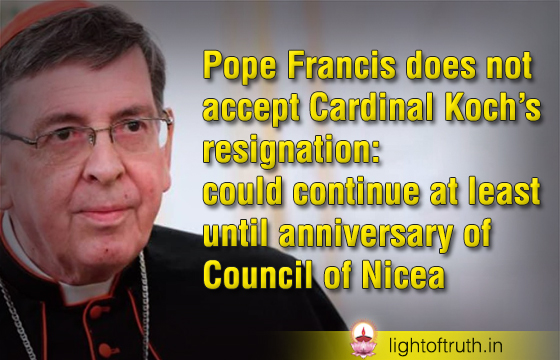
Pope Francis does not accept Cardinal Koch’s resignation: could continue at least until anniversary of Council of Nicea
At 75, the customary age for resignation under canon law, Swiss Cardinal Kurt Koch offered his resignation to Pope Francis. The Pope, however, declined the request–at least for now. In a recent interview with Vatican News, Koch revealed that Francis had responded with a standard phrase meaning that he would remain in office until further notice. “The Holy Father will decide in due time,” Koch said. Koch has served as the head of the Dicastery for the Promotion of Christian Unity since 2010, overseeing the Vatican’s efforts to foster dialogue and collaboration among Christian denominations. His extended tenure suggests that Francis values continuity in the Church’s ecumenical work at a time when unity is both a theological and practical challenge. Koch’s office engages with diverse Christian communities, navi-gating theological and cultural differences that shape ecumenical dialogue. As he explains, discussions vary greatly depending on the group involved. “We share a deep theological heritage with the Eastern Churches but are shaped by different cultural traditions,” Koch observed.
“With Protestant communities, we have more cultural similarities but fewer theological commonalities.”
This contrast highlights the complex nature of Christian unity—sometimes bound by shared beliefs, sometimes by shared history, but often hindered by both. Despite these challenges, Koch remains hopeful that more believers will recognize the importance of unity, citing Jesus’ own prayer for his followers to be one.
Observers speculate that Koch will continue in his role at least through May 2025, when Christian leaders will mark the anniversary of the First Council of Nicea in Iznik, Turkey. The historic council, convened in 325 AD, produced the Nicene Creed—a foundational statement of Christian belief still used by many denominations today. Koch sees the event as an opportunity for churches to commemorate their shared history. “It is a wonderful occasion for all Christian communities to reflect together on this ancient confession of faith,” he said. The symbolic significance of gathering in Nicea is undeniable, even if little remains of the original council site. Pope Francis has expressed interest in attending the event, but his participation remains uncertain due to health concerns. The Vatican has not confirmed any travel plans, and at a recent press conference, medical officials offered a cautious response: “The trip is not confirmed.” Koch, however, remains optimistic. “I hope it will be possible,” he said. “It would be a powerful gesture to celebrate together in Nicea.”
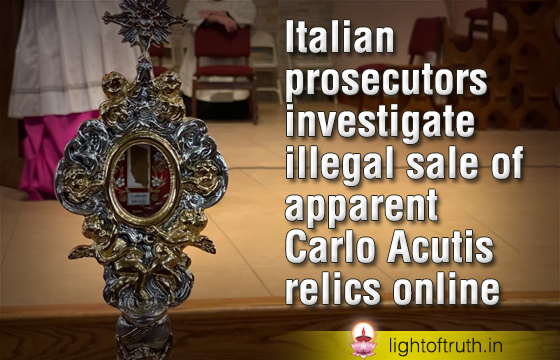
Italian prosecutors investigate illegal sale of apparent Carlo Acutis relics online
Italian prosecutors are in-vestigating the illegal online sale of alleged relics of Blessed Carlo Acutis, who will be declared the first millennial saint next month. The investigation by the Perugia Public Prosecutor’s Office was prompted by a complaint by the bishop of Assisi, the city where Acutis’ tomb is located for public veneration.
“On the internet, there is a marketplace for relics concerning various saints, such as our St. Francis, complete with a price list. Something impossible to accept,” Bishop Domenico Sorrentino of Assisi-Nocera Umbra-Gualdo Tadino said in a statement on March 26. Sorrentino filed a formal complaint with Italian authorities after learning of an internet auction of an alleged first-class relic of Acutis’ hair, which sold online for 2,000 euros by an anonymous user.
“We do not know whether the relics are real or fake,” the bishop said. “But if it were also all fabricated, if there was deception, we would be not only in the midst of a fraud but also of an insult to religious belief.” According to canon law of the Catholic Church, the sale of first- and second-class relics is strictly forbidden. Relics can only be given away by their owners, and some very significant relics, such as a heart, arm, etc., cannot be given away without the permission of the Vatican. Acutis’ canonization Mass is scheduled to take place in St. Peter’s Square on April 27 during the Church’s Jubilee of Teenagers.