
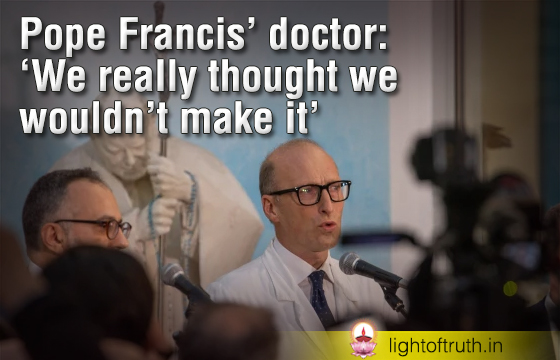
The head of the medical team that treated Pope Francis during the 38 days he spent at Rome’s Gemelli Polyclinic Hospital, Dr. Sergio Alfieri, revealed that one of the most critical moments of his hospitalization was when they had to choose between continuing the therapy or letting the pope die. “We had to choose whether to stop and let him go, or push it and try every drug and therapy possible, running the extremely high risk of damaging other organs,” he said in an interview with the Italian newspaper Il Corriere della Sera.
In the interview, Alfieri described in detail the doctors’ response to the respiratory crisis suffered by the pope on Feb. 28. According to the medical report published that day, Pope Francis suffered an isolated attack of bron-chospasm, a severe coughing fit that suddenly worsened his clinical condition, after days of moderate optimism at the Vatican.
Although the pope never lost consciousness and cooperated with the specialists’ therapeutic manoeuvres, the alarms went off, and doctors opted to place him on a non-invasive mechanical ventilation mask to help him breathe. “For the first time, I saw tears in the eyes of some people who were close to him. People who, I’ve come to understand during this period of hospitalization, truly love him, like a father.
We were all aware that the situation had worsened further and there was a risk that he might not make it,” Alfieri explained.
However, despite the risk of causing irreversible kidney and bone marrow damage due to the medical treatment he underwent, they decided to act. “We really thought we wouldn’t make it,” he said. It was a difficult decision, as Alfieri recounted, ultimately supported by the decision of the pope himself, who, through his personal health assistant, Massimiliano Strappetti, his personal nurse at the Vatican, gave a clear order: “‘Try everything, let’s not give up.’ And no one gave up.” In the end, Pope Francis responded to the treatment. However, after his recovery, there was another moment of intense concern.
While eating, the pope suffered an episode of vomiting, and the gastric juices ended up entering his lungs. “We were just coming out of the toughest period, and while eating, Pope Francis vomited and inhaled it. That was the second truly critical moment because, in these cases, if you don’t act quickly, there’s a risk of sudden death, in addition to complications in the lungs, which were already the most compromised organs,” Alfieri related.
The doctor explained that, despite the seriousness of the situation, Pope Francis was always fully aware, “even when his condition worsened.” “He was aware, like us, that he might not survive the night,” the doctor stated.
He added: “We saw the man who was suffering. However, from the first day he asked us to tell him the truth and wanted us to tell the truth about his condition.” In this regard, the director of the medical-surgical department at Gemelli Polyclinic Hospital expressed the desire for transparency that prompted the Vatican to report on Pope Francis’ health. “We communicated the medical information to the secretaries, and they added other information that the pope later approved. Nothing has ever been modified or omitted,” he noted.
In the interview, Alfieri also highlighted the pope’s incredible strength, both physical and mental: “In the past, when we spoke, I would ask him how he managed to keep up this pace, and he always replied, ‘I have a method and rules.’ Beyond a very strong heart, he has incredible resources.” In addition to the pope’s stamina, the Gemelli medical coordinator added that the prayers offered by faithful around the world in recent days also contributed to his recovery. “There is a scientific publication that says prayer strengthens the sick. In this case, the whole world began to pray. I can say that twice the situation was lost, and then it happened like a miracle. Of course, he was a very cooperative patient. He underwent all the therapies without ever complaining,” he stated.
Category Archives: International
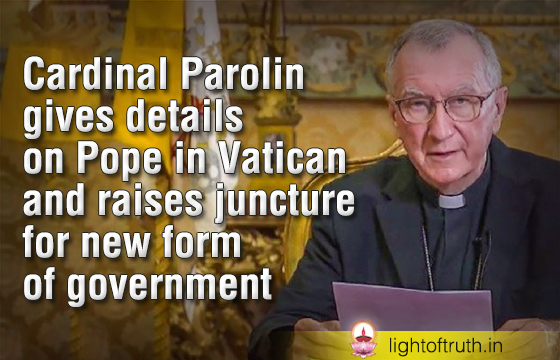
Cardinal Parolin gives details on Pope in Vatican and raises juncture for new form of government
As Holy Week approaches, the Vatican remains uncertain about Pope Francis’ ability to preside over key liturgical events, given his ongoing recovery from a serious respiratory infection. Vatican Secretary of State Cardinal Pietro Parolin acknowledged that the pontiff might not be able to govern the Church as he once did, suggesting that alternative ways to fulfill his role will need to be considered. Speaking on March 27 at an event in Sacrofano, near Rome, Parolin shared that he continuously receives messages from people praying for the pope’s full recovery. “Perhaps he won’t be able to work as before, and in that case, we must find different ways for him to continue leading the Church,” he said.
Since his release from the hospital on March 23, Pope Francis has remained secluded in the Vatican, avoiding public engagements. “He is resting, he is not seeing anyone, and as far as I know, he has no scheduled audiences,” Parolin confirmed. The emphasis, he stressed, is on allowing the pope the necessary time to heal. “The only solution is to remain calm and refrain from any public activity for now.” Despite the pope’s health concerns, the Vatican has yet to clarify how the Holy Week liturgies will be conducted. The official schedule has been published, but no presiding clergy have been named, leaving open the possibility that Francis may not participate in person. Vatican insiders suggest that a contingency plan is being developed, possibly involving multiple cardinals leading different ceremonies in his place. Parolin acknowledged the uncertainty, stating, “We will see whether the pope can preside over the celebrations or if he will delegate certain cardinals to act on his behalf.”
Given medical recommendations for at least two months of convalescence, a more extended period of reduced activity for the pontiff seems likely. At 88, Pope Francis has faced increasing health struggles in recent years, including surgeries and hospitalizations. His latest bout with bilateral pneumonia has raised questions about his long-term ability to maintain the demanding responsibilities of the papacy. While he has dismissed past speculation about resignation, the evolving situation may require adjustments in how he exercises his leadership.

Jesuits extend reparations offer to victims of alleged Rupnik abuse
The Society of Jesus is offering reparations to about 20 women who say they were sexually, psychologically, and spiritually abused by the disgraced ex-Jesuit artist Father Marko Rupnik. Rupnik is accused of having committed serious sexual, psychological, and spiritual abuse of dozens of religious sisters under his spiritual care over decades. His case is currently under investigation by the Vatican.
Father Johan Versuchen, Rupnik’s former superior and current general counsellor and delegate for the Interprovincial Houses and Works of the Society of Jesus in Rome, said he sent a letter to the women who have come forward with accusations against Rupnik, offering an open invitation to reparations, according to The Associated Press.
While the letters were not made public out of respect to the alleged victims, some excerpts were shared by Laura Sgrò, a lawyer for the alleged victims, Religion News Service reported. In the letters, Versuchen reportedly lamented that Rupnik had not publicly taken responsibility for his actions nor repented. He told The Associated Press that in the letters he invited alleged victims to share what they needed and how the order can meet that need.
Versuchen also reportedly offered to start a “process of healing” and shared that the Jesuit order is “uneasy” with the situation and aware that “the various kinds of violence suffered at the time are compounded by the pain caused by the lack of listening and justice for many years.” Sgrò thanked the Jesuits for the gesture of reparation and called on the Vatican in the statement to follow “the example of the Society of Jesus and bring Marko Rupnik to trial as soon as possible, restoring dignity to the victims.” ”There really can be no more delay now; justice just has to be done,” she said.
In Sgrò’s statement, the alleged victims thanked Versuchen for “acknowledging the mistakes made thus far” and having “finally welcomed and embraced the victims of Marko Rupnik, offering them the support that had been lacking until now.”
The Jesuits want to protect the privacy of the alleged victims and do not plan to share future information on dialogue with them, Versuchen told RNS. ”Any eventual journey toward reparation will depend entirely on the person who was invited,” Versuchen told RNS. “We wrote the letter because we, too, need reparation and healing,” he continued. “We have a lot to learn from them, and to do better in the future, to avoid any type of abuse in the company of Jesus.”
Diocese promotes day of ‘unplugging’ from screens, devices for Lent
The Diocese of Arlington, Virginia, is promoting a ”Dio-cesan Day of Unplugging” – intentionally eliminating screen time or time spent consuming digital media – on March 28 as a Lenten fasting discipline to encourage Catholics to spend more time with God as opposed to spending time on their smart devices. Noting that fasting is a “practice of self-discipline with a penitential focus,” the diocese, which is led by Bishop Michael Burbidge, called “unplugging” from the addicting influence of the internet, phones, and social media a “worthwhile and challenging type of fasting.”
Citing studies suggesting most people spend more than two hours a day on social media, the diocese said such statistics beg the questions: Are we spending more time with our devices than with God? And are we investing more time on social media than on nurturing in-person relationships within our communities? “When we fast from food or luxuries, we create space for God. Our fast reminds us of our need for God and brings us back into relationship with him.
Fasting also invites us to renew our relationships with one another in our communities,” the diocesan announcement says.
As suggestions for alternative activities to engage in rather than screen time on March 28, the diocese suggested numerous prayerful activities including attending daily Mass; making a Holy Hour or even a holy “five minutes”; praying a rosary or Divine Mercy chaplet for a loved one or the souls in purgatory; reading Scripture, the catechism, or a classic spiritual book; walking in nature; journaling; or attending the Stations of the Cross.
Works of charity would also be a good idea, the announcement says, suggesting Catholics take advantage of volunteer opportunities at their parish or local Catholic Charities, spend fellowship time with their community, or offer to grocery shop for an ill, elderly, or pregnant neighbour.
The Catholic day of “unplugging” was inspired by the Global Day of Unplugging promoted March 7–8 by the nonprofit Unplug Collective. Pope Francis is promoting screen time fasts this year as part of the ongoing Jubilee Year of Hope. As part of the special year, by the pope’s decree, Catholics worldwide can obtain an indulgence through various acts of penance. Francis’ decree specifically mentions as an option for obtaining a plenary indulgence “abstaining for at least one day a week from ‘futile distractions,’ such as social media or television.”

Cardinal Parolin urges EU bishops to foster peace, dialogue, unity
Addressing the Plenary Assembly of the Commission of the Bishops’ Conferences of the European Union (COMECE), Cardinal Pietro Parolin, Vatican Secretary of State, reaffirmed the Holy See’s commitment to fostering diplomacy as a means of conflict resolution.
Speaking to the delegates gathered from 26 – 28 March in Nemi, a town in the Alban Hills outside Rome, the Cardinal also urged political leaders to “set aside divisions and ideological barriers” in favour of genuine dialogue. He underscored that Europe, rooted in a deep Christian tradition, has a particular responsibility to be a beacon of peace and solidarity in an increasingly fragmented world.
Cardinal Parolin highlighted the multiple crises affecting the continent, from geopolitical tensions to economic instability and migration challenges. He warned against the temptation to retreat into nationalistic or isolationist policies, stressing that “the European project must continue to be one of integration, not division; of bridges, not walls.” Quoting Pope Francis, he reminded those present that “war is always a defeat for humanity” and called upon European leaders to intensify diplomatic efforts to end conflicts, particularly in Ukraine and the Middle East. “Dialogue remains the only viable path,” he said, insisting that the Church’s role is to promote reconciliation and understanding in the face of hostilities.
The Secretary of State dedicated much attention to the importance of solidarity in addressing social and economic inequalities, and said that the Church must continue advocating for policies that place the dignity of the human person at the centre of economic and social systems. “The European Union was built on the principles of solidarity, respect for human dignity, and justice. These values must not be abandoned in times of difficulty but rather strengthened,” he stated. He also called for greater attention to the needs of migrants and refugees, urging policymakers to adopt humane and fair immigration policies.
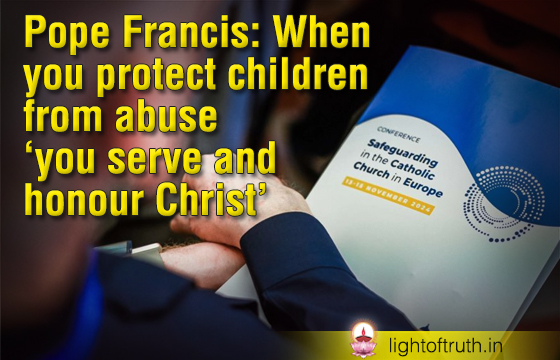
Pope Francis: When you protect children from abuse ‘you serve and honour Christ’
In a written message on March 25 to the Vatican’s commission for the protection of minors from sexual abuse, Pope Francis urged the group to continue to “keep watch while the world sleeps,” and to care for victims and survivors by listening “with the ear of the heart” to their experiences. “Abuse prevention,” he said, “is not a blanket to be spread over emergencies but one of the foundations on which to build communities faithful to the Gospel.”
Pope Francis’ message was sent to participants in the March 24–28 plenary assembly of the Pontifical Commission for the Protection of Minors (PCPM), which he established in 2014. With the reform of the Roman Curia in 2022, the commission — whose mission is to help local Churches around the world to safeguard minors and vulnerable adults from sexual abuse — became part of the Dicastery for the Doctrine of the Faith.
The PCPM released its first annual report on Church policies and procedures for safeguarding in 2024. During its 10 years of work, the pontifical commission has “enabled a safety network to grow within the Church,” the pope said. He also encouraged the group to “keep going!” “Continue to be sentinels that keep watch while the world sleeps. May the Holy Spirit, teacher of living memory, preserve us from the temptation to file away grief instead of healing it,” he said.
Relating the PCPM’s service to “oxygen” for the local Churches and religious communities, Francis asked the group to increase its joint work with the departments of the Roman Curia and to build alliances with civil authorities, experts, and associations outside of the Catholic Church.
He also requested that they “offer hospitality and care for the wounds of the soul to victims and survivors, in the style of the good Samaritan. To listen with the ear of the heart, so that every testimony finds not registers to be compiled but the depths of mercy from which to be reborn.”
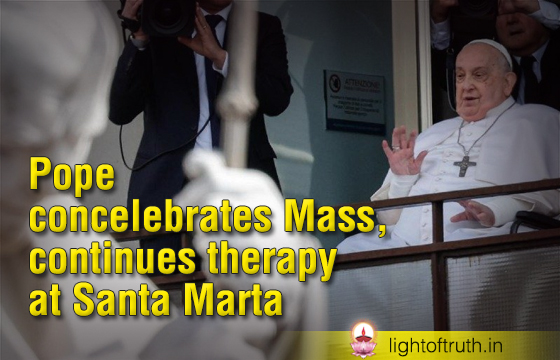
Pope concelebrates Mass, continues therapy at Santa Marta
Pope Francis’ convalescence continues at his residence of Casa Santa Marta with his continued treatment, mobility and respiratory-related physiotherapy, especially for voice recovery, personal prayer, and concelebrating Mass in the residence’s chapel.
These were among the updates the Holy See Press Office provided to accredited journalists regarding the Pope’s health after he was discharged on Sunday, 23 March, following 38 days of hospitalization in Rome’s Gemelli Hospital due to bilateral pneumonia.
After greeting 3,000 people from a balcony at the hospital and briefly stopping at Rome’s Marian Basilica of Santa Maria Maggiore, Pope Francis returned to his Vatican resi-dence, Casa Santa Marta, where he began his period of recovery and rest.
The Pope’s period of convalescence and rest at his residence should be about “two months,” maintained Doctor Sergio Alfieri, the doctor overseeing the Pope’s hospitaliza-tion at Gemelli, and Dr. Luigi Carbone, his personal physician, at Saturday evening’s press conference at Gemelli Hospital.
“The Pope,” the Holy See Press Office noted on March 25, “is following the convalescence plan as described by the doctors on Saturday.” At the time, Doctors Alfieri and Carbone stated that the Holy Father must continue pharmacological treatment “for a long time, administered orally,” while undergoing full-time mobility and respiratory-related physiotherapy, continuing as he had done daily at the Gemelli.
The physicians also advised him to avoid meetings, whether individual or group, and to receive 24-hour medical assistance to provide for his needs, including oxygen therapy, and to address any possible emergencies. This care is being provided by the Directorate of Health and Hygiene of Vatican City and a medical team is always present with the Pope.
The Holy Father continues to receive oxygen therapy under the same conditions as during his hospitalization—high-flow oxygen through nasal cannulas at night, with a gradual reduction of oxygen therapy during the day.
Vatican Dissolves Miles Christi Religious Institute Amid Ongoing Scandals
The Vatican has officially decreed the dissolution of the religious institute “Miles Christi”, marking the end of its existence as a clerical institute of diocesan right. The decision, formally approved by Pope Francis on February 6, 2025, was announced by the Dicastery for Institutes of Consecrated Life and Societies of Apostolic Life. Bishop Mauricio Landra, Auxiliary Bishop of Mercedes-Luján, has been appointed as the pontifical delegate responsible for overseeing the institute’s closure. His appointment brings an end to the tenure of Archbishop Jorge Ignacio García Cuerva, who had served as the Vatican’s commissioner for “Miles Christi” since late 2022. A Troubled History Leading to Dissolution Founded in 1994 in the Archdiocese of La Plata, Argentina, “Miles Christi” was once regarded as a promising religious institute. However, in recent years, its reputation suffered due to serious allegations against its founder and members. In February 2020, the institute’s founder, Roberto Juan Yannuzzi, was expelled from the clerical state after being found guilty of offenses including sexual misconduct with adults, abuse of authority, and violating the secrecy of confession to absolve a complicit party. This marked the beginning of increased scrutiny of “Miles Christi” and its internal governance.
By December 2022, under the leadership of Archbishop Víctor Manuel Fernández, the Archdiocese of La Plata terminated the institute’s management of San Luis Gonzaga Parish and San Francisco de Asís School, institutions it had overseen for 16 years. These responsibilities were transferred to the archdiocese. Shortly thereafter, additional concerns emerged. A formal complaint of sexual abuse involving a “Miles Christi” priest had reportedly been filed with the religious institute’s leadership in early 2022.
The case was later escalated to the archdiocese, then expanded, and ultimately submitted to civil authorities. By early 2023, Archbishop García Cuerva, in his role as Pontifical Commissioner, announced the closure of «Miles Christi’s San Ignacio Centre in La Plata, further signaling the Vatican’s growing intervention in the institute’s affairs. On March 6, 2025, Bishop Landra issued a statement confirming that Miles Christi had been formally notified of the Vatican’s decision. Acknowledging the complexity of the situation, he expressed hopes that the closure would be carried out with “justice and charity” and entrusted the process to the intercession of Mary, Mother of the Church.
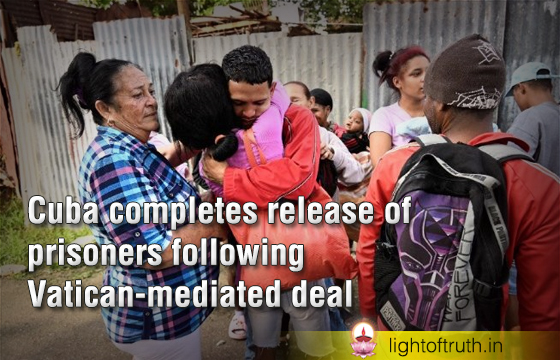
Cuba completes release of prisoners following Vatican-mediated deal
In one of his final official acts, and in the wake of a Vatican-mediated deal with the Cuban government, Joe Biden on January 14 removed Cuba from a US terrorism blacklist in exchange for an agreement by the Cuban government to free 553 prisoners.
The United States, the European Union, the Catholic Church and rights groups have long pushed the island nation to release hundreds of protesters jailed following anti-government protests in July 2021, the largest since Fidel Castro’s 1959 revolution.
In a statement after the deal, Cuban President Miguel Díaz-Canel said, “As part of the close and fluid relations with the Vatican State, I informed Pope Francis of [the decision to free the prisoners] in the spirit of the 2025 Jubilee.”
The deal was overturned by the new US presidency just six days after Donald Trump was sworn in, but prisoners have continued to be sporadically released. In February, the Vatican Secretary of State, Cardinal Pietro Parolin, called the gradual release of the Cuban prisoners “a sign of great hope” at the start of the Holy Year, and he expressed hope for more “gestures of clemency” from governments in the spirit of the Jubilee.
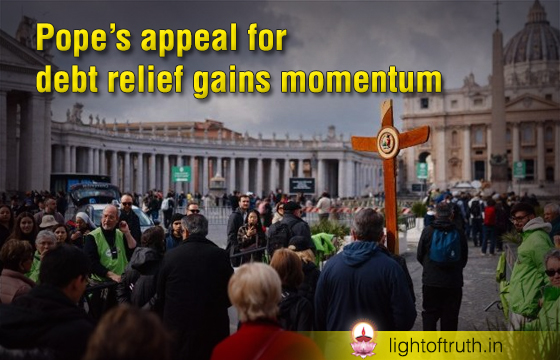
Pope’s appeal for debt relief gains momentum
In more than 160 countries, Pope Francis’ call for debt relief is becoming manifest, says Eric LeCompte, the Executive Dire-ctor of Jubilee USA Network, a development coalition of more than 750 religious groups and organizations around the world, in an interview with Vatican News.
The coalition, which includes Pope Saint John Paul II among its founders, frequently advises the Catholic Church and Bishops’ Conferences around the world on implementing the Church’s vision for the Church on Jubilee, a vision of debt relief, debt cancellation, and building an economy that provides for everyone.
For more than 25 years, LeCompte has led religious groups to win policies that alleviate poverty, address global conflict, and promote human rights. He has also addressed the United Nations General Assembly on needed economic and climate policies to achieve the Sustainable Development Goals.
Amongst other roles and responsibilities, LeCompte, who serves on boards of faith-based development and financial transparency organizations and recently received an honorary doctorate from Catholic Theological Union of Chicago, has advised a UN General Assembly process on global sovereign bankruptcy structures to alleviate poverty and is a member of expert UN working groups.